
Turn recordings into transcripts and summaries in minutes
Upload audio or video for multilingual transcription, AI notes, and action items
Do you ever feel overwhelmed facing a two-hour recording after a meeting? Questions like "Who said what?" and "Where’s the decision?" can turn post-meeting cleanup into a nightmare.
According to the latest 2026 test data, AI tools have made huge leaps in processing speed and summarization logic. However, there are still significant differences between tools in "Chinese recognition," "multi-speaker separation," and "summary depth." This article reviews 9 popular tools (including Meeting Ink, Otter, Tinrec Instant Recording, Plaud, etc.) and helps you quickly narrow down options based on the following criteria:
- Processing Efficiency: Who delivers transcripts fastest?
- Summary Quality: Who can auto-generate actionable to-do items?
- Scenario Fit: Mobile recording, online meetings, or video files?
Quick Guide Conclusions:
- For ultimate speed and Taiwanese Hokkien recognition: Prioritize Meeting Ink.
- For hardware recording and phone calls: Plaud with its recording card is the top choice.
- If you need post-meeting AI query and multimedia parsing: Try Tinrec (Instant Recording)—it excels in understanding and extracting action items.
- On a budget and occasional use: Good Tape or Yating Transcript’s free tier can serve as backups.
Why Is Recording Review So Hard? From "Dictation" to "AI Understanding"
Traditional voice recorders or phone recordings suffer from low information density and retrieval difficulty. A 60-minute recording can take 1.5x longer to replay for details. Modern AI meeting tools have evolved from simple "Automatic Speech Recognition (ASR)" to "Natural Language Understanding (NLU)":
- Speaker Diarization: Automatically identifies different speakers (e.g., Speaker A, Speaker B), solving multi-person discussion chaos.
- AI Summary: No more plain transcripts—extracts meeting minutes, decisions, and to-do lists automatically.
- Multi-format Support: Beyond recordings, now handles video links or podcasts.
2026 Hot AI Meeting Tools: Specs and Speed Comparison
Based on the latest test data (benchmark: 26-minute standard audio file), here’s how each tool performs in speed and features. We especially included Tinrec, which emphasizes a "recording-to-understanding workflow":
| Tool | Transcription Time (approx.) | Summary Generation | Languages Supported | Key Highlights | Best For |
|---|---|---|---|---|---|
| Meeting Ink | 1 min 58 sec | Fast (26 sec) | Chinese/English/Japanese/Taiwanese Hokkien | Extremely fast, supports Taiwanese Hokkien, Google Calendar integration | Business meetings, localization needs |
| Tinrec (Instant Recording) | Real-time / Fast | Yes (with action items) | Chinese/English/Japanese/Korean, etc. (10 languages) | AI query, multi-format (video/link) support, cross-platform cloud sync | Study notes, content creation, decision meetings |
| Otter.ai | 3 min 35 sec | Moderate | Primarily English | Strong English recognition, good Zoom integration | International all-English meetings |
| Plaud | 49 sec | Fast | Multi-language | Hardware recording card, phone call recording | Business calls, field interviews |
| Vocol.ai | 3 min 29 sec | Moderate | Chinese/English/Japanese | Project collaboration, keyword search | Team project management |
| Yating Transcript | 4 min 34 sec | Slow | Chinese/Taiwanese Hokkien/English | Taiwan accent optimized, transcript editing | Transcriptionists, interviews |
| SeaMeet | 3 min 46 sec | Fast | Multi-language | Google Meet/Teams extensions | Regular online meetings |
Data Note: Data for Meeting Ink, Otter, Plaud, etc., referenced from 2026 standard tests (26-min audio file); Tinrec data estimated based on comparable AI model performance.
Stop organizing recordings by hand
Upload audio or video and automatically get a transcript, summary, and action items
In-Depth Review: Best Solutions for Three Different Needs
1. Speed & Localization: Meeting Ink
If your meetings include a lot of Taiwanese Hokkien, or you need a summary within 3 minutes after the meeting ends, Meeting Ink is the performance leader. Tests show its audio upload and processing workflow is very smooth, and the 2026 version integrates with Google Calendar, making it ideal for efficiency-focused sales teams.
2. Understanding & Knowledge Management: Tinrec (Instant Recording)
Unlike simple transcription tools, Tinrec acts more like a "knowledge base assistant." Its strength lies in subsequent information utilization.
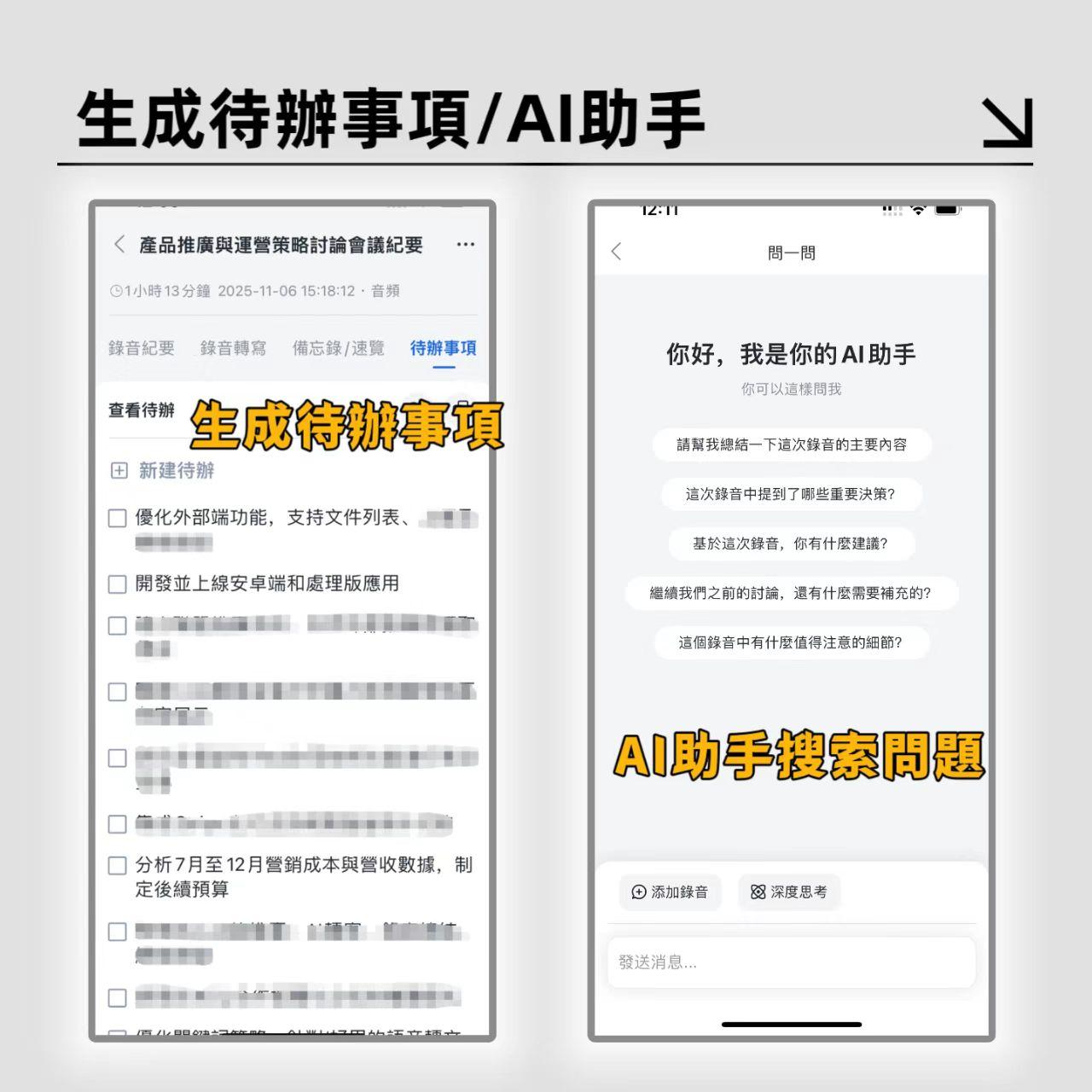
- AI Query: This is a key differentiator. For long recordings, instead of reading the transcript yourself, you can ask the AI: "What was the conclusion about the marketing budget in this meeting?" The system answers based on the recording.
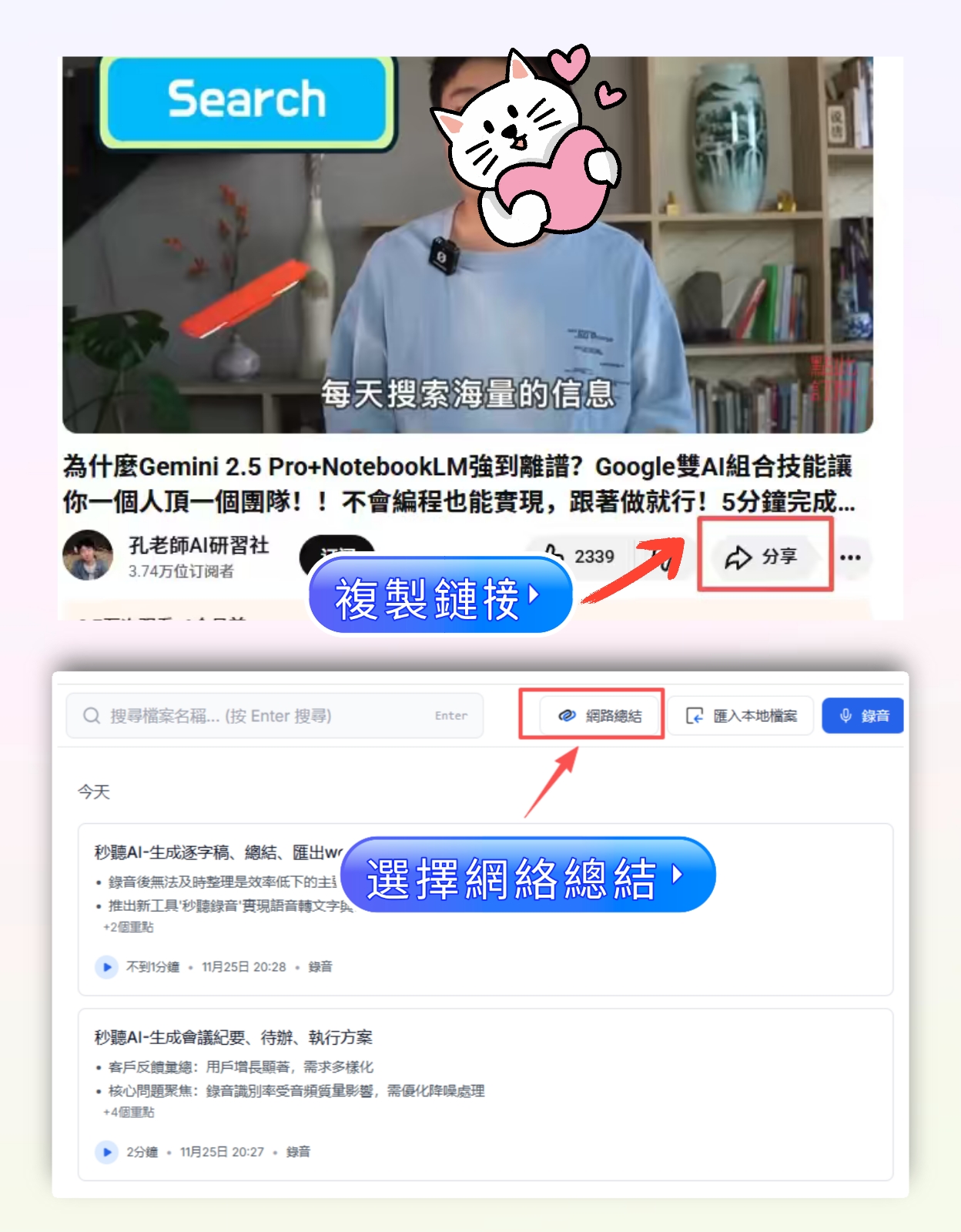
- Multi-source Support: Besides recordings, it supports uploading audio files or even pasting YouTube/Podcast links to transcribe, great for content creators or students organizing online courses.
- Structured Output: It automatically distinguishes speakers and converts transcripts into a "To-Do List" that directly feeds into your workflow.
3. Mobile Call Recording: Plaud
Plaud takes a hardware approach—a dedicated recording card that attaches to the back of your phone, solving the pain point of iPhones not being able to record calls. If you're a journalist or salesperson who frequently needs to record spontaneous phone conversations, Plaud’s hardware advantage is unmatched. The downside is you need to carry extra equipment, and the software features are relatively limited.
Practical Guide: How to Quickly Generate Meeting Action Items with Tools
Below, we use Tinrec (Instant Recording) as an example to show how to process a 60-minute multi-person meeting in 5 minutes. This logic applies to most advanced AI tools.
Step 1: Choose Recording Mode
Select your entry point based on your scenario:
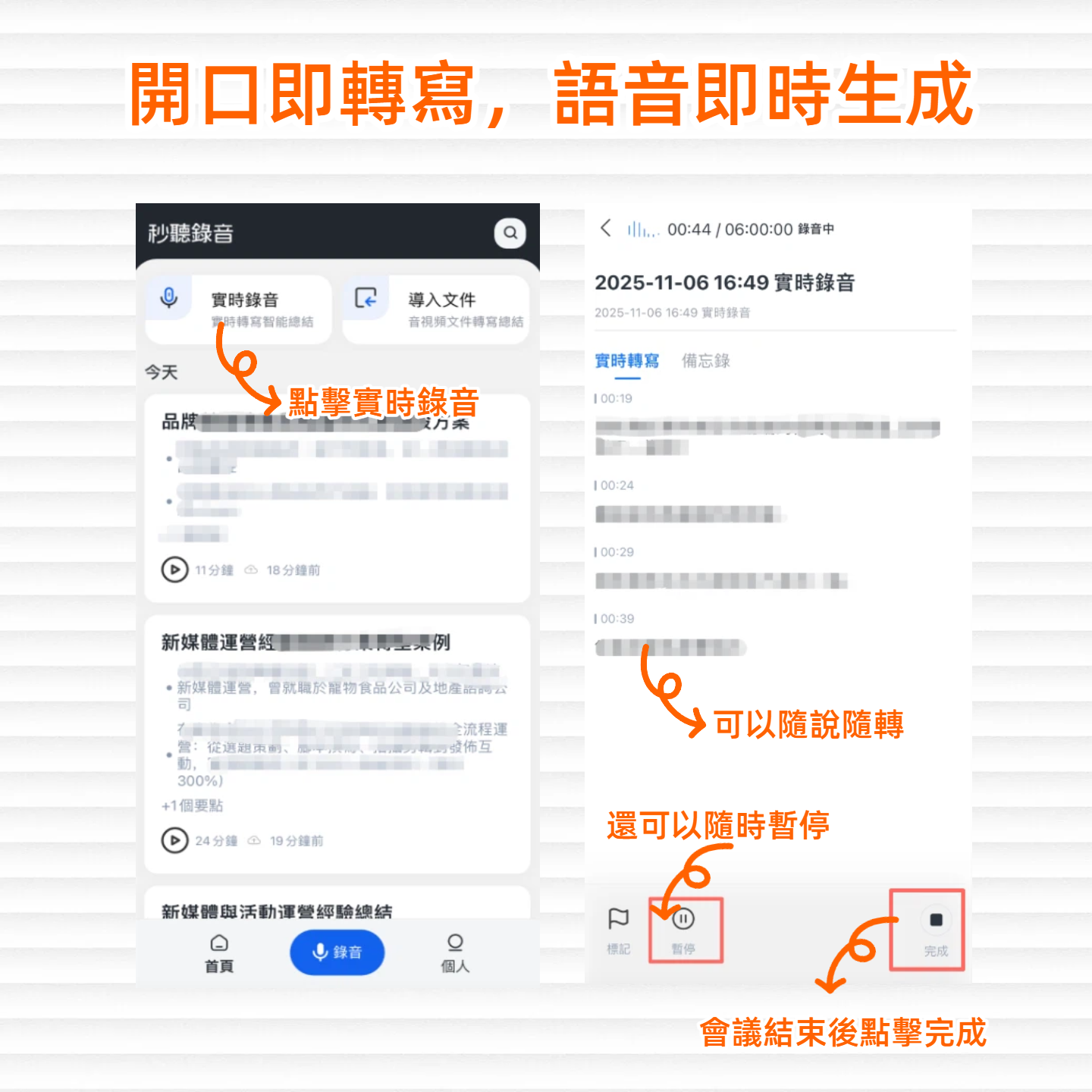
- In-person meeting: Use the mobile app or web version, click Record & Transcribe in Real Time. Tinrec supports iOS/Android/Web sync—record on phone, view on computer.
- Online meeting / existing files: If you have recorded MP3/MP4 files, upload using Audio File to Text.
- Web content: For Zoom recording links or YouTube videos, use Video Link to Text.
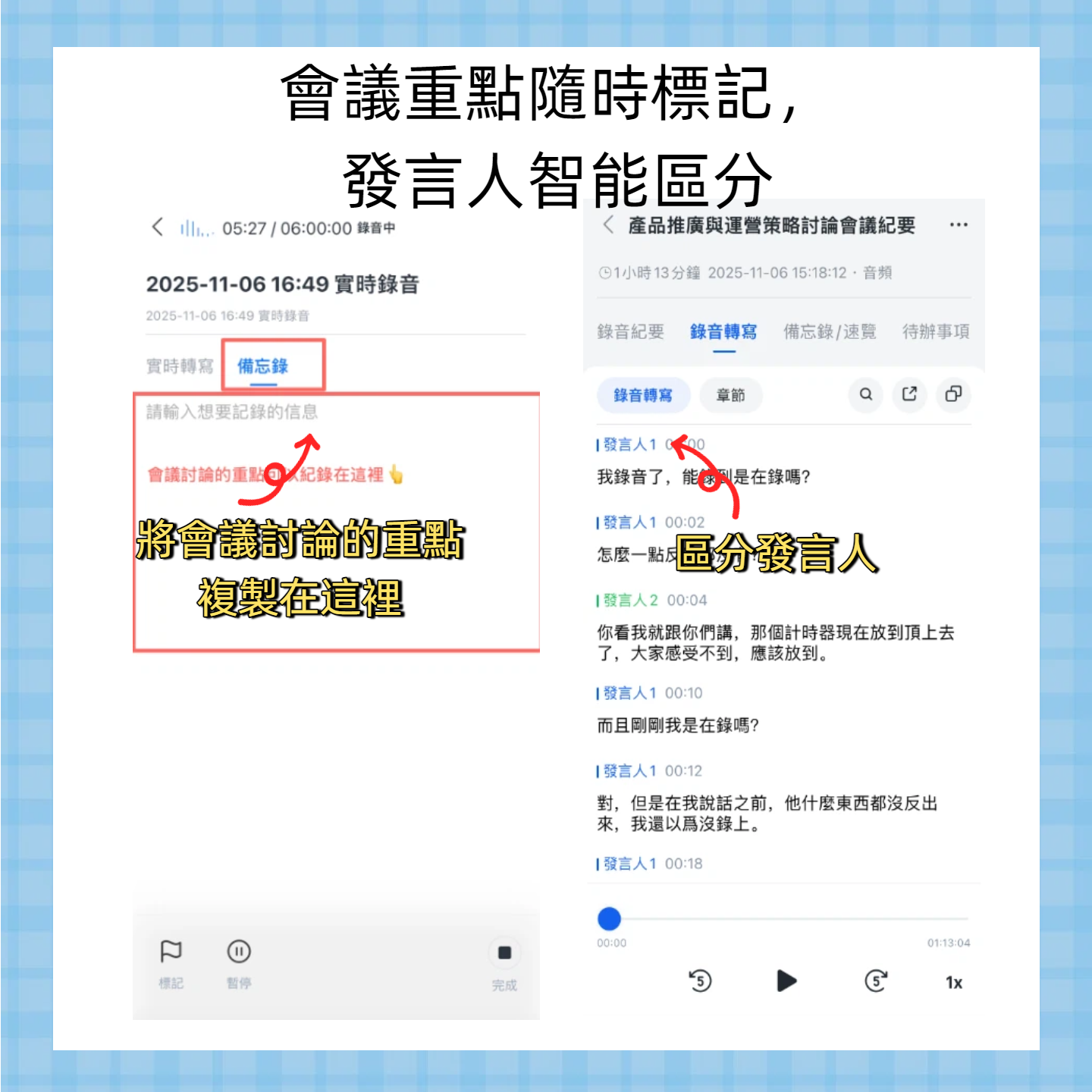
Step 2: Auto-Differentiate Speakers
After upload or recording, the system automatically performs voiceprint recognition. When reviewing the transcript, it’s recommended to quickly label speaker names (e.g., Speaker A -> Product Manager) so subsequent summaries attribute responsibilities more accurately.
Step 3: Generate AI Decision Summary & Action Items
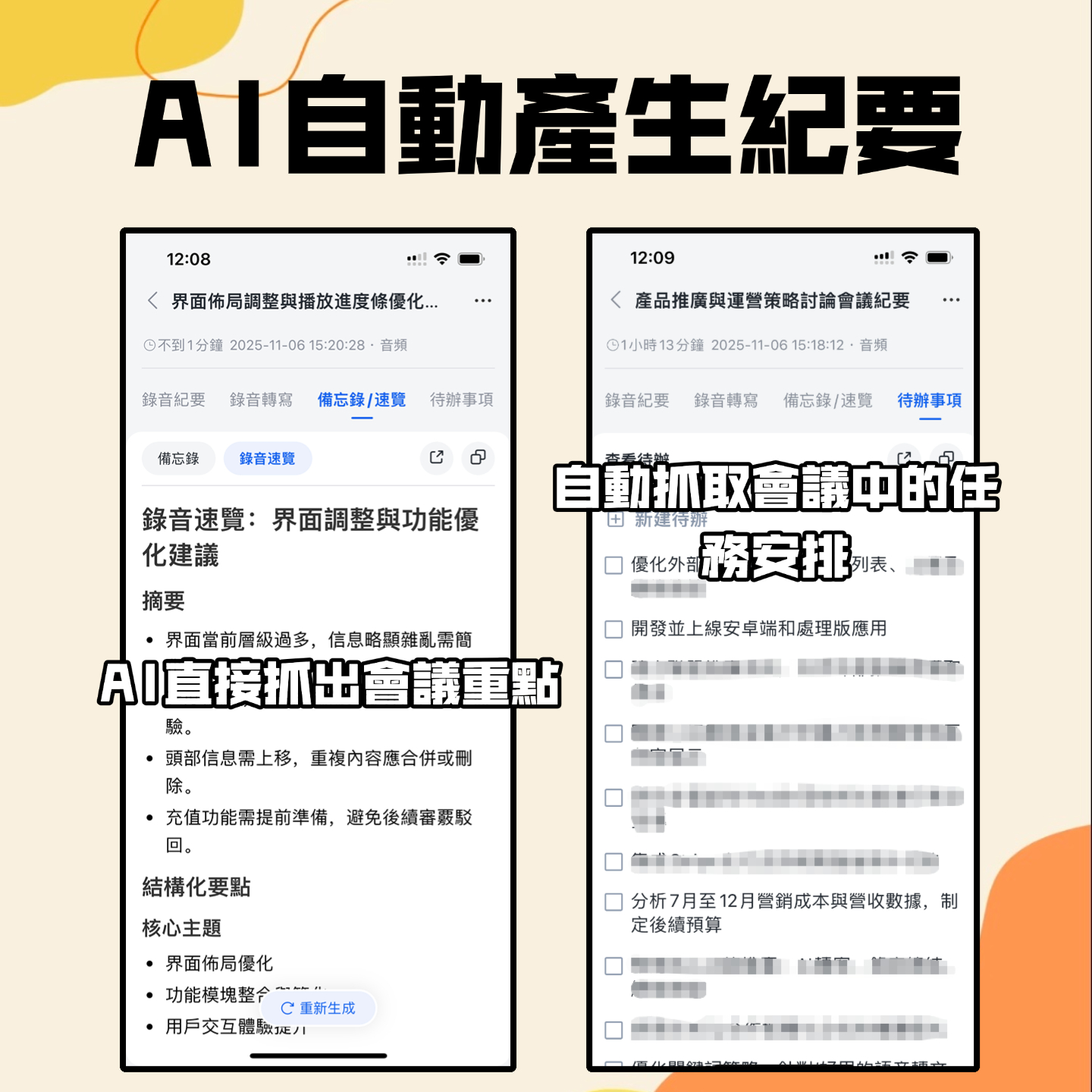
Don’t waste time rereading the full transcript! Click the AI Summary button. The system restructures the conversation into:
- Meeting Purpose
- Key Discussion Points
- Action Items: This is the most valuable part—clearly lists who needs to do what by when.
Step 4: Use AI Chat to Find Details
If the summary misses a specific detail (e.g., "What was the exact quote?"), use the AI Query feature—ask a question like you’re chatting, and the system will locate the exact timestamp in the recording and provide the answer.
FAQ
Q1: Can these tools record in the background on iPhone? Most apps (like Plaud, Tinrec, Otter) support iOS background recording, but for phone calls, due to Apple’s privacy policy, special hardware (like Plaud) or speakerphone is usually required. For regular in-person meetings, using the app to record works fine.
Q2: Does overlapping speech affect recognition in multi-person meetings? Yes. Even with speaker diarization, if two people talk simultaneously at similar volumes, accuracy drops. It’s best to maintain one-speaker-at-a-time etiquette and place the recording device in the center of the table.
Q3: What are typical free tier limitations? Common limitations include monthly recording minutes (e.g., 60-100 minutes) or single recording length. For example, Tinrec offers 100 free minutes per month; Good Tape’s free version has longer queue times.
Q4: Can AI understand mixed English terms in a Chinese meeting? Tools like Meeting Ink, Tinrec, and Otter have multilingual recognition. For Chinglish, Tinrec and Meeting Ink are better optimized, recognizing common workplace terms like KPI, Schedule, Project.
Q5: How is recording privacy and security handled? Check each tool’s privacy policy. Most paid tiers (e.g., SeaMeet, Tinrec) use encrypted transmission and cloud storage, and do not use user data for public model training. For highly sensitive content, consider offline processing options or enterprise plans.
Q6: Can I turn YouTube videos into text notes directly? Yes. Tinrec and some tools support link parsing—paste the URL to generate transcripts and summaries, useful for organizing webinars or instructional videos.
Turn every recording into actionable outcomes
Get 60 free transcription minutes when you sign in. No credit card required.
Related Reading
You might also like
Tinrec Recording-to-Text 2026 Tutorial: Bot-Free Online Meetings + Auto-Generated Meeting Minutes
A mid-level manager's hands-on review of Tinrec for recording-to-text: comparing it with PLAUD Note, covering online meetings, post-transcription processing, cross-platform use, and team collaboration, to help you painlessly convert audio files to text.
Tinrec vs Notta 2026 Hands-On Comparison: Save the Most Time with These Transcription Tools
This article compares two speech-to-text tools, Tinrec and Notta, across five key dimensions: Chinese transcription, meeting recording, AI post-processing, team collaboration, and export/integration, to help you find the best fit for your needs.

Tinrec vs Otter.ai 2026: Speech-to-Text for Chinese Meetings & Team Collaboration
Looking for a speech-to-text tool? This article compares Tinrec and Otter.ai on Chinese recognition, meeting recording, AI post-processing, and team collaboration to help you choose the best fit.

2026 Hands-On Comparison of 3 Recording-to-Text Tools: Which Saves the Most Time for Cantonese Transcription and AI Summaries?
Central district office workers test Tinrec, Otter.ai, and Notta for recording-to-text, focusing on Cantonese recognition, AI post-processing, and cross-platform performance, to help you choose the most time-efficient meeting notes solution.

3 Best Speech-to-Text Tools in 2026: From Free Trials to Team Collaboration
A mid-level manager tested multiple speech-to-text tools and compiled the top 3 recommendations for 2026, along with 4 key factors to consider when choosing, and why Tinrec is the most practical for meeting notes and team collaboration.

Tinrec Speech-to-Text Tutorial 2026: 3 Steps to Transcribe Audio + AI Auto-Summarization
Wondering which speech-to-text tool is easy to learn? This guide uses Tinrec (秒听录音) as an example to show how to turn recordings into transcripts and key summaries in 3 steps, plus 4 criteria for choosing an easy-to-use tool—perfect for beginners.

Best Recording-to-Text Apps in 2026: We Tested 4, and This Free Version Is the Best Value
We tested 4 recording-to-text tools, and Tinrec's free version is sufficient, with the most reliable Cantonese recognition, plus AI Q&A and team spaces, so office workers no longer need to work overtime transcribing.

3 Best Voice-to-Text Apps Tested in 2026: Stop Wasting Time on Meeting Notes
A mid-level manager tests voice-to-text apps for accuracy, AI summaries, cross-platform support, and team collaboration to find the biggest time-saver.

2026 Test: 4 Best Free AI Transcription Tools Compared – Which Saves You the Most Time?
We tested several free AI transcription tools for Cantonese meetings, interviews, and lectures commonly used by Hong Kong office workers. We compared free quotas, transcription accuracy, AI summarization, and cross-platform support to help you pick the most time-saving tool.