
Turn recordings into transcripts and summaries in minutes
Upload audio or video for multilingual transcription, AI notes, and action items
Facing endless meeting minutes, lecture notes, or the dilemma of not wanting to type when inspiration strikes, a good "free mobile speech-to-text app" is a lifesaver for modern people. Tools on the market range from simple voice input (like Gboard) to AI-powered meeting assistants (like Otter.ai and Tinrec), but which one supports Chinese best? Which has the most generous free tier?
This article will not just list them; we'll analyze the pros and cons from a "practical scenario" perspective. Quick verdict: If you only need simple short-phrase input, your phone's built-in keyboard or Gboard will suffice. If you need to transcribe English meetings, Otter.ai is the industry standard. If you prioritize Chinese recognition accuracy and need AI-generated meeting summaries and action items, Tinrec is a more locally tailored choice. Let's dive in.
Why Speech-to-Text is Key to Efficient Work
With the maturity of AI speech recognition technology, the old ways of "handwritten notes" or "type as you hear" are outdated. Based on market observations and user feedback, modern speech-to-text tools address three major pain points:
- Low information density: Traditional audio recordings can only be replayed, not searched. Converting to text makes information scannable and searchable.
- Heavy memory load: Meetings or classes can last hours, and it's hard for the human brain to remember every detail. AI transcripts ensure no key points are missed.
- Time-consuming organization: Producing meeting notes from audio typically takes 2-3 times the recording length. Modern tools automate this process.
2026 In-Depth Comparison of Popular Speech-to-Text Tools
Based on feature strength, free-friendliness, and language support, we've selected representative tools for evaluation. Here's a decision reference table for "Chinese-speaking users":
| Tool | Best Use Case | Chinese Support | Core Features | Price/Free Tier |
|---|---|---|---|---|
| Gboard | Real-time short messages, social media posts | Excellent | Seamlessly integrated with keyboard, completely free, ideal for fragmented input | Free |
| Tinrec | Meeting notes, lecture notes, video summaries | Excellent | Transcribes recordings/files/videos, auto-generates summaries and to-do items | Free tier: 100 min/month |
| Otter.ai | Cross-border English meetings, team collaboration | Weak | Excellent English recognition, automatic speaker identification (Chinese not supported) | Free tier: 300 min/month (English only) |
| Google Docs | Long-form writing on desktop | Excellent | Cloud-based real-time dictation, no software installation needed | Free |
| Mac Dictation | Apple ecosystem note-taking | Excellent | Offline capable, integrated into macOS/iOS | Free |
| Nuance Dragon | Medical/legal professional dictation | Select versions only | High accuracy for specialized vocabulary, customizable commands | Higher price ($699/lifetime) |
| Microsoft Office | Word/Outlook document processing | Excellent | Integrated into Office 365, suitable for office work | Requires Microsoft 365 subscription |
1. Lightweight Input Picks: Gboard and Mac Dictation
For users who just want to "type by speaking" to send messages or write memos, no complex app downloads needed.
- Gboard: Google's keyboard supports multi-language switching and real-time voice input with fast response. Great for both Android and iOS users.
- Mac Dictation: Built into Apple devices, supports offline recognition, and can even input emojis via voice. Ideal for Apple fans daily use.
Stop organizing recordings by hand
Upload audio or video and automatically get a transcript, summary, and action items
2. Best for Professional English Meetings: Otter.ai
Otter.ai is extremely popular in Western markets, especially for remote teams. It can automatically join Zoom and Google Meet meetings for recording and real-time transcription. Its strengths are accurate English recognition and speaker differentiation. However, for users who need Chinese transcription, the major drawback is that it currently does not support Chinese, and free tier features (like export formats) are limited.
3. Chinese Meetings & All-in-One Assistant: Tinrec
If your scenarios are mostly Chinese (or mixed Chinese-English) meetings and classes, Tinrec fills the gap left by Otter in the Chinese market. It goes beyond just converting speech to text, emphasizing a complete workflow from recording to action.
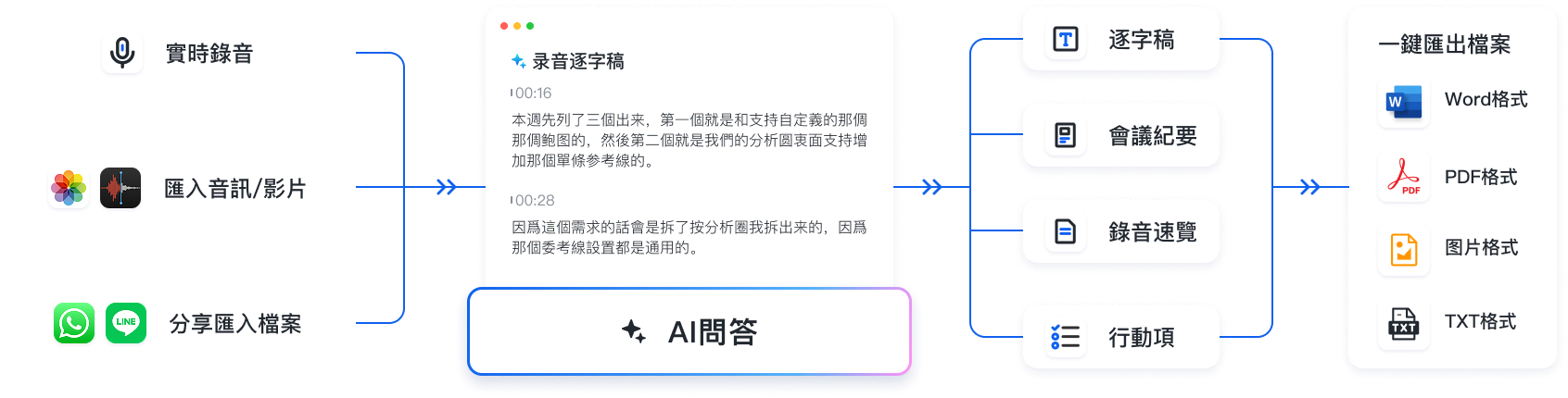
- Multi-language support: Supports 10 languages including Chinese, English, Japanese, and Cantonese, solving cross-language meetings or language learning needs.
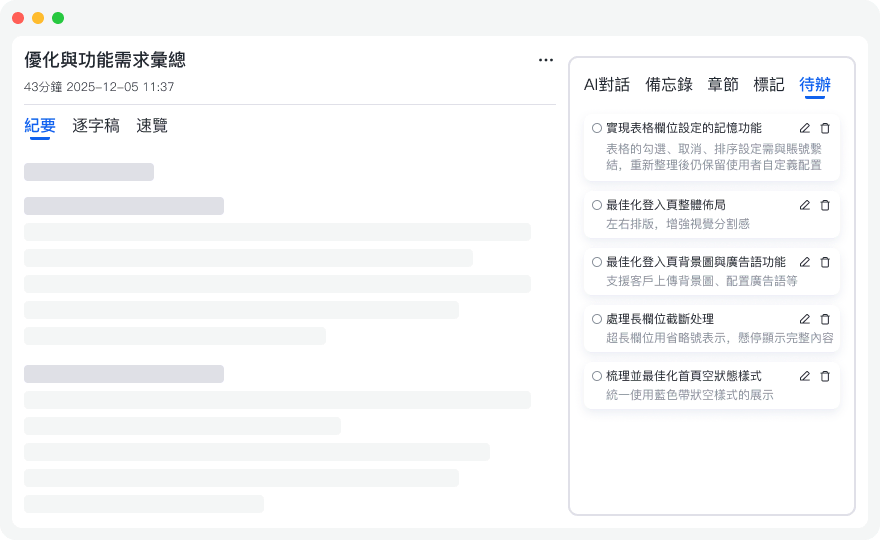
- AI smart summary: Besides transcripts, it automatically extracts "meeting minutes" and "action items" so you don't have to read through thousands of words.
- Multi-source input: Supports live recording, uploading audio files (MP3/WAV, etc.), and even pasting YouTube/Podcast links to convert to text notes.
Hands-On Tutorial: How to Efficiently Turn Audio into Usable Notes
After choosing the right tool, how do you operate it for maximum efficiency? Using Tinrec's interface as an example, here's how to organize a 1-hour meeting in 5 minutes.
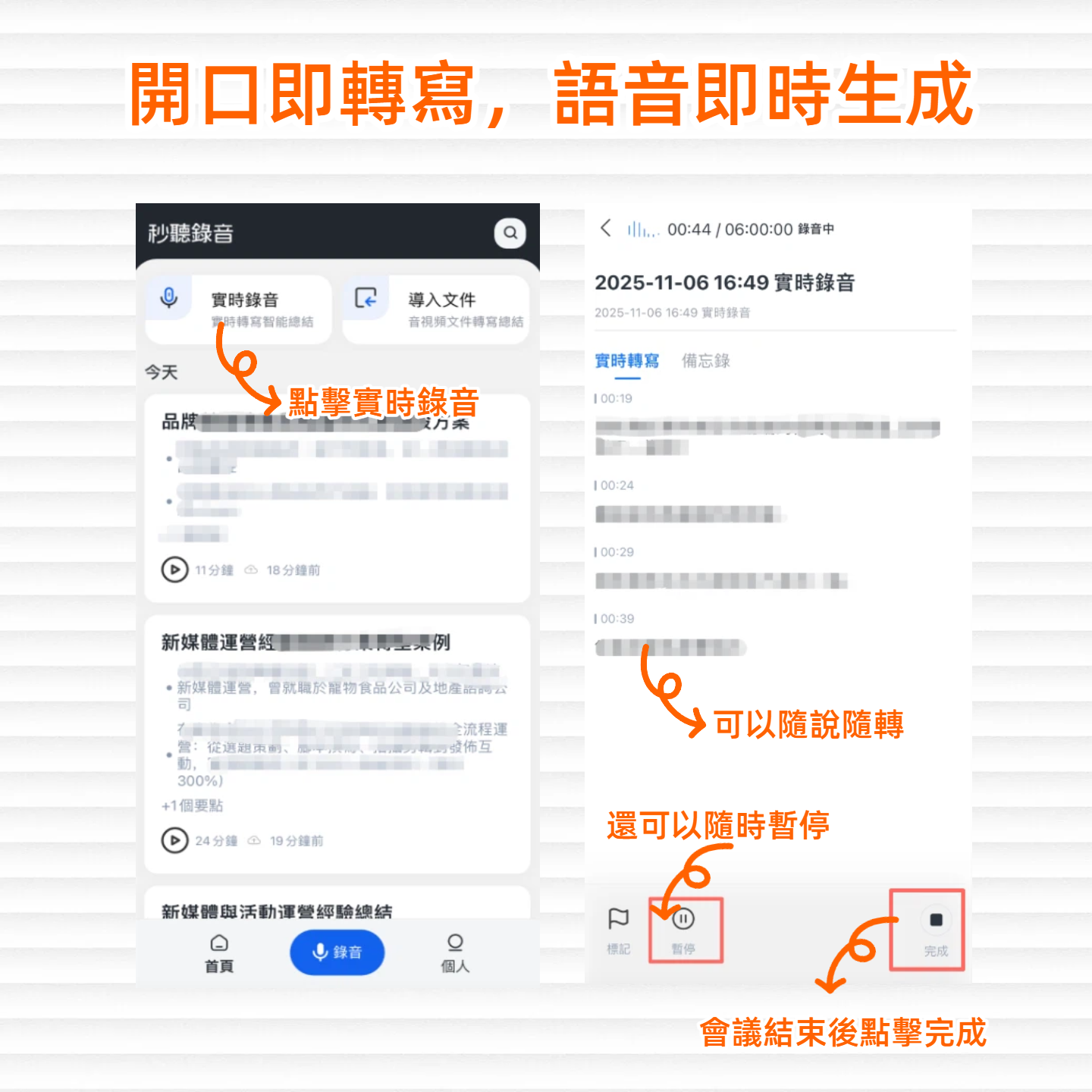
Step 1: Choose Recording or Import Mode
Enter the app or web version, then select the entry point based on your situation:
- Live meeting: Tap "Start Recording" to transcribe speech to text in real time. Place your phone near the speaker to reduce background noise.
- Existing file: If you already have a recording file, select "Audio File to Text" and upload it.
- Online learning: For online courses or YouTube videos, copy the URL and use the "Video Link to Text" feature.
Step 2: Use AI for Content Understanding
Traditional tools require you to read through the text yourself. Now you can accelerate with AI features:
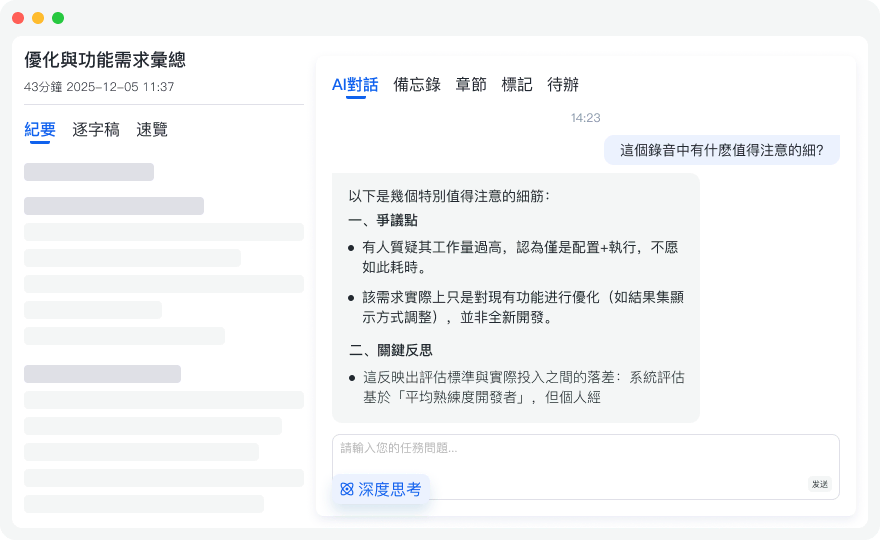
- View summary: The system automatically generates structured key points.
- AI chat query: This is the biggest time-saver. Instead of Ctrl+F, you can ask the AI directly: "What was the budget limit the manager mentioned?" or "List three exam points from this lecture." The AI answers based on the recording content.
Step 3: Export and Share
After verifying the content, export notes as Word, PDF, or Markdown, or copy the generated "action items" into your project management software.
Pitfall Avoidance Guide: Choosing a Speech-to-Text App
Before committing to a paid or long-term app, keep these points in mind to avoid pitfalls:
- Language support: Verify the app supports your primary languages (especially Chinese and dialects). For example, Nuance Dragon desktop and Otter.ai currently have weak Chinese support.
- Privacy policy: Meeting notes often contain sensitive information. Choose tools with clear privacy policies to prevent data misuse.
- Free tier limits: Many "free" apps have recording time caps (e.g., 60 min/month). Tinrec offers 100 minutes per month for free, which is relatively generous for light users. For heavy users, a subscription often offers better value than paid human transcription per minute.
- Noise resistance: Recognition accuracy heavily depends on recording quality. In noisy environments, consider using a directional microphone or a tool with built-in noise reduction.
Frequently Asked Questions (FAQ)
Q1: Can the iPhone's built-in Voice Memos transcribe to text? iPhone Voice Memos only records audio; it cannot directly generate transcripts. You need to import the recording into a third-party app (like Tinrec or Otter) for transcription, or use iOS keyboard dictation for real-time input.
Q2: Can these tools translate? For example, turn English audio into Chinese text? Some tools support this. Tinrec supports multi-language recognition. While its main function is transcription (write what it hears), the transcribed text can be translated or summarized via the built-in AI assistant.
Q3: How long does it take to transcribe an audio file? Typically, transcription time is much shorter than the audio length. For example, Tinrec can transcribe and analyze a 1-hour recording in a few minutes, saving significant manual effort.
Q4: What are the typical free tier limitations? Most free tiers limit "monthly transcription minutes," "single recording length," or "export formats." For instance, Otter.ai free tier only supports English and caps at 300 minutes/month; Tinrec free tier offers full features but limits to 100 minutes/month.
Q5: Does Google Docs voice input support audio files? Google Docs voice input is designed for real-time dictation, not uploading audio files for transcription. To transcribe a file, you'd need technical workarounds like virtual audio cables to let the computer "hear" the playback, which is complex.
Q6: How do I handle a large number of videos that need transcription? Manual video transcription is very time-consuming. Use a tool that supports "video to text." You can upload video files, or if the video is on YouTube/TikTok, use Tinrec's link parsing feature to quickly get a text summary of the video content.
Turn every recording into actionable outcomes
Get 60 free transcription minutes when you sign in. No credit card required.
Related Reading
You might also like

2026 Complete Guide to AI Meeting Notes: Transcript Comparison and Tinrec Alternatives
Many people think AI meeting notes just mean turning recordings into transcripts, but the real time sink is turning all that text into actionable conclusions and to-dos. Based on a student's real project experience, this article compares transcripts and meeting notes, and explains how Tinrec handles bot-free recording, post-meeting organization, AI Q&A, and team spaces—helping you decide if the free version is enough.

2026 AI Meeting Recorder Comparison: 5 Tools Tested — Which One Actually Turns Meetings into Actionable To-Dos?
Most people choose an AI meeting recorder based only on transcription accuracy, then end up never using it after a year of recordings. This article uses five practical criteria to compare Tinrec, Otter.ai, Granola, Notta, and others on meeting capture methods, post-meeting outputs, Chinese language handling, and team governance—helping you pick the right solution within your budget.

2026 AI Meeting Recorder Comparison: No-Bot Online Meeting Transcription and the Fastest Meeting Minutes
Many people think AI meeting notes just means adding a bot and waiting for a transcript, but the real problems start after transcription. This article addresses common misconceptions, outlines four key factors for choosing an AI meeting recorder, and compares Tinrec, Notta, Otter.ai, and Granola on capture methods, post-meeting organization, and team collaboration, with a buying guide and recommendations.

AI Meeting Notes in 2026: How to Choose — 5-Step Hands-On Comparison to Find Your Best Fit
If you can't keep up with meeting notes, the problem is often not the meeting itself but choosing the wrong tool. This article compares Tinrec and PLAUD Note step by step across five dimensions — recording sources, online meetings, post-meeting output, Chinese-language experience, and team governance — to help you decide which one better fits your work style.

2026 AI Meeting Notes Software Comparison: Are Free Versions Enough, and Which Really Saves You Time?
We tested and compared AI meeting notes tools like Tinrec, Otter.ai, Notta, and PLAUD from three angles: how meeting audio gets in, what you can do after transcription, and who controls team data. We also break down free version limits, team seat and billing differences to help you pick the one that truly saves time.

2026 AI Meeting Notes Software Comparison: Which One Actually Saves You Time After the Meeting?
Most people approach choosing AI meeting notes software the wrong way from the start: they mistake transcription for meeting notes and assume a bot must join the meeting. This article tackles common misconceptions, breaks down the selection logic using five key points, and compares Tinrec, Notta, Otter.ai, and PLAUD with hands-on testing, plus a guide to avoiding pitfalls and specific recommendations.

2026 AI Meeting Recorder Comparison: Tinrec vs Otter.ai vs Notta vs PLAUD for Chinese Meetings
The pain starts after the meeting ends. We compare Tinrec, Otter.ai, Notta, and PLAUD on recording methods, Chinese recognition, post-meeting organization, and team collaboration, with free tiers, pricing, and pitfalls to help you pick the one that truly saves time.

Tinrec vs Notta 2026: 5-Dimension Comparison for Chinese Online Meeting Notes
After an online meeting, do you still need to spend extra time organizing meeting notes? Starting from the real needs of 'online viewing,' this article compares Tinrec and Notta across 5 dimensions, and summarizes key purchasing considerations, practical use cases, and FAQs for AI meeting notes tools, helping you find the right way to organize Chinese meetings.

4 AI Meeting Transcription Tools Tested for 2026: Which Free Version Is Actually Enough?
People searching for 'free AI meeting transcription online' really need to decide three things: whether the free quota can last through a meeting, whether the meeting requires inviting a bot, and whether there's AI to organize the transcript afterward. This article uses these three criteria to test and compare the free plans and post-meeting workflows of Tinrec, Notta, Otter.ai, and PLAUD NotePin, and provides practical tips and selection advice for office workers in Hong Kong.