

Turn recordings into transcripts and summaries in minutes
Upload audio or video for multilingual transcription, AI notes, and action items
Google Meet Built-in Transcription vs Tinrec: Quick Overview
Online meetings come with two major fears: having to take manual notes while the meeting is happening, leading to distraction and missed points; or forgetting the conclusions from a meeting the previous week. Google Meet's built-in transcription lets some users see live captions during the meeting, but its organization capabilities are limited. Tinrec is an AI-powered workspace that lets you record and organize meeting audio through your browser without needing to download an app.

| Google Meet Built-in Transcription | Tinrec | |
|---|---|---|
| Price | Included with Google Workspace subscription (specific editions) | Free tier with monthly base hours; Pro monthly/annual plans |
| How to Use | Enable directly in Google Meet web version | Desktop web or mobile browser, no app installation required |
| Key Difference | Live captions, transcription only available during meeting | Recording can be organized, queried, exported, and managed across platforms after the meeting |
This article compares these two "no-download app" solutions across five dimensions that matter most to US users: language support, comprehension and organization, record saving, cross-source integration, and post-processing capabilities.
Dimension 1: Language Support for Transcription
Google Meet's built-in transcription primarily supports English; some Workspace editions can enable subtitles in other languages, but Chinese recognition is not fully available, and mixed Chinese-English meeting scenarios can hardly produce accurate verbatim transcripts. This significantly limits its usefulness for teams that primarily operate in English but have multilingual needs.
Tinrec, on the other hand, was designed from the start to cover Chinese, traditional Chinese, and multilingual scenarios. It not only supports Chinese meeting transcription but also handles mixed Chinese-English and code-switching content more effectively. We tested both tools with the same 10-minute mixed Chinese-English product discussion recording (quiet indoor environment). Tinrec clearly distinguished between Chinese and English and produced accurate text, while Google Meet's built-in transcription generated大量 garbled text or blanks.
→ This dimension: Tinrec clearly wins, especially for meetings where English is not the sole language.
Dimension 2: Post-Transcription Understanding and Organization
After a meeting, Google Meet's built-in transcription only provides a plain text transcript of the captions—no summary, no highlights, no action items. If you need to find conclusions from a two-hour meeting, you still have to read through the entire transcript.
Stop organizing recordings by hand
Upload audio or video and automatically get a transcript, summary, and action items
Tinrec goes beyond transcription to emphasize "understanding after transcription." After recording, the AI automatically generates a summary, sections, and action items. You can ask questions conversationally, like: "What was the budget cap discussed just now?" or "When is the delivery date the marketing team agreed to?" The AI answers based on the transcript content, so you don't have to manually search.
→ This dimension: Tinrec wins big—turning static data into actionable information.
Dimension 3: Cross-Platform Record Keeping and Search
Google Meet's caption records only persist with the meeting. If you don't manually copy them out after the meeting, the record disappears in that meeting's chat or Drive. Also, records from different meetings are isolated—you can't search across meetings for "contract terms discussed with a client last month."
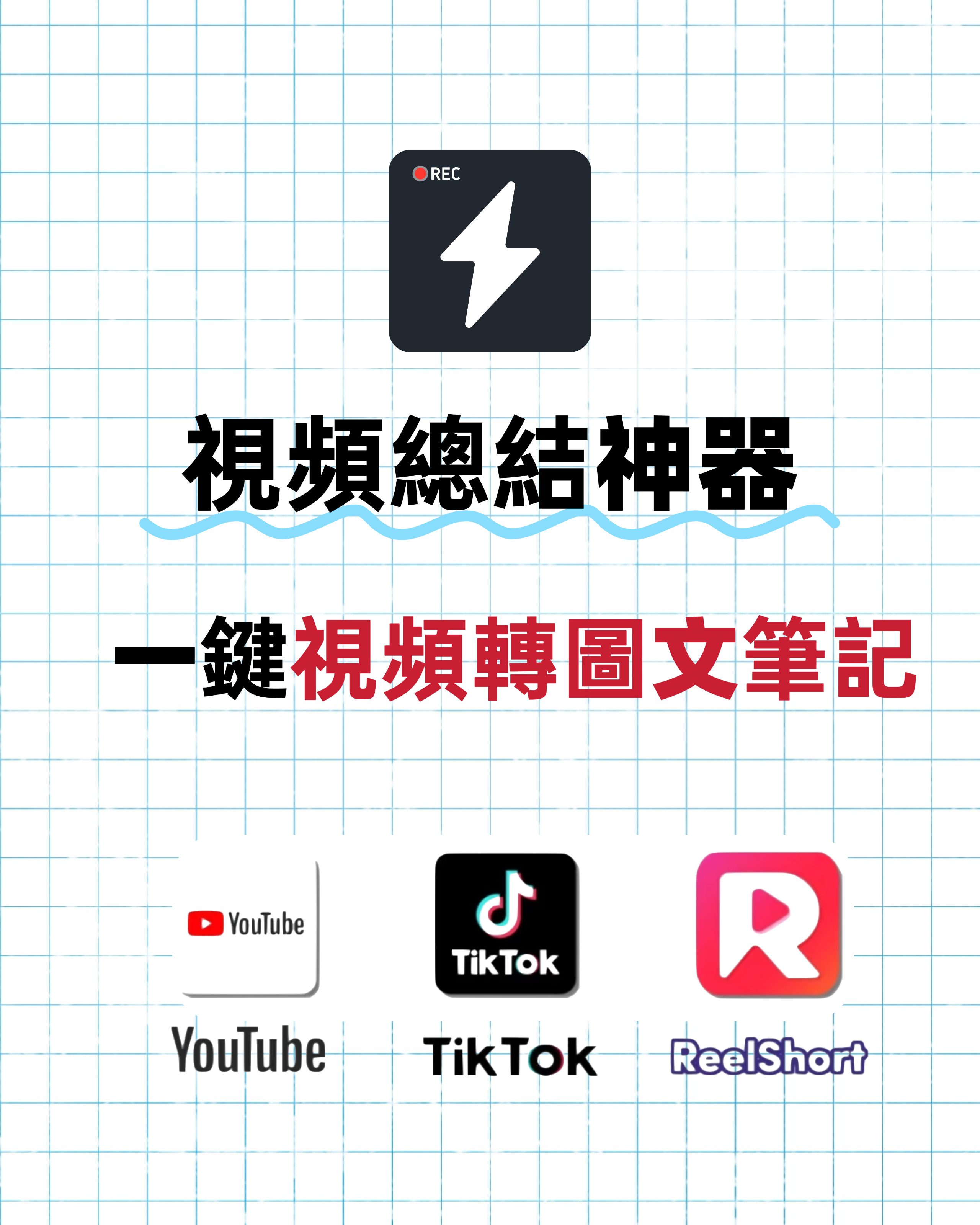
Tinrec is designed more like an audio knowledge base: all recordings and transcriptions are saved in the cloud, allowing you to revisit any meeting at any time, search across all historical records by keyword, and even use AI Q&A to compare key points across different recordings. This is especially valuable for teams that need to track long-term projects and accumulate meeting decisions.
→ This dimension: Tinrec provides long-term record management that Google Meet built-in cannot match.
Dimension 4: Diversity of Input Sources
Google Meet's built-in transcription only works within Google Meet itself. If you want to organize in-person meeting recordings, lecture audio, or competitor product launch videos from YouTube, it's completely useless.
Tinrec is a multi-source audio organization tool: you can upload local audio files, paste links to public videos (e.g., YouTube, Bilibili), or even directly record audio playing on your computer. This means that whether the meeting is online or offline, formal or impromptu, all audio can go through the same organization workflow.
→ This dimension: Tinrec's usage scope far exceeds a single meeting platform, making it suitable for those who need to organize material from multiple sources.
What Unique Advantages Does Each Have?
Tinrec's Unique Advantages
- Ideal for English and Multilingual Meetings: From transcription to summary, designed for multilingual users, so you don't have to compromise on English-only tools.
- Cross-Platform Record Library: Centralized management of all meetings, lectures, and interviews—searchable, queryable, and comparable.
- Complete Post-Processing: Beyond verbatim transcripts, it automatically generates summaries, action items, chapters, and exports to tools like Notion and Google Docs.
- Zero Installation: Use it through a browser on desktop or mobile without needing to install any software.
Google Meet Built-in Transcription's Advantages
- Native Integration: With a qualifying Workspace account, enable it with one click during a meeting—no need to open another tool.
- Live Captions: Useful for accessibility or when you need to confirm keywords in real time.
Summary: Which Should You Choose?
• If your meetings are primarily in English (or multilingual) and you need post-meeting summaries, action items, and key takeaways → Tinrec (Google Meet built-in transcription can hardly handle non-English content) • If you want to centralize meeting records, course recordings, YouTube videos, and be able to search and ask questions anytime → Tinrec (Google Meet built-in records cannot be searched across meetings) • If you only need live English captions during the meeting and don't need post-meeting organization → Google Meet built-in transcription is enough • If your team is fully on Google Workspace and all meetings are short, purely English, and don't need long-term archiving → Google Meet built-in may be considered
In short, for users who need to turn meeting content into actionable knowledge, Tinrec is the more complete choice. You can try the free tier to record a Google Meet meeting and experience the process from recording to automatic organization of action items.
Tinrec turns recordings into searchable, summarizable, exportable knowledge.
Turn every recording into actionable outcomes
Get 60 free transcription minutes when you sign in. No credit card required.
Related Reading
You might also like
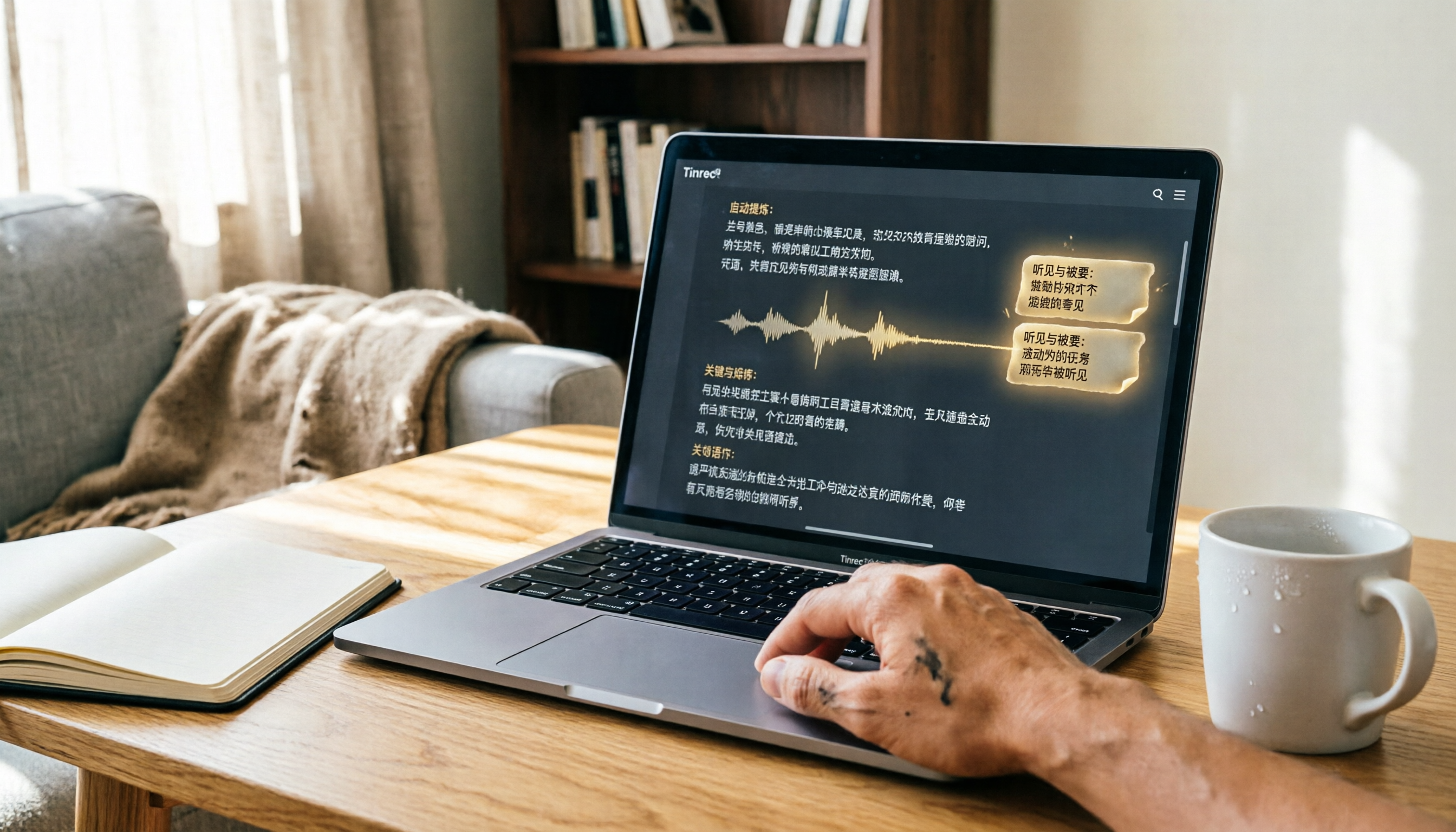
2026 Mac Recording-to-Text App Comparison: Which AI Meeting Notes Really Save Time?
Apple's built-in Voice Memos makes recording easy, but it can't transcribe audio. This article hands-on tests Tinrec, Otter.ai, and Notta, covering accuracy, AI summaries, cross-platform support, and free plans, to help you find the best fit for meetings, classes, and interview notes.
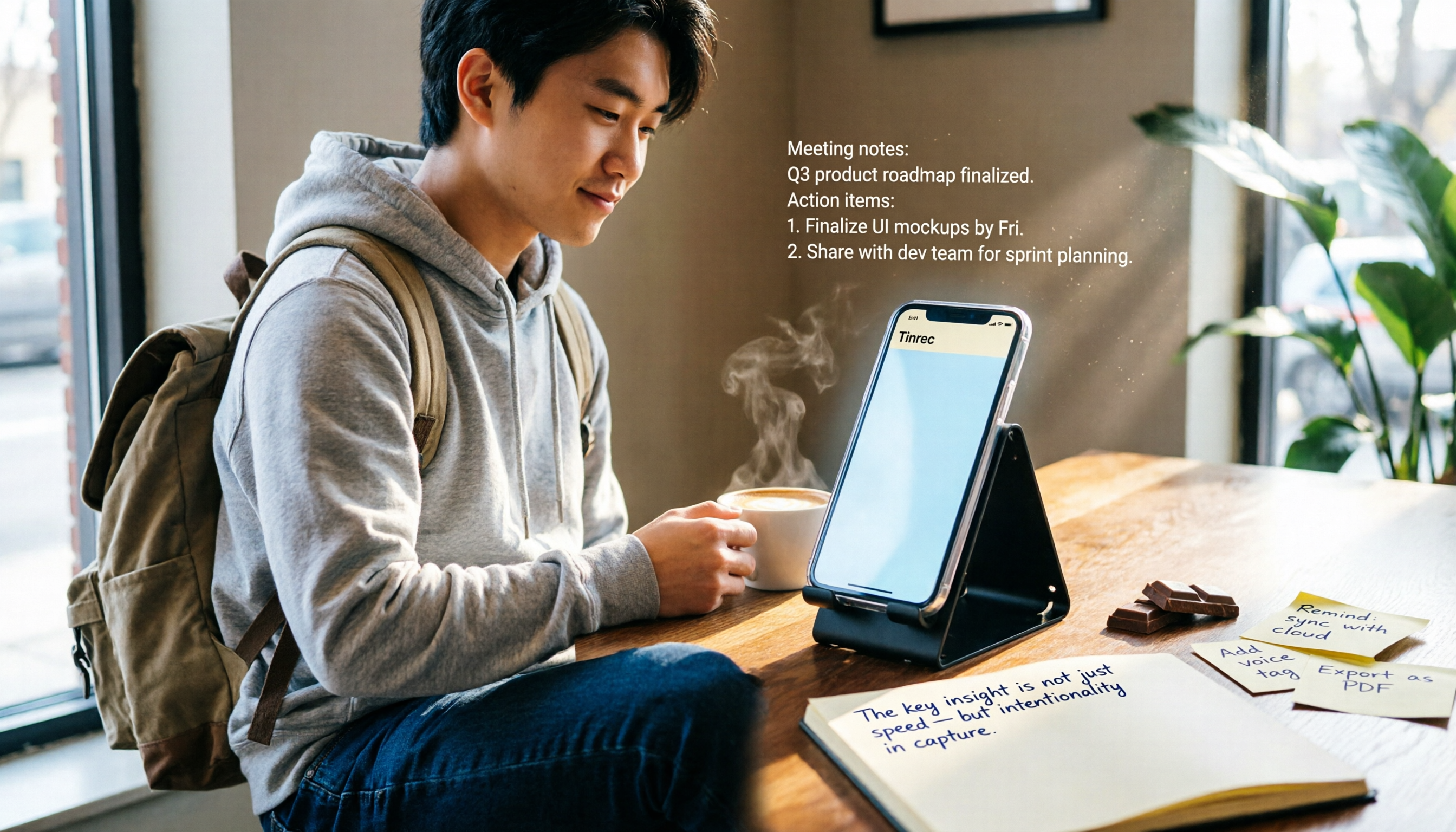
iPhone Voice-to-Text Test in 2026: Built-in Dictation vs. Apps Compared, This AI Q&A App Made Note-Taking 3x Faster
A college senior tested iPhone voice-to-text methods, from built-in dictation to third-party apps. See how Tinrec’s free plan saved 3 hours of note-taking time per week, plus a pitfall guide and student-focused buying advice.

iPhone 17 Screen Recording Free Options in 2026: 5 Tools Reviewed
How to screen record on iPhone 17? This article covers built-in screen recording, Dual Capture tips, and recommends tools like Tinrec to transcribe audio from recordings, from free to paid options.

Best AI Meeting Recorder Tools in 2026: Automatic Summaries, Action Items, and Multi-Source Organization
Looking for an AI meeting note tool but not sure where to start? This article reviews 6 top solutions—from automatic summaries and action items to cross-platform collaboration—and shows you how to save up to 80% of your meeting note time with the right tool.
2026 Free AI Meeting Notes Tools Buyer's Guide: 2 Hands-On Reviews and Practical Tips
Don't want to spend money on hardware but still want to use AI to organize meeting recordings? I actually compared Tinrec, a pure software tool that provides instant recording, with Plaud Note, which integrates hardware. From free plans, recording sources, post-processing capabilities, to cross-platform flexibility, this guide helps you find the best free AI meeting notes solution for your needs.
iPhone Call Recording in 2026: Do You Still Need Tinrec? 3 Reasons to Convince You
iPhone's built-in call recording in iOS 18.1 is handy, but organizing recordings still takes time. This article shows how Tinrec turns call recordings into searchable notes, summaries, and to-dos to boost learning and work efficiency.

2026 Hands-On Comparison of 4 Computer Recording Tools: More Than Just Recording, They Help You Organize Key Points
Struggling to organize your computer recordings after capturing them? This test of 4 computer recording tools — from free options to AI-powered organization — helps you find the most suitable solution.

2026 Complete Guide to AI Meeting Minutes: Auto-Generated Transcripts and Action Items to Double Meeting Efficiency
Still wasting time on meeting minutes? This article shows how to use AI recording tools to auto-generate transcripts, summaries, and action items, with hands-on comparisons of Tinrec, Notta, Otter.ai and more to help you pick the best solution.

2026 iPhone Screen Recording with Audio: 2 Methods Compared — Is the Built-in Feature Good Enough?
Can iPhone screen recording capture audio? This hands-on comparison tests the built-in screen recorder against two third-party apps, showing how to record system sounds and ambient sound, and explains the common causes of no-audio issues and how to fix them.