

Turn recordings into transcripts and summaries in minutes
Upload audio or video for multilingual transcription, AI notes, and action items
2026 Google Meet Built-in Recording vs Tinrec: Which is More Useful for Meeting Notes?
If you meet on Google Meet, you've probably heard of "Companion Mode." Simply put, it lets you join the meeting with a second device (like a laptop) while using the room's camera and speaker, eliminating echo and making it easier to share your screen or use chat.
But here's the problem: what was discussed, decisions made, and who needs to do what—these still rely on human memory. Many people use Google Meet's built-in recording and transcription features, but how effective are they? Compared to a dedicated AI recording and organizing tool like Tinrec, which one saves you more time on meeting notes?
I tested both with the same 30-minute meeting recording, comparing Google Meet's built-in meeting notes and Tinrec across 5 dimensions. Read on to find out which one you should choose.
Google Meet Built-in Meeting Notes vs Tinrec Quick Overview
Google Meet Built-in Meeting Notes is an add-on for Google Workspace that lets you record meetings, generate transcripts, and automatically email summaries afterward. It suits teams already in the Google ecosystem that only need online meetings.
Tinrec is an AI audio/video organizing tool that handles not just meetings but also audio recordings, videos, and online videos. It transcribes, summarizes, chapters, extracts action items, and even lets you ask questions about your recordings.
| Google Meet Built-in Meeting Notes | Tinrec | |
|---|---|---|
| Price | Requires specific Google Workspace plans (Business Standard from $14.4 USD/month) | Free tier with basic monthly allowance; Pro monthly card NT$290 |
| Supported Platforms | Google Meet web/app | iOS, Android, Web |
| Input Sources | Google Meet only | Live recording, audio/video files, online video links |
| Core Outputs | Transcript, recording, simple summary | Transcript, AI summary, chapters, action items, subtitles, mind map, multi-format export |
Now let's compare them across 5 dimensions.
Dimension 1: Real-time Transcription & Speaker Identification
Google Meet's built-in transcription shows live captions during the meeting and produces a transcript afterward, with speaker labels (requires Workspace account and login). In quiet environments, English accuracy is high, but Chinese occasionally mishears words, and overlapping speech often leads to missing or misattributed text.
Tinrec performs better in Chinese scenarios. Testing the same Chinese meeting, Tinrec clearly distinguished speakers, even with background keyboard noise, with almost no errors. Transcription is near real-time, and you get AI-summarized results immediately after the meeting.
→ Result: Tinrec is more stable for real-time Chinese transcription with noise resistance, and speaker identification doesn't require a specific account ecosystem.
Dimension 2: AI Summaries & Key Points
Google Meet auto-generates a meeting summary with key discussion points and action items, but only in English, and the summary is often short and shallow. If you need a detailed Chinese summary, you have to do it yourself.
Tinrec's AI summary is far more practical. It doesn't just give a summary; it automatically breaks it into "Key Discussion Points," "Decisions," and "Action Items," each with timestamps. For anyone who just wants to quickly grasp the conclusions, Tinrec's summary is ready to use.
→ Result: Tinrec provides richer, structured summaries with clickable timestamps, significantly outperforming Google Meet's brief English-only summaries.
Dimension 3: Action Item Extraction
Google Meet's summary occasionally includes "Action Items," but it relies on AI to catch them, and you can't customize the format or add notes. If the AI misses something, you have to manually go back to the recording.
Stop organizing recordings by hand
Upload audio or video and automatically get a transcript, summary, and action items
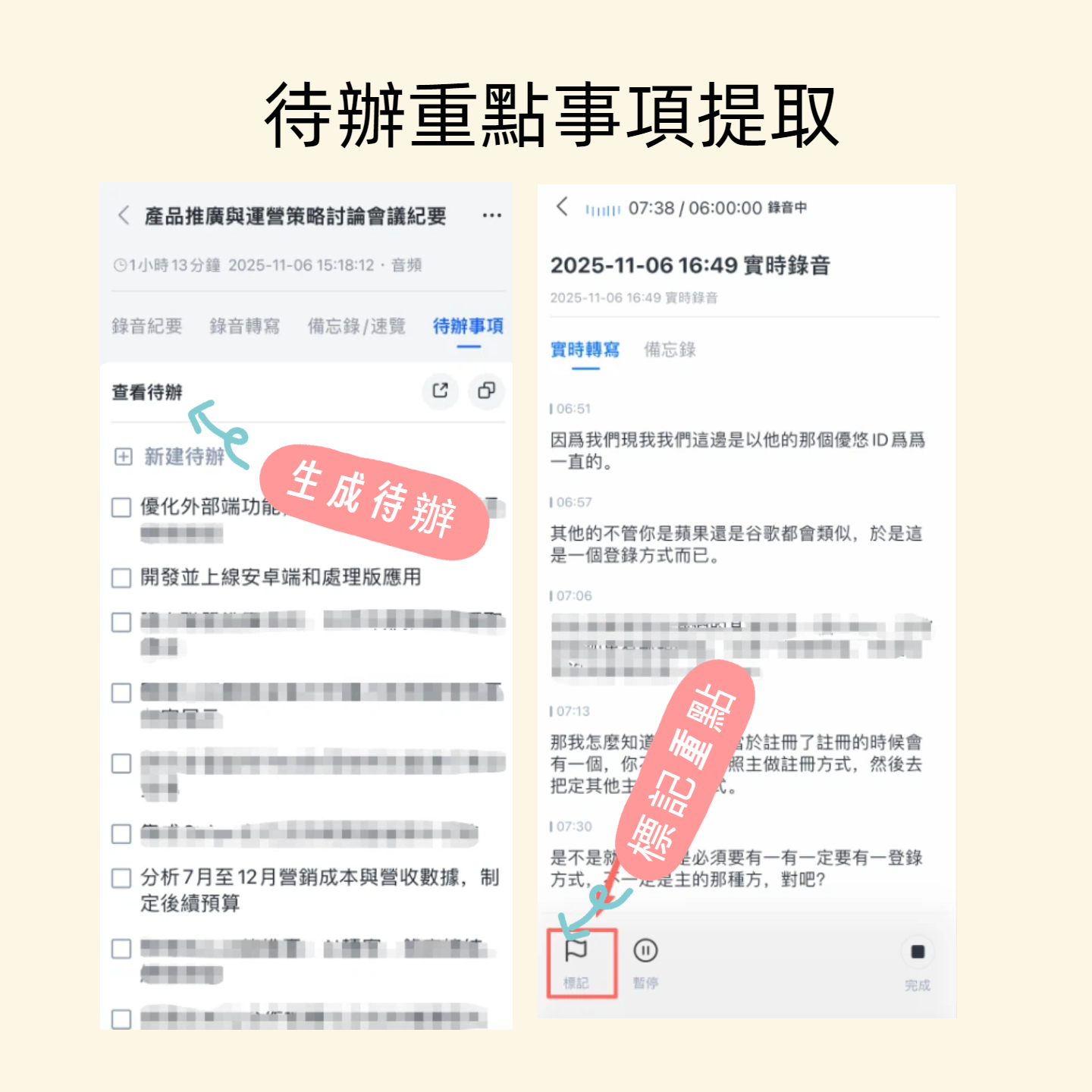
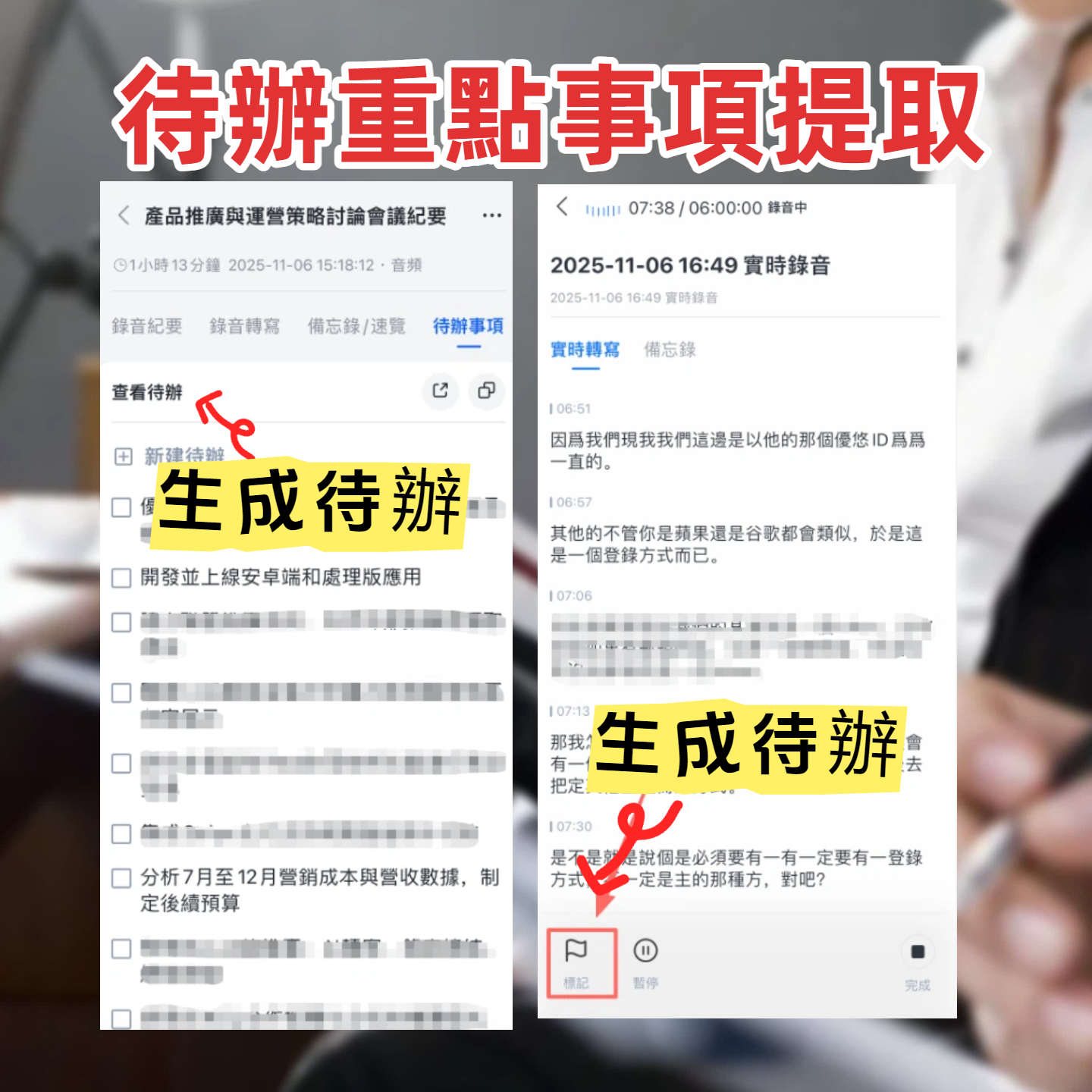
Tinrec has a dedicated action item extraction feature that identifies who needs to do what from the transcript and lists them. You can mark completion status in the app and export as text or sync to other tools—great for project tracking.
→ Result: Tinrec's action item handling is more mature, actionable, and exportable; Google Meet currently lacks such flexibility.
Dimension 4: Multi-Source Content Recording
Google Meet's transcription and recording are limited to your meetings on that platform. If you have in-person meeting recordings, interview audio, or want to organize YouTube tutorials, Google Meet can't help.
Tinrec brings all these in: upload audio/video files or paste links to public videos (YouTube, Bilibili, etc.), and it will transcribe, summarize, and chapter them. This is convenient for non-meeting use cases like podcast transcripts or lecture recordings.
→ Result: Tinrec is a multi-source audio/video organizing workstation; Google Meet's built-in recording is limited to a single meeting platform—huge flexibility gap.
Dimension 5: Post-Meeting Search & Q&A
Google Meet meeting notes are emailed to you; you can search keywords within that transcript, but to recall "what was said about the budget last time," you have to dig through your email.
Tinrec's AI Q&A blew me away. All historical recordings become a searchable database. You can ask natural-language questions like "When is the launch date for this project?" and the AI answers based on the recording content, with source snippets. It's like Google Search for your meeting data.
→ Result: Tinrec turns passive transcripts into a conversational knowledge base—Google Meet has no equivalent feature, a decisive advantage.
What Are the Unique Strengths?
Tinrec's Unique Strengths
- Cross-source organizing: Meetings, courses, interviews, videos all in one place, building your personal audio/video knowledge base.
- AI conversational search: Search historical recordings by asking questions, no need to listen to entire meetings.
- Flexible export: Export as TXT, Word, PDF, or sync to Notion, Google Docs—fits right into your existing workflow.
- Traditional Chinese friendly: Interface and transcription support Traditional Chinese (Taiwan), very user-friendly for local users.
Google Meet Built-in Recording's Unique Strengths
- Ecosystem integration: If your company fully uses Google Workspace, one-click recording and transcription during meetings, no extra installation needed.
- Linked to meeting context: Recordings and transcripts are automatically tied to that meeting, making it easy to review in context.
Conclusion: Which One Should You Choose?
- If you only occasionally record English meetings in Google Meet and don't need deep organization → Google Meet built-in is enough, but check your Workspace plan.
- If you frequently have Chinese meetings that need detailed notes, action item tracking, or want to manage all your recordings in one place → Tinrec is the more complete choice—especially its AI Q&A, which will dramatically boost your information retrieval efficiency.
- If your work involves not just meetings but interviews, courses, and online videos that need organizing → Tinrec's multi-source support is an irreplaceable necessity.
In a nutshell: Google Meet built-in recording is a "meeting accessory," while Tinrec is a "workbench" that turns all your audio/video content into usable data. I recommend downloading Tinrec's free version and testing it with your own meeting recordings to see which organizing style works better for you.
Frequently Asked Questions
Q: Can Google Meet's Companion Mode record? A: Companion Mode itself does not have recording capabilities; it's mainly for joining a meeting with a second device's speaker and camera. However, any participant (including those in Companion Mode) can start meeting recording if permissions allow, which will capture audio and transcription together.
Q: Can Tinrec automatically join a Google Meet? A: Tinrec currently does not offer an auto-join bot. You can open Tinrec on your computer or phone to record live while joining the meeting on another device, still capturing the content and getting AI organization.
Q: Will recording a Google Meet meeting with Tinrec cause echo? A: As long as you use one device for the meeting and another for recording, and lower the meeting device's speaker volume or use headphones, there will be no echo. You can also upload the recording file to Tinrec afterward for organizing.
Q: Is the free tier of Tinrec sufficient? A: The free tier provides a monthly basic transcription allowance, suitable for trying live recording and online video transcription. If you have 2–3 meetings per week, the Pro monthly card is more cost-effective; for short intensive use, consider the weekly pass.
Q: Which has higher transcription accuracy, Google Meet or Tinrec? A: Both perform well in quiet environments, but in our tests with Chinese + multi-speaker scenarios, Tinrec's transcript quality was more stable, and its AI summaries and action item extraction were significantly more useful. Accuracy still depends on audio quality; we recommend testing with your own recording.
Q: What languages does Tinrec support? A: Tinrec supports Chinese (including Traditional), English, Cantonese, and more. The interface also offers Traditional Chinese (Taiwan), which is friendly for users accustomed to local terminology.
Turn every recording into actionable outcomes
Get 60 free transcription minutes when you sign in. No credit card required.
Related Reading
You might also like

2026 Hands-On Comparison of 3 AI Recording Tools: Plaud Audio to Text, Why Tinrec Is Better for Teams
This article compares Plaud recording hardware with Tinrec AI meeting notes tool, explains how to handle Plaud audio files, and analyzes Tinrec's advantages in transcription, summarization, and team collaboration. It's ideal for readers seeking efficient recording and organizing solutions.

2026 AI Voice Recorder Comparison: Tinrec vs Plaud Note – Costs and Features Fully Analyzed
This article compares Tinrec and Plaud Note in terms of costs, hardware expenses, online meeting recording, historical audio organization, team collaboration, and AI post-processing capabilities to help you decide which is better for users in the U.S.

Tinrec vs Plaud Note in 2026: A 5-Dimension Comparison for Hong Kong Professionals
Thinking about buying a Plaud voice recorder? This article compares Tinrec and Plaud Note across five dimensions—cost, online meetings, post-transcription processing, team collaboration, and language support—to help you choose the best AI recording solution for Hong Kong office workers.

2026 Hands-On Test: 3 AI Recording Tools Compared—Is Tinrec's Free Plan More Practical Than Buying a Plaud Recorder?
Want to use AI recording tools to organize meetings and interviews but torn over whether to buy a Plaud recorder? This hands-on comparison tests hardware recorders, phone recording apps, and Tinrec's meeting notes tool to show which one suits office workers best.

2026 AI Recording Tool Buying Guide: PLAUD vs Tinrec Hands-On Recommendations
Still deciding between a PLAUD recorder and a software solution? This article compares hardware recording with Tinrec's AI meeting tool in real meeting, interview, and team collaboration scenarios to help you find the truly time-saving choice.

2026 Notion Alternatives: 5 Steps to Take Meeting Minutes with Tinrec
Still using Notion for meeting minutes? This article starts from real pain points, compares Tinrec and Notion for meeting notes, and provides a 5-step tutorial on how to use Tinrec to record online meetings without bots, auto-generate summaries and action items, turning meetings into searchable, collaborative team knowledge.

How to Take Meeting Minutes in 2026: 5 Steps to Replace Notion Free with Tinrec
Notion's free plan has trial limits for meeting notes. Switch to Tinrec for bot-free recording, AI summaries, to-dos, and team collaboration. Complete efficient meeting minutes in 5 steps.

What Does "Meeting Minutes" Mean? A Guide to Writing Meeting Minutes in English
Searching for "meeting minutes 中文" usually means you want to know how to say and write meeting minutes in English. This article covers the correct usage of "meeting minutes," common sections in meeting minutes, useful phrases, and introduces tools like Tinrec that can help you create meeting minutes quickly, saving you from overtime work.

Notion AI vs Tinrec in 2026: A 5-Dimension Comparison to Choose Your Meeting Notes Tool
Notion AI meeting notes may seem convenient, but limitations like the free plan, browser audio capture, and transcript retention could trip you up. This article outlines 5 common limitations of Notion AI and compares 7 meeting notes tools including Tinrec, Otter, Fireflies, Notta, TurboScribe, and Granola to help you find the best AI meeting assistant.