

Turn recordings into transcripts and summaries in minutes
Upload audio or video for multilingual transcription, AI notes, and action items
What Can Google Meet Recording-to-Text Do for You?
After every Google Meet meeting, do you spend half an hour or more replaying recordings, transcribing, and organizing action items? With the right tool, all these tedious tasks can be handled by AI.
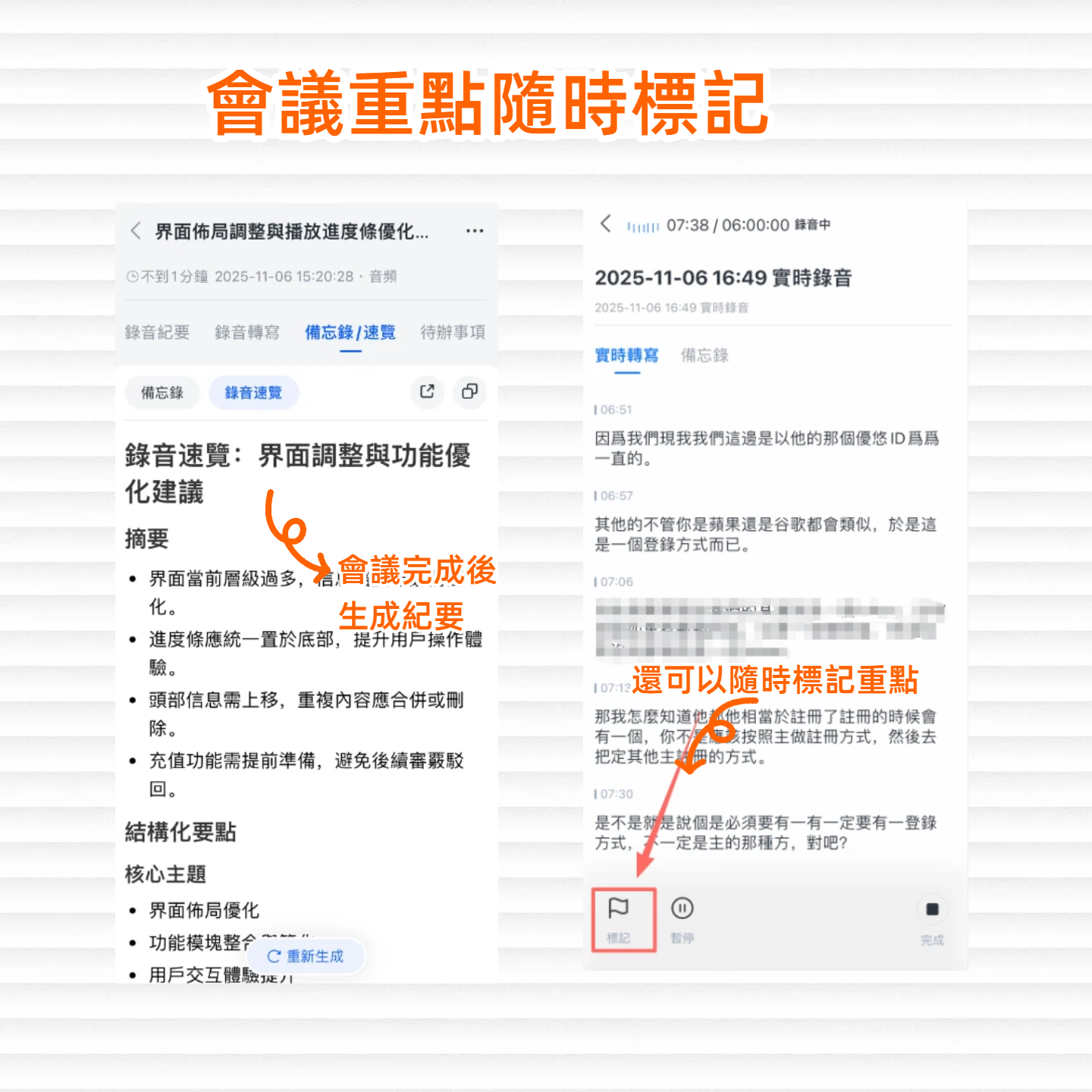
For example, Tinrec not only transcribes Google Meet meeting recordings but also automatically generates summaries, action items, and even lets you ask questions like a coworker—such as "Who mentioned the budget in the last meeting?"
Scenario 1: Get Meeting Minutes Within 3 Minutes After the Meeting
In the past, a two-hour meeting might require another hour to organize. Now with Tinrec—once the meeting recording ends, AI has already marked topics, conclusions, and action items, including who is responsible and deadlines.
Scenario 2: Record Google Meet on Your Computer While Continuing on Your Phone
Tinrec supports web, iOS, and Android. While you're in a Google Meet on your computer, you can start Tinrec's real-time recording—transcribing as the meeting progresses. If you need to step away, you can seamlessly switch to your phone to continue recording.
Scenario 3: Find Information from a Month-Old Meeting Just by Asking
Historical meeting recordings pile up in folders, and finding a specific sentence often requires replaying the entire audio. Tinrec's AI conversation search lets you ask questions directly, such as "What was the client's feedback on the new proposal?" It pulls the answer from the recording without listening from start to finish.
What Are Tinrec's Core Capabilities?
To know which solution suits you, first understand what the tool can do. The following four capabilities are key to judging a recording-to-text tool, and we'll also show how Tinrec delivers them.
Real-Time Transcription with Less Than 1 Second Latency
Tinrec transcribes text simultaneously as you record, not after the recording ends. During a Google Meet, you can watch the text to identify important discussion points and mark them immediately, saving time on later organization.
AI Structured Summary, Not Just a Block of Text
After transcription, Tinrec automatically breaks down content into sections like "Meeting Topic," "Discussion Process," "Conclusions," and "Action Items," instead of just giving a condensed paragraph. This is especially useful for professionals who need to quickly grasp key points from multiple meetings.
AI Conversation Search, Turning Recordings into a Searchable Database
After transcription, you can directly ask Tinrec: "Who said the deadline should be by the end of the month?" or "What requirements did the client mention?" It replies based on semantic understanding, so you don't have to scroll through the transcript.
Multiple Export Formats, Seamlessly Integrate into Your Workflow
Organized meeting minutes and to-do lists can be exported as Word, PDF, TXT, or even synced directly to tools like Notion and Google Docs. This way, you can continue working in your usual environment without being tied to a new app.
Practical Application Scenarios
Scenario 1: Weekly Routine Meetings, Automatically Generate Action Items
After each weekly Google Meet with your team, simply upload the recording to Tinrec (or use real-time recording), and AI automatically extracts assigned tasks for each person, including deadlines. You just paste the to-do list into a group chat or project management tool, saving organization time.
Stop organizing recordings by hand
Upload audio or video and automatically get a transcript, summary, and action items
Scenario 2: Client Online Meetings, Quickly Produce Follow-Up Emails
After a requirements discussion with a client on Google Meet, you used to have to listen to the recording while drafting an email. Now with Tinrec's AI Q&A, just ask "What are the three key requirements the client mentioned?" and get a well-structured follow-up email draft instantly.
Scenario 3: Remote Interview Recordings, Accurately Review Candidate Responses
HR or managers conducting remote interviews via Google Meet can simultaneously record and transcribe with Tinrec. After the interview, use AI conversation search to ask, "What was the candidate's answer about project management experience?" to quickly compare multiple candidates.
Scenario 4: Online Courses or Lectures, Turn Content into Review Notes
When taking an online course or attending a lecture via Google Meet, record and transcribe with Tinrec. Afterward, in addition to the transcript, you can use AI summary and chapter organization to condense two hours of content into a five-minute review note.
4 Things to Consider When Choosing a Google Meet Recording-to-Text Tool
There are roughly three ways to handle Google Meet recordings: using Google Meet's built-in transcription, installing third-party meeting bots, or using multi-source AI recording tools like Tinrec. Which one suits you? Look at these four points.
1. Transcription Accuracy: Real-World Chinese Testing Matters
Don't just look at official numbers—audio quality, multiple speakers, and mixed Chinese-English content all affect accuracy. We tested with Chinese meeting recordings and found that Tinrec's word error rate is below 10% for clear audio, sufficient for most workplace needs. Importantly, it recognizes Taiwan-specific terms better than some overseas tools.
2. Organization Capability: Transcribing Is Just the Start—Real Value Is in Organization
Tools that only provide transcripts still require you to dig for key points. Tinrec goes beyond transcripts by automatically providing chapters, summaries, action items, and even allowing AI Q&A to extract specific information—that's where the real time savings come in.
3. Cross-Platform and Source Support: Not Just Google Meet, But Also Other Audio Files
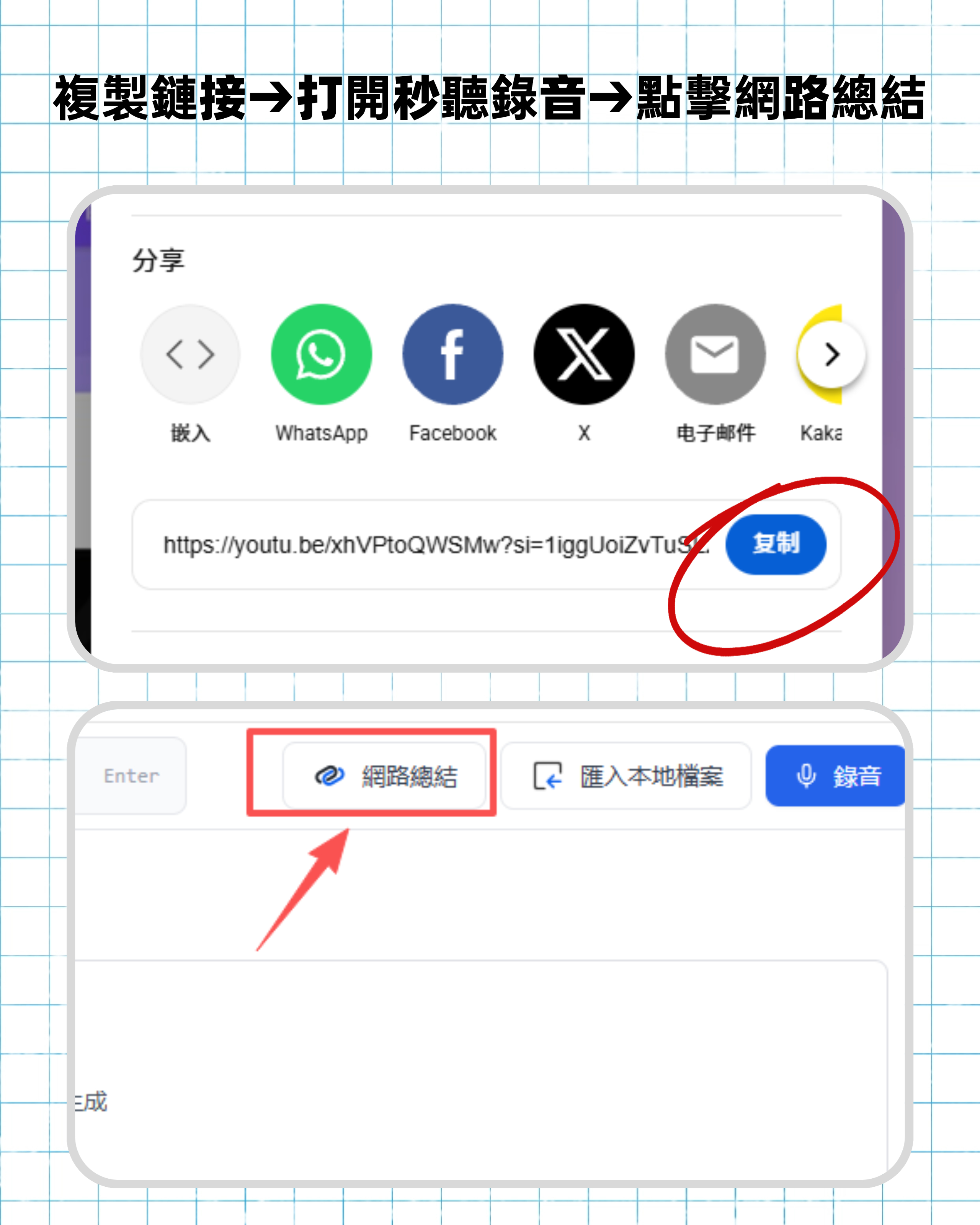
Some solutions are limited to online meetings, but your work involves more than meetings. Tinrec can import audio files, videos, and even parse online video links like YouTube, so one tool handles all transcription needs without switching between apps.
4. Pricing and Free Plan: Try Chinese Transcription Quality First
Tinrec's free version offers a basic monthly transcription quota, enough to test one or two Google Meet meetings. If you need more, consider the weekly card or Pro plan—no need to pay upfront. Use the free quota to test the tool's Chinese meeting organization quality, which is more useful than any review.
Frequently Asked Questions
Q1: Can Tinrec automatically join a Google Meet meeting?
Tinrec does not automatically join meetings. However, you can have Google Meet open on your computer alongside Tinrec's web or app version, and select "Real-time Recording" to transcribe as you record. If you already have a meeting recording file, you can import it later for transcription.
Q2: Is the free plan's quota sufficient?
If you only have two or three Google Meet meetings per week, the free plan's monthly quota is usually enough to transcribe recordings, provided the meetings are not too long. We recommend starting with the free version to experience the Chinese meeting organization quality.
Q3: Can Tinrec distinguish between multiple speakers?
Yes. Tinrec supports speaker diarization. The transcribed output labels each speaker as Speaker A, Speaker B, etc., making it easy to identify who said what and improving post-meeting efficiency.
Q4: Where is the transcribed data stored? Is it secure?
Transcribed content is stored in your Tinrec account and can be deleted at any time. Data transmission is encrypted and meets standard privacy protection levels for software services. However, if the meeting content is highly confidential, please confirm with your company's security policies.
Q5: Besides Google Meet, can it handle recordings from other meeting apps?
Yes. As long as you can obtain an audio file (from Zoom, Teams, or in-person meetings), you can import it into Tinrec for transcription. It also supports parsing online videos like YouTube, not limited to Google Meet.
Summary
Stop letting meeting notes eat into your after-work hours. Instead of manually organizing after every Google Meet, let a tool automatically turn your recordings into searchable content with summaries, action items, and more.
Tinrec not only solves transcription but also allows you to ask questions, export, and generate reports afterward. The free plan provides a basic quota, so we recommend starting with one or two meetings to give it a try.
Turn every recording into actionable outcomes
Get 60 free transcription minutes when you sign in. No credit card required.
Related Reading
You might also like

2026 Meeting Post-Processing AI Free Plans: A Look at Two Options
Convert meeting recordings into text and key points without manual transcription. This article compares the free plans of two popular meeting post-processing AI tools, Tinrec and Otter.ai, from transcription quality, input sources, AI summaries to Chinese support, to help you find the best option.

Tinrec vs Otter.ai 2026: 5-Dimension Showdown – Which Extracts Meeting Action Items Better?
Afraid you'll forget meeting takeaways? Can auto-extraction really work? This article compares Tinrec and Otter.ai across 5 key aspects—action item extraction, Chinese support, AI Q&A—to help you choose the best tool.

Effortless Meeting Notes in 2026? 4 Steps from Recording to AI Summary
No more overtime typing transcripts! We tested Tinrec's instant recording transcription, a 4-step guide to turn meeting recordings into AI summaries, plus an AI chat to find key points. Cantonese recognition is accurate—a must-read for office workers.

2026 Comparison of 4 AI Meeting Note Tools: Which Has the Most Convenient One-Click Export?
Are you always spending too much time organizing meeting notes? This article tests 4 AI meeting note apps, from real-time transcription, AI summaries, one-click export to cross-platform support, to find the solution that truly saves you time.

How to Implement AI Office Automation in 2026? 5 Steps from Recording to Auto-Generated Reports
This article shares an AI office automation workflow that uses Tinrec to transform meeting recordings into searchable, organized data, saving you time on meeting minutes.

2026 Hands-On Comparison of 4 Meeting Minutes Automation Tools: Which Saves the Most Time for Chinese Users?
Spending too much time on meeting minutes? This article tests 4 AI tools, covering speech-to-text, AI summaries, multi-scenario applications, and pricing, to help you find the best automated meeting minutes solution for Chinese-speaking users.

2026 Guide to Choosing a Recording-to-PPT Tool: 2 Tested and Recommendations
If you're looking to turn recordings into PPTs, what you really need isn't a magic one-click PPT generator, but a tool that quickly organizes recordings into reusable content. Which is better for Hong Kong workers: Tinrec or Otter.ai? We compare them on Cantonese recognition, AI organization, multi-platform support, and pricing to help you pick the time-saving champ.

Tutorial: Google Meet Recording Transcription & AI Summary in 2026 – No Installation Needed
Wondering where your Google Meet recordings go? This article covers 5 tools, from free to professional, to quickly transcribe, summarize, and extract action items from meeting recordings. Use them instantly without installation, so you never miss key points.

2026 5 Best Recording-to-Text Apps Compared: Google Meet Camera Not Working? AI Recording-to-Text Still Gets Meeting Notes
Google Meet camera suddenly not working? No worries—AI recording-to-text apps automatically capture meeting highlights. This article compares 5 popular apps across transcription accuracy, AI features, and free plans to see which best suits Hong Kong office workers.