

Turn recordings into transcripts and summaries in minutes
Upload audio or video for multilingual transcription, AI notes, and action items
After every meeting, organizing recordings and key points is a headache. Finding a suitable AI tool to automatically process meeting recordings is a need for many office workers. There are plenty of options on the market, but are the free plans sufficient? What are the differences in features?
This time, we've sorted out two AI meeting post-processing tools that are highly discussed among users in Taiwan—Tinrec (秒聽錄音) and Otter.ai—comparing their free plans, core features, and applicable scenarios. After reading, you'll be able to decide which one suits you better.
Tinrec vs Otter.ai|Quick Overview
Tinrec is an AI audio/video processing tool that integrates "real-time speech-to-text, audio transcription, and online video parsing," supporting iOS, Android, and web versions. Its free plan provides basic transcription credits and access to core features.
Otter.ai is a well-known AI meeting notes service, excelling at automatically joining online meetings like Zoom and Google Meet, generating meeting summaries, and identifying speakers. It also offers a free plan.
Below is a quick comparison of their basic information, followed by a detailed look from four key dimensions.
| Feature | Tinrec (秒聽錄音) | Otter.ai |
|---|---|---|
| Core Positioning | Multi-source audio/video processing tool | AI meeting notes and collaboration |
| Supported Platforms | iOS, Android, Web | iOS, Android, Web |
| Free Plan Highlights | Monthly basic transcription credits, covering core features | 300 minutes of transcription per month, up to 30 minutes per session |
This article compares them from four dimensions: "Real-time recording and transcription quality," "Input sources and cross-scenario applicability," "AI summaries and post-processing capabilities," and "Chinese and multilingual support," and concludes with their unique strengths and suitable scenarios.
Dimension 1|Real-time Recording and Transcription Quality
Real-time recording is the foundation of meeting notes. We care about recognition accuracy and processing speed.
Otter.ai performs stably in English real-time transcription, especially for meetings with standard American accents, achieving high accuracy. However, with multiple speakers, background noise, or strong accents, the error rate increases.
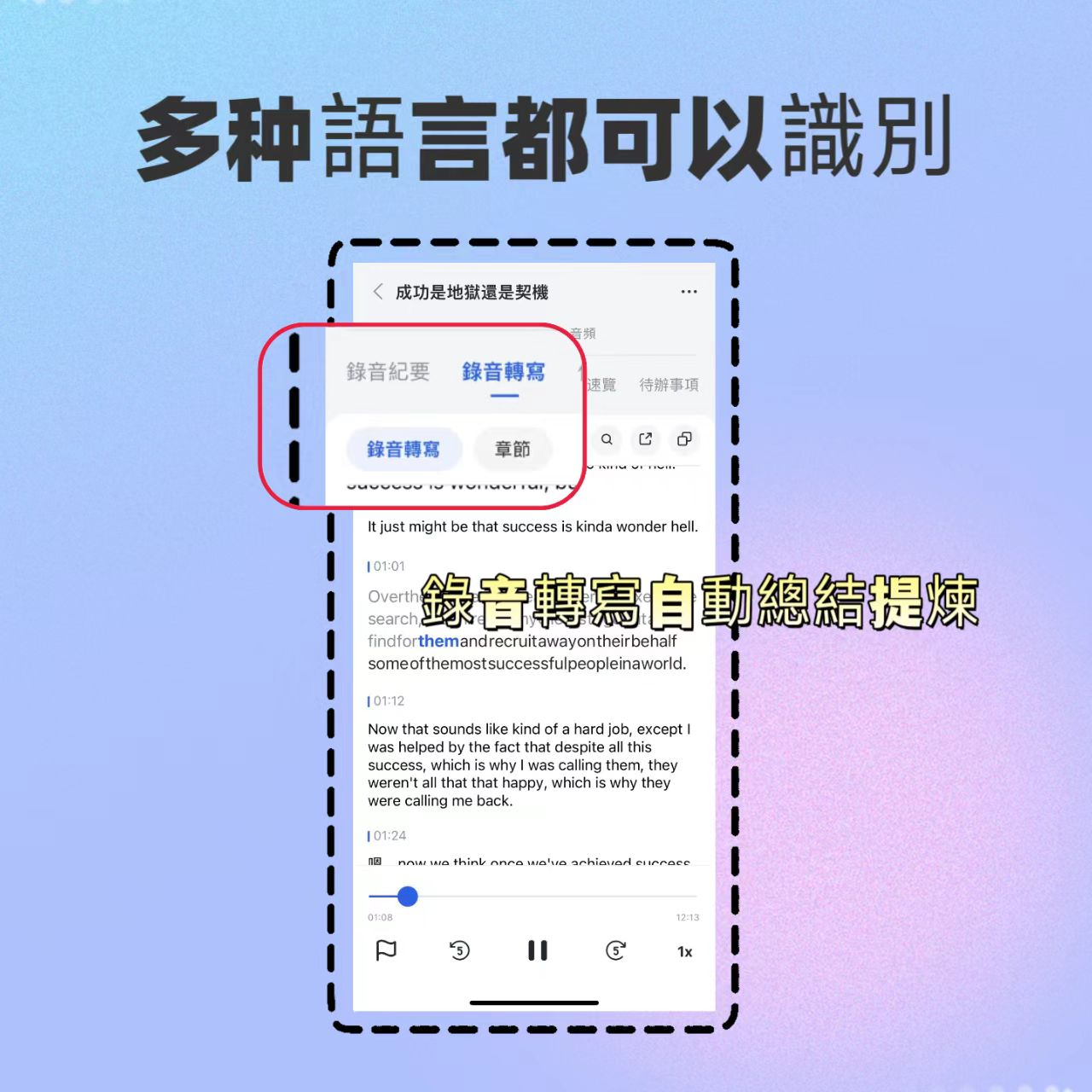
Tinrec has invested heavily in Chinese real-time speech-to-text, supporting Mandarin, Cantonese, Taiwanese, and other dialects. In a typical office meeting environment, its recognition is high, and the transcription appears almost instantly on screen. For users in Taiwan, real-world tests show that Tinrec offers a better recognition experience for Chinese meetings than Otter.ai.
→ This dimension: For Chinese meeting scenarios, Tinrec clearly wins.
Dimension 2|Input Sources and Cross-Scenario Applicability
Beyond meetings, you might need to process lecture recordings, interview files, or even YouTube and podcast content.
Otter.ai's design is centered on online meetings. While it also supports uploading audio files, its main features revolve around meeting workflows, such as auto-joining calendars and real-time note sharing. For non-meeting audio/video materials, its capabilities are limited.
Tinrec is more than just a meeting tool; it also supports:
- Pasting public video links from YouTube, Bilibili, Xiaohongshu, TikTok, etc., to convert them into text and auto-summarize.
- Uploading local audio or video files for quick transcription and structured highlights.
- Integrating three input sources—real-time recording, file import, and online video parsing—in one tool.
For those who need to process various audio/video materials, Tinrec offers much greater versatility.
Stop organizing recordings by hand
Upload audio or video and automatically get a transcript, summary, and action items
→ This dimension: Tinrec is clearly more comprehensive in input sources and scenario coverage.
Dimension 3|AI Summaries and Post-Processing Capabilities
Converting to text is only the first step. Being able to quickly grasp key points and extract action items is where time is truly saved.
Otter.ai's auto-summary focuses on meeting notes, listing sections like "Discussion Topics," "Action Items," and "Decisions," which is very practical. It also has an AI Chat feature for asking questions about the meeting content, but the depth of answers is somewhat limited.
Tinrec offers more post-processing options:
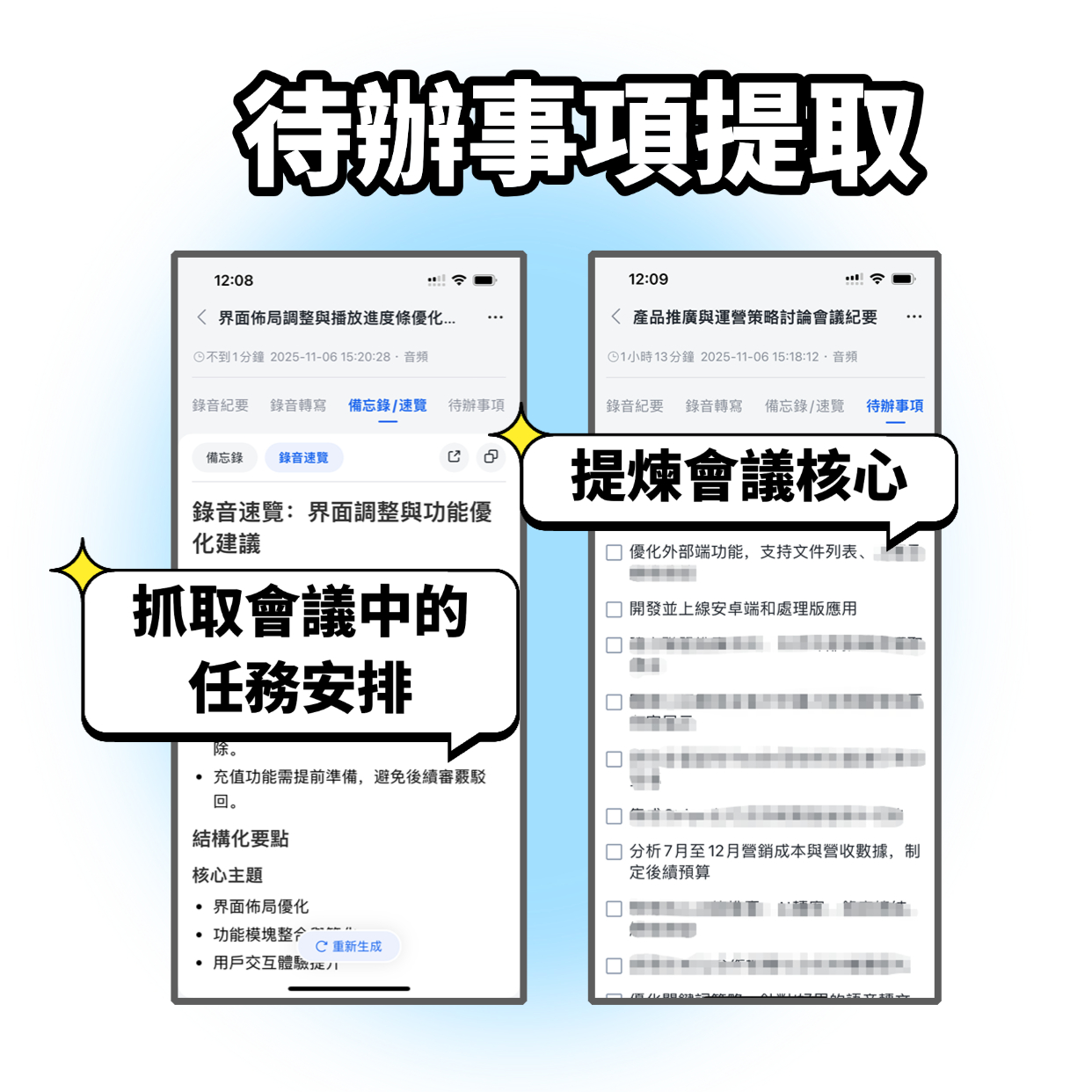
- Auto-generation of summaries, chapters, action items, and key highlights.
- An AI Q&A feature that lets you query details about the recording like you would a personal assistant.
- Export results in various formats (text, PDF, DOCX, etc.) or sync to Notion, Google Docs.
- Further use of Agents to generate meeting reports, tables, and other deliverable documents.
Both have similar basic summary capabilities, but Tinrec offers richer Q&A depth and export flexibility.
→ This dimension: Tinrec's post-processing toolkit is more complete, giving it a slight edge.
Dimension 4|Chinese and Multilingual Support
For Chinese users, speech recognition accuracy and interface localization are important evaluation points.
Otter.ai's strength is English. Although it supports Chinese, accuracy and feature details are noticeably inferior to English; the interface and terminology are still primarily in English, creating a higher barrier for those not familiar with English.
Tinrec's product positioning includes a complete Chinese usage scenario, from Traditional Chinese interface, Chinese (Mandarin, Cantonese) and English speech recognition, to Chinese meeting note generation, all specially tuned. If your meetings or audio are primarily in Chinese, the experience is much smoother.
→ This dimension: Tinrec wins big in Chinese scenarios.
What Are Their Unique Strengths?
Tinrec's Unique Strengths
- One-stop multi-source audio/video processing: Import meetings, lectures, interviews, and online videos without switching tools.
- Deeply integrated AI Q&A: Not just summaries; you can ask follow-up questions like an assistant who heard every recording.
- Rich export and post-processing: Turn transcriptions into meeting notes, reports, or tables ready for use.
- Free plan includes core features: No credit card required; start testing transcription, summaries, and Q&A right after downloading.
Otter.ai's Unique Strengths
- Deep integration with online meeting platforms: Automatically joins Zoom, Google Meet, etc., great for teams with heavy online meeting usage.
- Mature team collaboration features: Shared notes and action item assignment, suitable for multi-user workflows.
Summary: Which Should You Choose?
Considering the typical scenarios for office workers in Taiwan, if your priorities are "Chinese meeting notes," "processing various audio/video materials," or "wanting to digest content after transcription," then Tinrec is the more complete choice.
- If you need high Chinese recognition and want to process non-meeting content like courses or videos → Tinrec
- If you often need AI to help extract key points, answer questions, and export in different formats → Tinrec
- If you only use it for fixed online meetings and are comfortable with an English interface, simple meeting notes are enough → Otter.ai free version is sufficient
In a nutshell: For most people who need to turn "recordings into usable information," Tinrec is closer to actual needs from input to output. We recommend downloading Tinrec's free version and testing it with your own meeting recordings.
Frequently Asked Questions
Does the Tinrec free version have a time limit?
The free version provides a fixed amount of transcription credits each month. Once used up, you'll need to wait until the next month for a refresh, or upgrade to the Pro plan for more hours. The actual credits are as shown in the app.
Which is better for Chinese, Tinrec or Otter.ai?
For Chinese meetings and content transcription, Tinrec is clearly superior; Otter.ai performs better in English environments.
Can I upload old recordings to transcribe them?
Yes, Tinrec supports importing mainstream audio and video formats; upload and it will transcribe and organize.
Does parsing online video links require authorization?
Tinrec supports pasting public video links (e.g., YouTube, TikTok) without special platform authorization, but we recommend complying with each platform's terms of service and copyright regulations.
Are the mobile versions of these tools good?
Both Otter.ai and Tinrec have iOS and Android apps with smooth operation. However, Tinrec's Traditional Chinese interface is more user-friendly for Taiwanese users.
Are meeting recordings secure and private?
Both tools use industry-standard encryption. Uploaded recordings are used only for transcription and analysis and are not shared publicly. Processed content can be deleted from your account at any time.
Turn every recording into actionable outcomes
Get 60 free transcription minutes when you sign in. No credit card required.
Related Reading
You might also like

2026 Comparison of 3 AI Meeting Workflow Tools: Which AI Features Are Most User-Friendly?
Spending hours on meeting notes? We tested 3 popular AI meeting tools—comparing transcription quality, AI features, and pricing—to help you find the perfect fit for your workflow.

2026 Test Comparison of 5 Automatic Meeting Report Generators: Which Free Version Is Best?
Tired of spending hours organizing meeting notes? This article tests 5 popular AI automatic meeting report tools, comparing free limits, cross-platform support, and AI summary accuracy to help you find the best solution.

The Best Meeting Minutes Automation Software of 2026: Auto Summaries & Action Items
Struggling to organize meeting notes? This article covers the best meeting minutes automation software of 2026, from free to paid plans, helping you quickly generate summaries and action items.

2026 Post-Meeting Automation Tool Buying Guide: 3 Products Tested and Recommendations
Meetings running into overtime, and still need to work late on meeting minutes? This article tests 3 post-meeting automation tools, including Tinrec, Otter.ai, and Notta, comparing accuracy, AI features, cross-platform support, and more, to help you choose the most time-saving solution.

2026 Real-World Test: 3 One-Click Meeting PPT Solutions Compared – From Recording to Slides, Which Actually Saves Half the Time?
Two hours in a meeting, another two hours making slides? This article tests three leading solutions to show you how to turn meeting content directly into presentations with the right tools—no more late nights transcribing.

Tinrec vs Otter.ai 2026: 5-Dimension Showdown – Which Extracts Meeting Action Items Better?
Afraid you'll forget meeting takeaways? Can auto-extraction really work? This article compares Tinrec and Otter.ai across 5 key aspects—action item extraction, Chinese support, AI Q&A—to help you choose the best tool.

Effortless Meeting Notes in 2026? 4 Steps from Recording to AI Summary
No more overtime typing transcripts! We tested Tinrec's instant recording transcription, a 4-step guide to turn meeting recordings into AI summaries, plus an AI chat to find key points. Cantonese recognition is accurate—a must-read for office workers.

2026 Comparison of 4 AI Meeting Note Tools: Which Has the Most Convenient One-Click Export?
Are you always spending too much time organizing meeting notes? This article tests 4 AI meeting note apps, from real-time transcription, AI summaries, one-click export to cross-platform support, to find the solution that truly saves you time.

How to Implement AI Office Automation in 2026? 5 Steps from Recording to Auto-Generated Reports
This article shares an AI office automation workflow that uses Tinrec to transform meeting recordings into searchable, organized data, saving you time on meeting minutes.