
Turn recordings into transcripts and summaries in minutes
Upload audio or video for multilingual transcription, AI notes, and action items
Tinrec vs Notta 2026: A 5-Dimension Showdown for Chinese Audio/Video Transcription
From Meeting Notes to Execution: How Far Is the Gap?
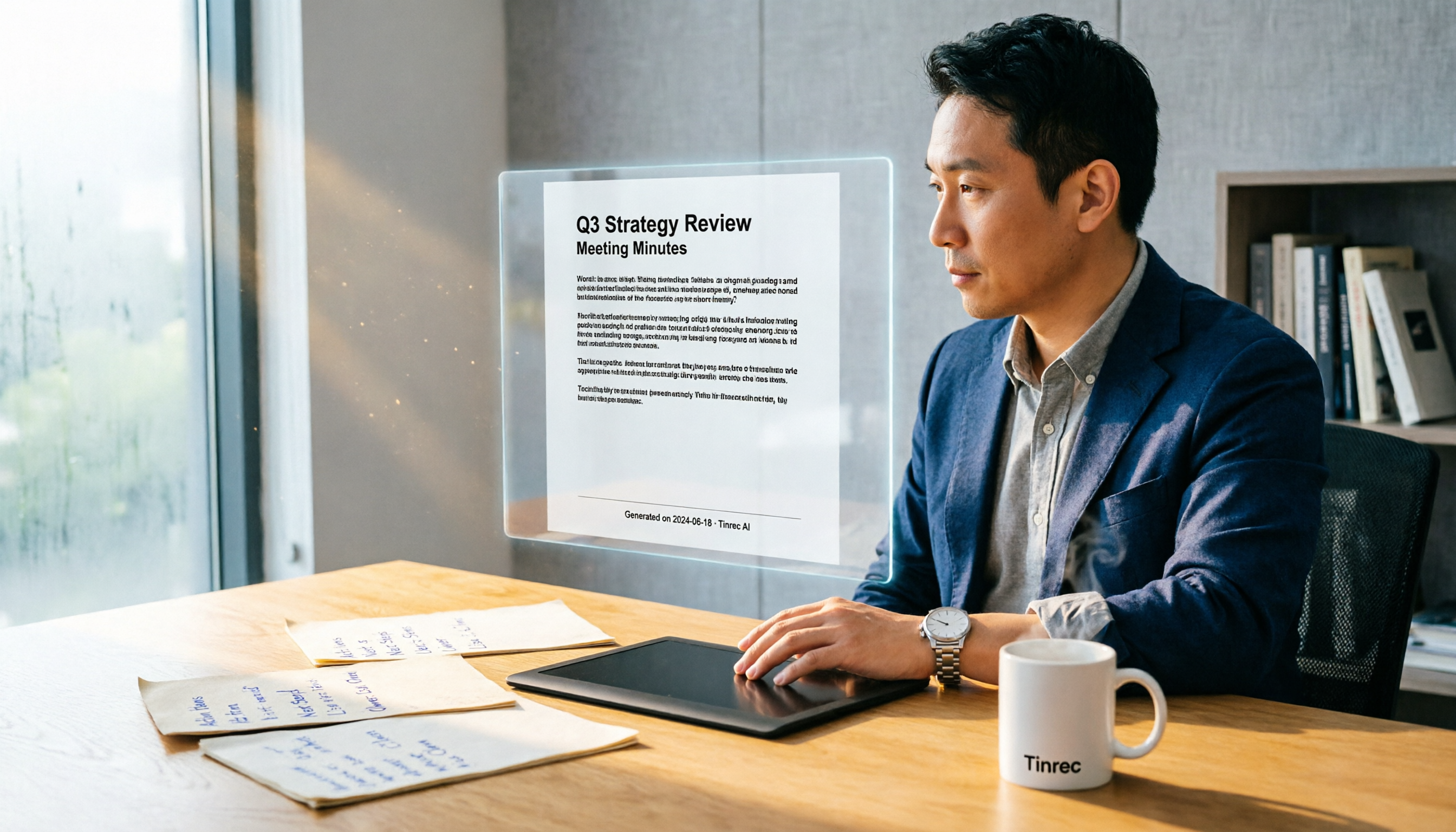
I recently sorted through a two-hour project meeting recording, and the transcript on my computer spanned thirty pages.
I spent the entire afternoon reading it, yet still couldn't find the three key decisions. Worse, each decision came with a string of action items—I had to copy and paste them one by one, then manually add assignees and deadlines.
Times like these make me think: there are plenty of speech-to-text tools, but why are so few that actually help me move from "recording" to "execution"?
The difference lies in some tools only finishing the first half, while others accompany you through the entire journey.
In this article, I'll share my hands-on experience comparing Tinrec (Miaoting Luyin) and Notta—which one travels better from meeting to execution.
(Screenshot: Side-by-side view of transcript and AI summary after importing an audio file, with arrow pointing to "AI Summary" button)
Before Choosing a Transcription Tool, Understand These 5 Key Points
Many people only look at price and minutes, but what truly impacts efficiency is whether you can "turn recordings into action." I suggest first examining these five dimensions:
Accuracy: Don't Just Trust the Official 98%
Those numbers are tested in a quiet recording studio. Real meetings have AC noise, keyboard clicks, and overlapping speech, causing accuracy to drop significantly. I always test with a snippet of my own meeting recording—five minutes tells the real story. Both Tinrec and Notta significantly outperform English-focused tools for Chinese, but there are still differences in real-world performance.
AI Features: The Real Work Begins After Transcription
Transcripts are just the first step. I need automatic summaries, automatic task extraction, and even the ability to query the recording like an assistant: "Who mentioned the budget in last week's meeting?" Only a few tools currently reach this level.
Cross-Platform: Record on Phone, Edit on Computer, Check on Web
I might record a meeting on my iPhone, then edit on my office computer, and review key points on my phone during my commute. If a tool is limited to a single device, I'm in trouble.
Input Sources: Not Just Recording, But Also Importing
I often need to transcribe online videos, podcasts, or old audio files. Tools that only support live recording effectively cut my capability in half.
Pricing & Value: The Free Plan Is a Trial
Don't just look at monthly fees; check if the free allowance is sufficient for a full trial. If the free version only transcribes five minutes, you can't gauge its real value.
Keep these points in mind as we dive into the comparison.
Tinrec (Miaoting Luyin) — My Top Pick After Testing
Tinrec's positioning is clear: it doesn't just give you transcripts—it turns all your audio/video data into a searchable, summarizable, queryable, and exportable "action database."
Three Input Methods, One Workspace
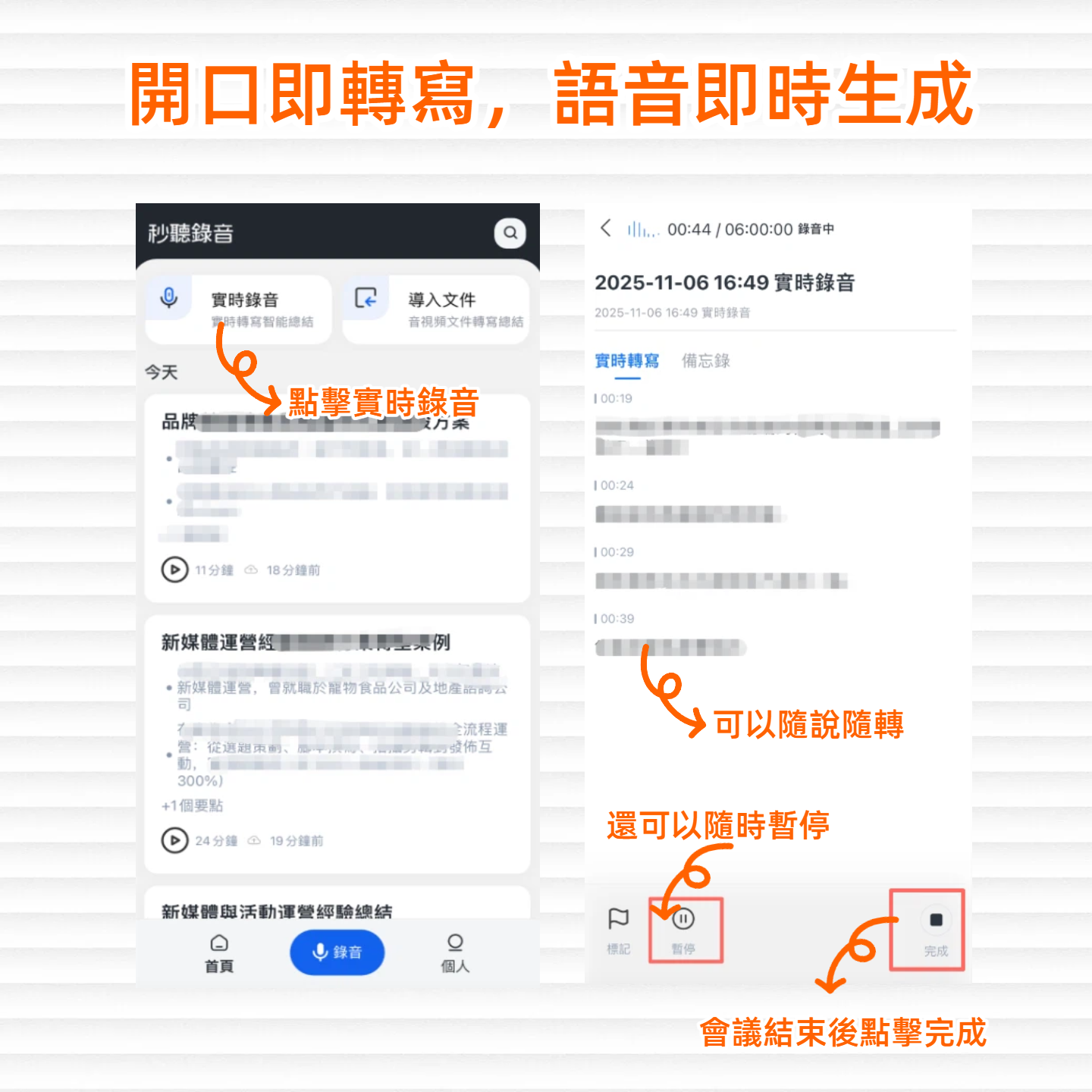
Open the app to record a meeting in real time; it generates the transcript as you speak. After the meeting, it produces a summary and action items—who needs to do what and by when, all at a glance.
(Screenshot: Real-time recording transcription interface, arrow pointing to real-time text and paragraphs)
Stop organizing recordings by hand
Upload audio or video and automatically get a transcript, summary, and action items
What impressed me even more is its online video link parsing: paste a YouTube or Bilibili link, and it directly extracts the audio track, transcribes it, and organizes chapters and key points. I used it to process a half-hour interview video, pulling out all cited paragraphs in five minutes.
(Screenshot: After pasting a video link, video on the left, real-time text summary on the right)
It also supports local file import—old meeting recordings and class recordings can be dropped in for processing.
AI Conversational Query: No More Digging Through Transcripts
This is where Tinrec pulls ahead. After recording, you can ask it in Chinese: "What was the conclusion of this meeting?" or "Who is responsible for the social media campaign?" It answers based on semantic understanding, not just keyword search.
(Screenshot: AI dialogue box with a question typed in, answer displayed below with timestamps)
Notta has AI summaries, but lacks this conversational query feature. You can only manually scroll through the transcript.
Action Item Extraction
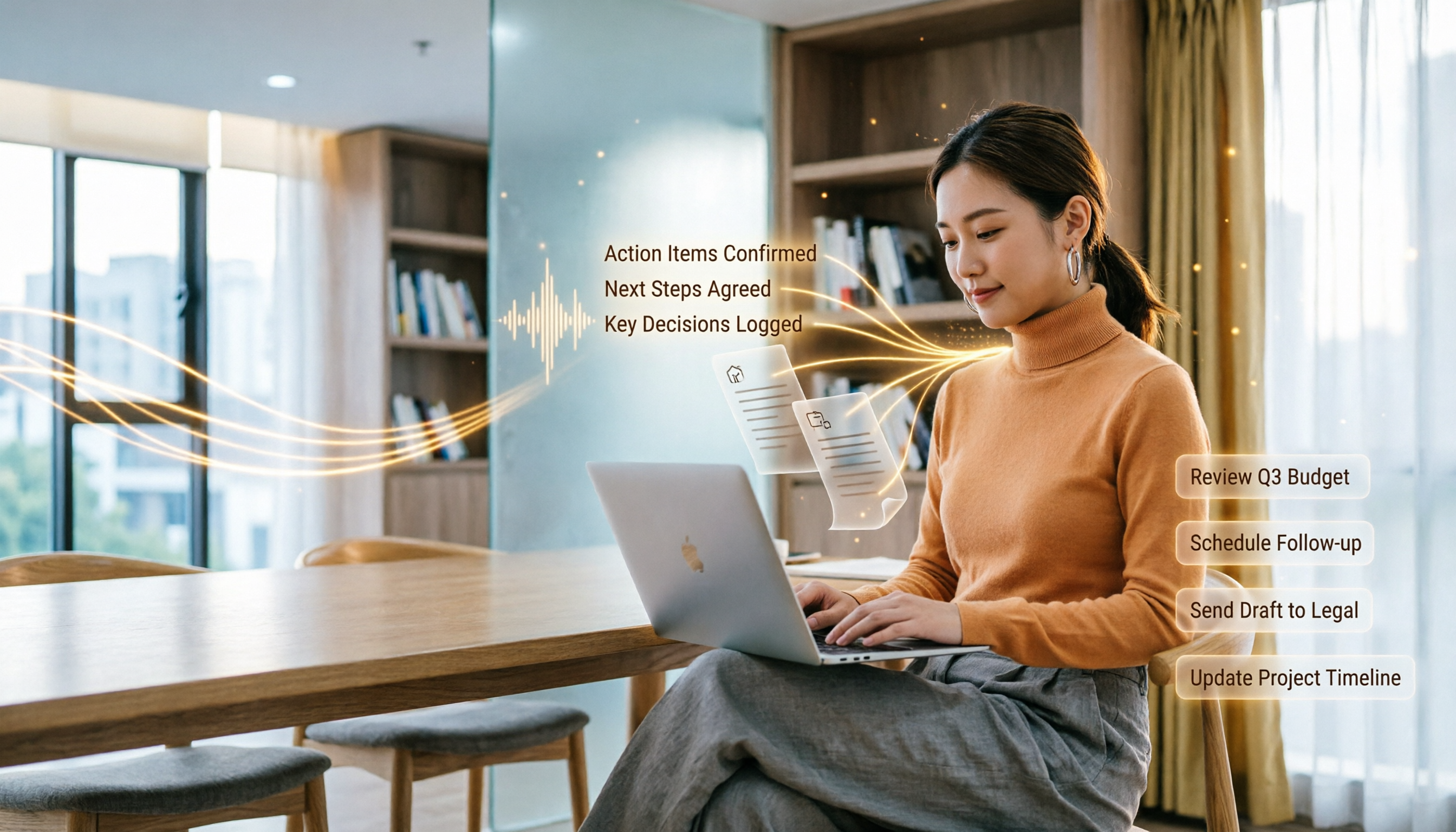
Tasks mentioned in the meeting are automatically listed. You can copy them to notes or export to Notion with one click. My weekly meetings now rely on this feature—no more post-meeting catch-ups.
(Screenshot: Action item list with checkboxes and export button on the right)
Test Data
Using a five-minute two-person meeting recording (Mandarin Chinese) with slight background noise, Tinrec's error rate was about 5%, Notta about 7%. The difference isn't huge, but Tinrec's summary captured key decisions more comprehensively.
Pros
- Multiple input sources: live, file, and web links for various needs.
- AI conversational query: ask directly for key points, saving a lot of review time.
- Cross-platform sync: iOS, Android, web—progress continues seamlessly.
(Screenshot: Synchronized interface on mobile and desktop web)
Cons
The free plan offers 100 minutes per month, which may not be enough for heavy meeting users. But for most people with three or fewer meetings per week, it's sufficient.
Who It's For
If you need to organize not just meetings but also online courses, interview recordings, and web videos, and you want AI to extract key points and generate action items, Tinrec is currently the most complete choice.
Besides Tinrec, Notta Is Another Option
Notta excels in transcription and translation, especially for multilingual needs. Its paid plan offers generous minutes, and the app interface is clean.
However, Notta lacks two features I use daily:
- AI conversational query: You can't directly ask about the recording content—only traditional search is available.
- Online video link transcription: Doesn't support pasting YouTube links, which is a deal-breaker for content creators.
So if you primarily deal with English meetings and often use translation features, Notta is worth considering. But if you need to process Chinese audio/video and quickly extract key points into action, Tinrec offers greater completeness.
Incidentally, Otter.ai is very strong for English meetings but doesn't support Chinese at all—a fatal flaw for us. Fireflies.ai excels at meeting automation but likewise lacks web video support.
Pitfall Guide: 3 Common Mistakes When Choosing Tools
Pitfall 1: Trusting Official Accuracy Without Testing
Many tools claim 98% accuracy, but that's lab data. Test with your own real meeting recording—five minutes tells you if it works.
Pitfall 2: Thinking Transcripts Are the End Goal
If you only use a tool for speech-to-text, you're using only a third of its potential. Features like Tinrec's AI conversational query and action item extraction are what truly take you from recording to execution.
Pitfall 3: Ignoring Cross-Platform Needs
If you record on iPhone today and edit on a computer tomorrow, a single-device tool will break your workflow. Ensure your chosen tool works on all your devices.
Summary: Which One Should You Choose?
If you're a Chinese user and often deal with recordings, courses, interviews, or online videos, Tinrec is my top recommendation. It doesn't just give you text—it lets you retrieve key points through conversation and automatically generates action items, truly turning audio/video into usable knowledge.
Quick Scenario Recommendations
- Need Chinese meetings + courses + web video transcription → Tinrec (full coverage)
- Heavy English meetings + real-time translation → Notta (strong translation features)
- English-only meetings + team collaboration → Otter.ai (best for English)
- Just want meetings to run without any follow-up → Honestly, such a tool doesn't exist yet
I recommend downloading Tinrec's free version to try—100 minutes per month is enough for two meetings and one video. If you like it, consider upgrading; if not, you've lost nothing.
In my experience, with the right method and tool, the action plan is ready the moment the meeting ends.
Turn every recording into actionable outcomes
Get 60 free transcription minutes when you sign in. No credit card required.
Related Reading
You might also like
Which Meeting Closure AI Tool Is Best? 2026 Hands-on Test of 3 Tools – Free Version Sufficient for Most
Meeting notes always scattered? We tested 3 AI tools and show you how Tinrec closes the loop from recording, transcription, minutes to to-do list – the free plan is enough for daily use.

2026 Hands-On Comparison of 4 Speech-to-Text Tools: Which AI Meeting Minutes Really Save Time?
We tested 4 speech-to-text tools, comparing accuracy, AI summaries, cross-platform support, and free tiers. Tinrec stands out for Chinese language scenarios and AI querying, making it ideal for meetings, learning, and content creation. This article helps you avoid common pitfalls and find the best tool for your needs.
2026 Meeting Minutes Tool Comparison: Which AI Tool Exports Word Reports Your Boss Will Love?
A mid-level manager tests 4 AI meeting minutes tools, from recording to Word report export. Find out which saves the most time and produces the most complete summaries—real experience and buying tips inside.
How to Automate Meeting Follow-Ups in 2026? A Complete 5-Step Guide
Automating meeting follow-ups is no longer just a buzzword! This guide uses Tinrec as the core tool to take you from recording to generating to-do items in 5 steps, fully upgrading your meeting follow-up workflow and ensuring you never miss an action item again.

The Complete 2026 Guide to AI Office Automation: Record, Transcribe, and Summarize Meetings with One Click — No More Overtime
Tired of staying late to write meeting minutes after every meeting? This guide to AI office automation in 2026 shows you how to use audio-to-text tools and AI meeting summarizers to automatically turn recordings into highlights, action items, and transcripts. We test Tinrec (SecondListening) head-to-head with other options to help you choose the most time-saving office automation solution.

2026 Comparison of 3 AI Meeting Minutes Tools: Can the Free Version Auto-Generate To-Dos?
We tested three mainstream AI meeting minutes tools and found that the free versions can already auto-generate summaries and to-do items. This article uses Tinrec as an example to fully analyze the core features, use cases, and purchasing considerations of meeting minutes tools, helping you choose the best solution for office workers.

2026 AI Workflow Automation Free Plans: 2 Options at a Glance
Looking for a tool to automatically organize meeting, interview, and lecture recordings into actionable data? This article compares Tinrec and PLAUD Note across input sources, organization capabilities, cost-effectiveness, and Chinese optimization to help you find the best AI workflow automation choice.

2026 Comparison of 4 AI Meeting Note Tools: Which One Really Saves You Time After Meetings?
Two hours in a meeting, another two organizing notes? We tested four AI meeting note tools and found that the real time-saver isn't just transcription—it's the "understanding and action" after recording. Tinrec excels in Chinese meetings, AI conversational search, and post-processing, turning recordings into immediately usable knowledge.

2026 Conference Recording to Text App Showdown: Which AI Meeting Summary Actually Saves You Time?
Tired of overtime taking meeting minutes? We tested Tinrec, Notta, Plaud Note, and Otter.ai — comparing Cantonese accuracy, AI summaries, cross-platform support, and free tiers to find the best time-saver for Hong Kong professionals.