
Turn recordings into transcripts and summaries in minutes
Upload audio or video for multilingual transcription, AI notes, and action items
Tinrec vs Otter.ai: Quick Overview
If you're used to recording meetings, classes, or interviews but never have time to replay and organize them, structured output becomes the key—not just transcribing to text, but automatically generating summaries, chapters, action items, and even querying content like a database.
Two highly discussed tools on the market—Tinrec (MiaoTing) and Otter.ai—have invested heavily in structured output, but their strengths and positioning differ. This article compares them across five practical dimensions.
| Item | Tinrec | Otter.ai |
|---|---|---|
| One-liner Positioning | Turn recordings into actionable knowledge | AI meeting notes and team collaboration |
| Pricing | Free plan with basic monthly quota; paid plans from weekly to yearly | Free plan: 300 minutes/month; Pro annual $8.33/month |
| Platform | iOS, Android, Web | iOS, Android, Web |
| Key Difference | Multi-source audio/video + rich post-processing | Meeting automation + strong team features |
Dimension 1: Automatic Summary and Chapter Generation
After recording a 30-minute meeting, most people just want to know the key points and what topics were discussed.
Otter.ai's AI summary automatically captures key discussion points and segments by speaker, available within minutes after the meeting ends. Objectively, English meeting summaries are high quality, while Chinese occasionally misses subtle tone shifts.
Tinrec not only provides a summary but also directly divides content into chapters, such as 'Project Progress Report', 'Budget Discussion', 'Next Steps', each with its own title and key points. We tested the same 25-minute Chinese product meeting recording (quiet office, 3-person conversation). Tinrec's chapter segmentation perfectly matched the actual agenda, and the summary captured decision points; Otter's summary tended to be a bullet list with weaker chapter structure.
→ This dimension: Tinrec offers more detailed structured segmentation, suitable for those needing quick review of long recordings.
Dimension 2: Action Item Extraction
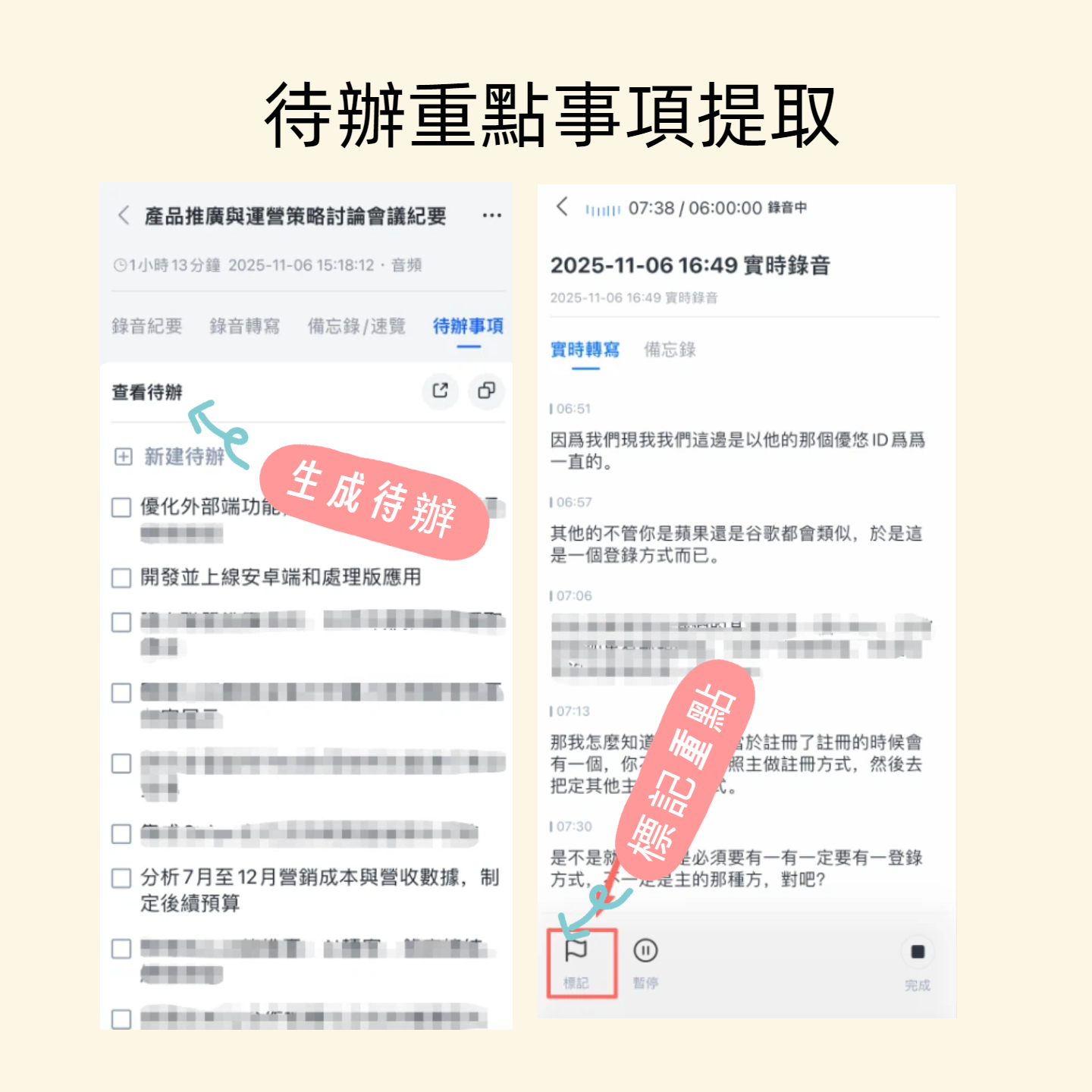
The worst outcome of a meeting is no follow-up. Another key aspect of structured output is automatically listing action items.
Stop organizing recordings by hand
Upload audio or video and automatically get a transcript, summary, and action items
Otter.ai's 'Action Items' identifies sentences like 'I'll handle it' or 'by next Friday' from the meeting, clickable for details. However, our tests found that Chinese meeting action item recognition is still unstable, sometimes tagging general statements as tasks.
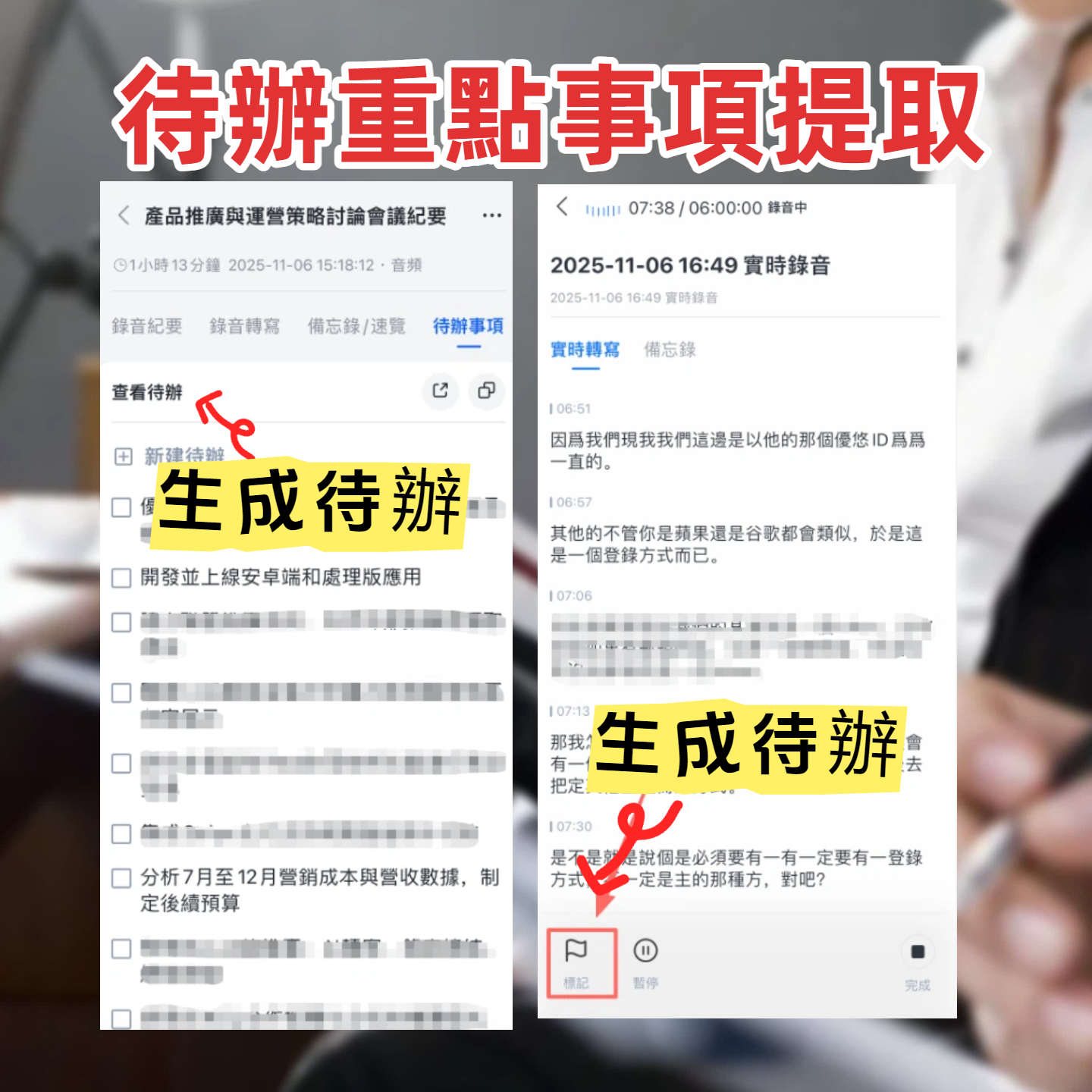
Tinrec provides a dedicated 'TODO List' that organizes 'who, what, when' into a table. In the same test meeting, Tinrec extracted 4 action items, 3 correct; Otter extracted 3, but 1 was not a real action item.
→ This dimension: Tinrec's Chinese action item extraction is more accurate, and the output format is easier to paste into project management tools.
Dimension 3: AI Conversation Query
Sometimes you don't just want to see the organized results; you want to ask questions about the recording content, like 'What was the budget mentioned in the last meeting?'
Otter.ai has 'Otter Chat' that allows you to ask questions within meeting notes, with answers accompanied by original paragraphs. English queries perform well, but Chinese Q&A sometimes yields irrelevant answers.
Tinrec's 'AI Q&A' is more like a database, allowing queries on a single recording or across recordings. When we asked 'What was the main cause of the project delay?', Tinrec directly cited two relevant dialogue segments and summarized a conclusion; Otter listed several possible related paragraphs, requiring manual synthesis.
→ This dimension: Tinrec's Q&A integration is stronger, more convenient for those who need to repeatedly look up historical data.
Dimension 4: Output Format and Subsequent Use
After obtaining structured data, whether it can be seamlessly exported to other tools also affects willingness to use.
Otter.ai supports exporting transcripts, summaries, and syncing to Google Calendar, Slack, etc., clearly team-collaboration oriented. However, formats are mainly text and email, with few structured tables.
Tinrec, besides basic transcripts and summaries, can export to Markdown, TXT, and even directly generate meeting minutes and reports, with one-click transfer to Notion, Google Docs, etc.
→ This dimension: Tinrec offers more diverse outputs with higher flexibility for further processing.
What Are Their Unique Advantages?
Tinrec's Unique Advantages
- Handles not only meetings but also courses, interviews, and online videos; structured output applies to various audio/video sources.
- Chapters, action items, and Q&A all in one go, no need to switch between different tools.
- Stable structured performance for Chinese content; correctly segments mixed Chinese and English.
Otter.ai's Unique Advantages
- Automatically joins online meetings and provides real-time transcription, ideal for teams with many remote meetings.
- High-quality English summaries and action items, clear advantage in business English scenarios.
Summary: Which Should You Choose?
If you want to turn recordings into immediately usable structured data and need to handle Chinese meetings, courses, or interviews, Tinrec is more complete in chapters, action items, Q&A, and export, saving you follow-up organization time.
If you're in an English business environment and your team heavily relies on online meeting automation, Otter.ai's real-time transcription and collaboration features will be more convenient, but Chinese structured output lags behind.
In a nutshell: For most people needing to organize Chinese audio/video content, Tinrec is a choice closer to structured output needs. Try the free version first and see how it handles your recordings.
Turn every recording into actionable outcomes
Get 60 free transcription minutes when you sign in. No credit card required.
Related Reading
You might also like

Best AI Meeting Assistant in 2026? We Tested 5 and Found the Most Complete One
I attend 15 meetings a week, and the worst part is the post-meeting cleanup. After testing 5 AI meeting tools on transcription quality, AI summaries, action item extraction, and cross-platform support, here's the one that truly turns recordings into usable data.
How to Automatically Organize Meeting Notes with AI in 2026: A 5-Step Guide
Spending two hours in a meeting and another two hours writing meeting notes? This guide teaches you how to use AI speech-to-text tools to auto-generate summaries and to-do lists. We tested Tinrec, Otter.ai, and 5 other services, covering everything from selection to pitfalls.

Tinrec vs Otter.ai 2026: In-Depth Comparison Across 4 Dimensions – Which Is Best for Cantonese-Speaking Users for Meeting Reviews?
Hong Kong professionals have meetings every day and need AI to help with reviews? We tested Tinrec and Otter.ai head-to-head, comparing Cantonese accuracy, multi-source support, AI Q&A, and export features. Find out which tool saves time and prevents overtime for Central office workers.
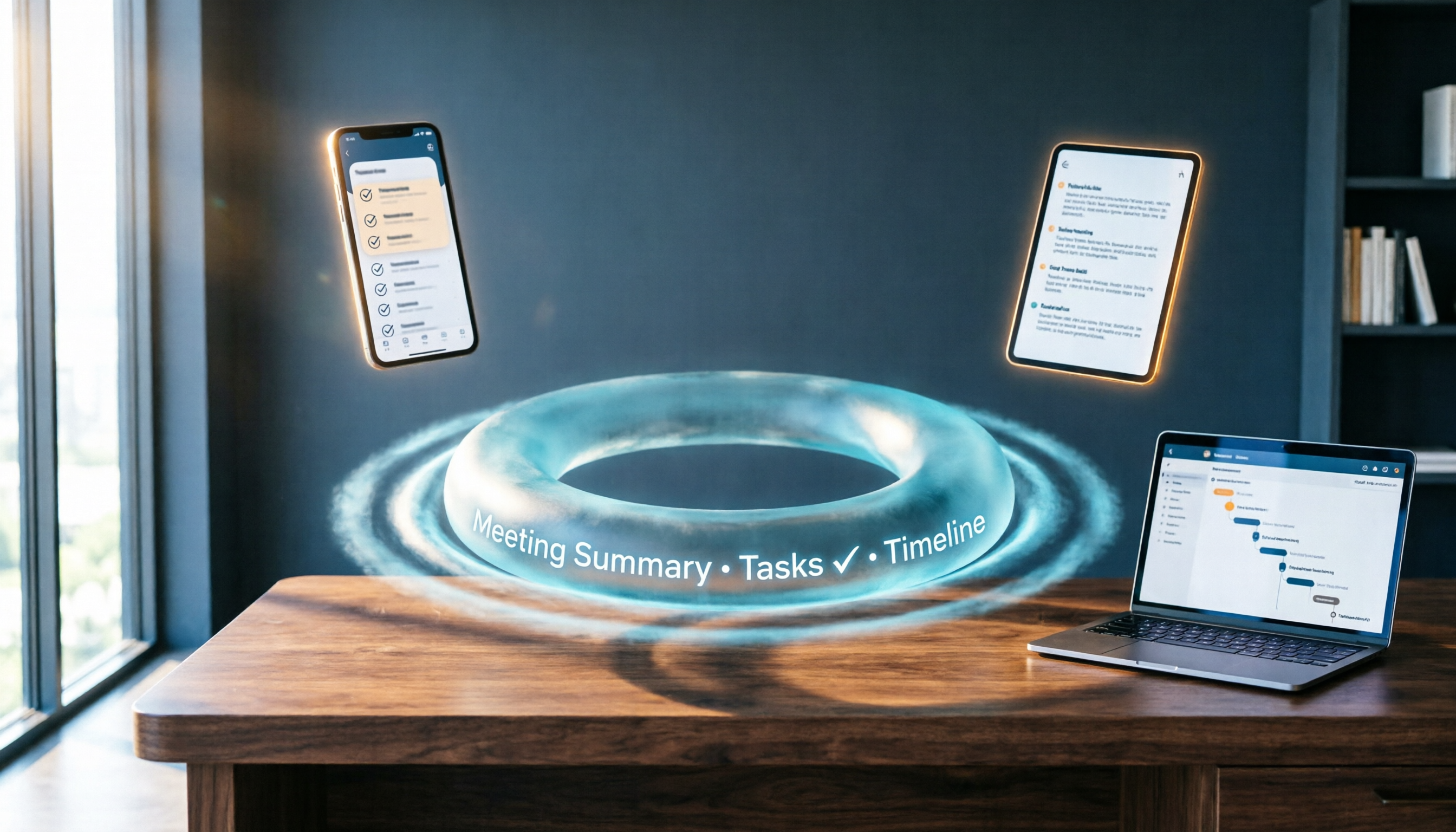
2026 AI Administrative Assistant Tools: No Hardware Needed + Cross-Platform Audio Transcription
Administrative work often gets buried under meeting recordings, interviews, online videos, and more. This article compares two AI administrative assistant tools: the software-based Tinrec and the hardware-based PLAUD Note. We analyze cost, input sources, post-processing capabilities, and cross-platform support across four dimensions to help you find the best solution for organizing audio notes and tasks.

Free AI Meeting Efficiency Tools in 2026: A Look at 3 Options
Tired of transcribing meeting recordings after hours? We tested free plans of Otter, Notta, and Tinrec——three AI meeting tools——to see which one truly saves time for Hong Kong workers, focusing on Cantonese recognition, multi-source input, and AI summarization.

2026 Comparison of 2 AI Meeting Efficiency Assistants: From Free to Hardware, Which One Fits You Best?
This article provides an in-depth four-dimensional comparison of two major AI meeting efficiency solutions—the software-based Tinrec and the hardware-based PLAUD Note—from input sources, AI features, pricing, and cross-platform flexibility, helping you find the option that best fits your workflow.

Free AI Agent Smart Organization Solutions in 2026: 3 Tools to Check Out
Want to use AI to automatically organize meeting notes, course notes, or interview transcripts? This article rounds up 3 AI Agent smart organization tools that offer free plans in 2026, using Tinrec as an example to show how you can turn audio/video into searchable, summarizable, actionable data with free credits.
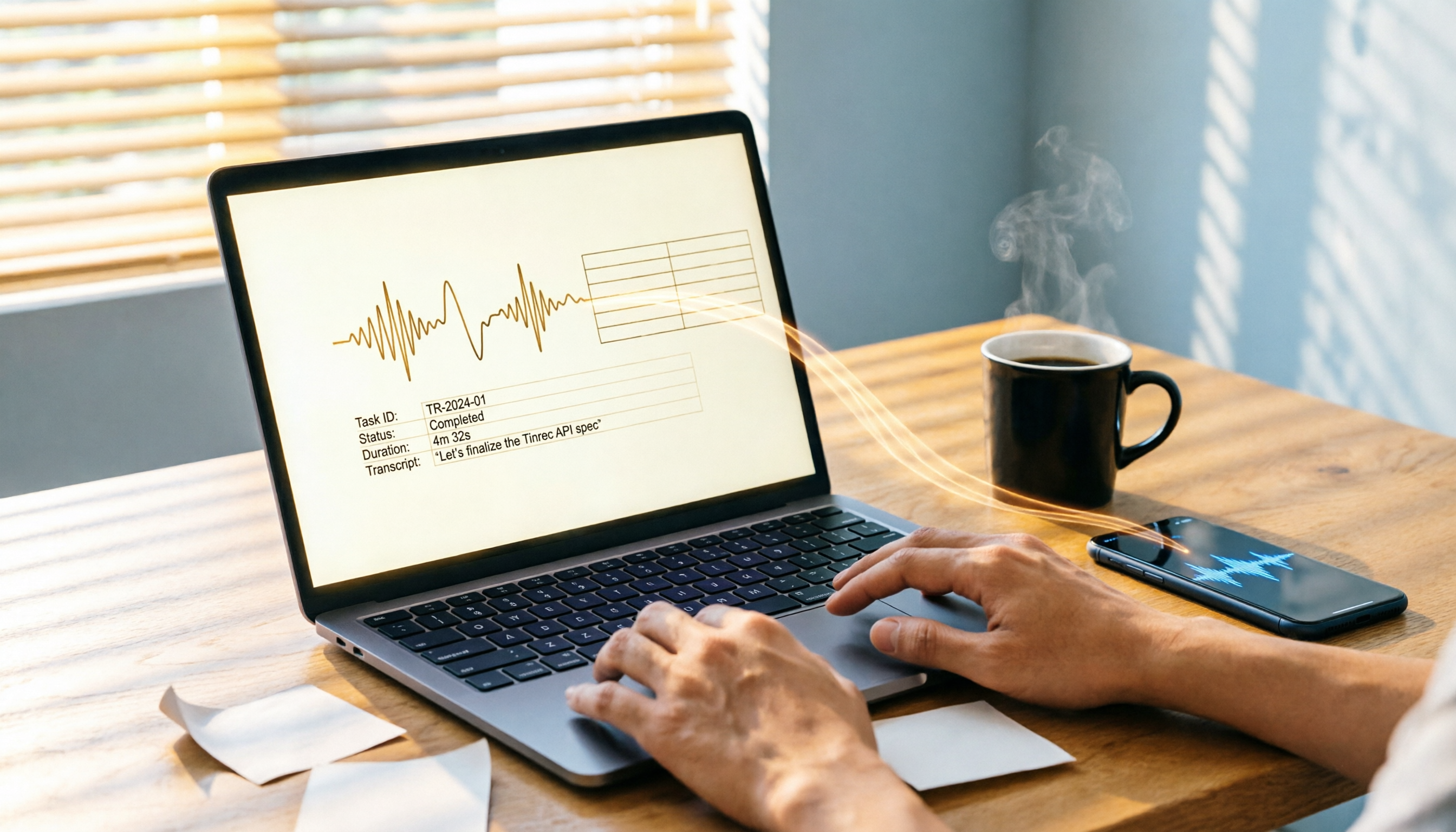
Tinrec vs Otter.ai 2026: 5-Dimension Showdown – Which AI Generates Excel More Efficiently?
AI Agent generating Excel is no longer a dream! This article puts Tinrec and Otter.ai to the test for meeting notes, task extraction, and table creation, showing you how to automatically convert audio recordings into editable Excel reports using AI. A must-read for office workers.

2026 Comparison of 4 AI Recording and Transcription Tools: Which One Has the Best AI Context Understanding Like a Real Assistant?
With so many voice-to-text tools on the market, which one offers true AI context understanding—not just keyword search, but answering your questions and generating reports? This hands-on review compares Tinrec, Otter.ai, Notta, and Fireflies.ai across AI Q&A, Chinese support, and post-processing capabilities to help you pick the one that feels like a real human assistant.