

Turn recordings into transcripts and summaries in minutes
Upload audio or video for multilingual transcription, AI notes, and action items
What Can AI Agent Context Understanding Do for You?
In conversational AI tools, "context understanding" is a key capability — it enables the AI to not just understand a single sentence, but to remember what you said earlier and provide coherent responses. Take Tinrec's AI dialogue query as an example: it allows you to ask follow-up details about meeting recordings, course audio, or interview content just like discussing with a real person, without starting from scratch each time.
Scenario 1: Quickly review key points after a meeting After a meeting, you can directly ask Tinrec: "Who mentioned the budget issue in the meeting?" "What was the deadline discussed last time?" It will give you precise answers based on the full meeting context, rather than just matching keywords.
Scenario 2: Save time when organizing interview material If you have a 1-hour interview recording, usually you'd have to listen back and forth to find a specific point. Now you can simply ask: "What was the interviewee's view on market trends?" Tinrec will provide a condensed answer based on context, along with timestamps for you to review.
Scenario 3: Remote teaching or course review A teacher's lecture recording might be 2 hours long. You can ask Tinrec: "What are the key points of chapter two?" "What examples did the teacher give?" Let the AI extract the essentials, so you don't worry about missing anything.
What Are the Core Capabilities of AI Agent Context Understanding?
AI Agent context understanding is not just about remembering conversations, but also being able to:
- Remember conversation context: Tinrec's AI tracks your question intent, ensuring tight relevance between questions and answers without mismatches.
- Cross-paragraph reasoning: When you ask "Why did he say that?", the AI reviews previous dialogue content to find explanations from context, rather than just repeating the original sentence.
- Navigate multi-turn Q&A without getting lost: You can ask several related questions in a row, and Tinrec stays on topic until you actively switch.
- Summarize and extract action items: Based on context, Tinrec automatically distinguishes between "discussion content" and "to-dos", so you don't have to read the entire transcript.
- Language and domain adaptation: Whether it's a meeting in Chinese, an interview in English, or a mix of both, Tinrec can judge terminology and proper nouns based on context, improving Q&A accuracy.
Practical Application Scenarios
Meeting Notes and Action Tracking
Traditional meeting notes are static documents, but Tinrec lets you "talk" to your meeting notes. For example, after a weekly meeting, you can ask: "What are the action items for next week?" "Who is responsible for contacting the client?" It will list the to-do list based on context and automatically tag the responsible person.
Stop organizing recordings by hand
Upload audio or video and automatically get a transcript, summary, and action items
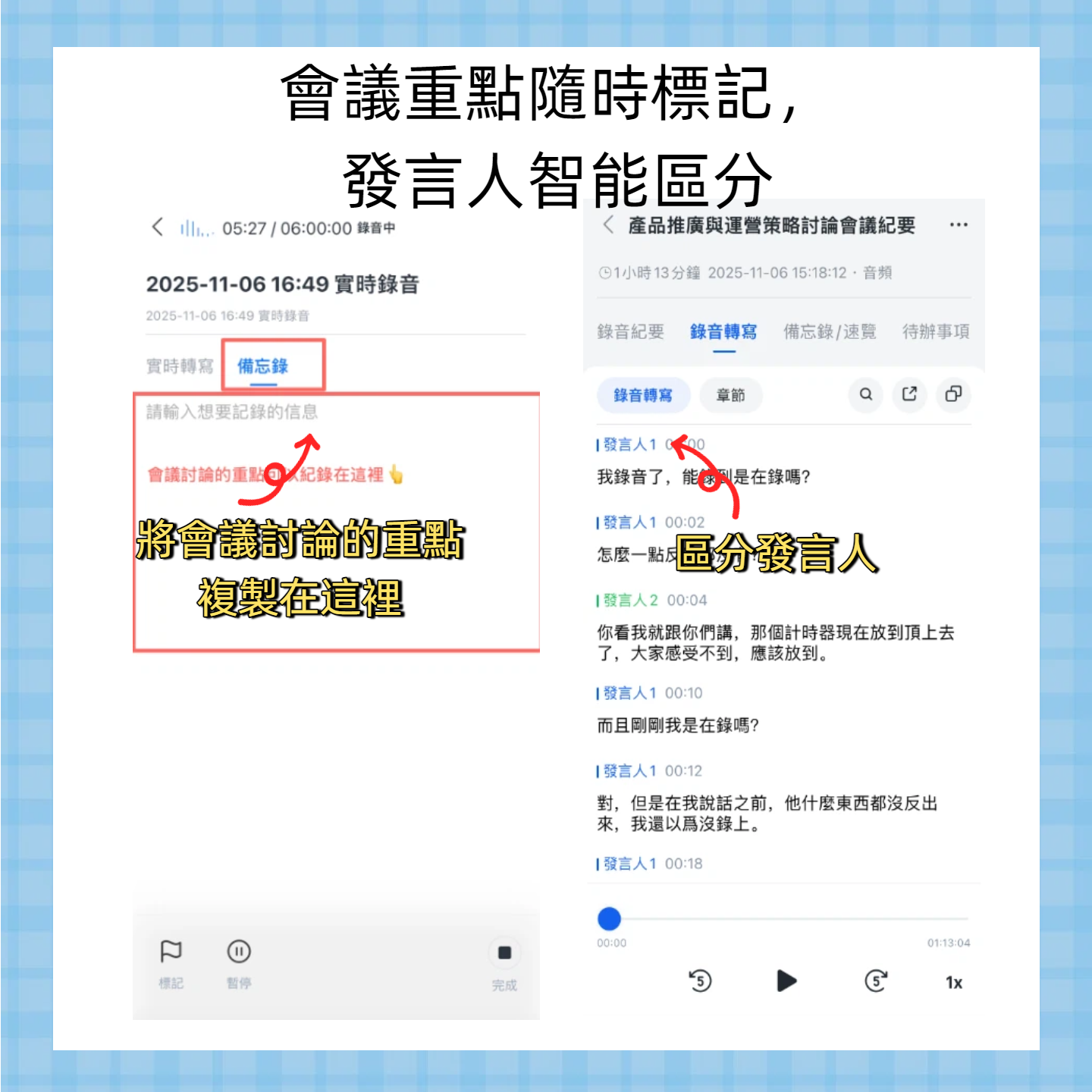
Image caption: Tinrec's AI dialogue query interface supporting multi-turn Q&A
Learning and Research Organization
When you record an entire class, instead of re-listening to 1.5 hours, just ask Tinrec: "What exam points did the professor emphasize in this class?" It can find key paragraphs from the class recording's context and even help you organize notes.
Content Creation and Material Extraction
When analyzing a YouTube video, you can paste the video link, have Tinrec transcribe it, and then ask: "What are the main points of this video?" "What data was mentioned?" Quickly collect creative material without having to watch and type.
Personal Knowledge Base Building
Over long-term use, Tinrec stores all your recordings and Q&A history, forming a searchable knowledge base. In the future, you can cross-reference meetings and ask: "Has the supplier list discussed last time changed?" Truly making past data actionable.
4 Points to Note When Choosing an AI Agent Context Understanding Tool
- Context memory length: Some tools only remember a few previous dialogues and fail for longer meetings. Tinrec's context window handles meetings over 2 hours without "losing memory" midway.
- Naturalness of multi-turn Q&A: Some tools' AI acts like a keyword search engine, unable to follow intent. Tinrec's conversation experience is closer to real human discussion, accepting follow-ups and clarifications.
- Language and domain support: If you mainly handle Chinese content or meetings mixing Chinese and English, make sure the tool understands correctly. Tinrec performs excellently in recognizing Chinese meetings and interviews, and supports multiple languages.
- Data privacy and security: Meeting content is often sensitive. Check if the tool offers data retention periods and deletion functionality. Tinrec lets users manage recordings and transcripts anytime, with various export and backup options.
Frequently Asked Questions
Q: What's the difference between AI Agent context understanding and regular AI Q&A?
A: Regular AI Q&A may only handle single questions without considering dialogue history. Context understanding remembers previous content, making subsequent Q&A more coherent. For example, Tinrec can remember you asked about "budget" in the meeting, and when you follow up with "Which department proposed it?", it knows you're referring to the same thing.
Q: Is Tinrec's context understanding accurate? Will it misunderstand me?
A: With clear recordings and grammatically correct questions, Tinrec is very reliable. But like human conversation, if the question is too vague or there's background noise, the AI may ask for clarification. We recommend being specific about the subject to improve accuracy.
Q: Does the free version also have context understanding?
A: Yes, the free version includes AI dialogue query, but with a monthly transcription limit. For average meeting frequency, the free quota is enough to experience the convenience of contextual Q&A.
Q: Can I export Q&A results?
A: Yes, Tinrec supports exporting summaries, to-dos, etc., as documents, and you can also copy AI Q&A content for integration into reports or note-taking apps.
Q: Do I need an internet connection to use context understanding?
A: Tinrec's AI Q&A requires an internet connection because the model runs in the cloud. However, audio files can be downloaded and stored first, then Q&A can be done after transcription.
Summary
AI Agent context understanding elevates AI tools from "dictation" to "understanding", greatly reducing time spent re-listening and searching. Whether you're in meetings, classes, interviews, or organizing materials, Tinrec helps you retrieve missed details through conversation. If you haven't tried this feature yet, start with Tinrec's free version — it offers a basic monthly quota to experience the convenience of contextual Q&A.
Turn every recording into actionable outcomes
Get 60 free transcription minutes when you sign in. No credit card required.
Related Reading
You might also like
2026 Review of 3 AI Voice-to-Excel Tools: Which One Auto-Generates Meeting Data Tables?
Need to turn meeting recordings into Excel reports? We tested Tinrec, Notta, and Otter.ai to see which truly saves time by directly producing structured data.

Which AI Agent Auto-Delivery Tool is Best? 2026 Hands-On Review of 3 Top Picks: Tinrec Generates Reports in One Click
A senior college student tests 3 AI tools to automatically turn recordings, meetings, and online videos into organized reports and to-do lists, saving all-nighters.

2026 Hands-On Comparison of 2 AI Recording and Summarization Tools: Which One Produces the Best Meeting Notes for PPT?
When making a PPT, the most time-consuming part is often not the layout, but converting meeting recordings, lectures, or interview content into structured key points. This article compares Tinrec and Otter.ai across five dimensions to see which AI recording tool is better for Chinese-speaking users to quickly organize presentation-ready material.

2026 Comparison of 3 AI Agent Document Generation Tools: From Recording to Document in One Click
Tired of spending hours transcribing meeting recordings, lectures, or interviews? AI Agent document generation technology can automatically turn audio into meeting minutes, reports, to-do lists, and more. Tinrec's Agent post-processing feature lets you generate documents in various formats on demand. This article compares three mainstream solutions to help you choose the most time-saving option.

2026 Free AI Meeting Notes Solutions: 4 Tools Compared at a Glance
Spending too much time on meeting minutes? This article tests 4 free AI meeting note tools—comparing transcription accuracy, AI summaries, and cross-platform support—to help you find the best free option and make meetings painless.

2026 AI Voice-to-Word Tool Buying Guide: 3 Tested & Recommended
This review tests 3 popular AI voice-to-Word tools, from free plans to paid options, to find which one best helps you turn meeting and lecture recordings into structured Word documents quickly, with complete buying advice.

2026 Comparison of 5 AI-Powered Recording Tools with Multi-Round Dialogue: Which One Can Really Help You Extract Key Information from Recordings?
AI recording tools do more than just transcribe speech; multi-round dialogue queries are the key. This article tests 5 audio/video transcription tools with AI Q&A features, including Tinrec, Otter.ai, Fireflies.ai, Granola, and PLAUD, showing how to use conversations to deeply mine recording content, with ready-to-use prompt templates.

Free AI Meeting Note Solutions for 2026: A Look at 5 Tools
Can't keep up with notes in class? Group discussions where no one remembers the conclusions? This article tests 5 AI meeting note tools from a student's perspective, telling you how to choose free plans and which one is best for recording lectures and reviewing for finals.
2026 Complete Guide to AI Agent Task Extraction: Automatically Capture To-Dos from Meetings with Tinrec
This article introduces Tinrec's AI Agent task extraction feature that automatically captures action items from meetings, interviews, or lectures, eliminating the need for manual note-taking.