

Turn recordings into transcripts and summaries in minutes
Upload audio or video for multilingual transcription, AI notes, and action items
Tinrec vs Otter.ai|Quick Overview
If you often need to turn meeting discussions, lecture recordings, or interview content into PPTs, you know the pain of "listening to 1 hour of recording and only coming up with 3 slides."
Instead of manually transcribing while listening, let AI extract the key points for you first. This time, we selected two of the most popular AI recording tools—Tinrec and Otter.ai—and tested them from the perspective of "whether the content can become PPT material" across five dimensions.
| Category | Tinrec | Otter.ai |
|---|---|---|
| Positioning | AI recording and audio/video organization workspace | AI meeting notes and team collaboration |
| Supported Platforms | iOS, Android, Web | iOS, Android, Web |
| Core Difference | Not just transcription, but emphasizes summaries, action items, AI Q&A, and subsequent output | Meeting bot automatically joins online meetings, mature for English business scenarios |
This article compares them across Chinese transcription quality, summary accuracy, action item extraction practicality, export format flexibility, and price friendliness for Chinese users to see which one is better for "recording and directly generating a PPT outline."
Dimension 1|Chinese Transcription Quality and Summary Usability
Otter.ai's English transcription performance is unquestionable, especially for native English meetings—speaker identification and real-time verbatim transcription are smooth. However, when it comes to Chinese content, accuracy drops, especially with mixed Chinese-English or Taiwanese colloquialisms, resulting in noticeably higher error rates.
We tested with a 3-minute recording of a Taiwanese team meeting (including product discussions, mixed Chinese-English technical terms, and slight background noise). Otter.ai's verbatim transcript required considerable manual correction, and the summary generated from it occasionally missed decision details.
Tinrec is more deeply optimized for Chinese scenarios, not only for general meeting language but also for better recognition of technical terms. On the same recording, Tinrec's error rate was significantly lower, and its AI summary was better at extracting "decision points" and "next steps." For quickly producing key PPT slides, this directly saves a round of manual reorganization.
→ This dimension: Tinrec clearly wins, especially for Taiwanese users who need precise Chinese content.
Dimension 2|Can Summary Key Points Directly Become a PPT Structure?
To create a logical PPT, the ideal scenario is for the tool to directly provide a structured summary, including background, discussion topics, conclusions, and action items.
Otter.ai's AI summary tends to be a "narrative overview," like a news summary of meeting highlights, suitable for quick review. But if you want to directly paste it into a PPT as titles and bullet points, you still need to reorganize it yourself.
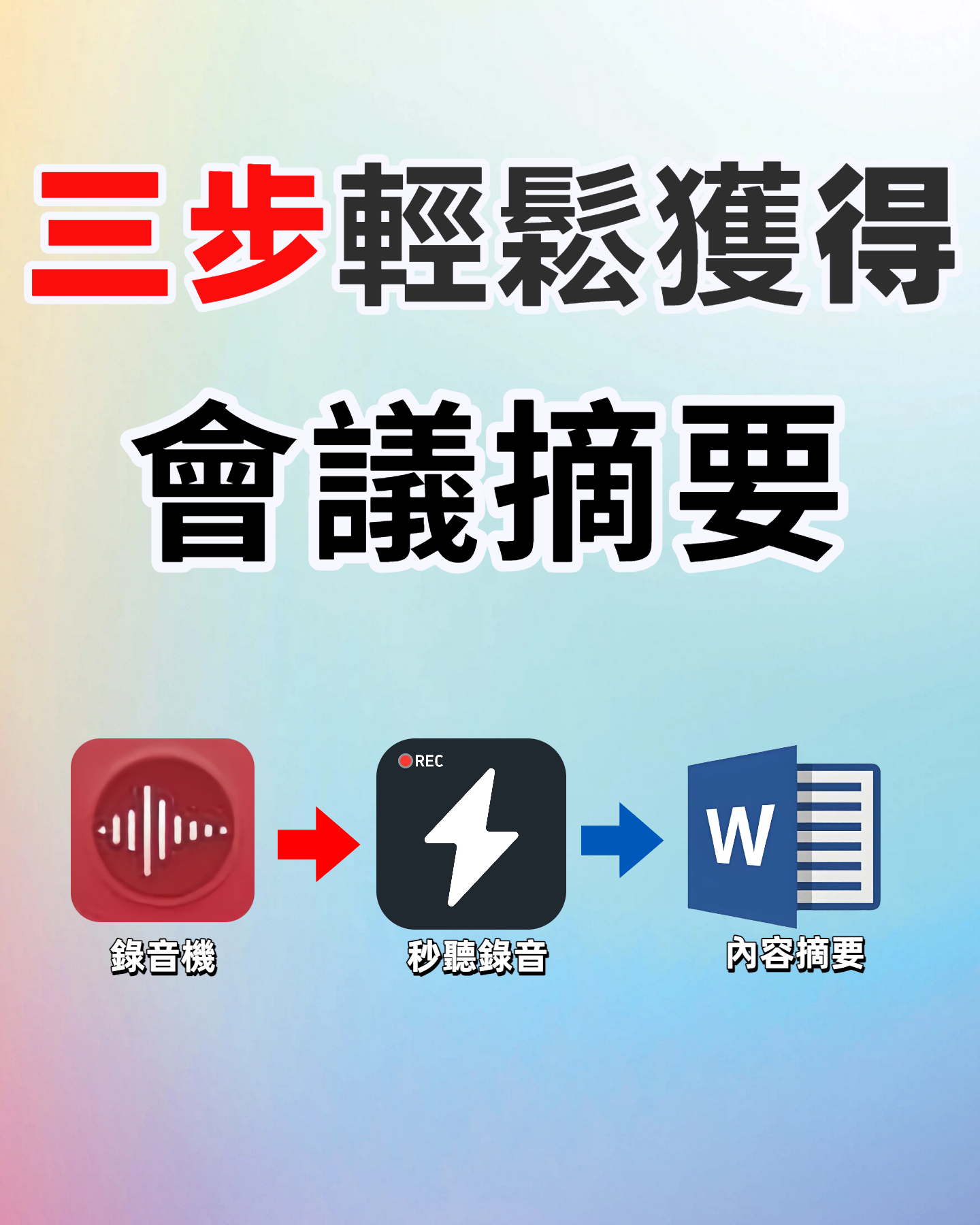
Tinrec's summary is more like a "presentation outline"—it automatically splits into sections, extracts key sentences, and even lists action items independently. In our test, from the end of recording to generating an outline ready for PPT, Tinrec saved about half the reorganization time.
→ This dimension: Tinrec wins; its summary is more directly helpful for producing PPTs.
Dimension 3|Action Item Extraction and Practicality
The "Next Steps" slide in a PPT usually requires digging out action items one by one from meeting notes.
Although Otter.ai has an Action Items feature, it often misses implicit assignment semantics (e.g., "Let Xiao Ming follow up on that") or misclassifies general discussion sentences as action items.
Stop organizing recordings by hand
Upload audio or video and automatically get a transcript, summary, and action items
Tinrec's action item extraction is much more accurate. It not only captures "who does what" but also automatically links to the original conversation timestamps, allowing you to quickly listen back for confirmation. This is very useful for executive presentations that need supporting recording clips.
→ This dimension: Tinrec clearly wins; its action item hit rate and usability are a level higher.
Dimension 4|Export Formats and Post-Processing Flexibility
Otter.ai can export to TXT, PDF, DOCX, SRT, etc., and supports integration with Slack, Dropbox, etc. However, to get content into a PPT layout, multiple conversions are still needed.
Tinrec supports common text and document exports, but more importantly, it can directly sync organized content to productivity tools like Notion and Google Docs, and even further process it via an Agent to generate reports or tables. For users who prefer to draft PPT text in a document editor first, this workflow is smoother.
→ This dimension: Tinrec wins slightly; its export ecosystem is closer to the document-to-presentation workflow.
Dimension 5|Price Friendliness for Chinese Users
Otter.ai's free plan offers 300 minutes per month, basic enough for light use. But to unlock more imports or team features, Pro is about US$8.33/month (annual only), and Business is US$19.99/month. For individuals or small teams primarily handling English meetings, this price is reasonable. But for mostly Chinese content, you have to consider whether it's worth paying higher costs for marginal accuracy.
Tinrec's free plan includes basic transcription credits, allowing you to try real-time recording and online video analysis. For project crunches or exam weeks, a weekly card can be a quick fix. If you have meetings or lectures to organize every week, the Pro monthly or annual plan is more cost-effective. For users focused on Chinese content, Tinrec offers better overall value.
→ This dimension: Tinrec ties (if your primary language is English, Otter has advantages; but for Chinese users, Tinrec is more worthwhile).
What Unique Advantages Does Each Have?
Tinrec's Unique Advantages
- Chinese content organization: Whether meetings, lectures, interviews, or online videos, Chinese recognition and summary usability are noticeably better.
- Direct production of presentation material: Sections, key points, and action items are already separated; just paste into PPT and start working.
- More diverse input sources: Besides real-time recording, it also accepts audio files, video files, and even YouTube links for automatic organization.
- High post-processing flexibility: Syncs to Notion, Google Docs, and can even ask AI to continue generating reports or tables.
Otter.ai's Unique Advantages
- Top-notch native English meeting experience: Automatically joins Zoom, Google Meet; suitable for global teams.
- Mature speaker identification: In pure English environments, accurately distinguishes different speakers.
Summary: Which One Should You Choose?
- If you need to quickly turn Chinese meetings, lectures, or interviews into a PPT outline → Tinrec (summaries and action items are directly usable, lower error rate)
- If you prefer to highlight key points during discussion and then use AI Q&A to extract material → Tinrec (AI dialogue query is your portable assistant)
- If you want sync between phone and computer, organize anytime anywhere → Tinrec (iOS, Android, web fully supported)
- If your team communicates entirely in English and heavily uses Otter's meeting bot feature → Otter.ai is still a good fit
One sentence summary: For most people who need to turn Chinese audio/video content into presentation material, Tinrec is the more complete choice. We recommend starting with the free version and testing it with your own recordings.
Frequently Asked Questions
Q: Can Tinrec automatically generate PPT files? A: Tinrec currently cannot export .pptx files directly, but it can produce structured summaries, section highlights, and action item lists. Copying these into PowerPoint or Google Slides for formatting is much faster than organizing from scratch.
Q: Is Otter.ai's Chinese transcription really that bad? A: It's not bad; it's just that its strength in English cannot be fully replicated in Chinese. If most of your meetings are in Chinese, Tinrec will be smoother. If mixed Chinese-English is frequent, try both.
Q: Is the free version sufficient? A: Tinrec's free version provides basic transcription credits, suitable for occasional recording organization. If you have intensive meetings or courses, consider the weekly card or Pro plan for better value.
Q: Is uploading online video for transcription legal? A: The tool supports pasting public video links for content organization, but users must comply with each platform's terms of service and copyright regulations.
Q: Can transcription accuracy reach 100%? A: No AI tool can guarantee 100%; actual accuracy depends on recording quality, accents, background noise, etc. For important content, we recommend cross-checking with the original recording.
Turn every recording into actionable outcomes
Get 60 free transcription minutes when you sign in. No credit card required.
Related Reading
You might also like

Tutorial: AI Agent Structured Output in 2026 – Generate Meeting Minutes and To-Do Lists Automatically with Tinrec
Still manually compiling meeting notes and to-do lists? This article introduces AI Agent structured output, using Tinrec voice recording as an example to show you how to generate meeting minutes, action items, tables, and other deliverables with one click, saving you time.
2026 AI Meeting Assistant Comparison: Tinrec, Otter.ai, Fireflies.ai, Notta – Which Saves You the Most Effort?
The most time-consuming part of meetings isn't the meeting itself, but the post-meeting cleanup—organizing notes and extracting action items. This article tests four AI meeting efficiency tools: Tinrec, Otter.ai, Fireflies.ai, and Notta, comparing transcription accuracy, AI summaries, cross-platform support, and more. Find out which free version is sufficient and how to avoid common pitfalls when choosing.
A Complete Guide to AI Agent Step-by-Step Processing in 2026: Features, Use Cases, and Tool Selection
A curated list of 5 AI Agent tools to help you process recordings, videos, and meetings step by step—from transcription to summaries—with selection recommendations.
2026 Comparison of 3 AI Agent Recording Tools: Which One Turns Audio into Action Items?
It's not just about converting speech to text—it's about AI that helps you organize key points, to-dos, and even generate meeting minutes and reports. Esor tests three tools and shares why he chose Tinrec.

2026 Comparison of 3 AI Smart Transcription Tools: Meeting Recordings & Online Videos Converted to Actionable Lists
A mid-level manager tests Otter.ai, Notta, and Tinrec—three AI transcription tools—from meeting minutes and online video transcription to AI chat queries. Find out which is best for busy professionals.
2026 Review of 3 AI Voice-to-Excel Tools: Which One Auto-Generates Meeting Data Tables?
Need to turn meeting recordings into Excel reports? We tested Tinrec, Notta, and Otter.ai to see which truly saves time by directly producing structured data.

Which AI Agent Auto-Delivery Tool is Best? 2026 Hands-On Review of 3 Top Picks: Tinrec Generates Reports in One Click
A senior college student tests 3 AI tools to automatically turn recordings, meetings, and online videos into organized reports and to-do lists, saving all-nighters.

2026 Comparison of 3 AI Agent Document Generation Tools: From Recording to Document in One Click
Tired of spending hours transcribing meeting recordings, lectures, or interviews? AI Agent document generation technology can automatically turn audio into meeting minutes, reports, to-do lists, and more. Tinrec's Agent post-processing feature lets you generate documents in various formats on demand. This article compares three mainstream solutions to help you choose the most time-saving option.
2026 Free AI Meeting Notes Solutions: 4 Tools Compared at a Glance
Spending too much time on meeting minutes? This article tests 4 free AI meeting note tools—comparing transcription accuracy, AI summaries, and cross-platform support—to help you find the best free option and make meetings painless.