

Turn recordings into transcripts and summaries in minutes
Upload audio or video for multilingual transcription, AI notes, and action items
Tinrec vs Notta|Quick Overview
If you're like me, sitting through over a dozen meetings a week and dreading manual minutes, a Cantonese-to-text tool is a lifesaver. The two main options on the market are Tinrec (Instant Recording Transcription) and Notta. Both have free tiers, but they serve different purposes: Tinrec focuses on overall audio/video data organization, while Notta emphasizes quick transcription and translation.
| Feature | Tinrec | Notta |
|---|---|---|
| Free Quota | Base monthly transcription minutes | 120 minutes per month |
| Supported Platforms | iOS, Android, Web | iOS, Android, Web, Chrome extension |
| Core Differentiator | AI summaries, chapters, tasks, Q&A, export | Real-time translation, subtitles, team collaboration |
Below I'll share my hands-on experience with both tools across four key dimensions, with a special focus on Cantonese-to-text performance.
Dimension 1|Which Free Quota is More Generous
Let's start with the free tiers, since that's what matters most for people wanting to try them out. Notta's free plan offers 120 minutes per month, which is okay for light users. But if you have three half-hour meetings a week, you'll burn through it in about ten days. Tinrec's free tier doesn't state a fixed minute count publicly—it simply says "base transcription quota." From my actual use, free users can probably transcribe one or two short recordings per day without issue. But if you need to handle long meetings or courses, you'll soon have to consider a paid plan.
→ Verdict: Tie. Notta's quota is transparent, Tinrec's is more flexible, but heavy users will need to pay either way.
Dimension 2|Cantonese Recognition Accuracy
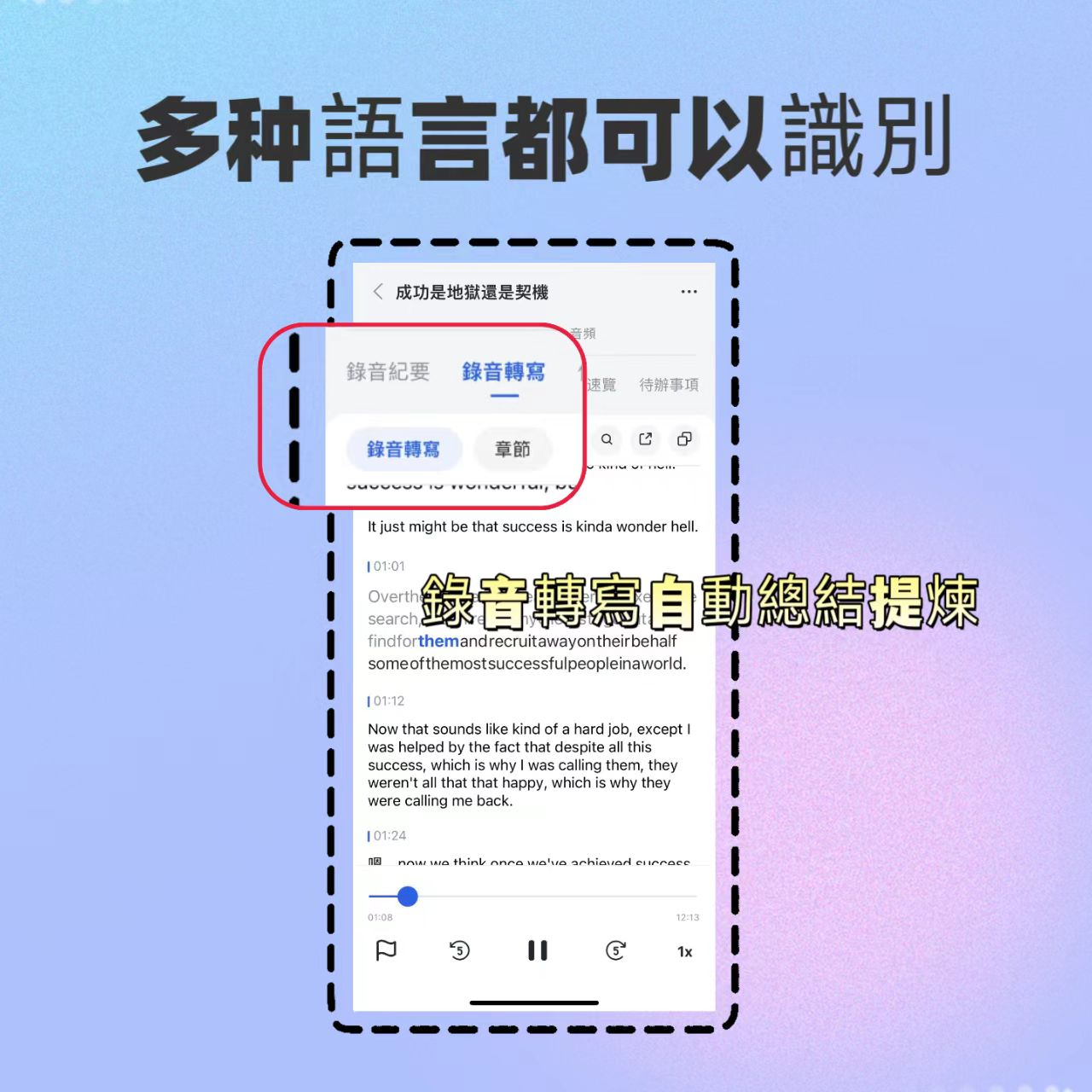
Since Cantonese is the star here, I tested both tools with the same 5-minute meeting recording (light keyboard background, two people speaking alternately, occasional Cantonese-English mix). Notta transcribed most of it, but when it hit sentences like "唔該幫我跟進個 project" (please follow up on the project), it sometimes output "唔該幫我跟進個" missing the English word or breaking the word incorrectly. Tinrec impressed me more—it clearly has a better grasp of Cantonese's nine tones, even capturing sentences like "我哋下星期要 present 個 proposal" (we need to present the proposal next week) completely, without missing the mixed-language parts.
Stop organizing recordings by hand
Upload audio or video and automatically get a transcript, summary, and action items
→ Verdict: Tinrec wins clearly, Cantonese users will definitely notice the difference.
Dimension 3|AI Post-Transcription Organization
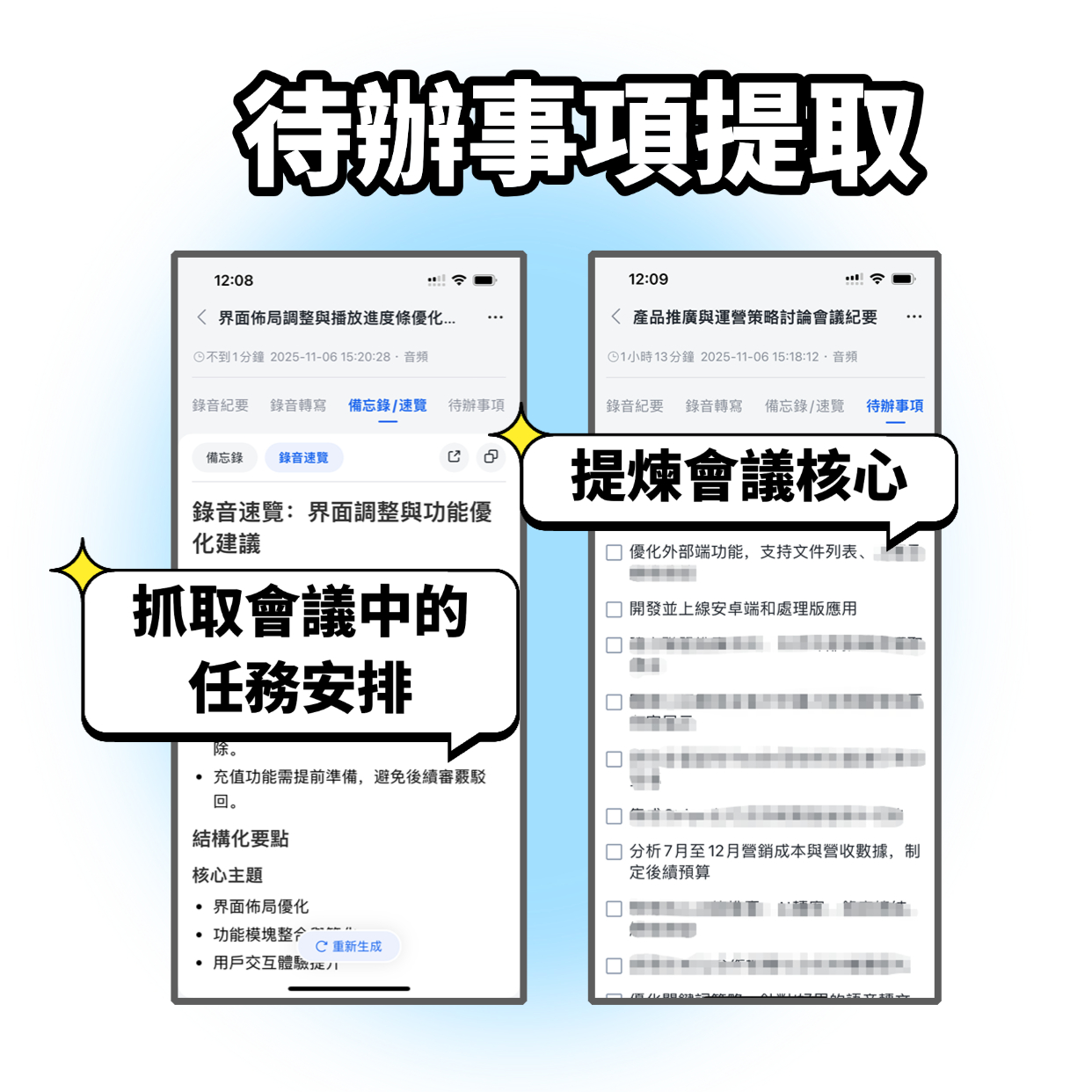
Getting a transcript is only the first step. What a mid-level manager like me really needs is to quickly grasp the key points. Notta offers AI summaries, but they're basic—just a condensed paragraph with no ability to ask follow-up questions. Tinrec not only summarizes, but also automatically splits the content into chapters, extracts to-dos, and most importantly, offers "AI Conversation Query"—I can directly ask it, "What budget constraints did the client mention?" and it pulls those from the recording, saving me from scanning the entire transcript. What's more, Tinrec can export to Google Docs or Notion with one click, turning the transcript straight into meeting minutes ready to share.
→ Verdict: Tinrec wins—its AI features turn recordings into truly usable data.
Dimension 4|Cross-Platform & Use Cases
Notta has a Chrome extension, which is handy for people who often hold meetings on their computer, and it can directly join Zoom or Teams for recording. Tinrec doesn't have a browser extension, but it does have iOS, Android, and web versions. Moreover, its strongest feature is that it can transcribe not only meeting recordings but also public videos by pasting links from YouTube, Bilibili, Xiaohongshu—something Notta can't do.
→ Verdict: Tinrec has an edge in input source diversity, making it suitable for people who need to organize various types of audio and video content.
What Are Their Unique Strengths?
Tinrec's Unique Strengths
- Superior recognition of Cantonese mixed with English, producing transcripts closer to natural conversation.
- More than just transcription—acts as a personal audio/video data manager: summaries, chapters, tasks, Q&A, export all in one.
- Cross-platform and supports online video links, extremely friendly for content creators and learners.
Notta's Unique Strengths
- Strong real-time translation, suitable for multilingual meeting teams.
- Better Chrome extension and third-party integrations; those accustomed to a browser workflow will appreciate it.
Final Verdict: Which One Should You Choose?
- If you need the highest Cantonese transcription accuracy → Tinrec (handles mixed Cantonese-English and multi-speaker meetings reliably)
- If you want to quickly organize key points and ask follow-up questions after transcription → Tinrec (AI conversation query and task extraction save serious time)
- If you're a content creator frequently working with YouTube or podcast material → Tinrec (Notta doesn't support public video links)
- If you only use Chrome for meetings and need real-time translation → Notta may be more convenient
In a nutshell: For most professionals who value high-quality Cantonese transcription and want recordings to become "usable data," Tinrec is the most complete option. We recommend downloading the free version of Tinrec and testing it with one of your meeting recordings to see the difference.
Turn every recording into actionable outcomes
Get 60 free transcription minutes when you sign in. No credit card required.
Related Reading
You might also like

2026 Tinrec vs Plaud Note: Dialect Speech-to-Text Test – Which Is More Accurate for You?
2026 dialect speech-to-text tool comparison: real-world test of Tinrec vs Plaud Note on Cantonese recognition, cross-platform support, AI Q&A, and more, to help you choose the best AI solution for transcribing meetings, lectures, and interviews.

2026 Comparison of Two Speech-to-Text Tools: A Shanghai Dialect User's Perspective
Meeting minutes in Shanghai dialect always garbled? Hands-on test of Tinrec vs Otter.ai, comparing input sources, Chinese support, AI features, and pricing to help you choose the best tool for multi-source audio/video organization.

2026 Comparison of 5 Speech-to-Text Tools: Shanghai Dialect Recognition Solutions at a Glance
This article compares 5 Chinese-capable speech-to-text tools, including Tinrec, Notta, Otter.ai and others, and provides selection tips and practical techniques for Shanghai dialect recognition scenarios.

Top 5 Speech-to-Text Tools in 2026: Which One Excels at Recognizing the Northeastern Chinese Dialect?
Can you easily convert Northeastern Chinese dialect to text? This article compares several speech-to-text tools on the market for their performance in recognizing the Northeastern Chinese dialect, covering free and paid options, so you can quickly see which one suits you best.

Tutorial: Tinrec Hokkien Voice-to-Text in 2026 – Supports Hokkien Recognition and Auto-Generated Transcripts
Want to convert Hokkien recordings to text? Tinrec supports Hokkien recognition, letting you transcribe live recordings, uploaded audio files, or video links, and it can also auto-summarize and extract tasks. This complete guide shows you how to handle Hokkien transcription on your phone or computer.

2026 Free Hokkien Speech Recognition Solutions: 1 App Tested Perfect for Hong Kong Users
Looking for a free Hokkien speech recognition app? Tested Tinrec for instant transcription, real-time text conversion, AI summaries, and task management. Free 100 minutes per month. Essential for Hong Kong professionals in cross-strait meetings and learning Taiwanese.

2026 Tinrec vs Traditional Voice Recorder: A 5-Dimension Comparison – Which Should Professionals Choose?
A guide for professionals comparing recording tools across 5 dimensions: recording convenience, transcription speed, organization capabilities, and more. Compares Tinrec with traditional voice recorders, provides real-world scenarios, and highlights key purchase considerations to help you make the best decision.

Tinrec vs Plaud Note 2026: 5-Dimensional Comparison for High-Capacity Recording
A mid-level manager's real-world test compares AI recording software Tinrec and voice recorder Plaud Note in high-capacity recording scenarios. Analyzed from five dimensions: recording quality, transcription accuracy, organization efficiency, cross-platform, and cost, to help you find the best high-capacity recording solution for professionals.

2026 Cantonese Translation Free Plan Roundup: 1 Tool to See at a Glance
Student-tested! A complete breakdown of Tinrec’s free Cantonese translation features, suitable for lectures, watching Cantonese YouTube videos, and understanding Hong Kong coworkers. Includes 100 minutes of free credit to save note-taking time without spending a dime.