

Turn recordings into transcripts and summaries in minutes
Upload audio or video for multilingual transcription, AI notes, and action items
Last semester I took a Hokkien literature class. The professor lectured entirely in Hokkien, and I hadn’t even mastered the pronunciation yet, so taking notes was impossible. Before the midterm, I stared at my sparse notes, cold sweat pouring—luckily, I later found a way to transcribe recordings. Here’s my experience for fellow students struggling like me.
Why You Need a Speech-to-Text Tool (Especially for Hokkien)
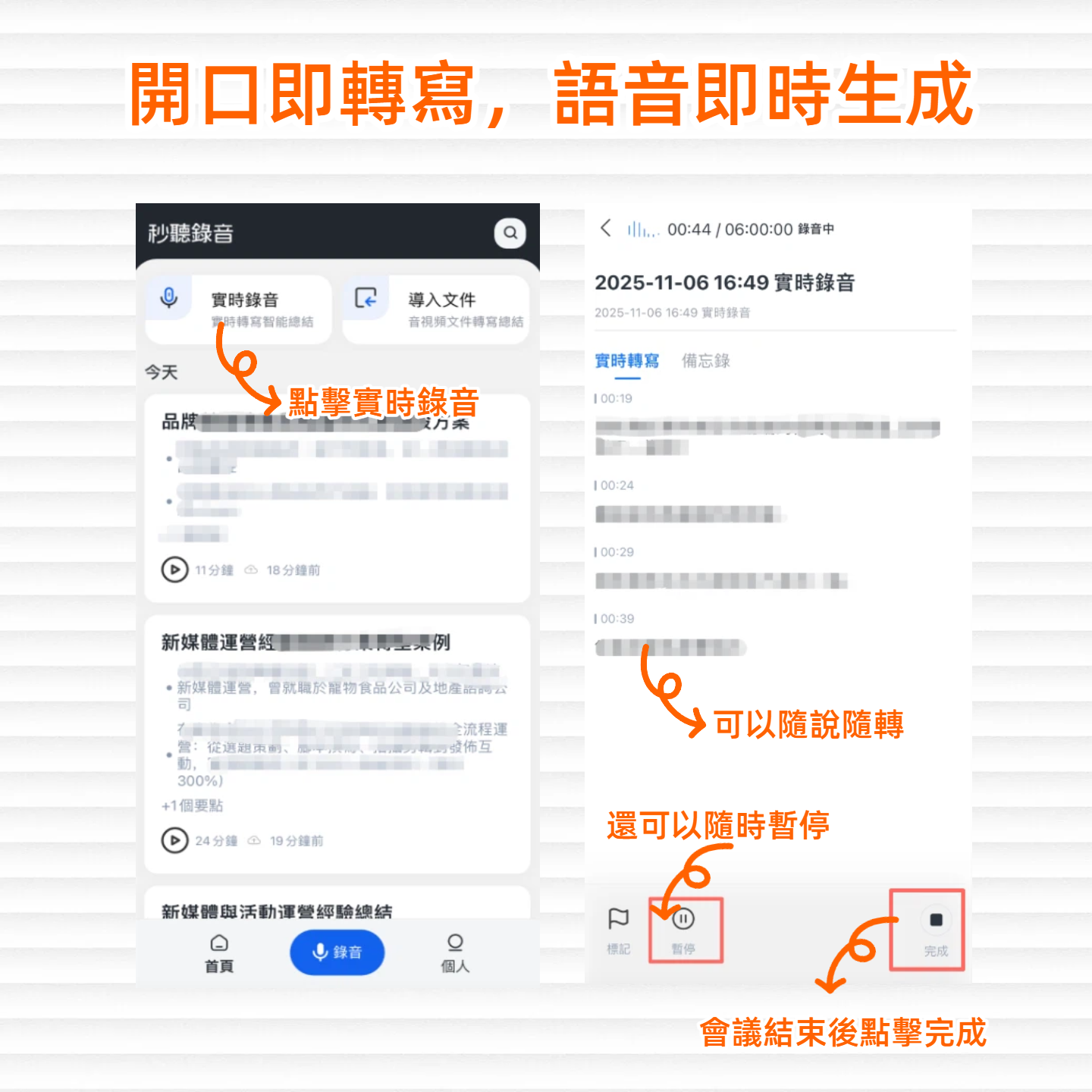
The biggest pain point in dialect courses is “can’t understand, let alone write it down.” Recording preserves the content, but listening to a 2-hour recording from start to finish is a time sink. Converting recordings to text lets you search for keywords, quickly compare with textbooks, and use AI summaries to highlight key points, doubling your review efficiency.
Option 1: Tinrec (Instant Recording) – AI Transcription That Even Handles Hokkien
This was my go-to tool last semester. In class, I’d just open Tinrec on my phone and record; it transcribes in real time. Although Hokkien has many tonal variations and Tinrec isn’t specifically optimized for it, in practice—as long as the classroom isn’t too noisy and the teacher speaks clearly—it captures about 70–80% of the content. The transcribed text is automatically divided into sections and generates an AI summary, so I can quickly see the lecture’s main points.
The killer feature is the “AI chat query”—during review, I just ask, “What are the Hokkien slang examples the professor mentioned?” and it pulls up relevant passages from the recordings, without having to scroll through the full transcript. Before finals, I used this to quickly scan every lecture’s highlights, saving a ton of time.
Price-wise, the free plan gives you basic transcription credits each month. I record two lectures a week (about 3 hours total), and it lasts about two weeks. If it runs out, you can buy a weekly card—costs about the same as a bubble tea and gets you through finals week. For long-term use, the Pro monthly plan works out to less than a bus fare per day, and it’s affordable for students.
Best for: Students taking dialect courses, organizing interview recordings, or building a personal recording library.
Stop organizing recordings by hand
Upload audio or video and automatically get a transcript, summary, and action items
Option 2: Built-in Voice Input on Your Phone – Free but Phrase-by-Phrase
If you only need to capture a few Hokkien words or short sentences, your phone keyboard’s voice input works. Open Notes, switch to voice input, ask the teacher to repeat, and it transcribes. But this method isn’t suitable for long recordings and won’t automatically organize highlights—only for emergencies.
Option 3: Free Online Speech Recognition Services – Fine Occasionally, But Risky
There are some free websites that transcribe uploaded audio. I tried a few, but most limit each session to 30 minutes or 1 hour, and the files stay on their servers. For private lecture recordings, that made me uneasy, so I only used them for public talks once or twice. If you don’t mind privacy and only need short clips, keep this as a backup.
Option 4: Manual Transcription – Most Accurate but Most Time-Consuming
The old-school method: transcribe the recording yourself or pay someone. Pros: accuracy near 100%, and you practice listening. Cons: a 1-hour recording can take 3 hours to transcribe—no time during midterms or finals. I only do this when I need a verbatim transcript for an assignment.
Option 5: Divide and Conquer with Classmates – Friendship Debt Is Hard to Repay
In group work, we split the recording among members. But someone always procrastinates, or the formats are inconsistent, and you end up redoing it yourself. Plus, owing classmates a favor means extra work on the next group project. It works in a pinch occasionally, but isn’t reliable long-term.
Which Option Should You Choose?
- Want to save the most time and manage all recordings long-term → Tinrec (AI summary + chat query + automatic sectioning, even for dialect courses)
- Only occasionally need a few Hokkien phrases → Built-in voice input (free, always available)
- Have existing recordings and want quick transcription without spending money → Free online services (watch for limits and privacy)
- Have time to spare or need 100% accurate transcripts → Manual transcription
- Have willing classmates with clear division of labor → Group collaboration (but remember to buy them bubble tea as thanks)
Most of the time, I just open Tinrec because it handles recording, transcription, organization, and review in one go. The time saved is better spent on other subjects or part-time work.
3 Things to Know Before Using Speech-to-Text Tools
- Recording quality determines transcription accuracy: Especially for tonal languages like Hokkien, background noise or distance can affect results. Sit in the front row or buy a cheap external mic—it makes a big difference.
- Always cross-check with textbooks: AI isn’t perfect, especially with different accents. Errors or missing phrases happen. Verify key concepts with your textbook or handouts to avoid misunderstandings.
- Free plans have limits—try before you buy: Tinrec’s free plan is enough to test full functionality. Try it on one or two lectures first to see if it fits your usage frequency before deciding on a paid plan.
Summary
With the right tools, dialect courses aren’t that scary. I went from being unable to take any notes to having neatly organized text and key summaries for every lecture—finals review was a breeze. If you’re struggling with Hokkien recordings, start with Tinrec’s free plan; it might just become your semester lifesaver.
Turn every recording into actionable outcomes
Get 60 free transcription minutes when you sign in. No credit card required.
Related Reading
You might also like
2026 Comparison of Two Voice-to-Text Apps: Which Is Better for Hokkien Translation?
Struggling with Hokkien translation? This article tests two popular voice-to-text apps, Tinrec and Notta, comparing them on Chinese recognition, multilingual support, and output organization. Find out which app's AI summaries, Q&A, and post-processing turn your Hokkien recordings into actionable content.

2026 Comparison of 4 Cantonese Translation Tools: Which Is Best for Cantonese to Text?
We tested 4 tools that support Cantonese, comparing accuracy, AI features, cross-platform support, and pricing. We recommend Tinrec as the best for Cantonese-to-text transcription, helping you quickly organize Cantonese meetings, lectures, and interviews.

Hakka Speech Recognition in 2026: Multi-Source Audio/Video Organization & AI Q&A
2026 Hakka speech recognition tool comparison: Tinrec vs Plaud Note. PK across input sources, post-transcription processing, cross-platform support, pricing, and dialect adaptability to help you choose the right tool.

2026 Hands-On Comparison of 4 Hakka Speech Recognition Tools: Which AI Saves You the Most Time for Transcribing Hakka Content?
Are you struggling to transcribe Hakka meeting recordings, elder oral histories, or community conversations? We tested several speech recognition apps, focusing on which one best understands Hakka, so you can wrap up your work faster without overtime.

2026 Comparison of 5 Speech-to-Text Tools: Which One Works Best for Shanghainese Recordings?
A hands-on comparison of 5 speech-to-text tools for processing Shanghainese recordings, including Tinrec, Notta, Otter.ai, and more. We analyze free plans, core features, and best-use scenarios to help you quickly pick the right one.

Tinrec vs Otter.ai 2026: 5-Dimension Comparison – Which Performs Better for Hakka Speech-to-Text?
Need to transcribe Hakka recordings? We compare Tinrec vs Otter.ai across 5 dimensions: Chinese recognition, AI features, cross-platform support, and more. Find out which tool suits Hong Kong users best.

2026 Complete Guide to Hokkien Translation: From Recording to Translation, All in One
How to choose a Hokkien translation tool? This article tests Tinrec and Notta, comparing speech recognition, translation accuracy, post-processing, and pricing to help you find the best Hokkien speech-to-text and translation solution.

Comparison of 2 Dongbei Dialect Speech-to-Text Tools in 2026: Which One Offers More Down-to-Earth Chinese Recognition?
We test Tinrec vs Otter.ai on Dongbei dialect recognition, AI organization features, and free plan limits to see which is better for transcribing Chinese audio with a Dongbei accent.

2026 Taiwanese Speech-to-Text App Showdown: Why Tinrec Outshines Yating
This article compares Tinrec and Yating, two Taiwanese speech-to-text tools, analyzing features, accuracy, use cases, and pricing to help you find the best assistant for meetings, classes, and interviews.