

Turn recordings into transcripts and summaries in minutes
Upload audio or video for multilingual transcription, AI notes, and action items
Why Do You Need a Speech-to-Text Tool?
In my freshman year, I took an Operating Systems class. The professor talked super fast and flipped through slides even faster. I tried taking handwritten notes, but when I opened my notebook before midterms, even an alien couldn't decipher my scribbles. Later, I started using a speech-to-text tool, and the entire lecture's key points were automatically organized. I never panicked for exams again.
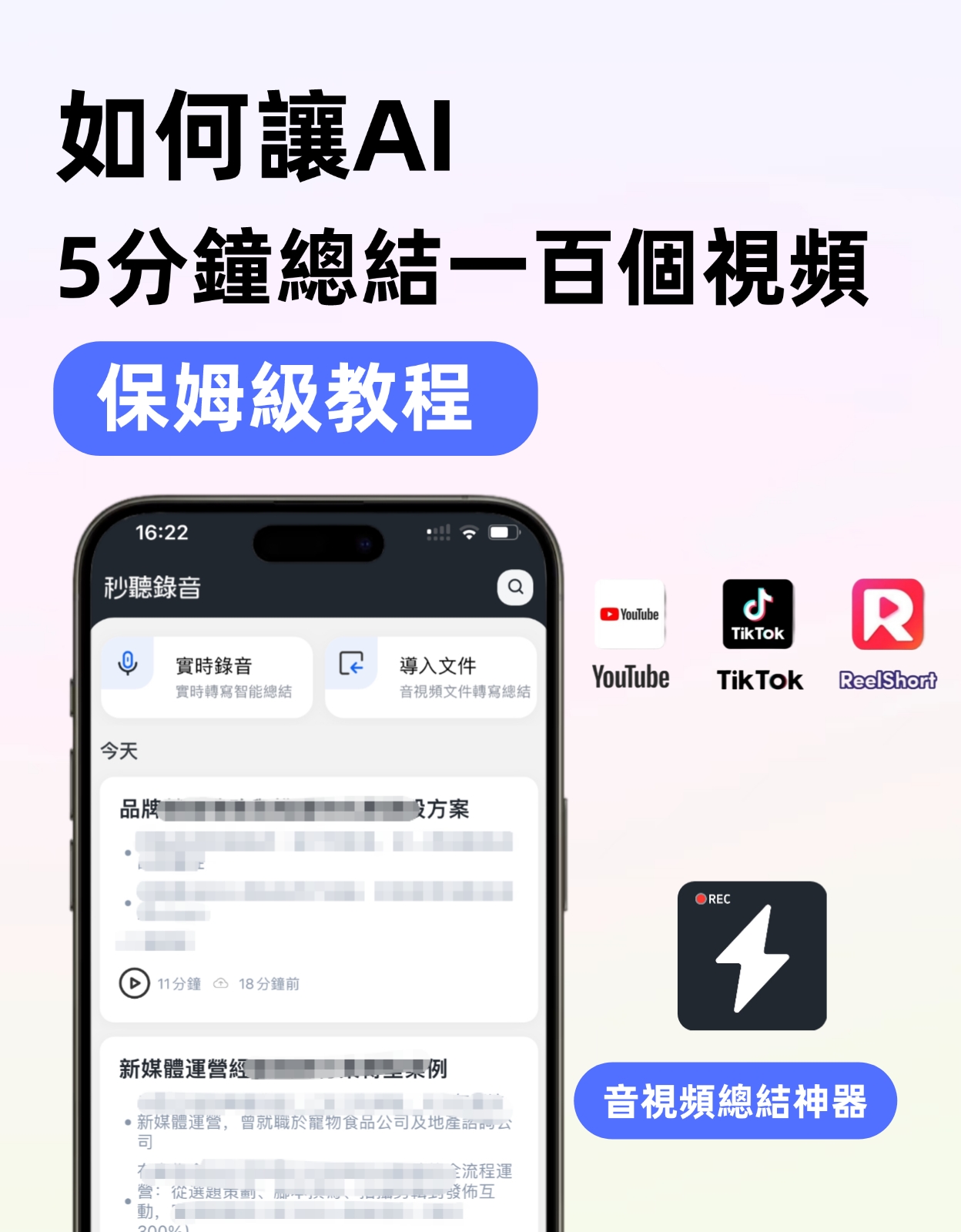
If you're a student who can't keep up with note-taking in class, nobody remembers the conclusions after group discussions, or you want to turn YouTube tutorial videos into organized notes, this guide will walk you through speech-to-text tools and recommend Tinrec, which I used for an entire semester.
What is Tinrec? More Than Just Speech-to-Text
Tinrec is an AI-powered audio and video organization tool. It doesn't just convert speech to text; it helps you turn meeting recordings, lecture audio, interviews, podcasts, YouTube videos, and more into searchable, summarizable, queryable, and exportable content.
For students, this means:
- Lecture recordings become notes automatically—no more manual transcribing.
- Group discussions generate meeting minutes and action items automatically.
- Paste a link to a YouTube tutorial and it summarizes the key points for you.
Tinrec's Core Features at a Glance
I used it for a whole semester, and these features were the most useful:
Real-Time Speech-to-Text
Open Tinrec, and the text appears while you're recording, with less than a second delay. In class, you can follow along with the text to make sure you didn't miss any key points, and the moment class ends, you already have a full transcript.
Audio/Video File to Text
For existing recordings or video files, just import them and they'll be converted to text. Before midterms, I dumped an entire semester's lecture recordings into Tinrec, and within half an hour everything was organized—I could even search for keywords to find specific sections.
Online Video to Text
This feature is basically designed for those of us who love learning from YouTube. Copy and paste the video link, and Tinrec turns it into a transcript, automatically generating a summary and chapters. I rely on this to quickly organize materials when writing reports.
AI Summary and Chapter Organization
For a two-hour lecture recording, Tinrec automatically splits it into chapters like "Chapter 1: Course Introduction" and "Chapter 2: Memory Management," and provides a summary. During finals review, just skim the summaries—your efficiency doubles.
Stop organizing recordings by hand
Upload audio or video and automatically get a transcript, summary, and action items
AI Conversation Query
This is my most-used feature. After a group discussion, just ask Tinrec: "What's the conclusion?" or "Who is responsible for what?" It gives you answers based on semantic understanding—no need to manually flip through 30 pages of transcript.
Action Item Extraction
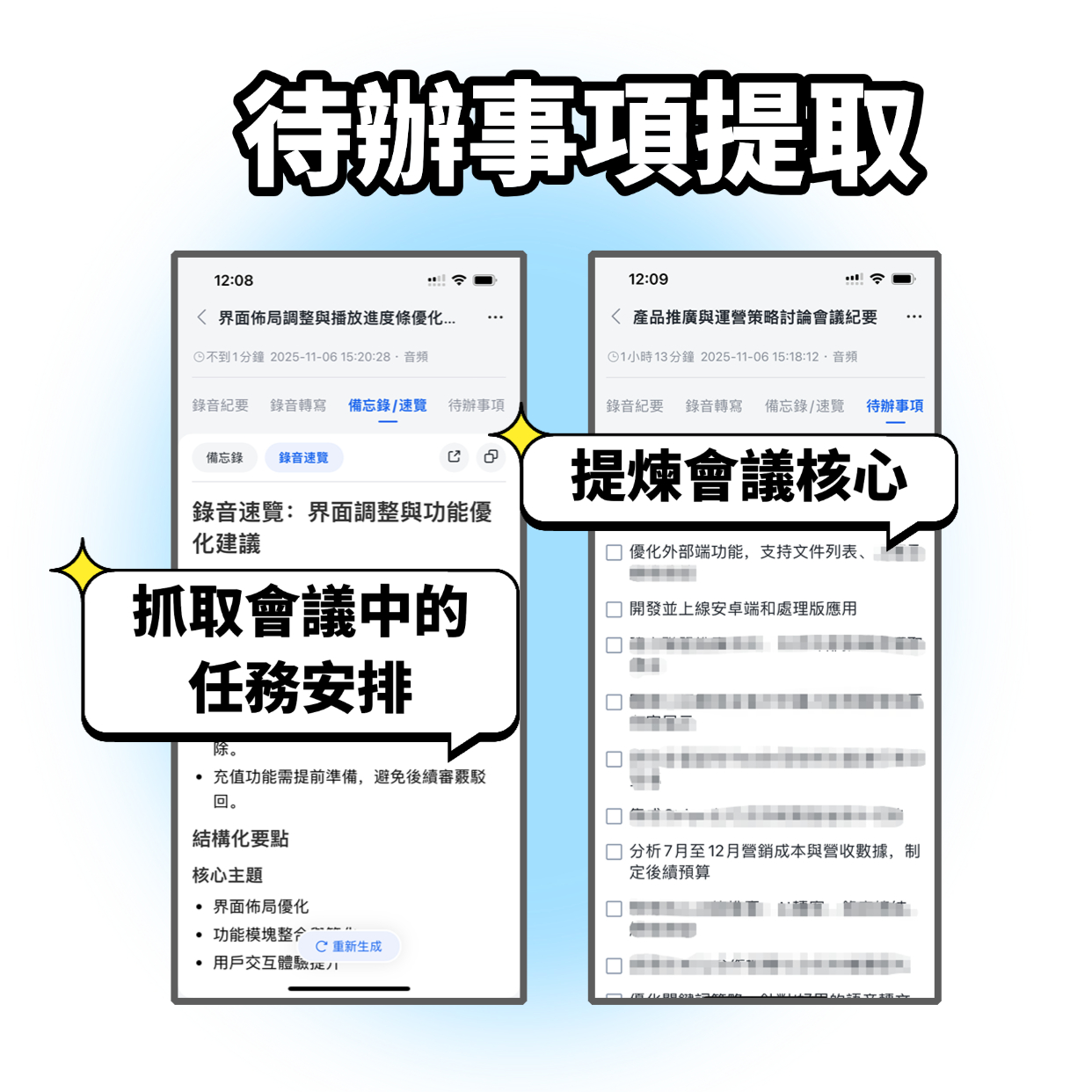
During meetings or discussions, Tinrec pulls out action items from the conversation like "submit by tomorrow" or "report next week" and organizes them into a to-do list. My classmates and I rely on this to track progress during group projects.
Multi-Format Export
Organized content can be exported as TXT, PDF, Word, or synced to Notion and Google Docs. I usually export my notes to Notion and refine them there, seamlessly integrating into my existing workflow.
Real Use Cases: A Student's Daily Life
Lecture Recording for Notes
Before, I'd try to handwrite notes in class but could never keep up with the professor's pace. Now I record with Tinrec, listen in class, and mark key points (Tinrec has a memo feature). After class, I use the AI summary to review—saving tons of time.
Group Discussions and Project Meetings
My department often has group presentations. After discussions, everyone talks at once and forgets the conclusions. Now I record with Tinrec and instantly share meeting minutes and action items in the group chat. My teammates call me an awesome teammate.
Watching YouTube Tutorials to Extract Key Points
When self-studying Python, I watched many foreign tutorial videos. I used to pause and take notes; now I just drop the link into Tinrec, which converts it into a text summary. I then review the highlights—my learning speed tripled.
Interview or Research Recording
For my senior capstone, I interviewed several industry professionals. Previously, transcribing would take days of painstaking work. Now, I import the audio file into Tinrec and get a draft in half an hour. Then I use the AI Q&A to quickly find key answers—even my advisor was impressed by the efficiency.
Key Considerations When Choosing a Speech-to-Text Tool
- Accuracy: Accuracy depends on recording quality, background noise, and accents. Tinrec performs well with clear audio, but I still recommend double-checking important content against the original.
- Free Tier: Budget is tight for students, so a decent free tier matters. Tinrec's free version offers a basic monthly transcription allowance (check the app for details). If you only record key lectures, it's sufficient; if you record every class, consider the Pro plan—it costs about the same as skipping two late-night snacks a month.
- Platform Support: Tinrec is available on iOS, Android, and web, so you can use it on your phone or computer. Cross-platform sync is convenient.
- Output Formats: Beyond just transcripts, features like summaries, action items, and export formats affect how easy it is to use the output. Tinrec does this really well.
- Language Support: Tinrec provides excellent support for Chinese and handles mixed Chinese-English content without issues—important for students in Taiwan.
Conclusion: Is Tinrec Worth Trying?
If you're like me and need to turn lecture recordings, group discussions, or online videos into well-organized notes, Tinrec is one of the few tools on the market that simultaneously handles transcription, organization, querying, and exporting. Especially for Chinese content recognition and post-processing, it's more grounded than many international tools.
I recommend downloading the free version and testing it with your own lecture recordings—it's more direct than reading any review. I've used it for an entire semester and have already convinced three classmates. They now rely on it for review notes during finals. If you want to make learning easier, give it a try.
(Note: The free tier allowance is as shown in the app; if there are changes, please refer to the official information.)
Turn every recording into actionable outcomes
Get 60 free transcription minutes when you sign in. No credit card required.
Related Reading
You might also like

2026 Comparison of Two Speech-to-Text Apps: Tinrec vs Notta – Which One Understands Your Chinese Meetings Better?
If you're looking for an alternative to Notta, Tinrec might be a better choice for Chinese users. This article fully compares Tinrec and Notta from core experience, features, use cases to buying tips, helping you make the best purchase decision.
Best Multilingual Meeting Transcription Tool? 2026 Test of Two: Tinrec Suits Hong Kong Workers Best
We tested two multilingual meeting transcription solutions: Tinrec and Plaud Note. See which one helps you finish work earlier!

2026 Free Korean Speech-to-Text Solutions Roundup: 5 Tools at a Glance
2026 Free Korean Speech-to-Text Solutions Roundup: A curated selection of 5 tools, with a step-by-step guide using feature-rich Tinrec to convert Korean audio and video into transcripts, including recording, transcription, proofreading, and export.
Free Minority Language Speech-to-Text Plans in 2026: A Look at 2 Options
An in-depth comparison of Tinrec and Notta's free plans: Minority language users looking for a free transcription tool? We compare them across 5 dimensions—input sources, AI processing, Cantonese accuracy, free tier value, and cross-platform experience—to tell you which one is worth trying.

How to Use Tinrec for English Meeting Notes: Real-Time Transcription & AI Summarization (2026)
Struggling with English meetings? Tinrec not only transcribes in real time but also generates AI summaries, extracts action items, and handles mixed Chinese-English speech. This comprehensive guide shows you how to use Tinrec for English meeting minutes, with a comparison to Otter, Notta, and more, so you can choose the best tool.

2026 Free Speech-to-Text Solutions: 2 Tools Compared
A mid-level manager puts two popular free speech-to-text tools—Tinrec and Otter.ai—to the test, comparing Chinese accuracy, free tiers, AI features, and cross-platform support to help you pick the best one for workplace productivity.

2026 Tinrec Voice-to-Text Tutorial: No Hardware Needed, AI Organizes from Multiple Sources
How to choose voice-to-text software? This article compares Tinrec and Plaud Note, from hardware requirements, input sources, AI features to pricing, and tells you why you don't need to buy a voice recorder — your phone can handle meetings, lectures, and online video transcription.

2026 Hands-On Comparison of 5 Cross-Border Meeting Note Apps: Which AI Summary Saves the Most Time?
Dealing with cross-border meetings daily, mixing English, Mandarin, and Cantonese? Still transcribing recordings after meetings? We test 5 transcription apps to see which one can quickly organize multilingual meetings, saving you time and overtime.
2026 Free Chinese-English Real-Time Translation Solutions: 3 Tools Compared
A must-read for professionals: hands-on testing of Chinese-English real-time translation tools. From cross-border meetings to self-study, Tinrec not only translates in real time but also transcribes audio and generates AI summaries, truly solving the pain points of middle managers.