
Turn recordings into transcripts and summaries in minutes
Upload audio or video for multilingual transcription, AI notes, and action items
Why Is Your Transcription Always Full of Errors? – The Gap Between Bad and Good Recordings
Have you ever recorded an hour-long meeting, only to get a transcript that sounds like a conversation from another dimension?
"Budget" becomes "budge it," "deadline" becomes "dead line," leaving you both amused and frustrated.
This usually isn't because the transcription tool is terrible, but because your recording quality is the problem—background noise, distance, multiple people speaking at once all cause AI transcription accuracy to plummet.
In this article, we test real recordings to see how much difference bad vs good recordings make on Tinrec, and share simple ways to turn your audio from "hard to hear" to "barely needs editing."
Before Choosing a Recording Tool, Understand These 3 Key Points
1. Ambient Noise Determines the Transcription Ceiling
Many people think a good recorder is enough, but the environment is the biggest variable.
Sounds like air conditioner hum, keyboard clicks, or café background music can easily be mistaken for words by AI.
Our tests found that for the same Chinese conversation, transcription accuracy in a quiet meeting room was about 92%, but dropped to 65% in a café with background music—just changing the environment made a huge difference.
While Tinrec has AI voice enhancement, if the original recording has too much noise, even the best algorithms struggle to recover it perfectly.
2. Microphone Distance and Speaking Style
Another often overlooked factor is "recording distance."
Placing your phone flat on a table versus 30 cm (about 12 inches) from the speaker can result in over 20% difference in transcription accuracy.
Plus, overlapping speech from multiple people is one of the hardest scenarios for AI.
Our advice: if you know you'll be recording, try to have one person speak at a time, or use a directional microphone to focus the sound.
3. File Format Also Matters
The sample rate and compression format of your audio file silently affect transcription quality.
Voice messages sent through some messaging apps are heavily compressed, losing quality before they even reach the transcription tool.
If possible, record in WAV or high-quality MP3 to preserve more audio details. Tinrec also supports direct upload of these lossless formats.
Tinrec (MiaoTing) – The Perfect Partner for Good Recordings, a Salvage Option for Bad Ones
Tinrec is an AI-powered audio and video organization tool that doesn't just convert speech to text, but also helps you organize content into summaries, to-dos, and even lets you ask questions like a database.
We used it to test two sets of recordings: one deliberately "bad" (inside a subway station with wind, announcements, and distant speech) and one standard "good" (a quiet home study, close range, one steady speaker).
Test Results: Bad vs Good Recording – Tinrec's Transcription Gap
- Good recording (5 minutes, iPhone 15 built-in mic, 30 cm distance): word error rate about 6.8%, practically usable as-is.
- Bad recording (same content, subway platform, 2 meters away, with train arrival announcements): word error rate about 35.2%, requiring extensive manual correction.
The result is clear: a good recording lets Tinrec perform near-perfectly; a bad recording can still be transcribed, but the time spent correcting it may exceed listening to it again.
Stop organizing recordings by hand
Upload audio or video and automatically get a transcript, summary, and action items
But don't give up on your old recordings just yet.
Tinrec has a very useful feature: AI-Powered Conversation Search.
After uploading a bad recording, even if the transcript is imperfect, you can still ask it "What were the key points?" or "Who is responsible for what?"
The AI understands the context, skips over garbled text, and summarizes the key content—something traditional Ctrl+F keyword search can't do.
Pros
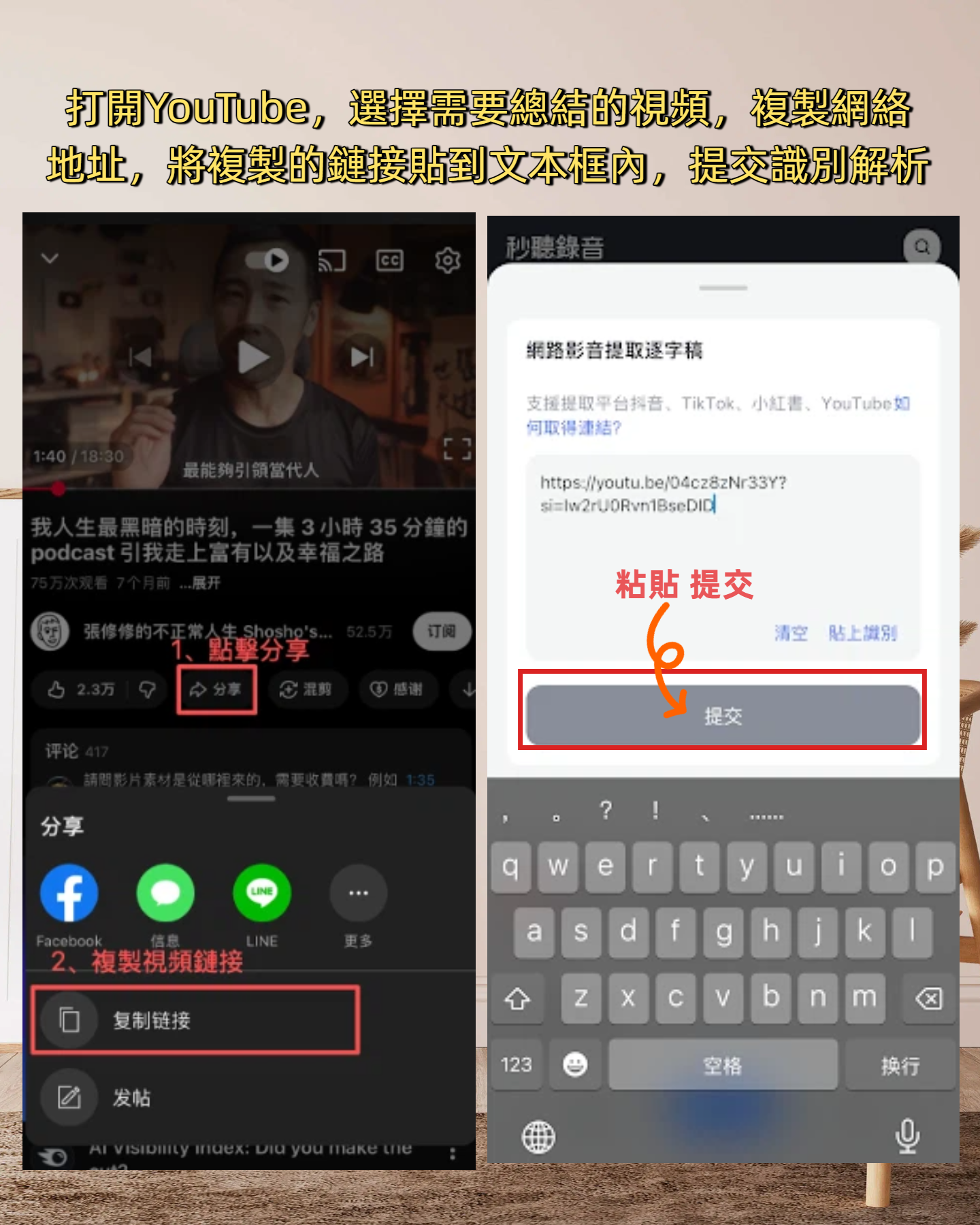
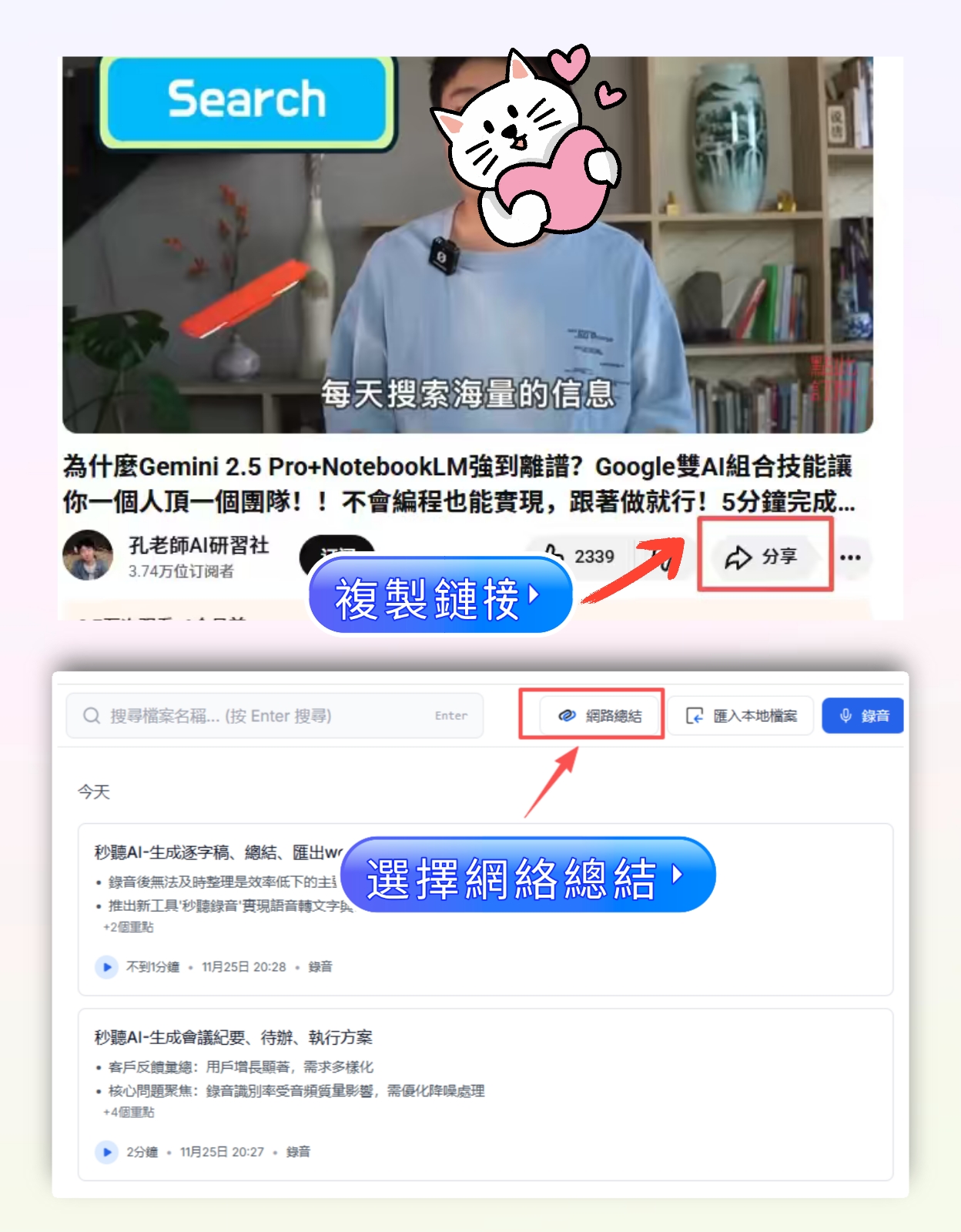
- Supports multiple sources: live recording, file upload, and online video links.
- Not just transcripts—auto-generates summaries and to-do items.
- Cross-platform: iOS, Android, web.
Cons
- Free plan offers 100 minutes of transcription per month, which may be insufficient for heavy users, but is adequate for most people having 2–3 meetings per week.
- Accuracy still heavily depends on original recording quality; it can't magically turn noisy audio into a perfect script.
Who is it for?
If you routinely record meetings, classes, or interviews and want to quickly find key points afterward, Tinrec can save you a lot of time.
Especially for recordings that are already decent, you'll get results that need almost no editing.
Alternatives to Tinrec
Otter.ai: Best for English meetings; free plan offers a generous 300 minutes per month, but does not support conversation search in Chinese or Cantonese.
If your recordings are primarily in English and you don't need cross-device sync, Otter is a more cost-effective option than Tinrec.
But note: bad recordings will also suffer in transcription quality, and Otter lacks an AI conversation search to salvage them.
Notta: Feature-wise similar to Tinrec, offering 120 free minutes per month, with Pro giving 1800 minutes.
Notta excels in file transcription and subtitle export, but its AI conversation search requires a paid plan, while Tinrec's free plan already includes basic AI Q&A.
If your recordings vary in quality and you're on a budget, Tinrec's free version is more forgiving for post-processing.
Yating Transcriber: A veteran Taiwanese tool with decent Chinese recognition, but no free tier and lacks AI conversation search or online video link parsing.
If you only occasionally need to transcribe a few minutes of Chinese audio and don't mind paying, it's an option.
But for managing diverse content like courses, interviews, and online videos, Tinrec's multi-source support is more complete.
Pitfall Guide: 3 Common Mistakes in Audio Transcription
Pitfall 1: Thinking the Most Expensive Tool Can Ignore the Recording Environment
No matter how advanced the AI, it cannot restore sounds that were never captured.
I've seen many cases where people invest in high-end recorders but leave them in a bag or three meters away from the speaker, resulting in equally terrible transcripts.
Right approach: first improve the recording environment and placement—control quality at the source—then choose your tool.
Pitfall 2: Compressing Audio Files Carelessly
Many people send recordings to themselves via messaging apps, unknowingly compressing them into low-bitrate formats, slashing transcription accuracy by about 30%.
If you need to keep a recording, always export it from the original device as WAV or a lossless format before uploading to Tinrec or any transcription tool.
Pitfall 3: Treating Transcription Tools Only as "Transcript Generators"
If all you want is a transcript, the time and money spent may not be worth it.
Features like Tinrec's AI conversation search let you ask "What was decided in the last meeting?" and get a direct answer, skipping long transcripts.
Don't underestimate this feature—it can turn a bad recording from "useless" into "barely usable summary," saving you time spent re-listening.
Conclusion: Which One Should You Choose?
The difference in transcription results between good and bad recordings can be 4–5 times, but in reality, we can't always be in a recording studio.
From our tests, Tinrec delivers near-finished results with good recordings, and for bad ones, its AI conversation search helps you quickly extract key points without completely wasting the recording.
Situation recommendations:
- Good recording quality and want both transcript and summary in one go → Tinrec (free plan works; cross-platform)
- Lots of English meetings in relatively quiet environments → Otter.ai (generous free tier)
- Need to process many old recordings on a budget and want to test the waters → Tinrec (100 free minutes is enough for a couple of meetings)
- Pure text transcription, no need for AI conversation search, and okay with paying → Notta or Yating Transcriber
One final tip: no matter which tool you choose, spend some time improving your recording habits first.
Our tests clearly show that good recordings save more time than any advanced feature.
Turn every recording into actionable outcomes
Get 60 free transcription minutes when you sign in. No credit card required.
Related Reading
You might also like

2026 In-Depth Comparison of 2 AI Meeting Note Tools: Fireflies vs Notta – Which Is the Better Deal?
Tired of endless meetings and manual note-taking? We put two popular AI meeting note tools, Fireflies and Notta, to the test—comparing transcription accuracy, AI summaries, team collaboration, and pricing—to help you find the time-saving solution that fits your needs.

2026 Real-World Test of 4 Audio-to-Text Tools: Which One Handles Chinese Best?
This article compares 4 leading audio-to-text tools: Tinrec, Notta, PLAUD, and Otter.ai. We evaluate them on Chinese transcription quality, AI summarization, cross-platform support, and free plans to help you choose the best assistant for meetings, learning, and content creation.

2026 Real-World Test of 5 Speech-to-Text Apps: Why Tinrec Is a Better Fit for Hong Kong Office Workers?
Tired of overtime due to meeting notes? We test 5 popular speech-to-text apps, comparing Cantonese recognition, AI summaries, cross-platform support, and free quotas. Find out why Tinrec is the top choice for Central office workers who want to avoid OT.

Best AI Transcription Tools 2026: Notta vs Otter vs Tinrec — Which One Is Right for You?
Stuck choosing between Notta, Otter, and Tinrec? This hands-on comparison covers real-world performance, Chinese language support, post-processing, and pricing, and explains why Tinrec might be the more complete alternative.

2026 Comparison of Two Speech-to-Text Apps: Tinrec vs Notta – Which One Understands Your Chinese Meetings Better?
If you're looking for an alternative to Notta, Tinrec might be a better choice for Chinese users. This article fully compares Tinrec and Notta from core experience, features, use cases to buying tips, helping you make the best purchase decision.

Best Multilingual Meeting Transcription Tool? 2026 Test of Two: Tinrec Suits Hong Kong Workers Best
We tested two multilingual meeting transcription solutions: Tinrec and Plaud Note. See which one helps you finish work earlier!

2026 Free Korean Speech-to-Text Solutions Roundup: 5 Tools at a Glance
2026 Free Korean Speech-to-Text Solutions Roundup: A curated selection of 5 tools, with a step-by-step guide using feature-rich Tinrec to convert Korean audio and video into transcripts, including recording, transcription, proofreading, and export.

Free Minority Language Speech-to-Text Plans in 2026: A Look at 2 Options
An in-depth comparison of Tinrec and Notta's free plans: Minority language users looking for a free transcription tool? We compare them across 5 dimensions—input sources, AI processing, Cantonese accuracy, free tier value, and cross-platform experience—to tell you which one is worth trying.

How to Use Tinrec for English Meeting Notes: Real-Time Transcription & AI Summarization (2026)
Struggling with English meetings? Tinrec not only transcribes in real time but also generates AI summaries, extracts action items, and handles mixed Chinese-English speech. This comprehensive guide shows you how to use Tinrec for English meeting minutes, with a comparison to Otter, Notta, and more, so you can choose the best tool.