
Turn recordings into transcripts and summaries in minutes
Upload audio or video for multilingual transcription, AI notes, and action items
Are you still re-listening to hours of meeting recordings, lecture notes, or interviews at 0.5x speed, manually typing transcripts? This is not only inefficient but also prone to missing important information due to mental fatigue. Common pain points include: insufficient free quotas, low Chinese recognition accuracy, inability to distinguish speakers, or messy, unstructured text after transcription.
This article takes an in-depth look at 7 popular speech-to-text tools in 2026, comparing them across dimensions such as accuracy, free quotas, and key features (e.g., AI summaries and subtitle export). Whether you're a creator needing video subtitles or a professional needing quick meeting minutes, you'll find your answer here.
Quick navigation suggestions:
- If you need an all-in-one solution for recording, transcription, and AI summaries: Start with Tinrec.
- If you focus on video editing and subtitle creation: MyEdit or PowerDirector are top choices.
- If you need mixed Taiwanese and Mandarin recognition: Yating Transcript performs well.
Review of 7 Top Speech-to-Text Tools in 2026
1. Tinrec — All-in-One AI Recording Note Assistant
Tinrec is not just a transcription tool; it emphasizes a complete workflow from recording to action. Beyond high-accuracy transcription, it solves the problem of traditional transcripts being overwhelming and hard to read by automatically generating meeting summaries and action items using AI.
- Supported Languages: 10 languages including Chinese, English, Japanese, Korean, German, Taiwanese Hokkien, Cantonese, and more.
- Free Trial: Free version offers 100 minutes of transcription per month.
- Key Features:
- Multi-device sync: Supports iOS, Android, and web, with real-time data synchronization.
- AI analysis: Automatically identifies speakers and generates summaries and to-do lists.
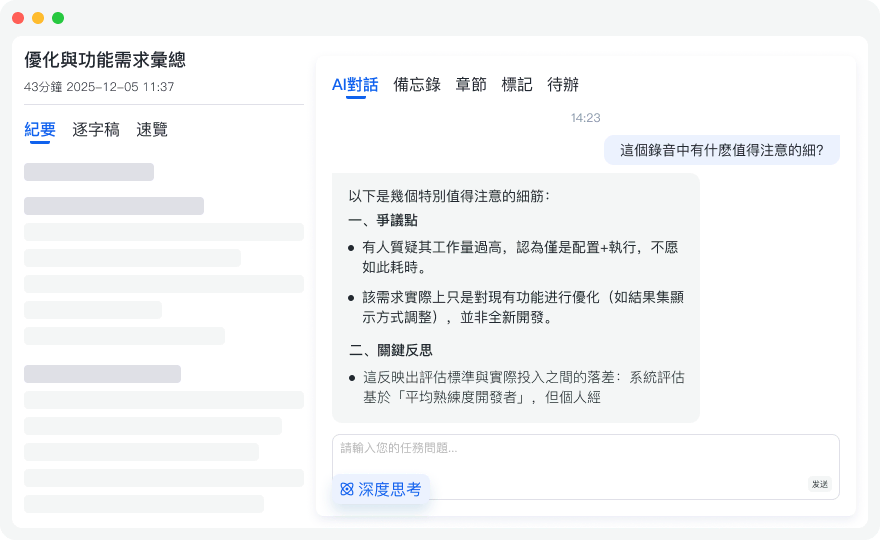
- Conversational queries: Ask AI questions about the recording content (e.g., "What was the budget decision mentioned in the meeting?").
- Multiple input sources: Supports live recording, audio file upload, and YouTube/Podcast link parsing.
- Use Cases: International meetings, classroom learning, podcast content organization.
2. MyEdit — Lightweight Online Audio Editor and Transcriber
MyEdit is a no-install online tool known for its intuitive interface. It combines audio editing and transcription, ideal for users who need to quickly trim audio and convert it to text.
- Supported Languages: 9 languages including Chinese, English, Japanese, Korean, and more.
- Free Trial: 3 minutes per day (membership-based).
- Key Features: Intuitive interface, supports editing transcriptions with timestamps. Includes noise reduction to optimize audio quality before transcription.
- Drawbacks: Cannot distinguish speakers, and daily free time is limited.
3. PowerDirector — Auto-Subtitle Tool for Video Creators
If you need speech-to-text for video subtitles, PowerDirector is a mature choice. It integrates speech recognition directly into its video editing software.
- Supported Languages: 10 languages including Chinese, English, Japanese, Korean, and more.
- Free Trial: 3 minutes per day (via a credit system).
- Key Features: Automatically converts speech to subtitle tracks, supports exporting SRT/TXT. Offers rich subtitle style customization.
- Drawbacks: Requires software download and is primarily designed for video editing workflows.
4. Yating Transcript — Top Choice for Taiwanese Localization
Developed by a Taiwanese team, it excels at recognizing Taiwanese accents, mixed Chinese and English, and Taiwanese Hokkien.
- Supported Languages: Chinese, English, Taiwanese Hokkien.
- Free Trial: New accounts get 300 minutes (must be used within one month).
- Key Features: Supports Mandarin and Taiwanese Hokkien recognition, ideal for local interviews or Taiwanese drama content. Provides a basic summary feature.
- Drawbacks: Slow processing speed (1 minute audio can take about 10 minutes to process), and requires payment after free quota expires.
5. cSubtitle — Focused on Short Video Subtitle Generation
cSubtitle is a simple online tool specialized in video subtitle generation, supporting multiple subtitle format exports.
Stop organizing recordings by hand
Upload audio or video and automatically get a transcript, summary, and action items
- Supported Languages: Chinese, English, Cantonese, and more.
- Free Trial: First 3 minutes of each audio/video are free.
- Key Features: Exports to .srt, .vtt, .docx, and other formats. Allows online preview and editing after transcription.
- Drawbacks: Free version has strict limitations, and no auto-segmentation for long recordings.
6. Good Tape — Journalists' and Media Professionals' Favorite
Originating from Denmark, this tool is designed for journalists handling large volumes of interviews, offering support for over 90 languages.
- Supported Languages: Over 90 languages.
- Free Trial: 3 audio files per month.
- Key Features: Minimalist interface focused on transcription accuracy. Auto-segmentation.
- Drawbacks: Free version has queue times (may need to wait over an hour), and Chinese punctuation support is weak.
7. GitMind — Mind Map Integrated Tool
This tool uniquely combines speech-to-text with mind mapping, suitable for users who need brainstorming or structured organization.
- Supported Languages: Chinese, English.
- Free Trial: 10 minutes of audio per day.
- Key Features: Generates a mind map alongside transcription to visualize content.
- Drawbacks: Interface may be overly complex if you only need plain transcripts.
Speech-to-Text Tool Comparison Table
For a quick overview, here is a comparison table:
| Dimension | Tinrec | MyEdit | Yating Transcript | Good Tape | PowerDirector |
|---|---|---|---|---|---|
| Free Quota | 100 min/month | 3 min/day | 300 min (first month) | 3 files/month | 3 min/day |
| Platform | iOS/Android/Web | Web | Web/App | Web | PC/Mac/App |
| AI Summary/Actions | Yes (summaries + to-do) | No | Basic summary only | No | No |
| Speaker Diarization | Yes | No | No | Yes | No |
| Processing Speed | Fast (real-time/async) | Fast | Slow | Slow (queue for free) | Fast |
| Primary Strength | Meeting minutes & study notes | Short audio editing | Taiwanese Hokkien recognition | Multilingual interviews | Video subtitle creation |
Practical Guide: 4 Steps to Convert Audio to Text with AI Tools
Once you've chosen a tool, here's how to apply it in real workflows. We use Tinrec as an example due to its comprehensive features, but the logic applies to most advanced tools.
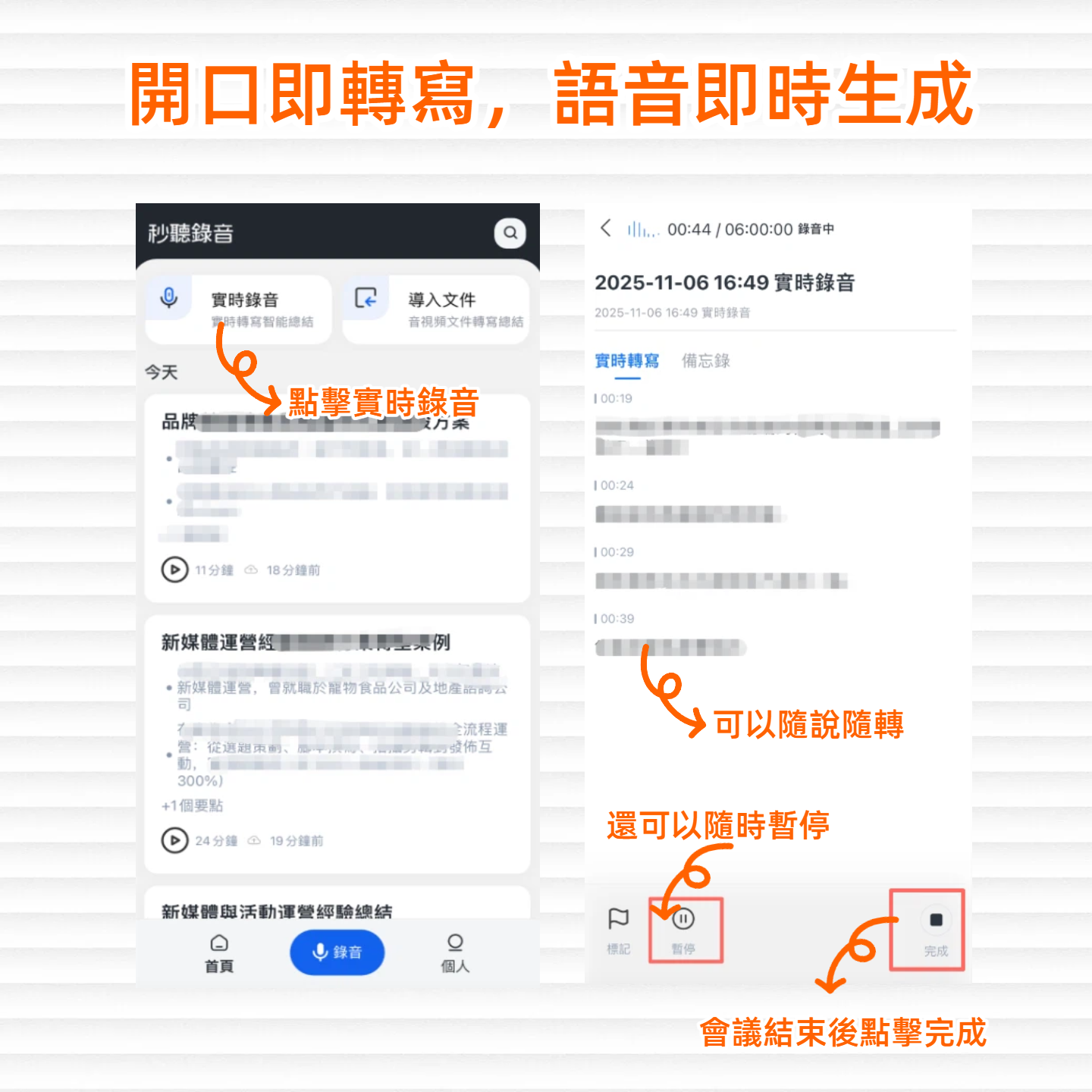
Step 1: Choose Input Method (Recording, File, or Link)
Most scenarios fall into "live meetings" or "post-event processing."
- Live Meeting: Open the app or web version, tap "Real-time Recording to Text", and the system displays text on screen as you record—great for marking key points during class or meetings.
- Existing File: If you have a recording file, select "Audio File to Text" and upload.
- Online Content: To transcribe a YouTube video or podcast, use "Podcast/Online Video to Text" and paste the link.

Step 2: AI Automatic Transcription and Speaker Diarization
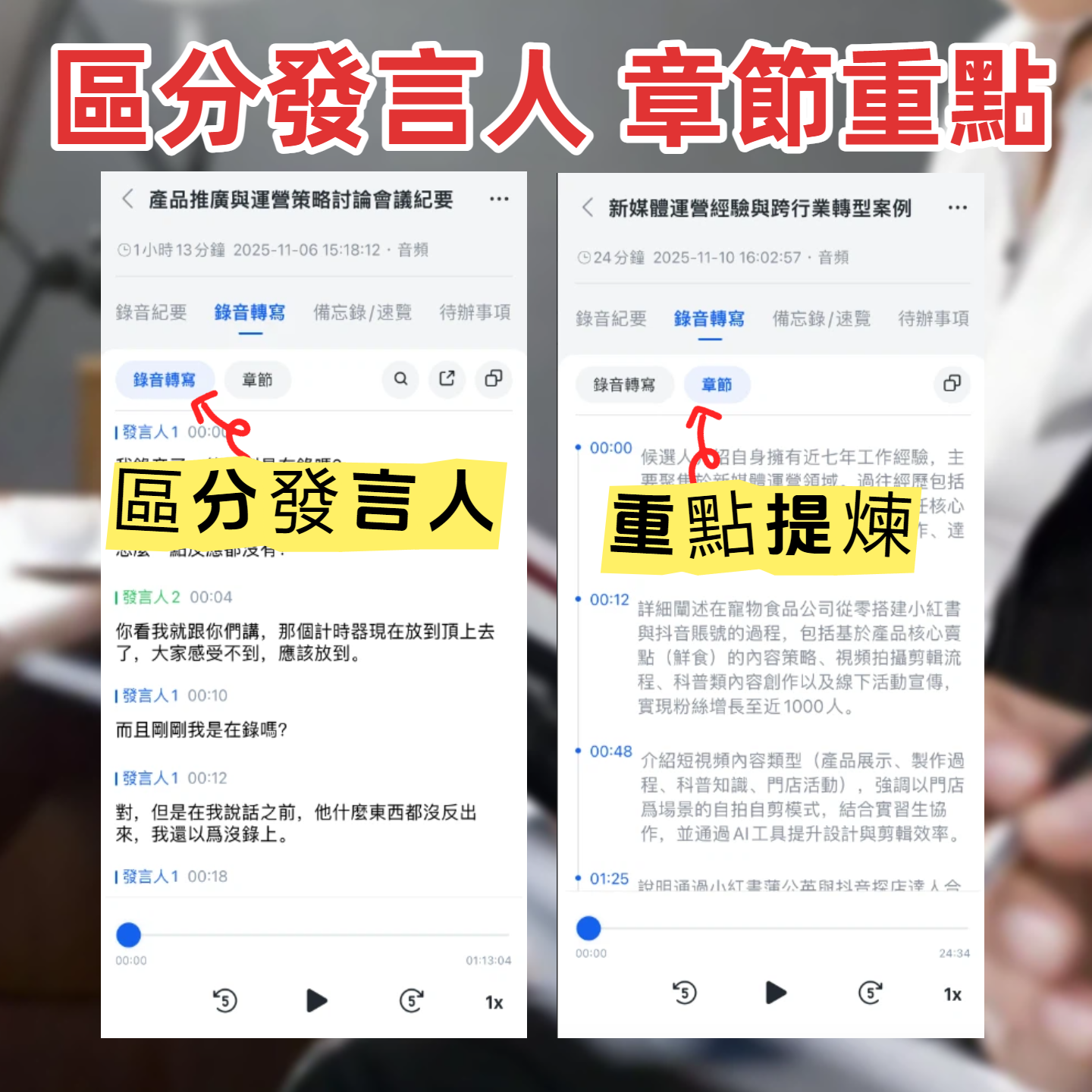
After uploading or recording, the system processes in the cloud. Advanced tools like Tinrec automatically identify speakers (e.g., Speaker A, Speaker B), which is crucial for reviewing meeting discussions.
Step 3: Get Smart Summaries and Action Items
Traditional tools stop after transcription, but AI tools add value through understanding. On the results page, you can view AI-generated:
- Full summary: Quickly grasp the core content of a 1-hour recording.
- Action items: Automatically extracted tasks stating who needs to do what by when.
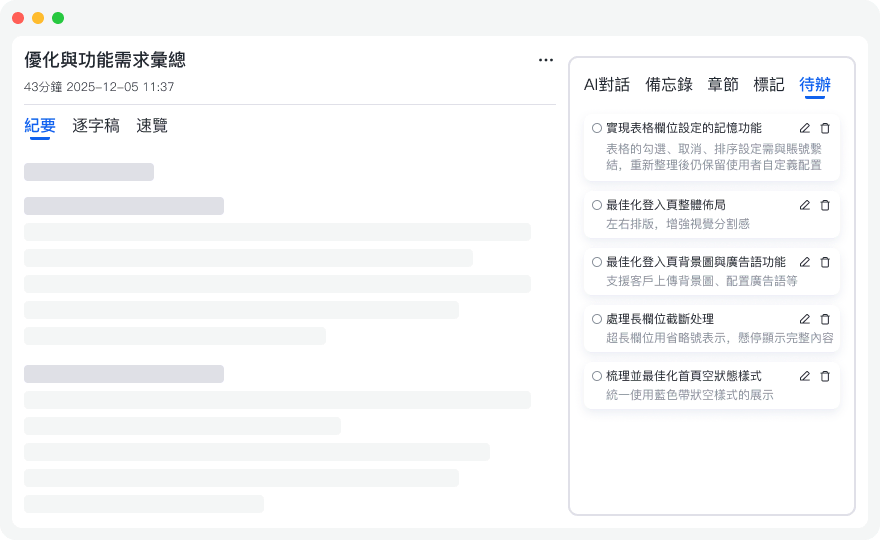
Step 4: AI Chat Query and Export
If you forget a detail, no need to reread the entire transcript. Use the "AI Chat Query" feature and type, "What was the conclusion about the marketing budget?" The AI answers based on the recording. Finally, export as Word, TXT, or PDF.
Frequently Asked Questions (FAQ)
Q1: Which free speech-to-text tool is best in 2026?
If you prioritize meeting notes and content organization, Tinrec is recommended because its free version offers 100 minutes per month with AI summaries. For short recordings under 3 minutes, MyEdit is a good no-registration option.
Q2: How to convert iPhone voice memos to text?
iPhone users have two options:
- Built-in: iOS 18+ Voice Memos supports basic transcription on certain models.
- Professional tool: Use Tinrec App to record directly, or share voice memos to Tinrec for detailed speaker diarization and AI summaries.
Q3: Can these tools handle Teams or Google Meet meetings?
Yes. Use the desktop version (e.g., Tinrec web) to enable "Live Recording" during the meeting (ensure the mic captures speaker audio, or use a virtual audio cable). Alternatively, download the meeting recording (MP4/MP3) and use the import feature.
Q4: What is the typical accuracy of audio-to-text conversion?
Current AI tools (e.g., Tinrec, MyEdit, Yating) achieve Chinese recognition accuracy of 95% or higher in clear environments. Accuracy may be affected by background noise, overlapping speech, and specialized terminology. Keep the recording device close to the speaker for best results.
Q5: Can I transcribe video to text?
Yes. PowerDirector and MyEdit support video uploads and SRT subtitle export; Tinrec goes further by accepting YouTube links to generate transcripts and summaries directly.
Q6: What are the limitations of free versions?
Most free tools have time limits (e.g., MyEdit: 3 min/day, Good Tape: queue times). Tinrec offers a generous 100 minutes per month for light users; Yating Transcript provides 300 minutes for the first month, then paid. Choose based on your usage frequency.
Turn every recording into actionable outcomes
Get 60 free transcription minutes when you sign in. No credit card required.
Related Reading
You might also like

4 Meeting Transcription Tools Tested for 2026: From Notta to Tinrec, Which Saves More Time on Post-Client-Visit Follow-Up?
The follow-up begins the moment a client visit ends. This article starts with the three most common pitfalls of post-meeting follow-up, explains why pure transcription tools often fall short, and uses Tinrec as the main focus to compare meeting transcription tools on summaries, action items, AI Q&A, export, and team knowledge retention, with team plan pricing and an FAQ included.

Best Free Team Meeting Knowledge Base Tools in 2026: 5 Options Compared
A team meeting knowledge base isn't just about taking notes during a meeting—it's about being able to find, search, and build on that information three months later. Drawing from real student group experience, this article compares 5 common approaches, explains how Tinrec can help, and breaks down the free tiers and paid thresholds that students care about most.

4 Requirements Interview Tools Tested in 2026: How to Quickly Turn User Interviews into Requirements Documents
User interviews are the first step in creating a requirements document, but interview recordings, transcripts, and requirements organization often take time. This article uses Tinrec as an example to explain how to use an AI meeting notes tool to quickly turn interview content into transcripts, summaries, action items, and requirements documents, and it compiles 5 purchasing considerations and common questions.

6 Best Client Visit Note-Taking Tools in 2026: Which Saves the Most Time on Recording, Notes, and Follow-Up Emails?
After a client visit, organizing notes and writing follow-up emails often takes the most time. This article reviews 6 meeting note-taking tools for client visits, covering live recording, transcripts, AI summaries, action item extraction, post-meeting documents, and follow-up email material. It compares free vs. paid plans, Chinese language support, and team collaboration features to help you find the best fit for your workflow.

5 Meeting Action Plan Templates Tested and Compared for 2026: Which One Actually Tracks To-Dos to Completion?
The key to a meeting action plan template isn't how good it looks—it's whether to-dos are fully captured and tracked to completion. This article compares five templates in real-world tests: 1:1, project weekly, client call, stand-up, and manager review. It explains how Tinrec turns discussions into action lists with owners and due dates using live transcription, AI summaries, action item extraction, and AI Q&A, plus five buying considerations and FAQs.

Best AI Meeting Assistants for Business in 2026: 5 Solutions Compared, AI Note-Taking and Integration Are the Deciding Factors
How to choose an AI meeting assistant for your business in 2026? This article compares 5 common solutions—Google Workspace, Microsoft Teams, Virsical, Manus, and hardware integrators—across 5 dimensions: automated meeting notes, multilingual support, room booking, hardware integration, and security management. It also includes a must-ask checklist before purchase to help you find the best fit for your team.

4 Post-Meeting Deliverable Templates Tested and Compared in 2026: Which Saves the Most Time from Transcript to To-Do List?
The biggest fear after a meeting isn't missing a recording—it's that no one remembers who promised what. This article covers the 3 most common mistakes in post-meeting deliverables, the fields a practical template should have, and demonstrates how Tinrec automatically goes from transcript to summary, to-dos, and team knowledge retention, plus purchasing considerations and FAQs.

2026 AI Meeting Assistant Comparison: 4 Tools Tested — How Meeting Agents Differ from AI Assistants
What's the difference between a meeting agent and an AI meeting assistant? Starting from real meeting scenarios, this article breaks down 4 key buying factors and compares Tinrec, Otter.ai, Granola, and Notta on recording methods, post-meeting output, Chinese language support, and team collaboration — plus 3 common pitfalls to avoid when choosing a tool.

2026 Post-Meeting Deliverables Tools Free Plans Compared: 4 Options at a Glance
Compare the free plans of post-meeting deliverables tools including Tinrec, Notta, Otter, and Granola, with a focus on how Tinrec turns meeting content into actionable deliverables through bot-free recording, AI summaries, action item extraction, and team spaces.