
Turn recordings into transcripts and summaries in minutes
Upload audio or video for multilingual transcription, AI notes, and action items
Faced with a two-hour meeting recording or classroom audio, do you ever feel helpless, spending several times the length just to replay and pause to capture a few key points? This is a common pain point for many administrative staff, students, and content creators. With AI technology maturing, today's tools not only "listen and transcribe" but also help you "understand" the content.
This article will highlight four noteworthy voice-to-text tools in 2026, offering a comprehensive comparison in terms of Chinese recognition accuracy, real-time recording support, and AI summary features.
Quick Navigation Recommendations:
- For simple file conversion with short audio: Go with MyEdit (online, no installation needed).
- For Taiwanese or localized interviews: Choose Yating Transcript.
- For academic research or large data integration: Use NotebookLM.
- For an all-in-one workflow of live recording + meeting minutes + action items: Consider Tinrec.
Why You Need Modern AI Voice-to-Text Tools
Traditional manual transcription takes about five minutes of work per minute of audio, and errors increase with waning concentration. Modern AI tools not only drastically cut transcription time (typically processing one hour of audio in minutes), but also solve the following problems:
- Difficult information retrieval: Audio files can't be keyword-searched like text.
- Lack of structure: Raw dialogue is unstructured, requiring time to extract key points.
- Cross-platform limitations: Some tools don't support mobile live recording, breaking the workflow.
Detailed Review of 4 Selected Voice-to-Text Tools in 2026
1. MyEdit: Lightweight Online Audio Editing Platform
MyEdit is a no-install online tool ideal for occasional users who don't want to download software. It supports 9 languages including Chinese, English, and Japanese, with an intuitive interface.
- Core Features: Supports uploading WAV, MP3, M4A files; transcribes text can be edited online and exported as .txt or .srt subtitle files. Includes noise and wind reduction to improve accuracy.
- Best For: Short video subtitles, occasional short audio transcription.
- Limitations & Pricing: Free daily limit of 3 minutes per day—suitable for very light use; advanced features require a subscription.
2. Yating Transcript: Best for Taiwanese Localized Language
Developed by a Taiwanese team, Yating Transcript excels at recognizing "Taiwanese Mandarin" and "Taiwanese Hokkien", making it ideal for local interviews or conversations with older generations.
- Core Features: Supports Chinese, English, and Taiwanese Hokkien recognition. Can upload audio/video files or paste YouTube links. Also supports live recording. Includes a "Key Summary" feature to extract core points from lengthy content.
- Best For: Taiwanese Hokkien interviews, local meetings, professional transcriptionists.
- Limitations & Pricing: New accounts get 300 minutes free (must be used within one month); subsequent usage is pay-per-minute.
3. NotebookLM: Google's AI Research Assistant
NotebookLM is an advanced data organization tool. It goes beyond transcription, excelling at "understanding and synthesizing" information.
- Core Features: Supports importing audio files, PDFs, web links; automatically generates summaries. Users can "chat" with their data by asking questions, and it can even generate a podcast-style summary with two AI hosts.
- Best For: Academic research, thesis organization, large-scale data analysis.
- Limitations & Pricing: Free and paid plans; the free version has limits on the number of notebooks and data sources.

4. Tinrec: From Recording to Action—a Productivity Assistant
Unlike the tools above, Tinrec was designed to solve the "workflow" problem. It emphasizes that recording isn't just for archiving, but for subsequent "use" and "action", particularly strengthening post-meeting automated organization.
Stop organizing recordings by hand
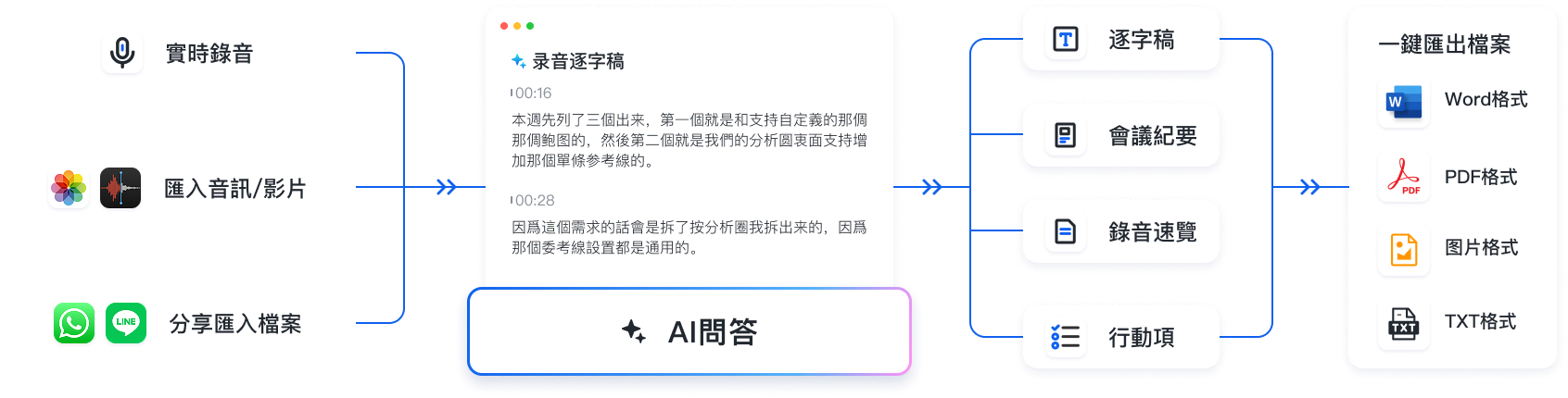
Upload audio or video and automatically get a transcript, summary, and action items
- Core Features: Supports iOS, Android, and web with multi-platform sync. Beyond basic live transcription and file upload, its strongest features include automatic generation of "meeting minutes" and "action items", as well as AI chat-based querying that lets you "ask" your recordings.
- Best For: International meetings (supports 10 languages), classroom notes, business discussions requiring output.
- Limitations & Pricing: Free tier offers 100 minutes of recording per month; Basic and Pro plans offer higher limits and advanced features.
Comprehensive Tool Comparison Table
To help readers quickly choose, here is a comparison of key dimensions across these four tools:
| Comparison Dimension | MyEdit | Yating Transcript | NotebookLM | Tinrec |
|---|---|---|---|---|
| Core Function | Audio editing & subtitles | Localized speech recognition | Research & database integration | Meeting minutes & action management |
| Language Support | 9 languages (incl. Chinese, English, Japanese, Korean) | Chinese, English, Taiwanese Hokkien | 80+ languages | 10 languages (incl. Cantonese, German, etc.) |
| Real-time Recording | Not supported (upload only) | Supported | Supported (via import) | Supported (mobile/web real-time transcription) |
| AI Summary / Action Items | None | Summary available | Powerful summary & Q&A | Auto-generates summaries, conclusions, to-do lists |
| Special Features | Noise reduction, audio enhancement | Taiwanese Hokkien recognition, punctuation correction | AI podcast generation, source citation | AI chat query, multi-device sync, video link parsing |
| Free Tier | 3 minutes per day | First month 300 minutes (one-time) | Free version has notebook limits | 100 minutes per month (recurring) |
Practical Guide: How to Turn Audio into Actionable Notes with AI Tools
Once you've chosen the right tool, how do you use it for maximum benefit? Using Tinrec's workflow as an example, here's a standard operating procedure (SOP) for efficient "audio-to-note" processing:
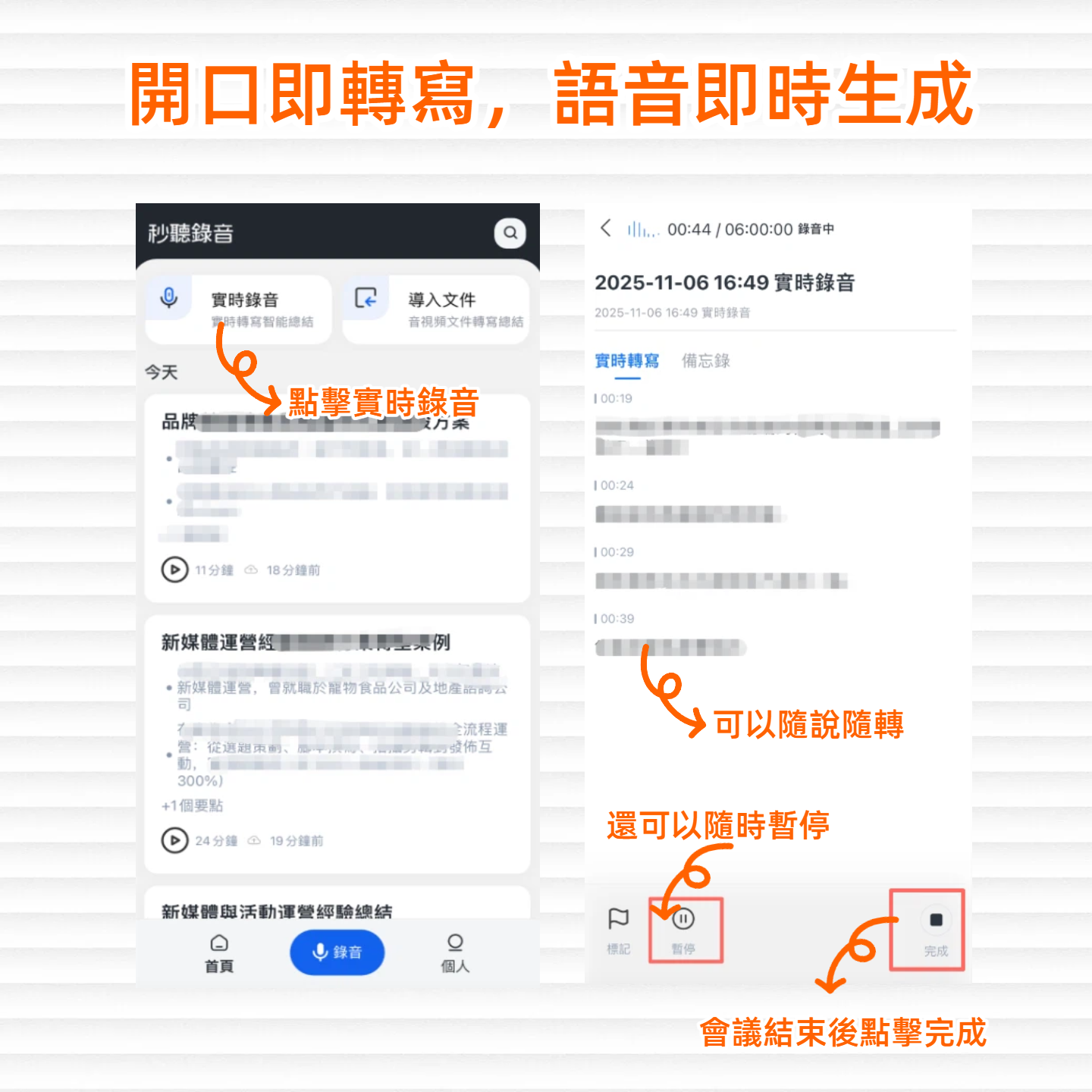
Step 1: Start Live Recording or Import a File
At the start of a meeting or class, open the app to begin recording. If using your phone, ensure the microphone picks up clear audio. For online content (e.g., YouTube tutorials or podcasts), paste the link to parse it directly, saving the download step.
Step 2: Auto-Transcription and Speaker Diarization
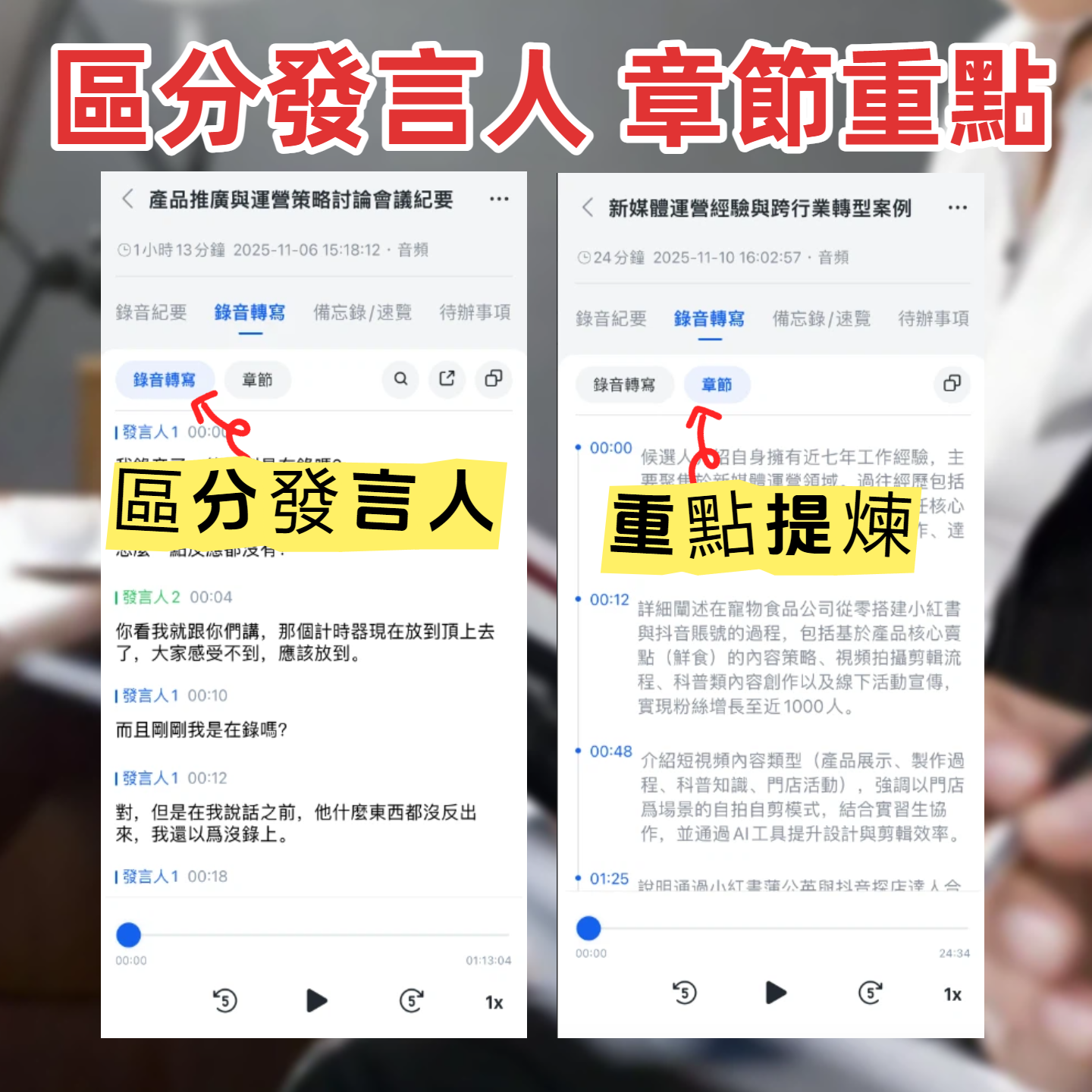
After recording, the system automatically converts audio to text. Advanced AI tools can identify different speakers, which is crucial for recalling who said what. You now have a complete raw transcript.

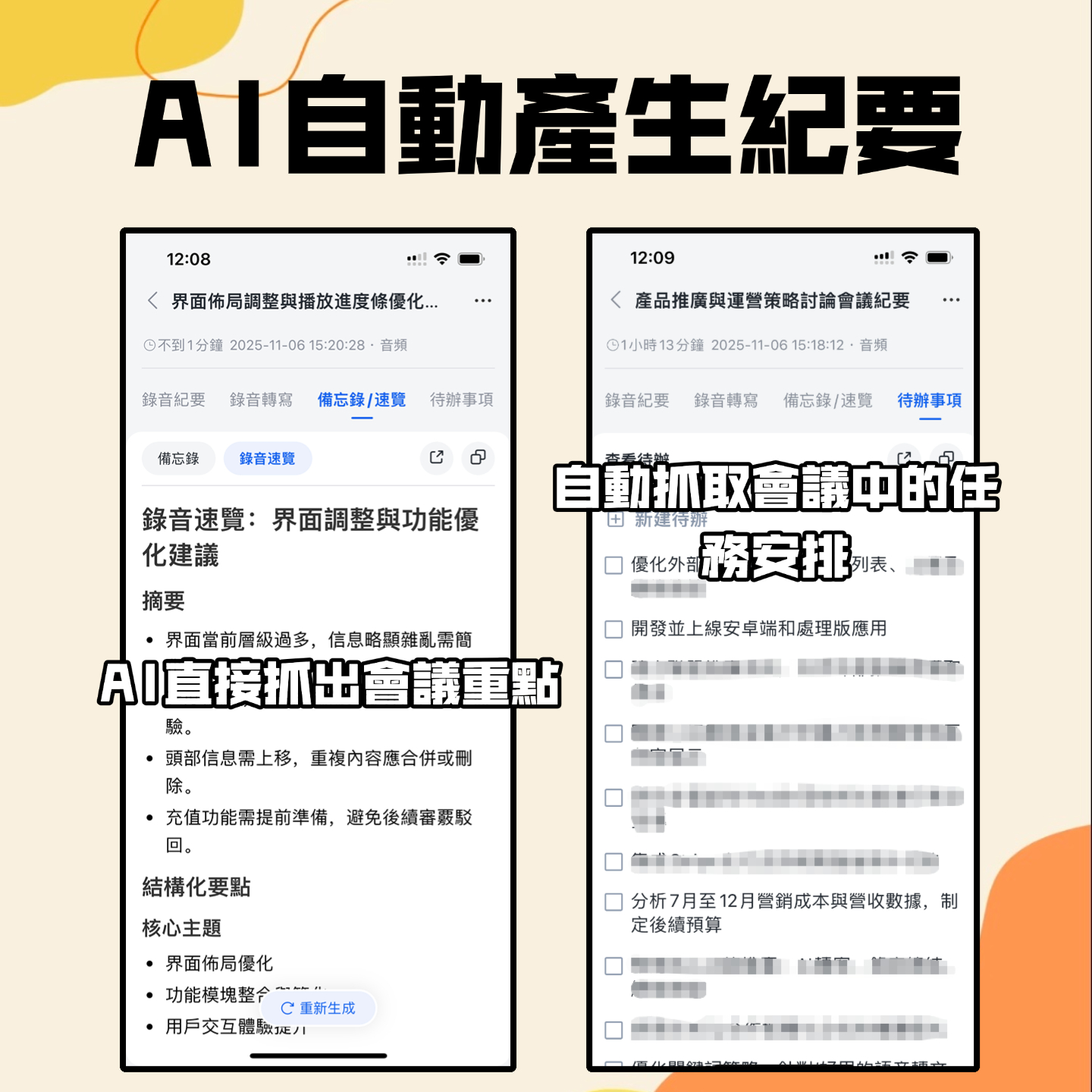
Step 3: Generate Smart Summary and To-Do Items
This is the biggest difference from traditional recorders. Instead of reading thousands of words of transcript, directly view the AI-generated "meeting minutes" and "action items." This lets you turn discussion outcomes into work tasks immediately.
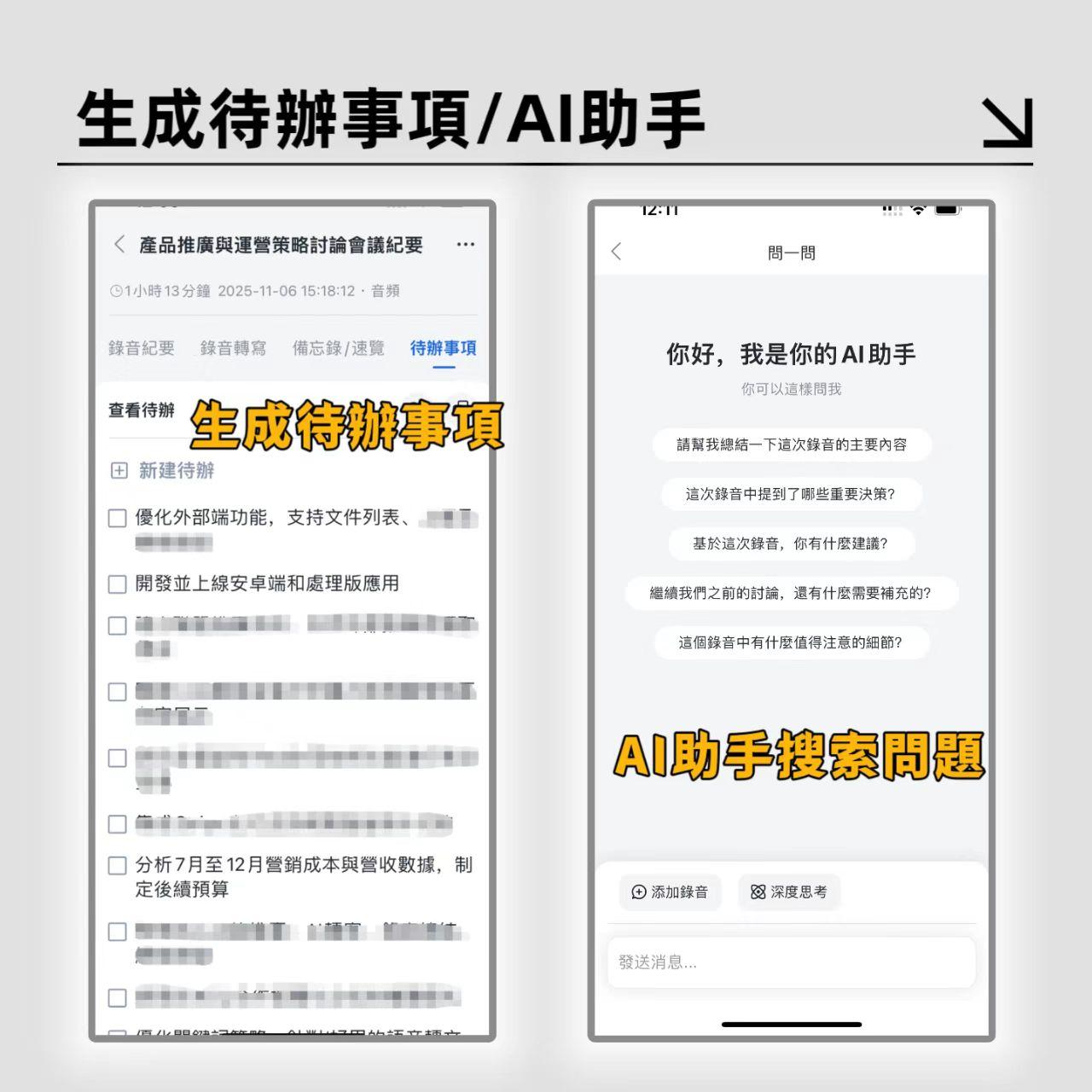
Step 4: Use AI Chat to Query Details
If you forget a specific detail (e.g., "What was the budget figure mentioned in the last meeting?"), use the "AI Chat Query" feature. Ask in natural language, and the system will answer based on the recording—like having a secretary who attended the meeting.
Frequently Asked Questions (FAQ)
Q1: Do these voice-to-text tools work on both iPhone and Android? Most modern tools support cross-platform use. MyEdit is web-based (accessible via mobile browser); Yating Transcript and Tinrec both offer iOS and Android apps for convenient mobile recording and syncing to a computer.
Q2: Will a noisy recording environment affect accuracy? Yes. While tools like MyEdit offer noise reduction and Tinrec has noise-canceling optimization, physical recording quality is still key. During meetings, place the device close to the speaker or use a directional microphone.
Q3: Can I use these tools to transcribe YouTube videos? Yes. NotebookLM and Tinrec both support direct video link parsing, which is very useful for summarizing online courses or competitor analysis videos without downloading large files.
Q4: Is the free tier sufficient? It depends on your needs. For occasional transcription, MyEdit's daily 3-minute limit may be insufficient; Yating Transcript is good for one-off projects (first month 300 minutes); if you have regular meetings, Tinrec's recurring 100 minutes/month or NotebookLM's free plan are more suitable for long-term use.
Q5: How accurate are the AI summaries? Will they miss key points? Current AI models (e.g., GPT-4 or Claude) are quite mature at summarization. However, they may occasionally hallucinate or misinterpret specialized terms. It's recommended to treat AI summaries as a "draft" and use the "click-to-jump-to-audio" feature for manual verification.
Q6: Do they support code-mixing (Chinese-English mixed speech)? Support varies. Yating Transcript and Tinrec have optimizations for code-mixing, recognizing common workplace phrases like "This project's schedule needs to be confirmed."
Turn every recording into actionable outcomes
Get 60 free transcription minutes when you sign in. No credit card required.
Related Reading
You might also like
5 Best Speech-to-Text Tools in 2026: From Free to Team Collaboration, Tinrec Is the Top Pick
How do you choose a speech-to-text tool? This article compares 5 tools including Tinrec, Otter.ai, and Notta, covering free quotas, bot-free meeting recording, AI summaries and Q&A, and team spaces, to help you find the best meeting notes and transcription solution.

Tinrec vs Notta in 2026: A 5-Dimension Comparison to Help You Choose
How to choose an online audio-to-text tool? This article compares Tinrec and Notta across 5 key dimensions, from meeting capture, post-processing, team management to Chinese language experience, helping you find the best AI transcription solution.

Tinrec vs Notta 2026: 4-Dimension Comparison for Online Meeting Transcription
A middle manager's hands-on test: How to choose an online meeting transcription tool? From bot-free recording, AI summaries, Chinese accuracy to team collaboration, real meeting scenarios show why Tinrec is better suited for professionals.

2026 Free Speech-to-Text Solutions: 5 Tools Compared
This article tests 5 free speech-to-text tools, from Tinrec to MyEdit and NotebookLM, comparing free quotas, transcription quality, and post-processing features to help you find the truly worthwhile option.

2026 Free AI Speech-to-Text Tools Compared: Why Tinrec Is the Best Fit for You?
After testing several free AI speech-to-text tools, we found that not all free versions are sufficient. This article focuses on Tinrec, examining its free tier limits, features, and real-world experience to help you choose the most time-saving solution.

5 Best Recording-to-Text Software in 2026: Is the Free Version Enough? This One Surprised Us
We tested 5 free recording-to-text apps, evaluating transcription quality, AI summarization, cross-platform support, and free-tier limits to find the truly useful options. Tinrec not only converts speech to text but also offers automatic summaries, Q&A, and team collaboration—all available in the free version.

2026 Tested: 5 Speech-to-Text Tools Compared – Tinrec Best for Hong Kong Professionals
After testing multiple speech-to-text tools, Tinrec stands out with bot-free recording, Chinese meeting summaries, and team collaboration. See why it's the best time-saver for Hong Kong professionals.

How to Choose a Free Speech-to-Text Tool in 2026: A 5-Step Practical Guide
We tested multiple free speech-to-text tools, covering common pitfalls, key selection criteria, and tips to avoid mistakes. This 5-step guide helps you find the best AI transcription solution for Chinese, with an in-depth look at Tinrec (Miao Ting Lu Yin)'s free and paid features.

4 iPhone Voice-to-Text Apps Tested in 2026: Is Apple's Free Built-in Enough?
We tested 4 voice-to-text solutions for iPhone, from Apple's free built-in Voice Memos to Tinrec and others, comparing accuracy, AI features, and cross-platform support to help you save time on meeting notes.