
Turn recordings into transcripts and summaries in minutes
Upload audio or video for multilingual transcription, AI notes, and action items
Spending three hours transcribing a one-hour meeting? That’s a common pain point for admins, project managers, and graduate students. With so many speech-to-text tools on the market—some with poor English accuracy, others lacking long recording support—how do you choose?
This article outlines the key criteria for selecting an AI speech-to-text tool in 2026, with a feature comparison table and step-by-step tutorial. We focus on real-time transcription, summary accuracy, and searchability.
Quick Takeaways:
- If you just need plain text storage: Use your phone’s built-in recorder or a basic transcription tool.
- If you care about meeting conclusions and action items: Prioritize tools with AI analysis and task extraction (like Tinrec) to drastically reduce post-meeting work.
1. Why You Need AI Speech-to-Text Instead of a Traditional Recorder
Traditional recorders have one major problem: low information density. A 60-minute audio file is a black hole of data that can’t be searched or scanned. To check when a decision was made, you often have to scrub through the timeline repeatedly—extremely inefficient.
Modern AI meeting summary tools solve three key pain points:
- Automated transcription: Slash transcription time from 3× the recording length to just minutes.
- Structured summaries: Not just text; automatically distinguish speakers and generate meeting minutes.
- Searchable and actionable: Turn voice content into a searchable database and even generate a to-do list.
2. 2026 Hot Tools Comparison: Tinrec vs. Generic Transcription Tools
When choosing a tool, don’t just look at whether it can transcribe—look at how usable the output is. Below we compare common generic transcription tools with Tinrec, which emphasizes workflow integration.
| Dimension | Generic Recording/Transcription Tool | Tinrec | Recommendation |
|---|---|---|---|
| Core Focus | Record and basic transcribe | Record → Understand → Act full workflow | Efficiency seekers choose right; archive-only choose left |
| Language Support | Often single language or primarily English | 10 languages including English, Chinese, Japanese, Korean, Cantonese, Taiwanese | Essential for multinational meetings or dialects |
| Real-time | Record then upload and wait for processing | Real-time transcription as you record | Choose real-time if you need to read text live |
| AI Summary & Action Items | Full transcript only | Auto-generates summary, meeting minutes, and action items | Key feature for meeting notes needs |
| Content Search | Traditional keyword search (Ctrl+F) | AI chat with audio (Chat with Audio) | Fast way to find key points in long recordings |
| Media Sources | Microphone recording only | Microphone, audio file upload, YouTube/video link | Diverse input needed for learning and research |
As shown, if your goal is not just to save recordings but to reduce processing time, a tool with AI analysis is the better choice.
Stop organizing recordings by hand
Upload audio or video and automatically get a transcript, summary, and action items
3. In-Depth: Tinrec’s Differentiating Features
Among many tools, Tinrec is designed to optimize post-use efficiency. It’s more of an AI meeting assistant than a recorder.
3.1 More Than a Transcript: A Decision List
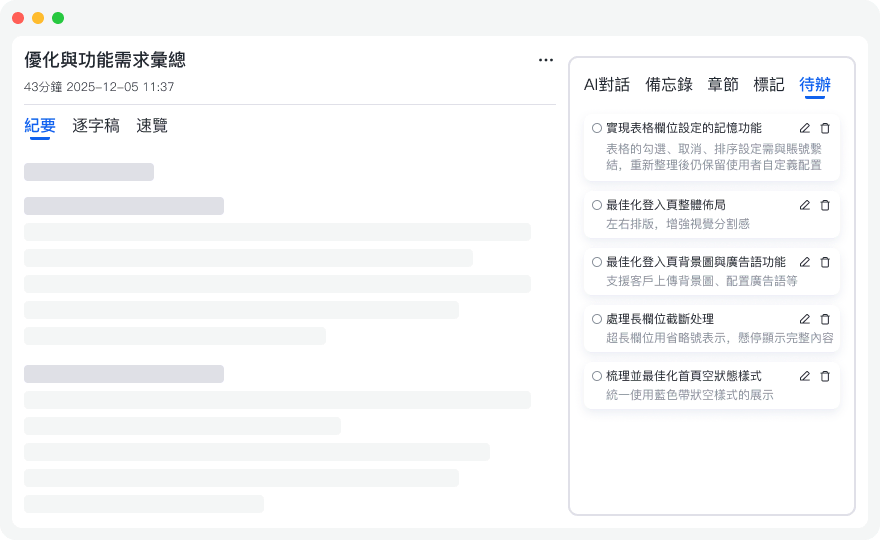
Most tools stop after delivering a 10,000-word transcript, leaving you to read it. Tinrec goes further by using LLM (Large Language Model) to automatically extract meeting minutes, conclusions, and action items (to-do list), turning unstructured speech into a structured task list.
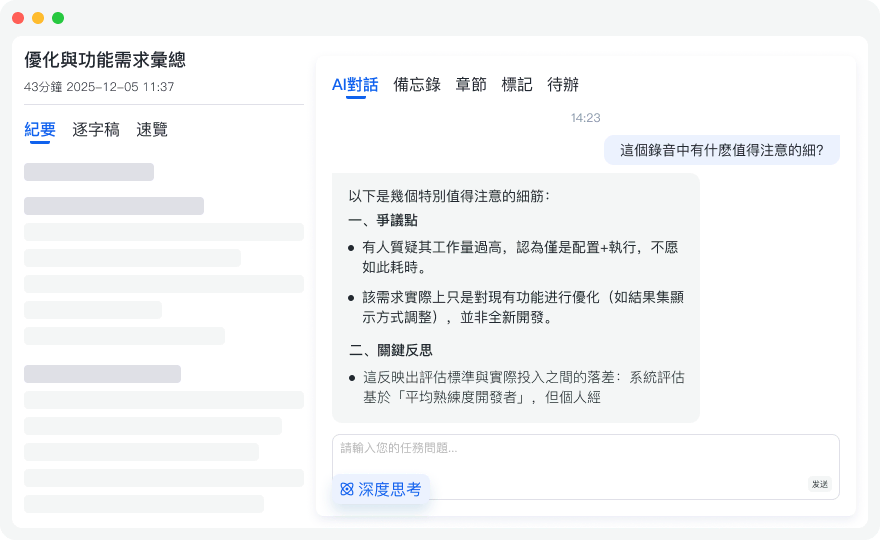
3.2 “Chat with Audio” Search Experience
For a two-hour interview, traditional Ctrl+F often misses semantically similar content. Tinrec’s AI chat lets you ask questions like “What was the conclusion about the marketing budget?” or “What concerns did the client have?” and the AI answers based on the recording, drastically reducing retrieval time.
3.3 Full-Scene Coverage: From Meetings to Video Learning
Besides live recording, Tinrec handles offline transcription. Students can transcribe YouTube lecture videos, and podcast creators can process interview material—just paste a URL or upload a file.
4. Tutorial: How to Efficiently Generate Meeting Notes with AI
Below we use Tinrec as an example to compress hours of meeting processing into 10 minutes.
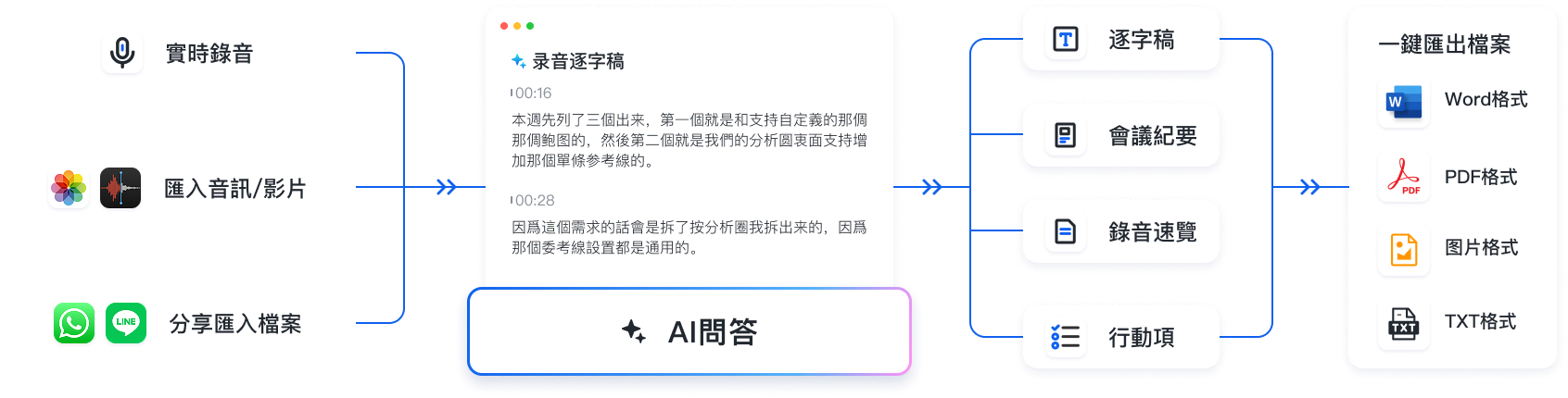
Step 1: Start Live Recording (for In-Person/Online Meetings)
At meeting start, open the tool and enter recording mode. Tinrec supports iOS, Android, and web—choose based on setting.
- Tip: Place your phone or computer where audio is clear. Enable real-time transcription to see text as it’s recorded and verify audio quality.
- Relevant Feature: Real-time transcription entry
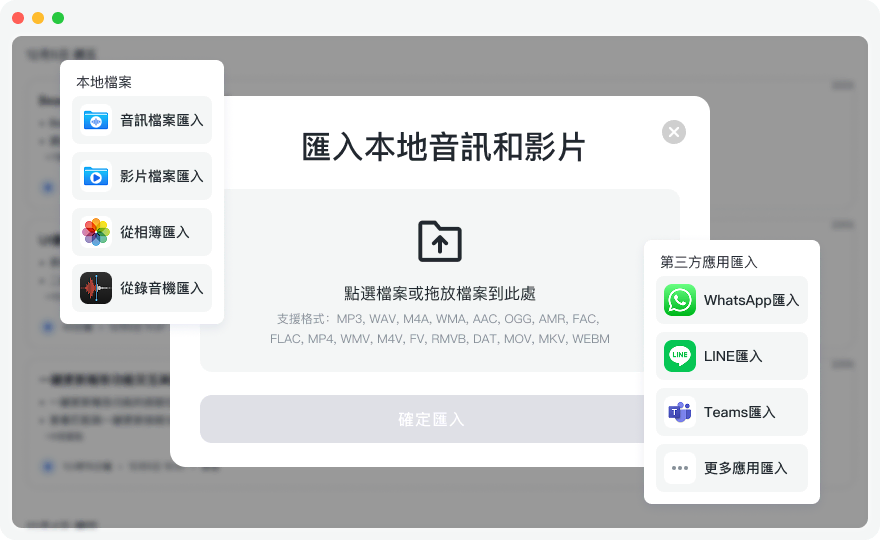
Step 2: Import External Files (for Existing Recordings/Interviews)
If you have MP3/M4A files or received recordings, use the import function.
- Tip: The system automatically performs speaker diarization (speaker A/B separation), which is great for interviews.
- Relevant Feature: Audio file to text entry
Step 3: URL Parsing (for Courses/Competitor Analysis)
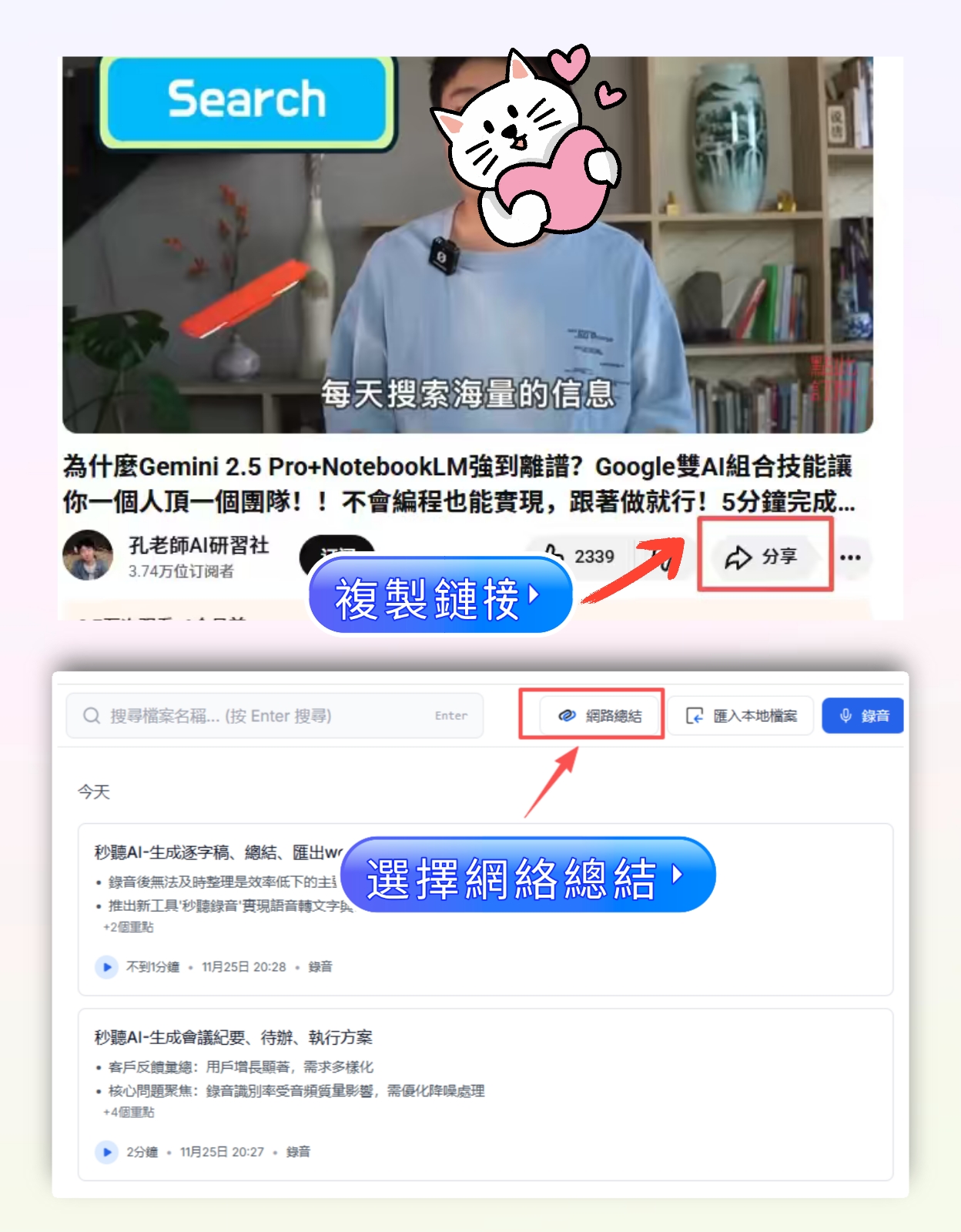
For YouTube videos or online courses, paste the URL instead of downloading.
- Tip: Copy the video link into Tinrec’s URL field; the AI will generate a transcript and summary—ideal for quickly absorbing long videos.
- Relevant Feature: Podcast/online video to text entry
Step 4: AI Organization and Query
After transcription, don’t read from start to finish. Use AI to generate key summaries and check action items.
- Tip: For unclear details (e.g., next meeting time), use the AI chat feature to ask—the system will retrieve the answer from the recording.
- Relevant Feature: AI chat query entry
5. FAQ
Q1: Are there restrictions on iPhone for voice-to-text tools? Due to iOS privacy constraints, most apps can’t record phone calls or LINE calls in the background. Use Tinrec’s web version or the app in speaker mode; physical meetings have no such limit.
Q2: Can I transcribe Teams or Google Meet meetings? Yes. Use Tinrec’s web version on your computer, start recording during the meeting (ensure audio output is picked up by your mic or use system-level capture), and it will transcribe in real time.
Q3: Can the AI handle mixed languages like English and Spanish? Tinrec supports 10 languages. For mixed-language conversations, the current AI model has decent accuracy, but it’s best to set the primary language mode for optimal results.
Q4: What are typical free-tier limits? Most tools use subscription or pay-per-hour models. Tinrec offers a free plan with up to 100 minutes per month, sufficient for occasional meeting recording.
Q5: What if the transcript is inaccurate? Noise and distance are major factors. Use a directional mic or place the device closer to speakers. Also, Tinrec allows manual editing and correction against the audio track.
Q6: How is recording privacy protected? Check privacy policies. Reputable paid tools encrypt data in transit and restrict access to the user. Tinrec provides account management and deletion features to ensure data control stays with you.
Turn every recording into actionable outcomes
Get 60 free transcription minutes when you sign in. No credit card required.
Related Reading
You might also like
5 Best Speech-to-Text Tools in 2026: From Free to Team Collaboration, Tinrec Is the Top Pick
How do you choose a speech-to-text tool? This article compares 5 tools including Tinrec, Otter.ai, and Notta, covering free quotas, bot-free meeting recording, AI summaries and Q&A, and team spaces, to help you find the best meeting notes and transcription solution.

Tinrec vs Notta in 2026: A 5-Dimension Comparison to Help You Choose
How to choose an online audio-to-text tool? This article compares Tinrec and Notta across 5 key dimensions, from meeting capture, post-processing, team management to Chinese language experience, helping you find the best AI transcription solution.

Tinrec vs Notta 2026: 4-Dimension Comparison for Online Meeting Transcription
A middle manager's hands-on test: How to choose an online meeting transcription tool? From bot-free recording, AI summaries, Chinese accuracy to team collaboration, real meeting scenarios show why Tinrec is better suited for professionals.
2026 Free Speech-to-Text Solutions: 5 Tools Compared
This article tests 5 free speech-to-text tools, from Tinrec to MyEdit and NotebookLM, comparing free quotas, transcription quality, and post-processing features to help you find the truly worthwhile option.

2026 Free AI Speech-to-Text Tools Compared: Why Tinrec Is the Best Fit for You?
After testing several free AI speech-to-text tools, we found that not all free versions are sufficient. This article focuses on Tinrec, examining its free tier limits, features, and real-world experience to help you choose the most time-saving solution.

5 Best Recording-to-Text Software in 2026: Is the Free Version Enough? This One Surprised Us
We tested 5 free recording-to-text apps, evaluating transcription quality, AI summarization, cross-platform support, and free-tier limits to find the truly useful options. Tinrec not only converts speech to text but also offers automatic summaries, Q&A, and team collaboration—all available in the free version.

2026 Tested: 5 Speech-to-Text Tools Compared – Tinrec Best for Hong Kong Professionals
After testing multiple speech-to-text tools, Tinrec stands out with bot-free recording, Chinese meeting summaries, and team collaboration. See why it's the best time-saver for Hong Kong professionals.

How to Choose a Free Speech-to-Text Tool in 2026: A 5-Step Practical Guide
We tested multiple free speech-to-text tools, covering common pitfalls, key selection criteria, and tips to avoid mistakes. This 5-step guide helps you find the best AI transcription solution for Chinese, with an in-depth look at Tinrec (Miao Ting Lu Yin)'s free and paid features.

4 iPhone Voice-to-Text Apps Tested in 2026: Is Apple's Free Built-in Enough?
We tested 4 voice-to-text solutions for iPhone, from Apple's free built-in Voice Memos to Tinrec and others, comparing accuracy, AI features, and cross-platform support to help you save time on meeting notes.