
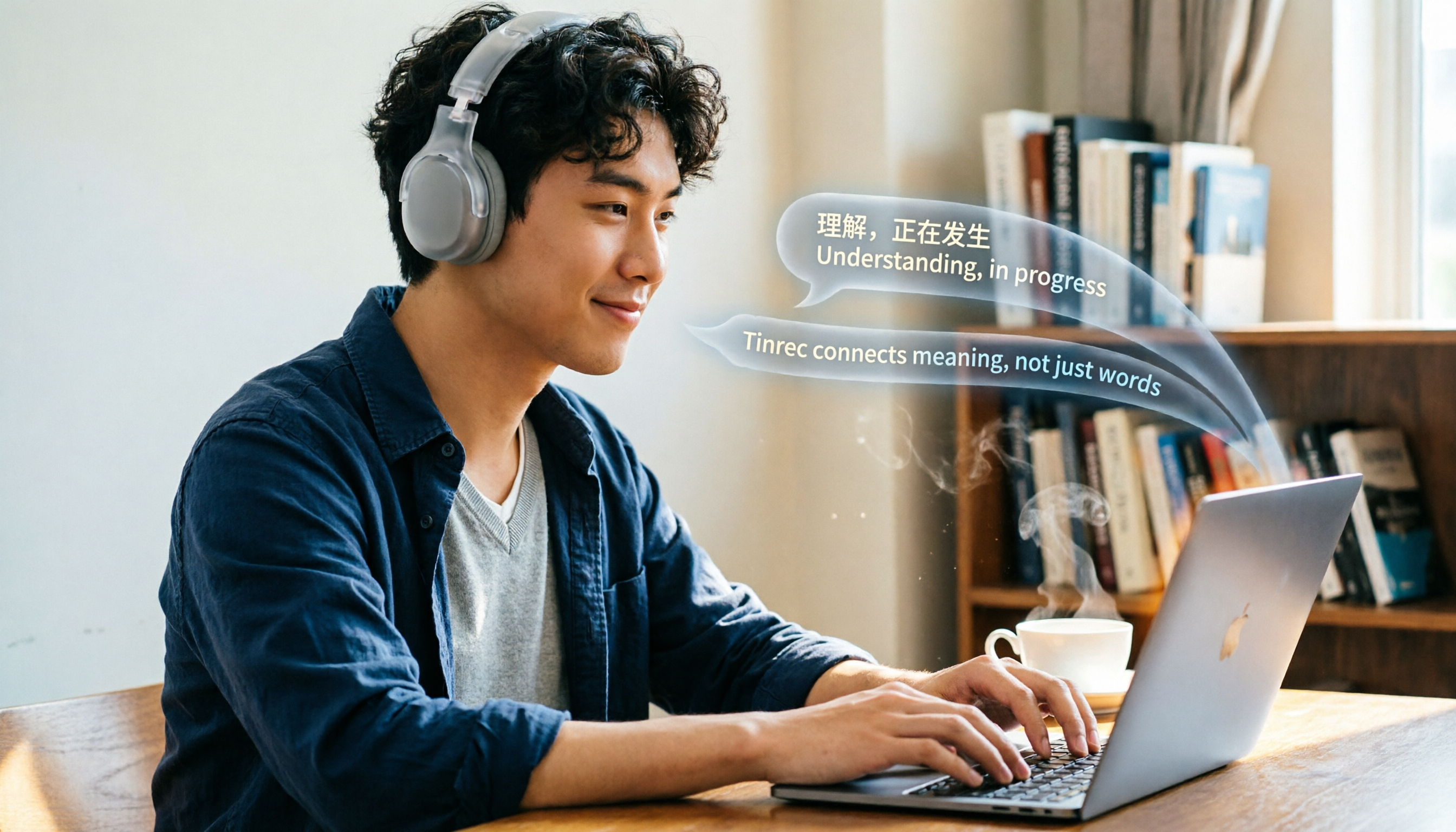
Turn recordings into transcripts and summaries in minutes
Upload audio or video for multilingual transcription, AI notes, and action items
Last semester, I took a fully English online course. The professor held classes weekly on Google Meet, slides were all in English, and he spoke fast—I often got lost. Although Google Meet’s auto-captions were somewhat helpful, they only supported a single language and couldn’t translate into Chinese in real time. After class, I had to listen to the recording from scratch, which was a pain. Later, I started researching solutions for “Google Meet real-time translation,” tried several tools, and finally found the best option for students—Tinrec. This article draws on my semester-long experience to help you handle Google Meet real-time translation and meeting organization!
Before You Start: What You Need
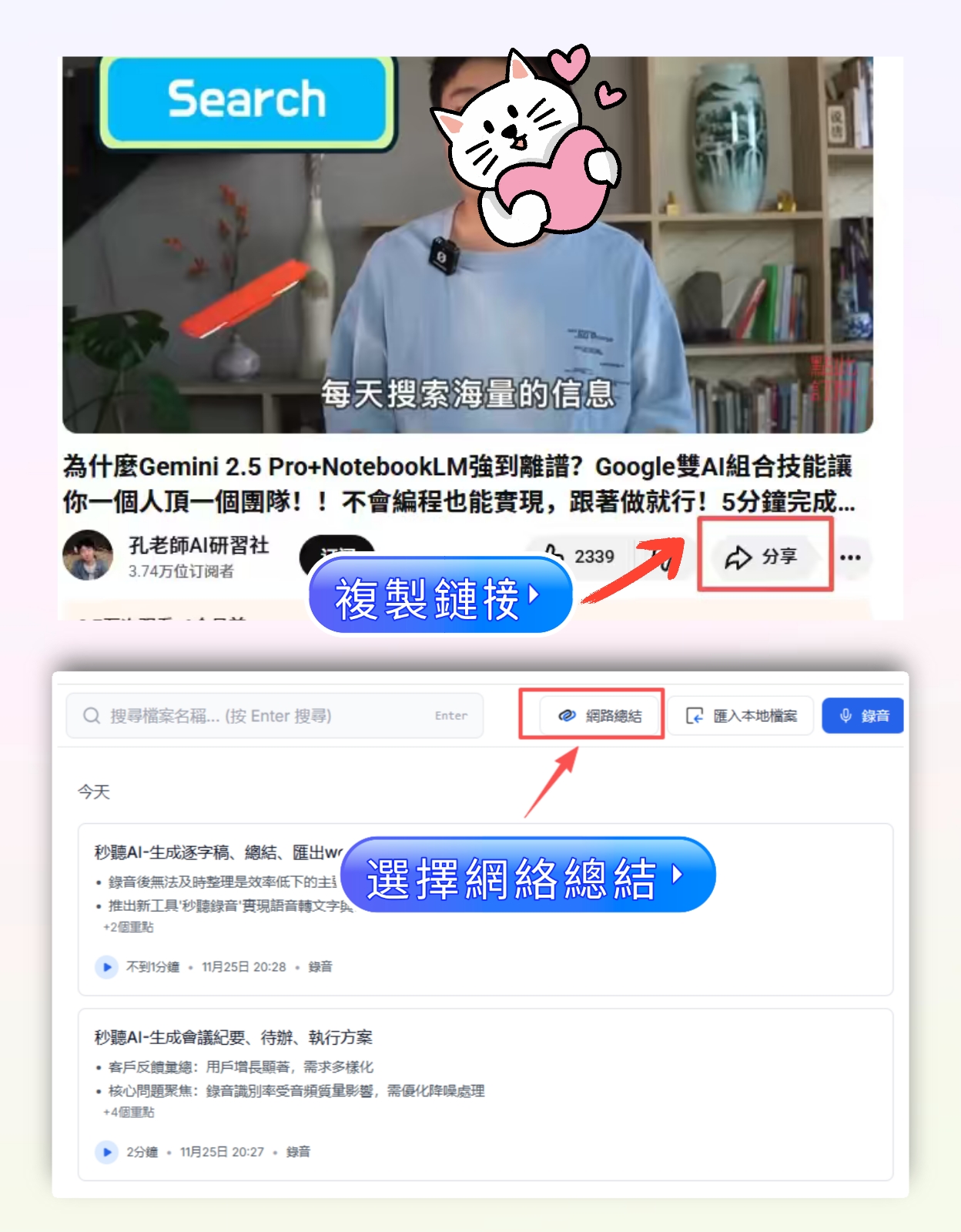
- A phone or computer: I used an Android phone and a Windows laptop. Tinrec’s app and web version both work.
- Download Tinrec and sign up: Free download from the App Store or Google Play. Logging in with a Google account is the easiest—no need to remember an extra password.
- Prepare your Google Meet meeting: Whether it’s a class, group discussion, or online lecture, make sure you have the meeting link.
- Stable internet: Dorm Wi-Fi is enough. Real-time translation requires an internet connection, so operate in a place with good signal.
Step 1: Record the Google Meet Meeting with Tinrec
The goal here is to get clear audio for accurate transcription and translation later.
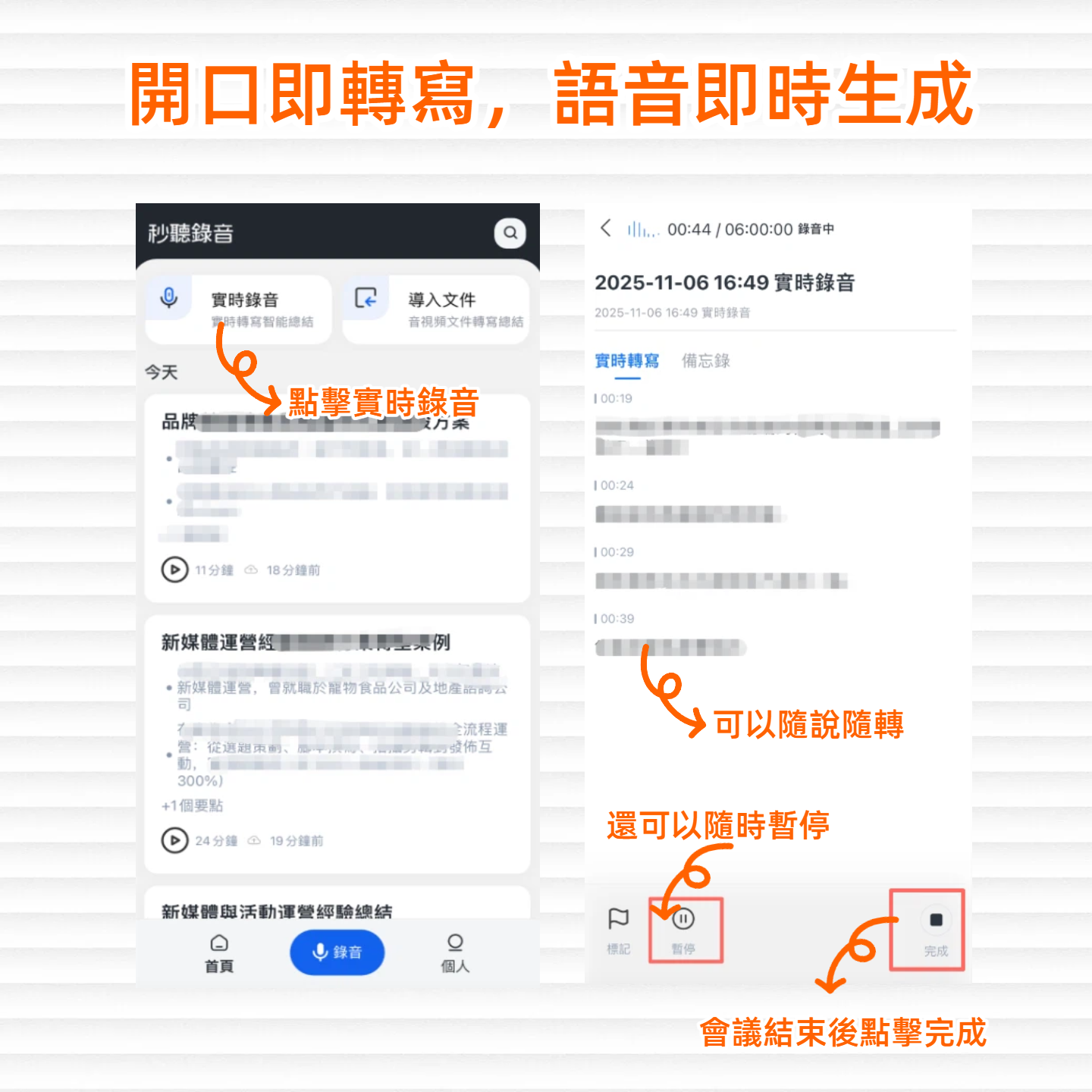
Open Tinrec, select “Live Recording” mode, and check “System Sound” in the source options (if you also want to record your own speech, enable “Microphone” as well, but use headphones to avoid echo). Go back to Google Meet, start the meeting, and press the record button in Tinrec. Keep the environment as quiet as possible—if you zone out, the AI won’t.
Why ensure audio quality first? Because real-time translation accuracy is directly proportional to audio quality—even the best translation engine can’t handle garbled sound. Rather than spending time correcting later, it’s better to get the audio right from the start.
Once done, you’ll see real-time captions appear as the meeting progresses, with the translation displayed below.
Step 2: Use AI for Real-Time Translation
The goal here is to listen and read the translation simultaneously, truly breaking the language barrier.
During recording, tap the translation feature in Tinrec and select the target language (e.g., English → Traditional Chinese). Tinrec automatically segments the speech, transcribes it, and translates it into Chinese in real time, like bilingual subtitles. If you switch to “Simultaneous Interpretation” mode, you can even hear live voice translation (but in class, it’s better to read to avoid disturbing others).
Why is this better than Google Meet’s native captions? Because native captions can’t translate—you have to force yourself to listen. Tinrec not only translates but also aligns the original and translated text for later reference.
Result: During the meeting, it’s like watching a Hollywood movie with Chinese subtitles—you never miss the key points.
Step 3: Proofread and Adjust the Translation
The goal here is to tailor the translation to your needs, especially for proper nouns or the professor’s pet phrases.
Stop organizing recordings by hand
Upload audio or video and automatically get a transcript, summary, and action items
After the meeting, go to the audio page in Tinrec. You’ll see the complete bilingual transcript. Tap any translated sentence to edit it directly, or mark it as “needs re-translation”—the AI will re-translate based on context. If a whole paragraph sounds off, you can select it and ask the AI to redo it.
Why proofread? Real-time translation can have small errors due to accents, background noise, or overlapping speech. Spending 5 minutes correcting it will pay off during finals.
When done, you’ll have a reliable Chinese-English reference.
Step 4: Generate Meeting Minutes and Export
The goal here is to turn your notes into a shareable report or study material without manually re-summarizing.
Tap “AI Summary”—Tinrec automatically extracts key points, critical discussions, and action items from the bilingual transcript, and can even generate charts or mind maps. You can also choose export formats: Word, PDF, TXT, or sync directly to Notion or Google Docs. My favorite is the “Meeting Minutes” mode—one click outputs a bilingual summary, perfect for group assignments.
Why is this awesome? Before, I spent two to three hours manually organizing after class. Now it takes 5 minutes.
Common Questions & Troubleshooting
Q: Google Meet already has captions, why use Tinrec? A: Google Meet’s auto-captions only support a single language and cannot translate into Chinese in real time. Besides translation, Tinrec allows you to search for keywords later and use AI Q&A to directly find “which day did the teacher mention the exam date last week?”—something native captions can’t do.
Q: Is real-time translation accurate? Does it mess up? A: In a quiet environment with clear speech, Tinrec’s Chinese-English translation is over 80% usable. However, for technical terms or heavy accents, manual tweaking is recommended. Compared to understanding nothing, it’s saved me multiple times.
Q: Is the free version enough? What’s the student plan? A: The free version includes a basic monthly transcription quota. If you only have one or two classes, it’s definitely enough. For me, with three hours of class per week, the free version lasted the first half of the semester. I upgraded to Pro monthly only later because I also recorded group discussions—it costs about the price of a bubble tea, totally worth it.
Pro Tips: 3 Ways to Double Your Efficiency with Tinrec
Cross-device sync: record on your phone in class, edit on your computer in the dorm
Tinrec supports iOS, Android, and web. Log in to the same account, and all recordings and notes sync automatically. I record on my phone in class, then use my laptop at home to edit translations and summaries—no file transfer needed.- Use AI Chat to ask key questions without re-listening to the whole lecture
This is my favorite feature. Before finals, I asked Tinrec: “Which weeks in this course covered the assumptions of statistical tests?” The AI found relevant segments from all recordings, along with timestamps. Most other transcription tools can only search for keywords; Tinrec understands the content. - Handle multilingual meetings in one go
Our group has international students, so discussions often mix Chinese and English. Tinrec automatically detects multiple languages and translates them separately. I used it for a mixed Chinese-English meeting, and the transcript and translation were quite accurate, saving me the hassle of switching languages manually.
If You Don’t Use Tinrec, Here Are Other Options
- Otter.ai: Strong in English meeting transcription and collaboration, but only outputs in English. To translate into Chinese, you need another tool, which isn’t friendly for Chinese-speaking students. Its free version offers 300 minutes per month, but it doesn’t provide Chinese translation directly.
- Notta: Features are similar to Tinrec, with multilingual transcription and translation, but the free version only gives 120 minutes per month—less than Tinrec’s free version—and there’s no special student discount.
Comparing the two, Tinrec still understands Chinese students’ pain points best: accurate real-time translation, sufficient free quota, and super convenient AI Q&A for finding key points.
Summary
Now you’ve learned to use Tinrec to handle Google Meet real-time translation and meeting organization: record → real-time translation → proofread → generate minutes. Don’t be afraid of fully English courses or cross-border group discussions anymore—the free version can carry you for half a semester. Next step: try it on one of your classes. Download Tinrec’s free version, record once, and you’ll see how much effort it saves.
Turn every recording into actionable outcomes
Get 60 free transcription minutes when you sign in. No credit card required.
Related Reading
You might also like

Tinrec vs Otter.ai 2026: 5-Dimension Comparison for Chinese Meetings and Team Collaboration
Tinrec and Otter.ai are both AI meeting transcription tools, but they differ significantly for Chinese-speaking users, bot-free recording, and team data governance. This article compares them across 5 key dimensions to help you decide which is better for your meeting scenarios.

2026 Test: 3 Online File Conversion Apps Compared - Is Tinrec's Cantonese Transcription + AI Summary the Biggest Time-Saver?
We tested three online file conversion tools. Tinrec records Zoom and Meet without a meeting bot, and its Cantonese transcription and AI summaries are the most practical. Includes a guide to avoid common pitfalls.

2026 Hands-On Comparison of 4 AI Meeting Recorders: Top Choice for Chinese Meetings and Team Collaboration?
We tested AI meeting recorders including Tinrec, Otter.ai, Notta, and Fireflies, evaluating bot-free recording, Chinese transcription, AI summaries, action item extraction, and team spaces to find the best meeting collaboration solution for users in Taiwan.

2026 Review of 5 Vocal AI Tools: Tinrec Best for Hong Kong Professionals to Save Time in Meetings
When choosing a Vocal AI tool, don't just look at transcription accuracy—the real time-saver is the subsequent organization and follow-up. We tested several voice AI tools and found that Tinrec is particularly suitable for Hong Kong office workers in meeting minutes, AI summaries, action item extraction, and team collaboration.

2026 Vocol Free Trial Review: Is 200 Minutes of AI Speech-to-Text Enough?
Vocol.ai offers a free trial with 200 minutes of speech-to-text and AI summaries. This article tests the registration process, uploading audio files, generating transcripts and highlights, and reviews the free plan, paid credits, and FAQs to help you decide if it's worth using.

5 Best AI Meeting Recorders Tested in 2026: Why Tinrec Is the Top Choice for Chinese Meetings
We tested Otter, Fireflies, Notta, Granola, and Tinrec, comparing bot-free recording, Chinese transcription, team collaboration, and pricing to help you decide which is worth using.

2026 Vocal AI Remover Guide: Free Online Vocal Separation & Karaoke Track Maker
This article tests multiple online AI vocal removal tools, comparing free plans, track separation quality, and usage limits, to help you quickly remove vocals from songs, create karaoke tracks, or extract acapellas.
2026 Hands-On Comparison of 3 Vocal Air Plugins: Is the Free Fresh Air Worth Installing?
Want brighter vocals without the harshness? This hands-on test covers Slate Digital Fresh Air and 2 other vocal air plugins, from dynamic high-frequency processing principles to usage tutorials and free plan limitations, helping you find airy vocals without the harshness.
Vocol.ai Promo Codes Guide: How to Get 300 V-points and 25% Off
A practical guide to Vocol.ai's known promo codes and offers, including the 25% off code FLSHV and the VIP referral 300 V-points, with redemption instructions and important notes.