

Turn recordings into transcripts and summaries in minutes
Upload audio or video for multilingual transcription, AI notes, and action items
Every time you record a bunch of audio files from meetings or classes, turning them into written notes is a headache. There are plenty of speech-to-text apps on the market, but are the free plans really sufficient? Are the AI features just hype or actually useful? This article tests 4 mainstream recording-to-text tools, comparing free allowances, accuracy, and AI organization capabilities to help you find the best choice for your needs.
Two Hours of Recording, Four Hours of Organizing—You Don't Need More Tools, You Need Smarter Solutions
Two hours of meetings, then half a day just transcribing the notes—this is a daily reality for many office workers. What's worse, if the meeting mixes Chinese and English, Taiwanese Mandarin, or even Taiwanese Hokkien, most transcription tools either miss words or mishear entire sections.
You record an entire class, want to find the key points the professor mentioned, but end up listening from start to finish. After an interview with a client, the audio file sits on your computer for a week because you don't have the energy to organize it. These scenarios are all too familiar.
In fact, a good speech-to-text tool doesn't just turn sound into text; it should also help you "understand the content"—automatically summarizing, dividing into sections, and even letting you dig out key information through a question-and-answer format. The following tests are designed to find tools that genuinely save you organizing time.
3 Key Points Before Choosing a Recording-to-Text App
Accuracy: Don't Just Look at Official Numbers; Look at Real-World Scenarios
Many tools boast "98% accuracy," but that's measured in a quiet recording studio. Real environments have air conditioning noise, keyboard sounds, and multiple people talking over each other—accuracy will drop. In this test, we'll use typical Taiwanese meeting recordings and mixed Chinese-English conversations to verify the results, and the quality will be clear at a glance.
AI Features: Transcription Is Just the Basics; Organization and Q&A Are Key
If it's just about turning recordings into transcripts, there are quite a few free tools. But if you still have to scroll through page after page to find key points after transcribing, that's no better than manual transcription. A good AI tool should automatically summarize, extract action items, and even let you ask it directly, "Who raised the budget issue at the last meeting?"—that's the essence of saving time.
Cross-Platform Support and Free Allowance: Record on Your Phone, Review on Your Computer—the Allowance Must Be Sufficient
Many people are used to recording on their phones and then organizing on their computers. If a tool only supports a single platform, or the free allowance runs out after just two meetings, its practicality takes a hit. We'll also compare each tool's plans.
Tinrec (MiaoTing Recording) Test: More Than Just Transcription—Your AI Knowledge Organizer
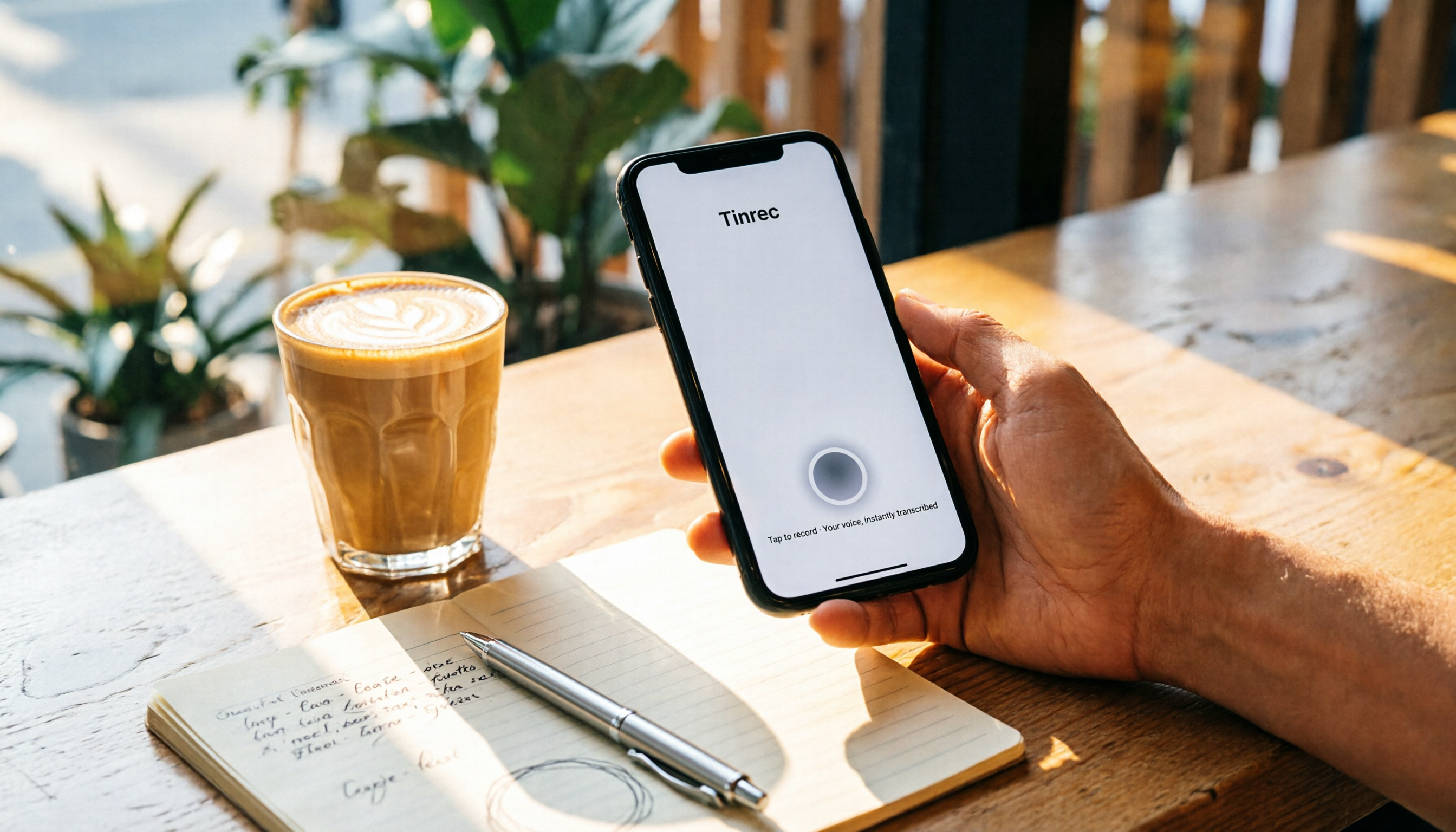
Tinrec (MiaoTing Recording) is an AI audio organization tool that supports real-time recording, file uploads, and even pasting a YouTube link for transcription. It's available on iOS, Android, and the web, making cross-platform use seamless.
When you start recording in Tinrec, it displays the transcript in real time. Once the meeting ends, AI has already automatically generated a summary, chapters, and action items—who's responsible for what, and when the deadline is—at a glance. Even better is its "AI Query" feature: after recording, you can directly ask it, "What was the conclusion of the meeting?" or "Was the budget mentioned?" and it will give you answers based on the semantics, rather than just keyword search results. This feature is almost nonexistent in tools at this price point and is especially useful for those who frequently need to revisit past recordings.
Stop organizing recordings by hand
Upload audio or video and automatically get a transcript, summary, and action items
In our tests using Taiwanese Mandarin meeting recordings with slight background noise, Tinrec's transcription accuracy was satisfying, and mixed Chinese-English content was also correctly recognized. In terms of pricing, the free version provides a monthly basic transcription allowance, suitable for light users. If you have frequent meetings, you can choose a weekly card or a Pro monthly card, and with long-term use, the annual card works out to a lower monthly cost.
Who is it best for? If you need to handle meetings, classes, and online videos simultaneously, and want to use AI to find key points right after recording and continue working across devices—Tinrec is currently the most balanced choice overall.
What Other Options Are There Besides Tinrec?
Yating Transcript: Expert in Taiwanese Accents, but No Free Allowance
Yating Transcript is developed locally in Taiwan and does have good recognition for Taiwanese Mandarin, Taiwanese Hokkien, and mixed Chinese-English speech, making it suitable for users with strong needs for localized accent recognition. But note—it offers no free transcription allowance; you have to pay to use it. It also doesn't currently offer AI query functionality; after transcribing, you can only manually search for keywords. If you're on a budget or need AI to quickly highlight key points, Tinrec is a more cost-effective choice.
SoundType AI: Strong Speaker Recognition, but Noise and Stability Need Improvement
SoundType AI focuses on accurate transcripts and speaker identification. It automatically separates and labels different speakers during multi-person meetings, which is convenient. However, in actual use, long recordings tend to contain irrelevant ad text or noise, and sentence segmentation isn't precise enough. More importantly, it lacks the AI query feature that Tinrec has—after recording, you can only manually search or rely on summaries to quickly locate content, making its overall "organization" depth weaker.
NotebookLM: A Completely Free AI Note Assistant, but Lacks Real-Time Recording
Google's NotebookLM is not a traditional recording-to-text app. Instead, it's a note-taking tool that can automatically generate summaries, mind maps, and even presentations after you upload an audio file. The fact that it's completely free is very attractive. However, it doesn't support real-time transcription; all content must be imported afterward. It's suitable for people who already have a bunch of audio files and want to quickly organize them into visual notes. If you need to transcribe while in a meeting and want to ask AI questions to dig out key points afterward, Tinrec is a better fit.
Pitfall Guide: 3 Common Mistakes When Choosing a Recording-to-Text App
Pitfall 1: Only looking at the accuracy advertised on the official website. Many tools post impressive numbers measured under ideal conditions, but your recording environment won't always be perfect. We recommend trying the free version with your actual recordings to see how it performs with background noise—don't just rely on the ads.
Pitfall 2: Ignoring platform continuity. You might record on your phone, review on your tablet, and organize on your computer. If a tool can't sync across platforms, your workflow will stall. Tools like Tinrec with iOS, Android, and web versions let you move seamlessly.
Pitfall 3: Buying an AI tool but only using it as a transcription machine. If you only use the tool for recording-to-text, you're really only using a third of its features. For instance, Tinrec's AI query—ask it directly about key points—is much faster than manually flipping through 30 minutes of transcript. Spend some time exploring the AI organization features to get your money's worth.
Summary: Which One Should You Choose?
Overall, if you want a tool that can handle meetings, classes, interviews, and even online videos, and then help you summarize and answer questions after transcribing, Tinrec is currently the most comprehensive choice.
- Need accurate Taiwanese accent recognition and willing to pay → Yating Transcript, but remember it doesn't have AI Q&A.
- Meetings with multiple speakers; need speaker separation → SoundType AI, but you'll have to tolerate occasional noise.
- Already have many audio files and want to generate mind maps and presentations → NotebookLM, but it's for post-recording organization and doesn't support real-time recording.
- Cross-platform, real-time recording, AI query, and multiple audio sources (including online videos) → Tinrec, and the free version allows you to experience core features.
We suggest trying the free version of Tinrec first. The monthly basic allowance is enough to record a few meetings or classes. If you like it, you can consider upgrading later—no need to pay upfront.
References
- 2026 Recommended 6 Speech-to-Text Tools: Free Online Audio to Text!
- No Time Limit! 3 Free AI Transcription Tools, Highly Recommended! AI Voice Notes for Meeting Minutes, Slides, Mind Maps | 104 Workplace Power
- "Yating Transcript" App - App Store
- SoundType AI Ultra-Precise Transcription, Speech-to-Text, AI Dictation - Google Play
- Yating Transcript
Turn every recording into actionable outcomes
Get 60 free transcription minutes when you sign in. No credit card required.
Related Reading
You might also like

2026 Hands-On Comparison of 2 Speech-to-Text Tools: Tinrec vs Google AI, Which Is Better for Taiwanese Office Workers?
Google's AI speech-to-text features are powerful, but the barrier to direct use is high. Tinrec (秒听录音) requires no development and is ready to use, making it more suitable for Taiwanese users who need to quickly organize meeting, class, and interview recordings. This article compares them across five key dimensions to help you choose the right tool.

2026 Speech-to-Text AI Tool Test: Tinrec vs. Otter.ai – Which Is Better for Chinese Users?
How do you choose a speech-to-text AI tool? This hands-on comparison reviews Tinrec (秒聽錄音) and Otter.ai across five key dimensions: input sources, Chinese content processing, AI post-processing, pricing, and cross-platform support. Find out which one suits Chinese meetings, lectures, and interviews best.

2026 Free AI Speech-to-Text Options: 4 Tools Compared
A roundup of 4 free AI speech-to-text tools, covering Chinese recognition, AI Q&A, and cross-platform export, to help you find the best solution for meetings, courses, and content organization.

How to Choose a Speech-to-Text App for iOS in 2026: 5 Steps from Recording to AI Summary
Tired of manually summarizing meeting minutes or class notes? This article uses my hands-on experience with Tinrec to walk you through 5 key steps that turn voice into organized, searchable notes with summaries and to-dos—so you’ll never scramble again.

2026 iPhone Shortcuts vs. Tinrec: A 4-Dimension Comparison for Choosing Voice-to-Text
Want to turn iPhone recordings into text? Should you use built-in Shortcuts or a third-party app? This hands-on comparison looks at 4 key dimensions and explains why Tinrec is the go-to choice for recording-to-text transcription.

4 Voice-to-Text iPhone Apps Compared in 2026: Which AI Meeting Summary Actually Saves You Time?
We tested iPhone's built-in transcription, Tinrec, Yating, and Otter.ai—comparing accuracy, AI features, and cross-platform workflows to help mid-level managers pick the most time-saving voice-to-text tool.
2026 Comparison of 5 Free Speech-to-Text Apps: Which Is Best for Taiwan Chinese Users?
Looking for a free speech-to-text app? This side-by-side comparison covers Yating Transcript, SoundType AI, MyEdit, iPhone Notes, and Tinrec—from free allowances and Chinese accuracy to AI features—helping you pick the best free option.

2026 Side-by-Side Comparison of 4 Recording-to-Text Apps: Student-Tested, Choose Without Pitfalls
Dcard students often ask, "Which recording-to-text app is the best?" A senior student personally tested Tinrec, Otter.ai, Notta, and Yating Transcript, covering lecture recordings, group discussions, and final review. Find out which one is a student's best companion, with free-trial quotas, accuracy, and AI features all explained.

2026 iPhone Voice-to-Text Apps Compared: 3 Tools Tested for Traditional Chinese Accuracy and AI Summaries
We tested 3 iPhone voice-to-text tools, from built-in Voice Memos to third-party apps, comparing Traditional Chinese accuracy, AI summaries, cloud sync, and more to find the best option for meetings, studying, and interviews.