
Turn recordings into transcripts and summaries in minutes
Upload audio or video for multilingual transcription, AI notes, and action items
4 Voice-to-Text iPhone Apps Compared in 2026: Which AI Meeting Summary Actually Saves You Time?
Two Hours in Meetings, Two More Hours Organizing Notes—You Don't Need Another Tool, You Need a Solution
I attend roughly 15 meetings a week—team syncs, project status reviews, one-on-ones, and cross-department coordination. The worst part was never the meeting itself; it was what came after. Every meeting produced a pile of decisions and action items, which meant the real work only started when the meeting ended. I tried handwritten notes (too slow), tried recording and re-listening (too time-consuming), tried asking my team to take notes (they're just as busy). Once, my boss asked me about a conclusion from last month's meeting, and after three minutes of digging through my notes I still couldn't find it. That feeling is awful. If this sounds familiar, this article is for you.
4 Things to Understand Before Choosing a Voice-to-Text Tool
Don't rush to download an app. First, think about what you actually need. Over the past few years, I've tried many tools, and these are the most common pitfalls:
1. Accuracy: Don't Just Trust the Official "98%" Those numbers are usually measured in a quiet recording studio. In a real meeting room, with air-conditioning noise, keyboard clatter, and people talking over each other, accuracy drops significantly. The only real test is to try it with your own recordings. In our test recordings, Tinrec performed consistently, especially on mixed Chinese-English conversations—its recognition was better than I initially expected.
2. AI Features: Does It Do More Than Transcribe? If the tool only gives you a transcript, you still have to read through it all yourself. What actually saves time is automatic summarization, action-item extraction, and even the ability to ask, "Who brought up the budget at the last meeting?" This kind of AI Q&A is the decisive difference.
3. Language Support: What Language Do You Meet In? If your meetings include Cantonese, English, or mixed Chinese-English, make sure the tool supports them. Many big-name international services excel only in English and fall apart with Cantonese. Tinrec and a few local apps offer more complete Chinese and Cantonese support.
4. Cross-Platform Sync and Export: Don't Let Your Data Get Trapped on Your Phone You record on your iPhone, but do you go back to your desk and organize on a computer? If the tool doesn't support cross-device sync or can't export to Notion, Google Docs, or similar, you'll end up moving files manually—which is almost as bad as not using the tool at all.
Tinrec (Instant Transcription): Our Top Pick After Hands-On Testing
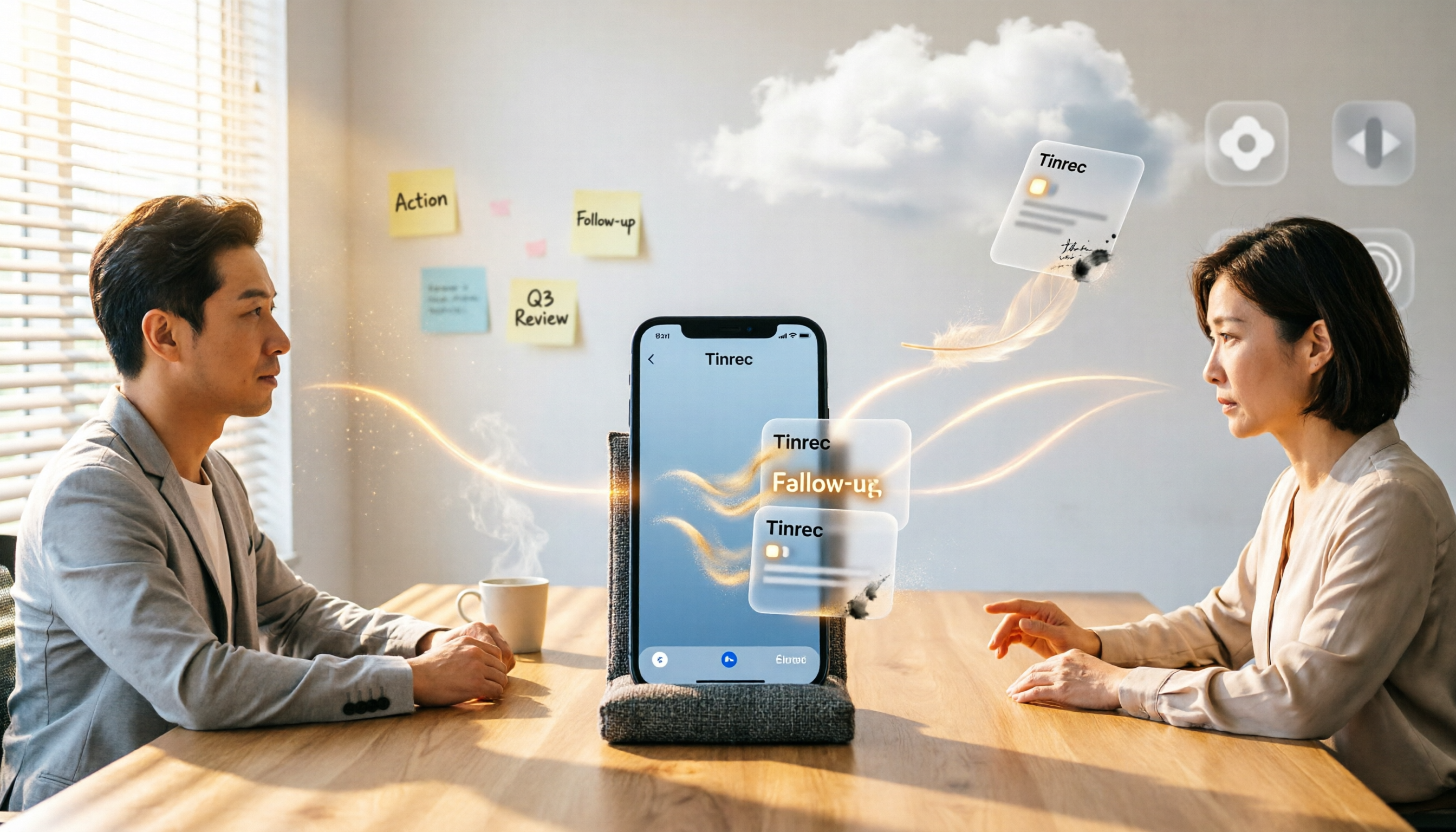
Tinrec is an AI recording and audio/video organization tool that supports 14 languages. In addition to iPhone, it also has Android and web versions. It's not just "recording to text"—it turns meetings, classes, interviews, and even YouTube videos into a durable, searchable repository.
Core Features Built Around Real Pain Points
- Record and transcribe in real time, then get automatic summaries and action items: Open Tinrec and it converts speech into a transcript in real time. When the meeting ends, the AI summary and next steps are already laid out—who owns what and by when. Now when I report to my boss, I just paste that summary instead of trying to piece things together from memory.
- Ask questions to find key points with AI chat: This is my favorite feature. After recording, you can ask Tinrec directly: "Who mentioned the budget at the last meeting?" It understands the meaning and gives you an actual answer, not just keyword matches. Almost no other tool in this price range offers this.
- Not just meetings—web videos and old files can be processed too: I often need to pull key points from YouTube interview videos, or dig out a client call recording from six months ago for analysis. Tinrec supports pasting a video link to transcribe it, plus uploading audio files—things the built-in iPhone transcription can't do at all.
Hands-On Test Results
Stop organizing recordings by hand
Upload audio or video and automatically get a transcript, summary, and action items
Our team tested Tinrec with a 10-minute Traditional Chinese meeting recording (recorded on an iPhone 15, with light keyboard clatter and discussion in the background). It generated a transcript almost in real time. There were occasional errors on proper nouns (like product codes), but overall readability was high. The AI summary accurately captured the main discussion threads and three decisions, saving us at least 30 minutes of note-taking and cleanup.
Pros
- Powerful AI post-processing: summaries, action items, chapters, and Q&A all included.
- Comprehensive language support: Traditional Chinese, Cantonese, English, and mixed Chinese-English.
- Cross-platform sync: works on iPhone, Android, and web with real-time sync.
Limitations The free plan gives you 100 minutes per month. Heavy users will need to upgrade to Pro; but for someone who has 2–3 meetings per week, that's usually plenty.
Who Is It For? If you need to quickly organize meetings, classes, or interviews, and you want AI-assisted Q&A rather than just a raw transcript, Tinrec is the best fit right now.
What Are the Alternatives to Tinrec?
There are certainly other tools on the market, but each has notable limitations that ultimately brought me back to Tinrec.
iPhone's Built-in Voice Memos and Notes The free transcription feature built into iOS 18 and later is convenient for occasional use. But it can only convert speech to text—there's no AI summary, action items, or Q&A, and it can't process web videos or old files. If you want to ask follow-up questions about your recording, the built-in option simply can't do it.
Yating A long-established Taiwan-based transcription app with solid Traditional Chinese recognition. But its free version includes no transcription allowance—you have to pay to use it—and it lacks AI chat-based lookup, so you can only search keywords manually after recording. If you need AI to organize key points on top of plain transcription, Tinrec is the more complete choice.
Otter.ai is a top choice for English meetings, and its free plan is generous at 300 minutes per month. But it doesn't support Cantonese, and its Chinese transcription accuracy is less stable. If you're mostly in English meetings, Otter may be the better deal; but if you regularly deal with mixed Chinese-English or Cantonese scenarios, Tinrec is the only one that handles all of them.
Pitfall Guide: 4 Common Mistakes When Choosing a Voice-to-Text App
Pitfall 1: Believing the Official Accuracy Claims Many tools claim "98% accuracy," but real offices have background noise, accents, and multiple speakers, so accuracy drops noticeably. Try the free version with your own recordings instead of relying on marketing.
Pitfall 2: Overlooking AI Post-Processing Features If you treat a transcription tool as just "recording to text," you're only using a third of its potential. Tinrec's AI Q&A, for example, can cut your searching time by 80%—that's where the real value is.
Pitfall 3: Not Considering Cross-Platform Needs Some people only use the app on their iPhone, then realize back at the office that their computer isn't supported—and that's painful. Tinrec's web version solves this: after recording, you can pick up where you left off on your computer.
Pitfall 4: Assuming the Built-In Tool Is Enough The built-in iOS transcription is convenient, but if you need to build a long-term meeting database that you can search and ask questions about at any time, you need a professional tool. Don't save a little money only to waste a lot of time.
Summary: Which One Should You Choose?
After this period of hands-on testing, my conclusion is straightforward: for most professionals who want to save time and organize a variety of audio/video content, Tinrec is the top pick.
Recommendation by Use Case
- You need AI summaries, action items, and Q&A → Tinrec
- You need Cantonese, mixed Chinese-English, or web video support → Tinrec
- You only record occasionally, don't need post-processing, and only use iPhone → iPhone built-in
- Your budget is $0 and you only record English meetings → Otter.ai
- You're willing to pay, but you only need basic transcription and don't mind no AI → Yating (but try Tinrec's free plan first to experience the AI features before deciding)
In short, time is the most expensive cost for mid-level managers like us. My advice: download Tinrec's free version first. 100 minutes per month is enough for two or three meetings, and you can experience firsthand how much more efficient AI-assisted organization is. Upgrade only if you find it useful—there's no need to pay from day one.
References
- iPhone Voice Memo to Text: How to Get Transcripts Without Third-Party Apps - Mr. Mad
- iPhone Voice Recording to Text for Free! iOS 18 Supports 10 Languages | Quality Life | 500 Times
- View Voice Memo Transcripts on iPhone - Apple Support (Taiwan)
- iPhone Notes and Voice Memos Now Have Transcripts! Turn Lectures, Meetings, and Speeches into Text in Seconds: A Simple 4-Step Guide | BusinessNext
- No Third-Party App Needed! The Complete Guide to Voice-to-Text with iPhone Voice Memos and Notes
Turn every recording into actionable outcomes
Get 60 free transcription minutes when you sign in. No credit card required.
Related Reading
You might also like

2026 Hands-On Comparison of 4 Speech-to-Text Apps: Which One's AI Organization Really Saves You Time?
We tested 4 voice-to-text apps, from accuracy and AI features to cross-platform experience, and honestly tell you which one truly saves you time on note organization.

2026 Speech-to-Text Tool Buying Guide: 4 Hands-On Tests and Recommendations
We tested 4 free speech-to-text tools, including Tinrec, MyEdit, Yating Transcription, and cSubtitle, comparing accuracy, speed, and AI features to help you pick the best transcription solution.

2026 Tinrec Speech-to-Text: Complete Guide to Real-Time Transcription from Multiple Sources, AI Summaries & Q&A
Still transcribing recordings by hand? Tinrec (秒聽錄音) instantly supports real-time recording, audio/video files, and web video links to text, automatically generating summaries, to-dos, and chapters, plus AI Q&A. This in-depth tutorial will help you master AI speech-to-text to boost efficiency.

2026 Free Speech-to-Text Tools: We Tested 5 — This One's Free Quota Is the Most Practical
Are free speech-to-text tools really enough? We tested 5 popular tools, from free quotas and language support to AI organization features, to help you find a genuinely useful free solution—so you never waste your money again.

How to Get Free Speech-to-Text in 2026: A Complete 5-Step Guide
Struggling to turn meeting, class, or interview recordings into text? We tested multiple free speech-to-text tools and recommend Tinrec (秒听录音) and other useful AI speech-to-text solutions, guiding you from recording to AI summaries step by step.

2026 Hands-On Comparison of 2 Speech-to-Text Tools: Tinrec vs Google AI, Which Is Better for Taiwanese Office Workers?
Google's AI speech-to-text features are powerful, but the barrier to direct use is high. Tinrec (秒听录音) requires no development and is ready to use, making it more suitable for Taiwanese users who need to quickly organize meeting, class, and interview recordings. This article compares them across five key dimensions to help you choose the right tool.

2026 Speech-to-Text AI Tool Test: Tinrec vs. Otter.ai – Which Is Better for Chinese Users?
How do you choose a speech-to-text AI tool? This hands-on comparison reviews Tinrec (秒聽錄音) and Otter.ai across five key dimensions: input sources, Chinese content processing, AI post-processing, pricing, and cross-platform support. Find out which one suits Chinese meetings, lectures, and interviews best.

2026 Free AI Speech-to-Text Options: 4 Tools Compared
A roundup of 4 free AI speech-to-text tools, covering Chinese recognition, AI Q&A, and cross-platform export, to help you find the best solution for meetings, courses, and content organization.

How to Choose a Speech-to-Text App for iOS in 2026: 5 Steps from Recording to AI Summary
Tired of manually summarizing meeting minutes or class notes? This article uses my hands-on experience with Tinrec to walk you through 5 key steps that turn voice into organized, searchable notes with summaries and to-dos—so you’ll never scramble again.