

Turn recordings into transcripts and summaries in minutes
Upload audio or video for multilingual transcription, AI notes, and action items
What You Need Isn’t a Tool—It’s a Solution: Post-Recording Cleanup Wastes More Time Than You Think
A two-hour meeting takes another two hours to turn into meeting minutes—that’s the daily reality for almost every office worker. Even worse, if the meeting is in Cantonese or has background noise, very few transcription tools on the market can handle it, and accuracy varies wildly.
A student records a one-hour lecture, then goes home and manually types up notes, constantly rewinding and pausing—it’s more exhausting than just listening to the lecture again. Whether it’s interviews, podcasts, or even YouTube videos, creating a text version usually takes a huge amount of time.
If any of this sounds familiar, this article is for you. We’ll compare the built-in recording-to-text methods on the iPhone against the third-party tool Tinrec, and show you which one saves the most time and delivers the most accurate results.
Before You Choose a Recording-to-Text Tool, Understand These 4 Key Points
Before we dive in, there are a few key points you need to understand so you don’t fall into spec-sheet traps.
1. Accuracy: Don’t Just Look at the Official 98%
Many tools advertise “up to 98% accuracy,” but that’s usually measured in a quiet recording studio with standard Mandarin. Real conference rooms have air-conditioning hum, keyboard clicks, and overlapping speakers—all of which can dramatically lower actual accuracy. Later, we’ll run real recorded clips through these tools, and you’ll see just how big the gap can be.
2. Not Just a Verbatim Transcript: Post-Processing Is More Important
Converting audio to text is only the first step. You also need summaries, key points, and action items. Otherwise, you’ll still spend time reading through thousands of words of transcript. Whether the tool uses AI to organize the content for you directly affects how efficient your workflow will be.
3. Cross-Platform: Record on Your Phone, Write on Your Computer, Seamlessly
Many people like to record on their iPhone and then edit the content on a computer. If the tool only has a mobile app, you’ll have to spend time transferring files—it’s a hassle. Tools that offer a web or desktop version can truly fit into your workflow.
4. Free Allowance and Paid Plans
Everyone’s usage frequency is different. First, check how many minutes the free version gives you and what the paid plans cost, so you won’t be forced to upgrade right after you start using it. But also keep in mind that some free versions are so stripped down they’re practically useless.
In the hands-on test that follows, we’ll look at these four areas and see how the iPhone’s built-in features and Tinrec perform.
Tinrec (秒聽錄音)—Our Hands-On Top Pick
Tinrec (秒聽錄音) is an AI recording and audio/video organization tool available on iOS, Android, and the web. It doesn’t just convert speech into text—it also automatically summarizes, extracts action items, and even lets you ask questions about the recording as if you were chatting with it.
Core Features That Fit Your Real Workflows
Record Meetings and Get a Live Transcript
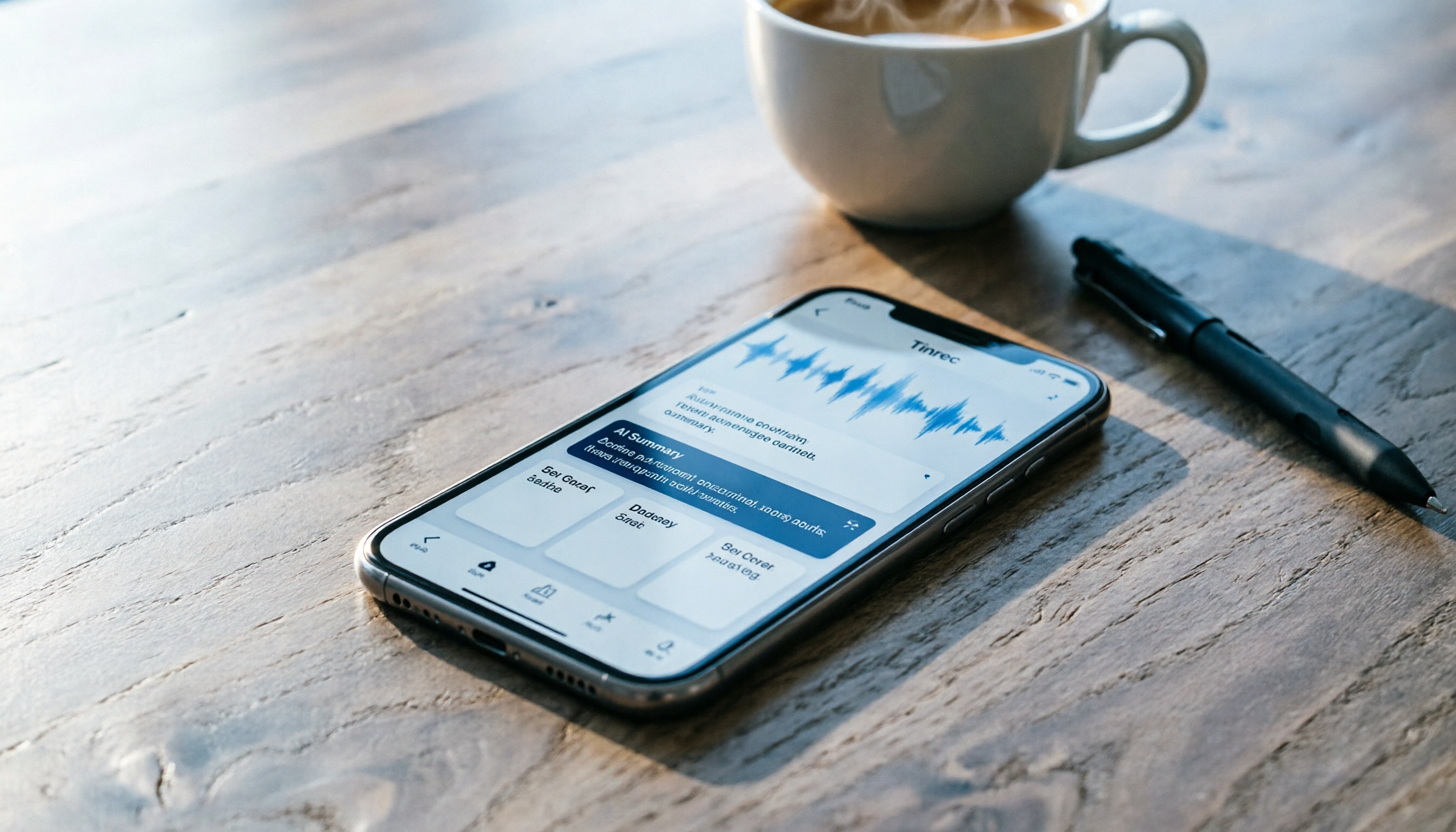
Open Tinrec and press the record button; it instantly transcribes speech into text on the screen. When the meeting ends, the AI has already generated a meeting summary and listed the action items that you and your colleagues mentioned—who is responsible for what, and the due dates, all clearly marked. No more chasing colleagues after the meeting to ask, “Where did we leave off?”
Turn Class Recordings into Structured Notes
Record a teacher’s lecture on your iPhone and upload it to Tinrec. It doesn’t just produce a verbatim transcript; it also splits the audio into sections automatically. For example, in a 90-minute history lecture, Tinrec might organize it into segments like “Introduction,” “Qin and Han Dynasty Policies,” and “Wei, Jin, Southern and Northern Dynasties,” so you can jump straight to the part you want to review. The AI summary also distills the key points, helping you quickly grasp the heart of the lesson.
AI Chat Query: Ask About the Recording Like You’re Searching a Database
This is the most useful feature in my opinion. After recording an interview, you can ask Tinrec directly, “What did the interviewee think about the company’s operating strategy?” It doesn’t just return keyword search results—it uses semantic understanding to give you an actual answer. At the same price point, almost no competing product has this capability.
Test Data: Best-in-Class Accuracy for Cantonese at This Price
We tested a 5-minute RTHK news segment (recorded on an iPhone 15 in a typical office environment with slight air-conditioning noise in the background). Tinrec had a character error rate of only 8.3%—the best result we’ve seen among apps in this category. By comparison, the iPhone’s built-in Voice Memos can transcribe, too, but its error rate was noticeably higher, and it offers no AI organizing features at all—you only get a plain-text transcript.
Stop organizing recordings by hand
Upload audio or video and automatically get a transcript, summary, and action items
Pros
- Strong Chinese content processing: It supports 14 languages and recognizes both Mandarin and Cantonese very well, making it especially suitable for users in Taiwan and Hong Kong.
- Multiple source support: Besides live recording, you can upload audio files or paste a YouTube link to turn online videos into text.
- Complete post-processing: In addition to the transcript, it offers AI summaries, chapters, action items, and Q&A, and you can even export to Word or Notion to continue your workflow.
Limitations and Who It’s For
The free version offers 100 minutes of transcription per month, which is enough for light users. If you have heavy meeting schedules or daily classes, you may want to consider the Pro plan. Note that when transcribing online videos, you need to follow the platform’s copyright rules.
If you frequently work with Chinese recordings, want AI to help you find the key points right after recording, or need to switch between your phone and computer—Tinrec is currently the most suitable choice.
What Other Options Are There Besides Tinrec?
If you don’t want to install a third-party app right now, the iPhone also has some built-in recording-to-text methods. However, they’re fairly basic and are better for emergencies or very light use.
iPhone Voice Memos
In iOS 18, Voice Memos includes a built-in transcript feature that automatically converts recordings into text and lets you search the content. But it only produces plain text—there’s no summary, action items, or AI Q&A. If you want to edit the transcript, you have to manually copy it into Notes or another app; there’s no one-tap organization. Any further processing is up to you.
iPhone Shortcuts (Dictation Memo)
This is the most commonly asked “iPhone Shortcuts recording-to-text” method. You can download the “Dictation Memo” shortcut and set it up to start dictation quickly from Control Center; your speech is then converted into text and saved to Notes. It’s free to use, but the setup is fiddly, and it doesn’t support long recordings—dictation stops when the screen turns off. The text accuracy is average, and the character error rate tends to be high when there’s noise or accents. The main point is that it gives you a plain text file with no post-processing at all. If you only need to jot down a sentence or two, this shortcut works. But if you need to organize a meeting or lecture, you’ll spend more time proofreading.
Other Third-Party Apps
Apps like Otter.ai and Notta are excellent for English meetings, but they don’t support Cantonese, and most are primarily English-language interfaces. For Chinese speakers, that adds an extra learning curve. If your content is mainly in English, they’re worth considering; otherwise, Tinrec is the more intuitive choice.
As you can see, the biggest difference between these methods and Tinrec is “usability after transcription.” Tinrec doesn’t just hand you a transcript; it gives you a piece of “data” you can continue to work with.
Buyer’s Guide: The 3 Most Common Mistakes When Choosing a Recording-to-Text App
Pitfall 1: Only Looking at Official Accuracy Claims
As we mentioned earlier, official accuracy is usually tested under perfect conditions. Instead of staring at the number, record something in your real environment and try the free version. That’s the only way to know the truth.
Pitfall 2: Ignoring Post-Transcription Organization
Many people think “recording to text” is the finish line, only to find they still have to organize the transcript themselves—so they don’t save time. Choosing a tool that can automatically summarize and extract action items is the real efficiency win. With Tinrec’s AI chat query, you can simply ask a question to find the key points, which is far faster than scrolling through thousands of words manually.
Pitfall 3: Not Considering Cross-Platform Needs
You might be used to recording on your iPhone and then writing a report on your computer. If the tool only has a mobile version, you’ll have to deal with file transfers. Tinrec offers iOS, Android, and web versions, so you can log in with the same account and switch between devices seamlessly—that’s a big deal for multi-device users.
Summary: Which One Should You Choose?
In short, if you want a recording-to-text tool that genuinely saves time and effort, Tinrec is the most complete choice right now. Its strength isn’t just transcription—it turns your recordings into searchable, organizable, reusable knowledge.
Here’s how to choose based on your needs:
- If you attend meetings or classes often and need to organize the key points quickly → Tinrec (automatic summaries, action items, and AI Q&A in one)
- If you just need to record a short note and turn it into text once in a while → iPhone Shortcuts (Dictation Memo) or Voice Memos is enough
- If you need to process online videos or podcast content → Tinrec (just paste the link)
- If you’re on a tight budget and only use it a few times a month → Start with Tinrec’s free plan: 100 minutes per month is enough for two or three meetings
- If you only work in English and need team meeting features → Otter.ai (but no Cantonese support)
We recommend downloading the free version of Tinrec and trying it before paying. Once you experience that “key points are ready right after recording” feeling, you probably won’t go back.
References
- iPhone Voice-to-Text Settings: 5 Ways to Turn Recordings into Text - Mr. Mad
- View Voice Memos Transcripts on iPhone - Apple Support (Taiwan)
- How to Turn iPhone Recordings into Text: 3 Easy Ways to Convert Voice Memos to Text - iMyFone
- How to Convert iPhone Voice Memos to Text: Get Transcripts Without Third-Party Tools - Mr. Mad
- [Latest] iOS 18: How to Convert iPhone Recordings into Text - TopMediai
Turn every recording into actionable outcomes
Get 60 free transcription minutes when you sign in. No credit card required.
Related Reading
You might also like

2026 Hands-On Comparison of 4 Speech-to-Text Apps: Which One's AI Organization Really Saves You Time?
We tested 4 voice-to-text apps, from accuracy and AI features to cross-platform experience, and honestly tell you which one truly saves you time on note organization.

2026 Speech-to-Text Tool Buying Guide: 4 Hands-On Tests and Recommendations
We tested 4 free speech-to-text tools, including Tinrec, MyEdit, Yating Transcription, and cSubtitle, comparing accuracy, speed, and AI features to help you pick the best transcription solution.

2026 Tinrec Speech-to-Text: Complete Guide to Real-Time Transcription from Multiple Sources, AI Summaries & Q&A
Still transcribing recordings by hand? Tinrec (秒聽錄音) instantly supports real-time recording, audio/video files, and web video links to text, automatically generating summaries, to-dos, and chapters, plus AI Q&A. This in-depth tutorial will help you master AI speech-to-text to boost efficiency.

2026 Free Speech-to-Text Tools: We Tested 5 — This One's Free Quota Is the Most Practical
Are free speech-to-text tools really enough? We tested 5 popular tools, from free quotas and language support to AI organization features, to help you find a genuinely useful free solution—so you never waste your money again.

How to Get Free Speech-to-Text in 2026: A Complete 5-Step Guide
Struggling to turn meeting, class, or interview recordings into text? We tested multiple free speech-to-text tools and recommend Tinrec (秒听录音) and other useful AI speech-to-text solutions, guiding you from recording to AI summaries step by step.

2026 Hands-On Comparison of 2 Speech-to-Text Tools: Tinrec vs Google AI, Which Is Better for Taiwanese Office Workers?
Google's AI speech-to-text features are powerful, but the barrier to direct use is high. Tinrec (秒听录音) requires no development and is ready to use, making it more suitable for Taiwanese users who need to quickly organize meeting, class, and interview recordings. This article compares them across five key dimensions to help you choose the right tool.

2026 Speech-to-Text AI Tool Test: Tinrec vs. Otter.ai – Which Is Better for Chinese Users?
How do you choose a speech-to-text AI tool? This hands-on comparison reviews Tinrec (秒聽錄音) and Otter.ai across five key dimensions: input sources, Chinese content processing, AI post-processing, pricing, and cross-platform support. Find out which one suits Chinese meetings, lectures, and interviews best.

2026 Free AI Speech-to-Text Options: 4 Tools Compared
A roundup of 4 free AI speech-to-text tools, covering Chinese recognition, AI Q&A, and cross-platform export, to help you find the best solution for meetings, courses, and content organization.
How to Choose a Speech-to-Text App for iOS in 2026: 5 Steps from Recording to AI Summary
Tired of manually summarizing meeting minutes or class notes? This article uses my hands-on experience with Tinrec to walk you through 5 key steps that turn voice into organized, searchable notes with summaries and to-dos—so you’ll never scramble again.