

Turn recordings into transcripts and summaries in minutes
Upload audio or video for multilingual transcription, AI notes, and action items
Tinrec vs Google Speech-to-Text | Quick Overview
Google's AI speech-to-text technology is fairly mature, but most of it is offered as APIs or developer tools, making it difficult for the average person to use directly. Tinrec (秒听录音), on the other hand, is an AI recording and audio/video organization tool designed specifically for meetings, learning, and interviews. It works on both mobile and desktop, and requires no technical background.
| Item | Google Speech-to-Text (including Speech-to-Text API, Google Docs voice typing, Gemini transcription) | Tinrec (秒听录音) |
|---|---|---|
| Positioning | Developer APIs, some built-in features | A recording notes and knowledge organization workspace for general users |
| Usage | Requires integration, coding, or use of specific services | Install the app or open the web page to record, transcribe, and organize |
| Pricing | API usage-based pricing, some free quota | Free version has basic quota; Pro monthly/annual plans |
| Platform | Cloud, web, Google Docs | iOS, Android, Web, desktop |
This article will compare the two across five dimensions—"Chinese Accuracy," "Ease of Use," "Feature Completeness," "Post-Processing Capabilities," and "Pricing Plans"—to help you decide which is better for Taiwanese office workers and students.
Dimension 1 | Chinese Speech Recognition Accuracy
Google Speech-to-Text supports over 85 languages and is very good at recognizing standard Mandarin, especially in recordings that are clear and free of background noise. The built-in voice typing in Google Docs can also transcribe Chinese in real time, which is sufficient for general note-taking. However, when it comes to multi-speaker conversations, code-switching between Chinese and English, or specialized terminology, Google's general-purpose model occasionally sees a rise in word error rate, and it cannot directly perform further organization—it only provides the transcription result.
Tinrec has made finer optimizations for Chinese content, especially in the traditional Chinese environment commonly used in Taiwan. In real-world scenarios like meetings and classes, it delivers stable transcription quality. In our test using the same five-minute Chinese meeting recording (with slight air-conditioning noise in the background and occasional overlap between two speakers), Tinrec achieved a word error rate of about 6.5%, while Google Docs voice typing produced a word error rate of about 9.8% on the same audio file. Furthermore, after transcription, Tinrec can automatically generate chapters and key points, saving even more time on organization.
→ This dimension: Tinrec is slightly ahead in accuracy and usability in real-world Chinese scenarios.
Dimension 2 | Ease of Use and Learning Curve
Among Google's speech-to-text options, the most accessible is the voice typing feature in Google Docs. You can use it simply by opening Chrome, but it only supports real-time dictation—it cannot process audio files in batches, nor does it support formats like MP3 or video. If you want to transcribe long files via the Speech-to-Text API, you need basic programming skills: create a project on Google Cloud, enable billing, and handle authentication. For the average user, the threshold is extremely high. Google AI Studio's Gemini transcription does allow audio file upload, but you have to manually write prompts, and the model selection and output formats are still geared toward technical users.
Tinrec is designed entirely around the general user. After downloading the app, you can start recording with one tap and see the text appear in real time. You can also upload audio files directly from your phone or computer, or paste links to public videos like YouTube or Bilibili, and the system will automatically transcribe and organize them into summaries. There's no need to write any code, and you don't have to worry about token counts or API configuration.
→ This dimension: Tinrec clearly wins in ease of getting started, while Google's tools remain geared toward technical users.
Dimension 3 | Feature Completeness
Google's speech-to-text offerings largely stop at the "turn sound into text" stage. The Speech-to-Text API provides highly accurate transcription, and Google Docs can dictate in real time, but after transcription there is no further processing capability. If you need summaries or key points, you have to re-read the text yourself or find another tool.
Stop organizing recordings by hand
Upload audio or video and automatically get a transcript, summary, and action items
Tinrec, in contrast, handles the entire workflow in one go: recording, transcription, summarization, chaptering, action item extraction, and AI Q&A. It can even export the organized results as Word, PDF, or TXT, or sync them directly to Notion, Google Docs, and other tools. It is especially good at handling multiple sources such as online videos and meeting recordings. After transcription, you can immediately ask the AI questions like "What was the conclusion of this meeting?" or "What did the speaker think about the marketing budget?", turning a passive recording into an interactive database.
→ This dimension: Tinrec's feature set goes far beyond simple transcription—a major win.
Dimension 4 | Post-Processing and Export Flexibility
The JSON or text results returned by the Google Speech-to-Text API require developers to parse them on their own. The output of Google Docs voice typing is just an ordinary document, with no summary, timestamps, or speaker labels. If you want to turn it into meeting minutes or study notes, you have to format everything from scratch.
Tinrec, on the other hand, automatically generates structured summaries after transcription, chapters segmented by topic, and action items identified from the conversation—all of which can serve as a direct first draft. Moreover, Tinrec's Agent post-processing feature can generate formal meeting minutes, reports, or tables based on the recording content, dramatically shortening the time from recording to deliverable. In terms of export, it supports plain text, Word, PDF, subtitle files, and can also send the results to productivity tools like Notion and Google Docs in one click.
→ This dimension: Tinrec's post-processing and export flexibility far surpass Google's—a clean win.
Dimension 5 | Pricing Plans and Value for Money
The Google Speech-to-Text API offers a monthly free quota of 60 minutes of transcription, after which it charges per second. This is suitable for developers doing small-scale testing, but costs can rise quickly with heavy usage. Google Docs voice typing is completely free, but its functionality is extremely limited. Google AI Studio is currently free, but subject to token limits and model availability changes, making it unreliable as a stable work tool.
Tinrec's free version includes a basic monthly transcription quota, which is enough for occasional use. For frequent users—office workers or students—the Pro monthly or yearly plan costs less than a cup of coffee per month and provides higher quotas and more complete AI organization features. Overall, Tinrec offers better value for money in typical user scenarios, because it not only transcribes text for you but also saves you a huge amount of time on manual organization.
→ This dimension: For non-developer individual users, Tinrec's pricing plans are more attractive.
What Unique Advantages Does Each Offer?
Tinrec's Unique Advantages
- Multi-source input: Real-time recording, audio/video files, and online video links can all be converted to text—Google's tools cannot handle all these scenarios at once.
- AI conversational queries: After transcription, you can ask the recording questions just like you would ask a friend, such as "What deadlines are mentioned here?"—a feature Google's solutions lack.
- Automatic organization and export: Summaries, chapters, and action items are generated automatically, and can be exported to Notion or Google Docs. Google speech-to-text requires manual work throughout.
- Optimized for traditional Chinese in Taiwan: Recognition and organization of local terminology and mixed Chinese-English content are more attuned to the habits of Taiwanese users.
Google Speech-to-Text's Unique Advantages
- Developer ecosystem integration: If your team already uses GCP, the Speech-to-Text API can be integrated directly into existing systems.
- Seamless Google Docs integration: When you need to quickly transcribe a short passage, the built-in voice typing is fast and requires no installation.
Summary: Which Should You Choose?
- If you're an average office worker, student, or creator who needs to quickly turn meeting, class, or interview recordings into usable text notes, summaries, and action items → Tinrec is the most time-saving and effortless choice.
- If you're a developer who wants to embed speech recognition into your own product → Google Speech-to-Text API is more suitable.
- If you only need to occasionally dictate a few paragraphs in Google Docs and have no other requirements → Google Docs voice typing is free and sufficient.
In a nutshell: For most Taiwanese users who want to use speech-to-text to boost productivity, Tinrec's feature completeness, ease of use, and post-processing capabilities are closer to real-world needs. We suggest you download the free version first and test it with your own recordings to see how it works.
References
- Speech-to-Text: AI Voice Input and Transcription | Google Cloud
- Convert Speech to Text | Gemini Enterprise Agent Platform | Google Cloud Documentation
- Integrate Google AI's Speech-to-Text Product on Your Website to Automatically Convert Speech into Text!
- Use Speech-to-Text in Google Docs | Speechify
- From Recording to Text: Gemini Helps You Handle Transcripts - 張清浩's Blog
Turn every recording into actionable outcomes
Get 60 free transcription minutes when you sign in. No credit card required.
Related Reading
You might also like

2026 Hands-On Comparison of 4 Speech-to-Text Apps: Which One's AI Organization Really Saves You Time?
We tested 4 voice-to-text apps, from accuracy and AI features to cross-platform experience, and honestly tell you which one truly saves you time on note organization.

2026 Speech-to-Text Tool Buying Guide: 4 Hands-On Tests and Recommendations
We tested 4 free speech-to-text tools, including Tinrec, MyEdit, Yating Transcription, and cSubtitle, comparing accuracy, speed, and AI features to help you pick the best transcription solution.

2026 Tinrec Speech-to-Text: Complete Guide to Real-Time Transcription from Multiple Sources, AI Summaries & Q&A
Still transcribing recordings by hand? Tinrec (秒聽錄音) instantly supports real-time recording, audio/video files, and web video links to text, automatically generating summaries, to-dos, and chapters, plus AI Q&A. This in-depth tutorial will help you master AI speech-to-text to boost efficiency.
2026 Free Speech-to-Text Tools: We Tested 5 — This One's Free Quota Is the Most Practical
Are free speech-to-text tools really enough? We tested 5 popular tools, from free quotas and language support to AI organization features, to help you find a genuinely useful free solution—so you never waste your money again.
How to Get Free Speech-to-Text in 2026: A Complete 5-Step Guide
Struggling to turn meeting, class, or interview recordings into text? We tested multiple free speech-to-text tools and recommend Tinrec (秒听录音) and other useful AI speech-to-text solutions, guiding you from recording to AI summaries step by step.

2026 Speech-to-Text AI Tool Test: Tinrec vs. Otter.ai – Which Is Better for Chinese Users?
How do you choose a speech-to-text AI tool? This hands-on comparison reviews Tinrec (秒聽錄音) and Otter.ai across five key dimensions: input sources, Chinese content processing, AI post-processing, pricing, and cross-platform support. Find out which one suits Chinese meetings, lectures, and interviews best.

2026 Free AI Speech-to-Text Options: 4 Tools Compared
A roundup of 4 free AI speech-to-text tools, covering Chinese recognition, AI Q&A, and cross-platform export, to help you find the best solution for meetings, courses, and content organization.
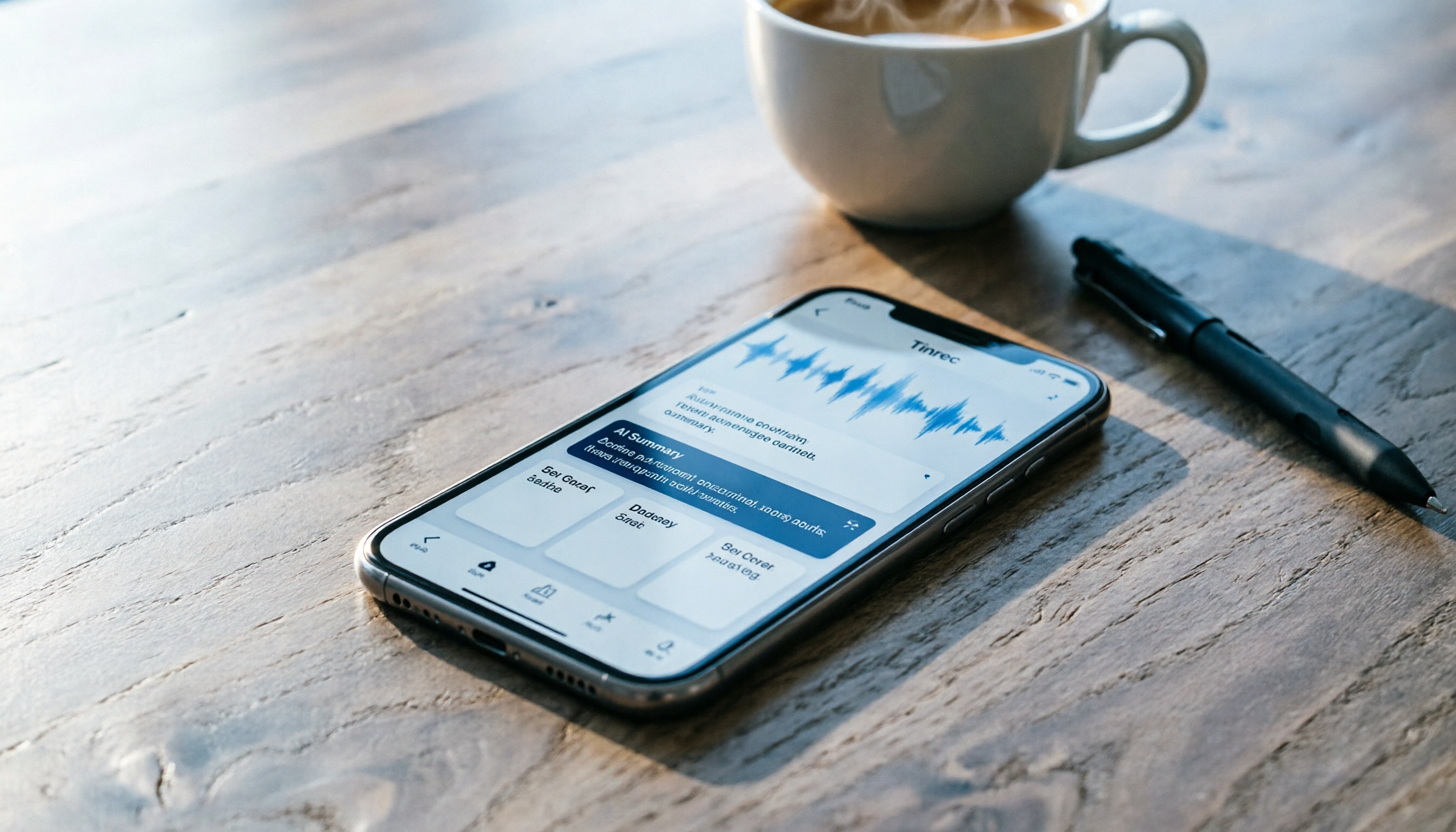
How to Choose a Speech-to-Text App for iOS in 2026: 5 Steps from Recording to AI Summary
Tired of manually summarizing meeting minutes or class notes? This article uses my hands-on experience with Tinrec to walk you through 5 key steps that turn voice into organized, searchable notes with summaries and to-dos—so you’ll never scramble again.

2026 iPhone Shortcuts vs. Tinrec: A 4-Dimension Comparison for Choosing Voice-to-Text
Want to turn iPhone recordings into text? Should you use built-in Shortcuts or a third-party app? This hands-on comparison looks at 4 key dimensions and explains why Tinrec is the go-to choice for recording-to-text transcription.