
Turn recordings into transcripts and summaries in minutes
Upload audio or video for multilingual transcription, AI notes, and action items
Have you ever spent hours pausing and replaying a 1-hour YouTube interview just to type out the transcript manually? Or struggled to find key points in an online course because there were no text handouts?
For content creators, students, and professionals, the need to convert video to text is growing. However, many tools have poor support for Traditional Chinese or lack key summarization features. This article evaluates the most noteworthy YouTube-to-transcript solutions in 2026, provides a detailed comparison table and selection tips, and demonstrates how to use AI tools to quickly extract video highlights.
Quick Navigation Guide:
- If you only need basic subtitles: use YouTube's built-in subtitle feature.
- If you need professional timeline editing: consider tools like Taption.
- If you want "transcription + AI summary + query dialogue" all in one: try Tinrec, an all-in-one AI assistant.
Why Do You Need a YouTube Video to Transcript Tool?
In the age of information overload, video content often has lower "information density" than text. Converting video to text solves three major pain points:
- Hard to search and review: Videos can't be searched with Ctrl+F like documents; converting to text lets you quickly locate key points.
- Time-consuming transcription: Manually transcribing a 1-hour video can take 3-4 hours; AI tools reduce this to minutes.
- Lack of structured summaries: Plain transcripts are still tedious to read; modern workers need AI-generated key summaries and actionable conclusions.
2026 Popular YouTube Video to Text Tools Comparison
When choosing a tool, besides transcription accuracy, pay attention to "post-processing" efficiency. Below is a comparison of three common solutions:
| Comparison Dimension | YouTube Built-in Subtitles | Traditional Transcription Software | Tinrec (AI Recording Assistant) |
|---|---|---|---|
| Traditional Chinese Support | Average (often has errors, mixed simplified/traditional) | High (needs manual proofreading or professional engine) | High (supports Traditional Chinese, Cantonese, etc.) |
| Input Method | No input needed (watch directly) | Download video file and upload | Supports direct YouTube link parsing |
| AI Key Summaries | None | Partial support | Auto-generates meeting minutes/to-do items |
| AI Query Dialogue | None | Rare | Supports (ask questions about the content) |
| Export Formats | Text only (requires plugin) | SRT/Word/TXT | TXT/Markdown/PDF/Audio |
| Best For | Simply understanding video content | Subtitle creation, professional transcription | Study notes, meeting summaries, content creation |
In-Depth Analysis: Tinrec's Differentiating Features
Among many tools, Tinrec positions itself not just as a "transcription tool" but as an assistant that turns audio/video into action. For users who need to organize YouTube content, it has several notable features:
Stop organizing recordings by hand
Upload audio or video and automatically get a transcript, summary, and action items
1. Direct Link Parsing, No Need to Download Videos
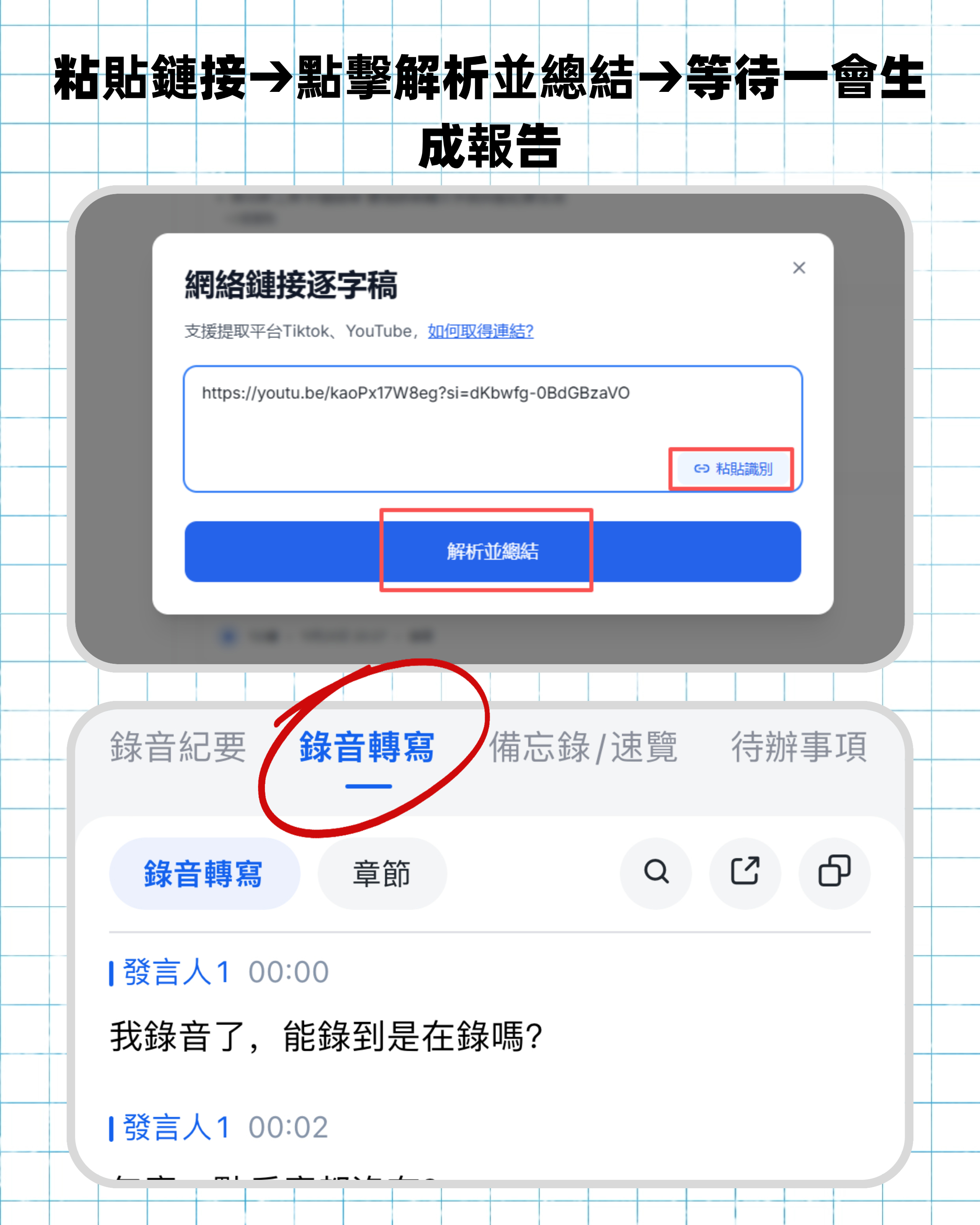
Many transcription tools require you to download YouTube videos as MP3 or MP4 files before uploading, which is cumbersome on mobile and consumes storage. Tinrec supports pasting YouTube or podcast links directly; the system automatically parses and transcribes in the cloud, saving download and conversion time.
2. From Transcript to AI Understanding
Tinrec not only provides a coherent transcript but also uses AI to analyze content, automatically generating summaries and action items. This is especially useful for tutorial videos or business interviews, allowing you to grasp core points at a glance without reading the entire transcript.
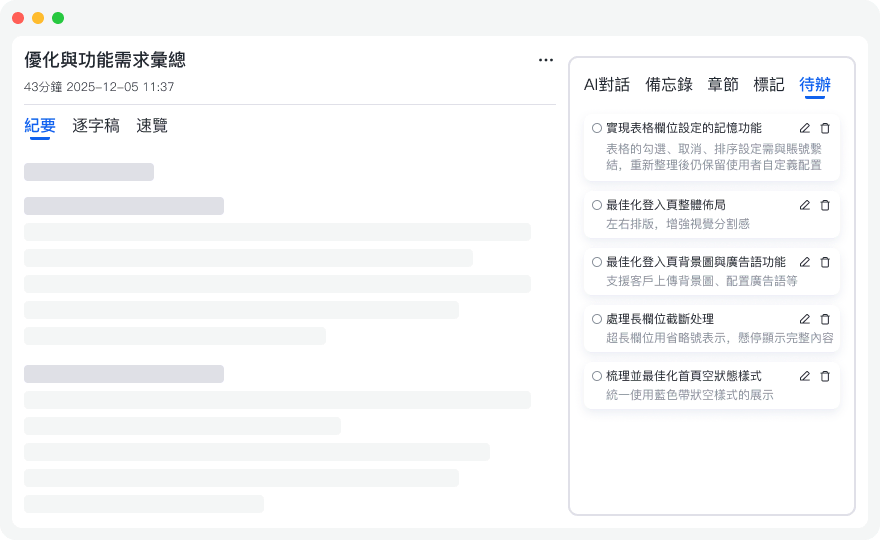
3. "Dialogue" with Your Video Content
This is the biggest difference from traditional tools. If a video is 2 hours long, you can simply ask in Tinrec's AI chat: "What was the speaker's conclusion about AI trends?" The system will answer based on the recording, enabling true knowledge retrieval.
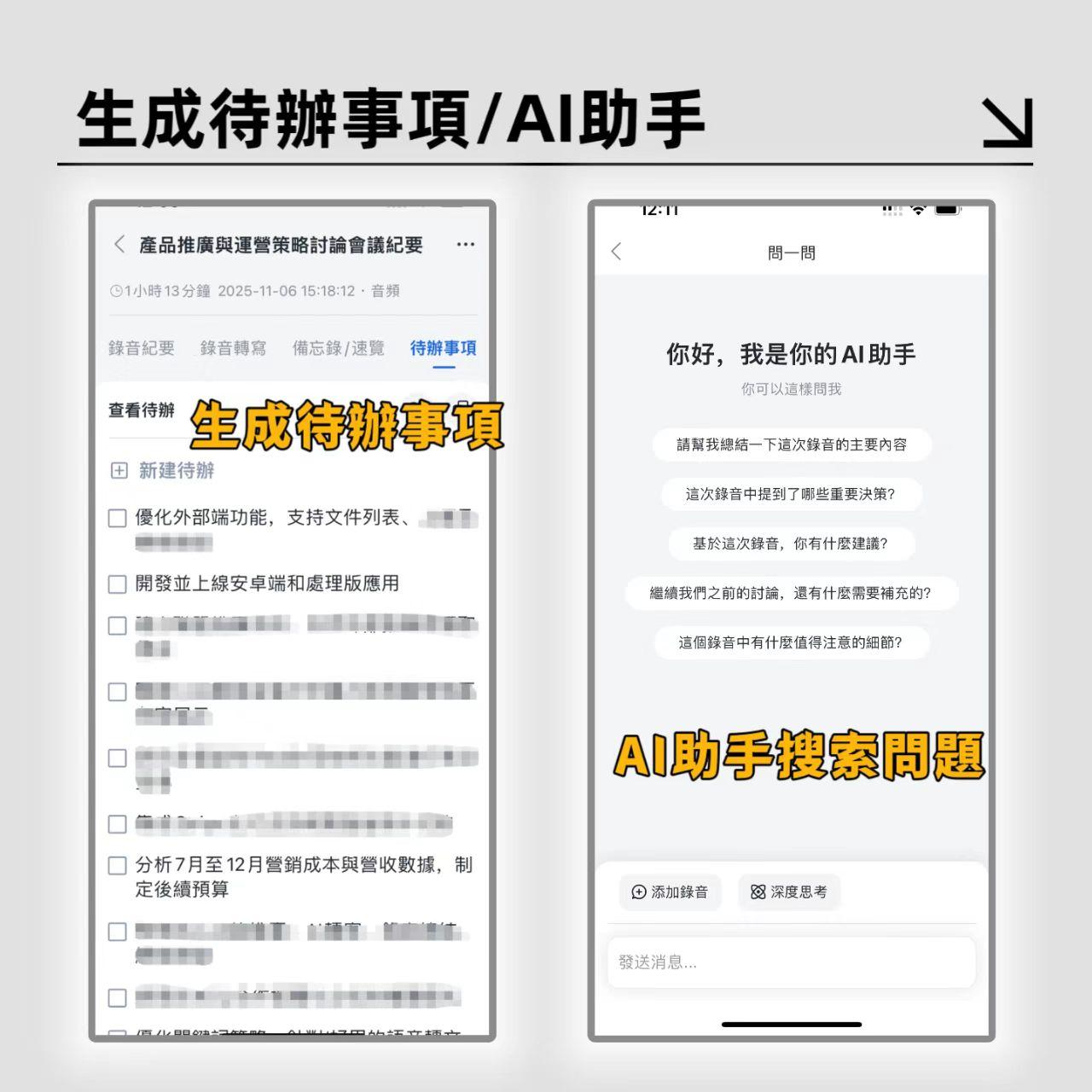
Practical Tutorial: How to Quickly Convert YouTube Videos into Traditional Chinese Notes
Here's a step-by-step guide on using Tinrec to turn a YouTube video into editable notes and summaries:
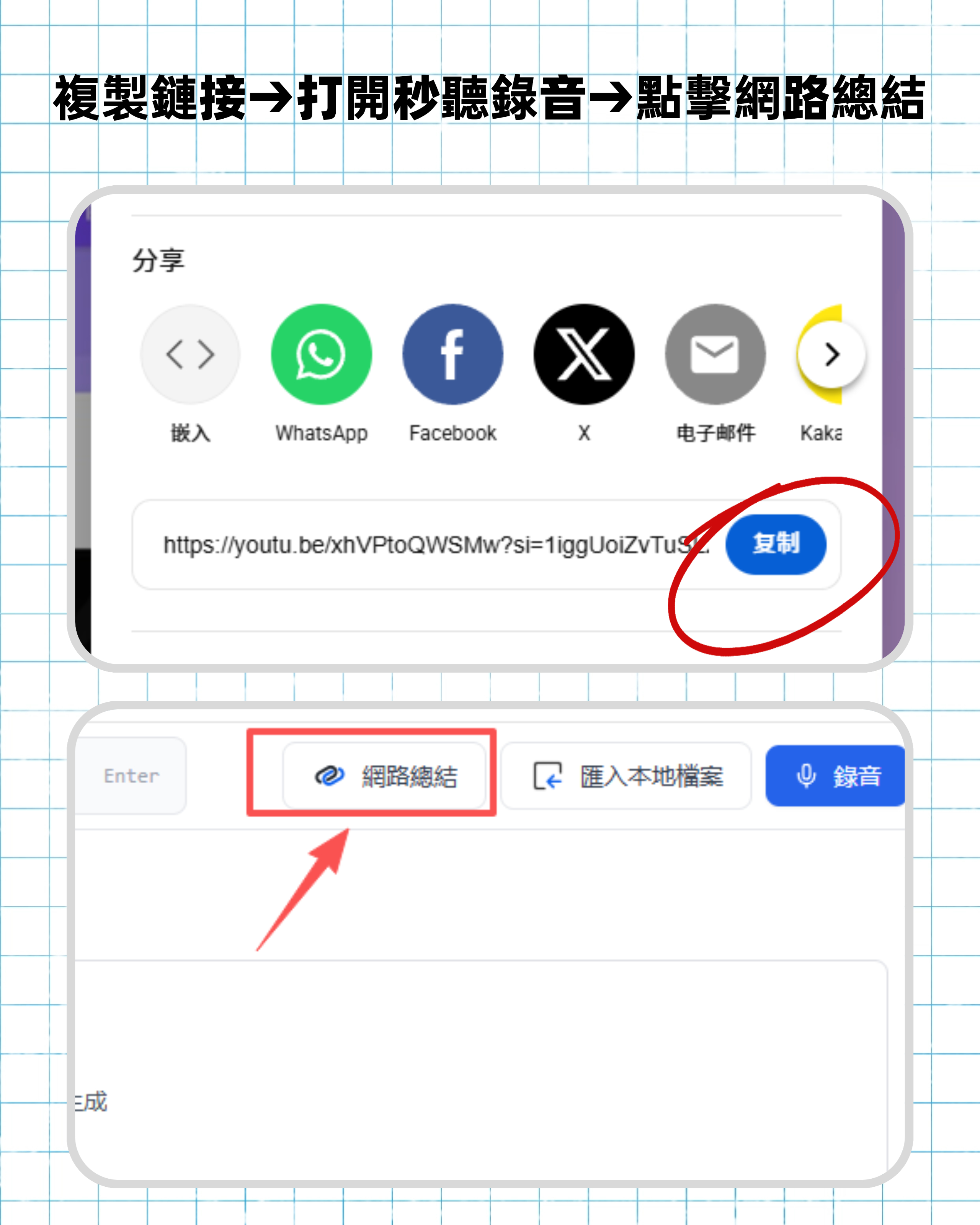
Step 1: Get the Video Link Open the YouTube app or website, find the video you want to process (e.g., online course, product launch, interview), tap "Share" and select "Copy Link."
Step 2: Use "Video to Text" Feature Open Tinrec (web or app), find the "Podcast/Online Video to Text" function.
- Action: Paste the copied YouTube link into the input field.
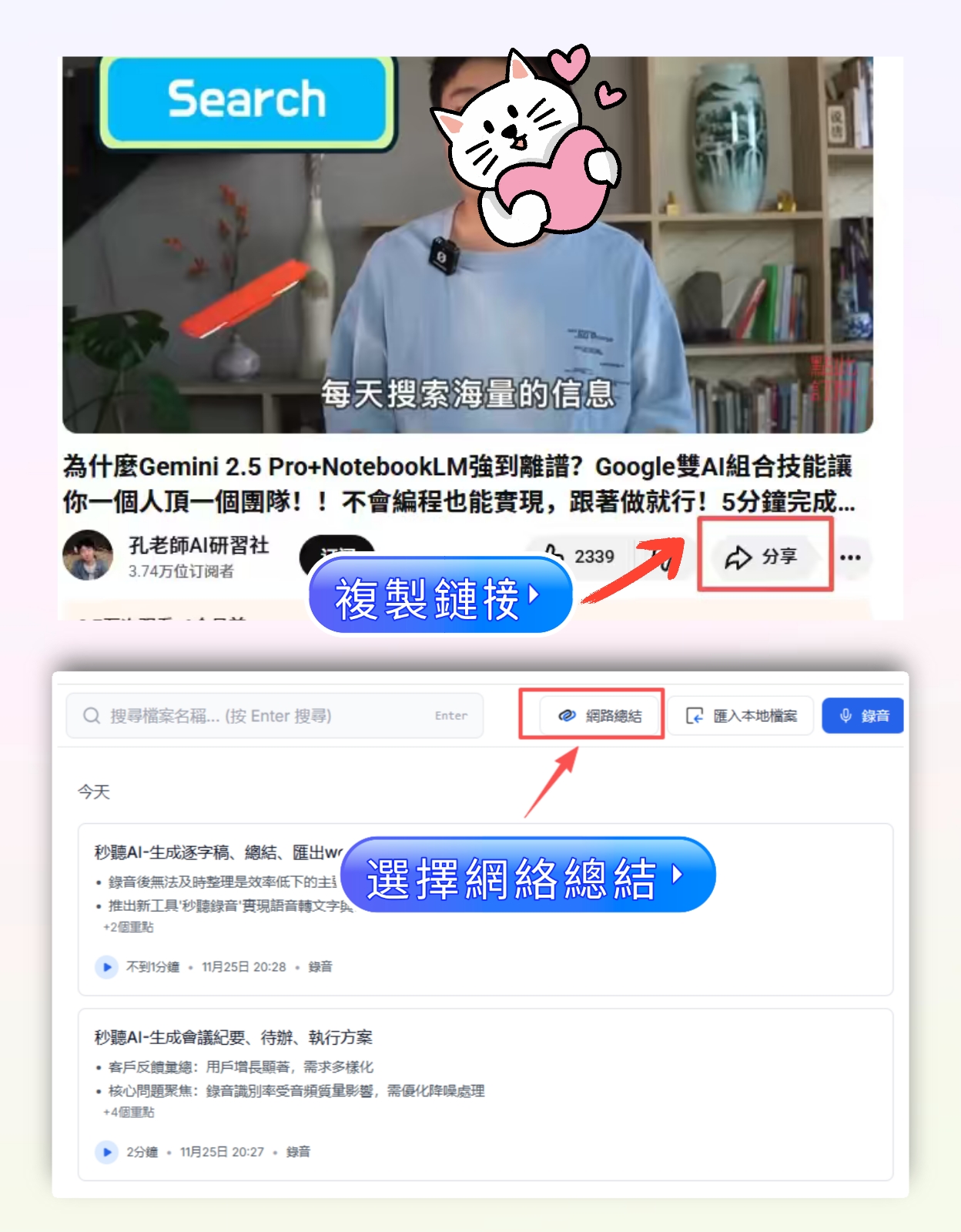
Step 3: Select Language and Transcribe In language settings, choose "Chinese" (the system will automatically detect Traditional Chinese context). Click start transcription; the system processes in the cloud, usually faster than the video length.
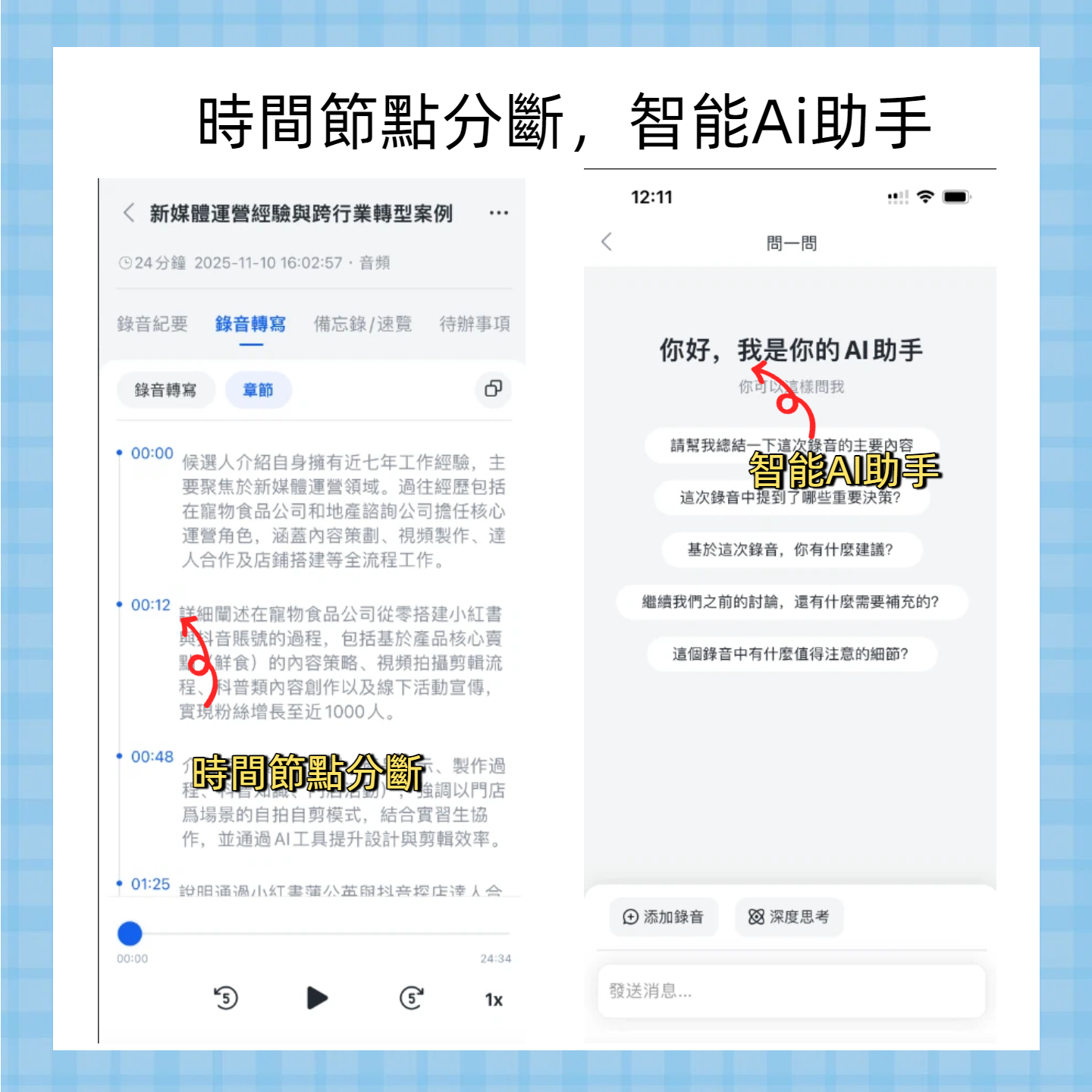
Step 4: View Summary and AI Query After transcription, you'll get:
- Full transcript: with timestamps and speaker differentiation.
- AI summary: key notes auto-generated.
- AI chat window: ask questions directly, e.g., "List three key data points mentioned by the speaker."
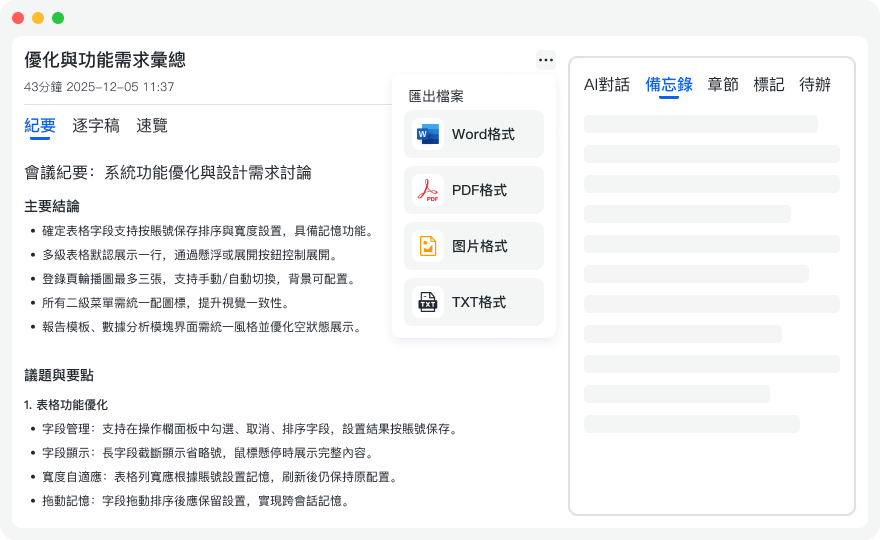
Step 5: Export and Share Finally, export the organized content as PDF, Markdown, or Word, save to Notion, or share with your team.
FAQ
Q1: What languages do YouTube-to-transcript tools support? Most tools support English, but support for Chinese (especially Traditional Chinese) varies. Tinrec supports Chinese, English, Japanese, Korean, Cantonese, and 10 other languages, suitable for international content.
Q2: Are the transcripts accurate? AI transcription accuracy is typically above 90%, best for clear interviews or speeches. Accuracy may drop with loud background music or multiple speakers. Choose tools that support audio file upload for noise reduction if needed.
Q3: Can I use it on mobile? Yes. Tinrec supports iOS, Android, and web, with cross-platform account sync. Copy a YouTube link on your phone to transcribe, then edit on your computer.
Q4: What are the free version limits? Most tools use a freemium model. Tinrec's free plan offers up to 100 minutes of recording/transcription per month, enough for occasional short videos. Upgrade to Basic or Pro for heavy use.
Q5: Can I export only the summary? Yes. Modern AI tools like Tinrec focus on understanding; you can copy the AI-generated meeting minutes or action items without exporting the full transcript.
Q6: Can I directly translate foreign videos? Some tools support post-transcription translation. Tinrec has multilingual recognition, can transcribe foreign audio, and uses AI chat to help you understand content in Chinese, achieving a translation-like note-taking effect.
Turn every recording into actionable outcomes
Get 60 free transcription minutes when you sign in. No credit card required.
Related Reading
You might also like

2026 Hands-On Comparison of 2 Speech-to-Text Tools: Tinrec vs Otter.ai—Which Is More Practical for Bot-Free Meeting Notes and Chinese Summaries?
This article compares Tinrec and Otter.ai, two AI meeting note tools, across five dimensions: meeting capture, Chinese transcription, AI post-processing, team collaboration, and cross-platform support. It also compiles real user feedback from PTT in 2024 to help you choose the best option for Taiwanese office workers.

2026 Tinrec Voice-to-Text Tutorial: Cantonese Support & AI Meeting Minutes
We tested Tinrec (Miao Ting Lu Yin) and show you how to use AI to quickly convert recordings to text, automatically generate meeting minutes and action items, saving hours of manual transcription.

2026 Tinrec Review: A Yating Transcript Alternative with Bot-Free Recording & AI Meeting Minutes
This tutorial explains how to use Tinrec as a replacement for Yating Transcript, enabling bot-free online meeting recording, real-time transcription, and AI-generated meeting minutes—ideal for professionals who need to quickly organize meeting notes.

2026 Hands-On Comparison of 2 Recording-to-Text Tools: Tinrec vs Otter.ai – Which One Should Hong Kong Professionals Choose?
A hands-on comparison of Tinrec and Otter.ai, two recording-to-text tools, across five key dimensions: Cantonese recognition, bot-free meeting recording, AI Q&A, cross-platform use, and team collaboration, to help Hong Kong professionals pick the best option.

2026 Hands-On Comparison of 4 Recording-to-Text Tools: Tinrec's Chinese Meeting Summaries Impress the Most?
PTT users often ask how to choose a recording-to-text app. This article focuses on Tinrec, testing the free quotas, Chinese accuracy, and AI summarization capabilities of 4 tools, covering complete use cases for meetings, interviews, and classes, along with purchasing considerations to help you avoid common pitfalls.

2026 Review of 3 Transcription Tools: How Tinrec Saves Hours on Dcard Users' Biggest Pain Point
Struggling to choose a transcription tool? This article starts with common pain points from Dcard users and tests Tinrec's real-time transcription, AI summaries, and team collaboration to help you save hours of manual transcription.

Tinrec Recording-to-Text in 2026: Cantonese Transcription + Auto Meeting Minutes
Hands-on test of Tinrec recording-to-text: Cantonese transcription, AI meeting minutes, and bot-free recording. See how it compares and where it fits.

2026 iPhone Recording-to-Text Test: Built-in Voice Memos vs Tinrec, 3-Dimension Comparison, Which Is Worth It?
How to choose iPhone recording-to-text tools? This article tests the built-in Voice Memos and Tinrec, comparing accuracy, language support, and post-processing, and shares pitfalls to avoid and buying advice.

The Complete Guide to Recording-to-Text in 2026: Hands-On Free Tools and Time-Saving Tips for Students
A senior student tests multiple recording-to-text tools, sharing how to choose and use free versions, leverage AI to organize transcripts, and why Tinrec is the top choice for Chinese-language courses and meetings.