
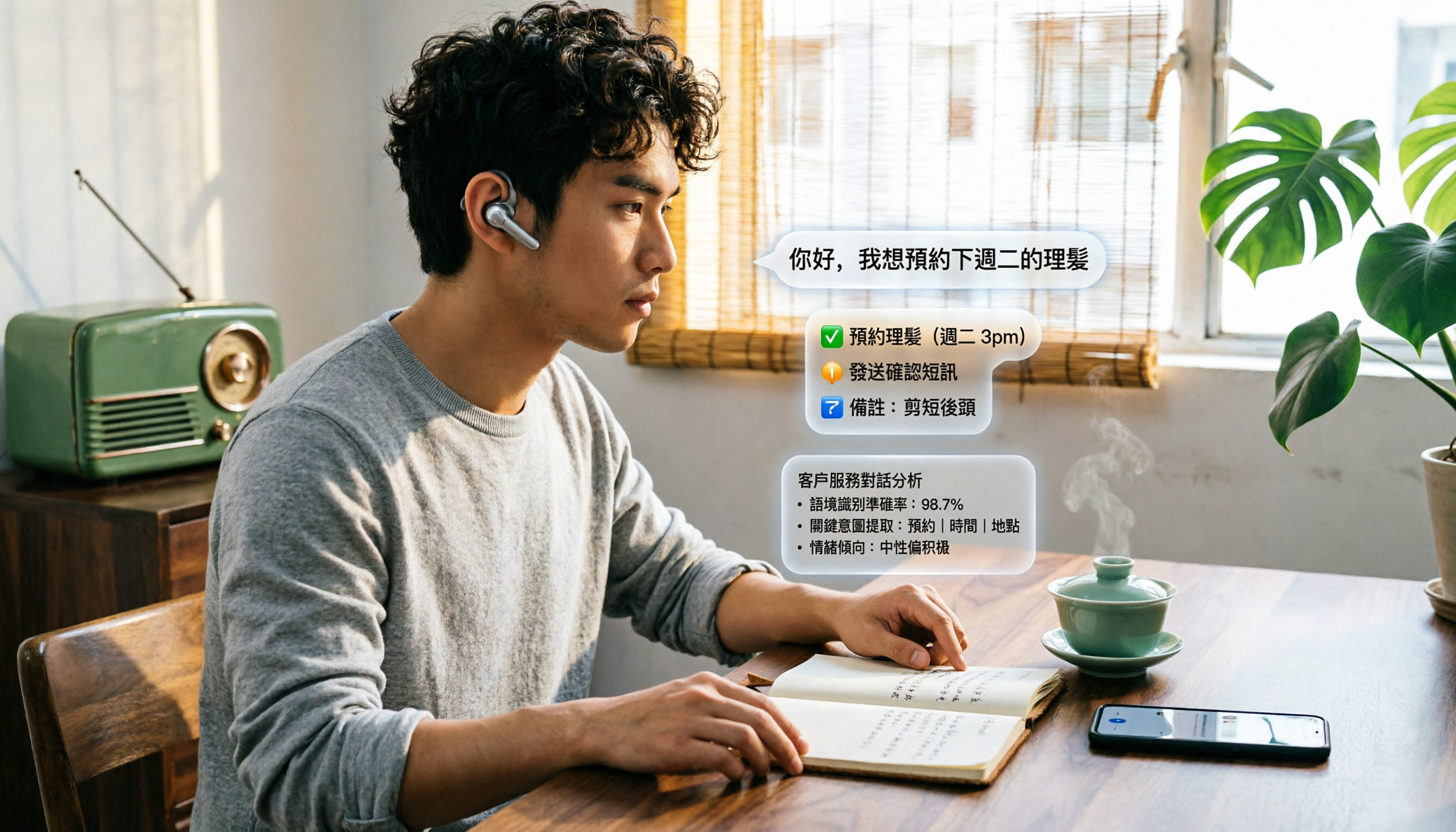
Turn recordings into transcripts and summaries in minutes
Upload audio or video for multilingual transcription, AI notes, and action items
More Than Transcription: I Need Content I Can Actually Use
Last month, I got a task: turn a two-hour Cantonese internal training recording into organized study notes.
I figured with so many speech-to-text tools out there, it shouldn't be hard.
But after trying several, I realized the problem isn't whether the transcription works—it's that after getting the transcript, I'm still overwhelmed.
Sure, I had the verbatim transcript. But with two hours of conversation, where do I even start? Which part is the key point? What action items did the instructor decide on at the end?
So I started thinking: for Cantonese speech-to-text, what I really need isn't just a transcript—it's a tool that directly helps me digest the content.
This article is my hands-on comparison of several Cantonese speech-to-text tools, along with my selection criteria and practical takeaways.
Three Key Factors When Choosing a Cantonese Speech-to-Text Tool
Many people only look at accuracy. But honestly, in normal environments, the difference in Cantonese recognition among mainstream tools isn't that big. What really affects your workflow is what you can do with the text after transcription.
Here's what I've learned matters more than raw numbers:
Can it summarize and organize right after transcription?
Finishing the recording is just the starting point. I need automatic summaries, auto-generated chapters, and automatic action-item extraction so I can open it and instantly know what the recording is about.
Can I find information through Q&A?
Often, we don't need to re-listen to the whole recording. We just want to ask, "Who mentioned the budget adjustment in last Thursday's meeting?" A truly useful tool should act like a conversational database, not just a text file you search for keywords.
Cross-device and multi-source convenience
I might record on my phone and review on my computer. I might also want to convert a Cantonese interview from YouTube directly into text. If a tool is locked to a single platform, it breaks my workflow.
(Screenshot: Selection notes with three key points circled: "Summary", "AI Q&A", and "Cross-platform")
Tinrec (秒聽錄音) — My Top Pick After Testing
After trying a bunch, I've centralized my workflow on Tinrec. Not because it has the most features, but because it exactly fills the gap I care about most: post-transcription organization.
Tinrec isn't just a recording-to-text app; it's more like a workspace for organizing audio and video content.
Scenario 1: Watching the transcript live during a meeting
When I attend Cantonese meetings now, I open Tinrec to record. As it records, the transcript appears on screen in real time. When the meeting ends, the AI has already generated a summary and action items—who does what and by when, all at a glance.
Previously, after a meeting I'd spend half an hour re-listening and taking notes. Now I only need five minutes to check whether the AI summary missed anything, and then I can send the results to colleagues.
(Screenshot: After a Tinrec meeting recording, the screen shows AI summary and action item list)
Scenario 2: Turning online videos into text assets directly
I often reference Cantonese industry analysis videos on YouTube. In the past, I'd take notes manually, which was slow.
Tinrec lets you paste a public video link and directly get the transcript, summary, and chapters. My current approach is: drop the video URL in, wait a few minutes, then read the AI summary to decide whether to dive into a specific part of the transcript.
This is far more efficient than watching the whole thing.
(Screenshot: Pasting a YouTube link in Tinrec, with generated summary and chapters below)
Scenario 3: Chatting to find past recordings
This is the feature I find most useful. After recording, I can type a question in Tinrec: "What did the interviewee say about product pricing in this interview?" It gives me a paragraph-style answer based on semantics—something I could never get by pressing Ctrl+F in a traditional transcript.
Among similar tools I've tried, not many have this "conversational query" feature.
(Screenshot: Typing a question in Tinrec's Q&A box, with an AI-extracted answer paragraph below)
Hands-on Testing
Stop organizing recordings by hand
Upload audio or video and automatically get a transcript, summary, and action items
I tested a five-minute Cantonese news recording (with slight background voices). Tinrec's transcript read smoothly, and it caught most colloquial expressions. It's not 100% perfect, but it's within acceptable range. More importantly, the auto-generated chapters and summary are almost ready to serve as initial notes.
Pros
- Goes beyond transcription—directly generates summaries, action items, and chapters, greatly reducing organization time.
- AI conversational search makes finding information feel like chatting, no need to flip back and forth through transcripts.
- Cross-platform (iOS, Android, web) plus support for online video links makes the workflow seamless.
Limitations
The free plan includes 100 minutes per month; heavy users will need to pay. But for those who meet two or three times a week or occasionally organize course recordings, it's worth starting with the free plan to experience the AI organization effect.
Who It's For
If you frequently need to process Cantonese meetings, interviews, or course recordings and want to see the key points immediately without spending tons of time manually organizing, Tinrec is a standout option worth trying.
Beyond Tinrec: What Other Options Are There?
Everyone's needs differ, so I also tried a few other tools that support Cantonese. Each has its strengths, but they all fall short in the "post-transcription organization" area that I value most.
Sonix
Sonix is well known in the English market and also supports Cantonese transcription. Its editor interface is professional, ideal for those who need fine-grained proofreading. However, it's pricier, and its main strength is transcription itself—it doesn't offer AI summaries or conversational search like Tinrec. If you need large-scale subtitle creation, Sonix is worth considering; but if you want usable meeting points right after transcription, the workflow involves several extra steps.
繪影字幕 (Zeemo)
Zeemo's strength is quickly converting audio to text, and it supports Cantonese. Upload a file and the transcription speed is fast, good for scenarios where you need a draft immediately. But it's more of a "transcription tool"—after it finishes, you still have to read the whole transcript and extract the key points yourself. It lacks the automatic summaries and action-item extraction that Tinrec offers, so follow-up organizing is heavier.
Speechnotes
Speechnotes has a dedicated page for Hong Kong Cantonese and is a lightweight web-based speech-to-text tool. No installation needed—just open and use. It's convenient for quickly dictating a short passage. However, its function is simple: just "speech to verbatim text," without AI summaries, chapters, or Q&A. If you only need to transcribe a few lines of Cantonese, it's handy; but for organizing an entire meeting or course, it's clearly insufficient.
Avoid These 3 Common Pitfalls When Choosing a Cantonese Speech-to-Text Tool
After going down my own wrong paths, I want to share three lessons I learned.
Pitfall 1: Only looking at accuracy, ignoring background noise tests
Many tools advertise high accuracy, but those are lab numbers. In real environments, air conditioning, keyboard clicks, and multiple speakers all affect the result. Instead of trusting numbers, I recommend testing with your own recordings to see if the transcript reads smoothly.
Pitfall 2: Choosing a tool that only transcribes, leaving you with heavy follow-up work
If a tool only converts speech to text, you're just left with a very long Word document. You have to do all the summarization and action-item extraction yourself. Tools like Tinrec that automatically summarize are already here, saving you the most time-consuming part.
Pitfall 3: Ignoring cross-platform needs, getting locked in
You might record on your phone, review on your computer, or want to convert an online video to text. If a tool only supports one platform, your workflow becomes fragmented. Check whether the tool has a web version and supports different systems—this affects long-term usage more than you'd think.
Summary: Which One Should You Choose?
Going through the whole process, my core takeaway is: Cantonese speech-to-text tools are already mature, but the real efficiency difference lies in what happens after transcription.
If your work or study often involves organizing Cantonese audio, here's how to choose:
- Need Cantonese transcription and want automatic summaries, action items, and Q&A search → Tinrec (most complete AI organization)
- Occasionally need fine-grained proofreading of large recordings or subtitle work → Sonix (strong editor)
- Just need to quickly transcribe a few lines of Cantonese without installing an app → Speechnotes (quick and convenient)
I suggest starting with Tinrec's free plan, using a few actual recordings to experience the AI summary and conversational search. If it truly fits your workflow, then consider the paid plan. Finding a method that matches your rhythm is what matters most.
References
- Transcribe Chinese (Cantonese) audio to text for free in seconds
- Speechnotes | Hong Kong Cantonese | Speech to Text Online Notepad
- Transcribe Cantonese audio to text - Zeemo
- AI Cantonese speech-to-text, professional Cantonese recognition
- Chinese (Cantonese) Audio Transcription - Convert Audio to Text (2026) | Sonix
Turn every recording into actionable outcomes
Get 60 free transcription minutes when you sign in. No credit card required.
Related Reading
You might also like

2026 Free Taiwanese Input Method Options: 4 Apps Compared
Want to type natural Taiwanese (Hokkien) on your phone but keep getting stuck? We tested 4 Taiwanese input method apps commonly used in Taiwan, covering romanization systems, voice input, candidate word accuracy, and cross-platform support to help you find the best one.

2026 Side-by-Side: Two Voice-to-Text Tools Compared — Which One Saves Cantonese Users Time?
Are you tired of listening to recordings and typing transcripts after meetings and overtime? Is WeChat's built-in Cantonese voice-to-text enough? We tested Tinrec across five dimensions — input sources, Cantonese recognition, organization features, cross-platform support, and pricing — to see which tool truly saves you time and helps you get off work earlier.

2026 WhatsApp Voice-to-Text Guide: 3 Methods Tested—Which Handles Cantonese Best?
WhatsApp voice-to-text finally supports Cantonese, but is it actually useful? I tested the official feature, third-party apps, and the pro tool Tinrec to show you which method suits Cantonese Android users best—beyond transcribing, it can organize, search, and export into usable data.

2026 Cantonese Speech-to-Text Tools: Tinrec vs Notta – Which Is Better for You?
Looking for an accurate Cantonese speech-to-text tool? We tested and compared Tinrec and Notta, analyzing speech recognition, Chinese-English code-switching, AI summaries, cross-platform support, and more to help you choose the right solution.

2026 Free Taiwanese Input Method Options for iOS: 4 Reviewed at a Glance
Wondering how to type Taiwanese/Hokkien characters on your iPhone? This article showcases 4 free Taiwanese input method apps for iOS, from the Ministry of Education's official app to pinyin-based options, helping you communicate easily in Taiwanese.

2026 iPhone Taiwanese Voice Input: 3 Tools Tested, Recording or Typing?
Want to type Taiwanese easily on iPhone? We tested 3 voice input solutions, from real-time typing to recording transcription, to help you find the best fit. Includes reviews of the MOE input method, third-party apps, and AI tools.

4 Speech-to-Text Tools Compared in 2026: Which Is Best for Chinese Meetings and Classes?
We tested 4 leading speech-to-text tools to find the best choice for users in Taiwan, covering Chinese transcription accuracy, AI summarization, and pricing.

2026 Hands-On Comparison of 4 Taiwanese Translation and Pronunciation Tools: From Lookup to Full-Sentence Reading, Which One Sounds Most Like the Local Accent?
Want to learn Taiwanese but don't know how to pronounce it? This hands-on test covers iTaigi, the MOE Dictionary, a Taiwanese AI translation app, and Yating Transcriber – from word lookup to full-sentence translation and audio reading – to show you which tool sounds most natural and closest to everyday conversation. Includes a buying guide and pitfalls to avoid to help you find the best Taiwanese learning assistant.

2026 Comparison of 4 Cantonese Speech-to-Text Tools: Real-World Test Reveals Which Is Best for Professionals
A Hong Kong mid-level manager tested four Cantonese speech-to-text tools, comparing free and paid options. Tinrec, Subanana, Speechnotes, and YouTuber AI — which offers the best accuracy and features? This article shows you through real meeting scenarios.