

Turn recordings into transcripts and summaries in minutes
Upload audio or video for multilingual transcription, AI notes, and action items
After the Meeting, the Real Challenge Begins — You Don't Need a Recording, You Need Action Items
A while ago, I was cleaning my hard drive and found a bunch of last year's meeting recordings.
I wanted to find a specific decision detail we'd discussed, but I had to click each recording and listen slowly.
After spending a whole afternoon, I still missed the most crucial sentence.
It was frustrating.
The purpose of a meeting isn't just to "meet"—it's to produce action afterward.
But if meeting notes remain stuck in audio files, action comes to a halt.
So I started researching: Is there a tool that doesn't just transcribe speech, but can also summarize what needs to be done?
Below are my findings after spending weeks testing all the mainstream tools on the market.
Before Choosing a Meeting Summary Generator, Understand These 4 Key Points
Many tools claim they offer "AI summaries and automatic meeting notes."
But in my experience, the devil is in the details.
What you really need to evaluate are the following four things.
1. Transcription Accuracy: Don't Just Look at Official Numbers—Look at Real-World Scenarios
Some tools claim 98% accuracy, but that's measured in a quiet recording studio.
Real meetings have keyboard sounds, people talking over each other, and various accents.
My advice is to use your own meeting recordings to test the free trial, and see if the transcript turns into gibberish.
2. AI Summaries Aren't Just Nice to Have—They Need to Truly Understand the Meeting
Many tools simply grab keywords and piece together a paragraph. That's not a summary; that's a collage.
A good summary should distinguish between "casual chatter," "discussion," and "decisions," and then clearly list the action items.
3. Your Meeting Content Isn't Only in Online Meetings
You might also have in-person meeting recordings, interview recordings, or want to organize a YouTube video into text.
If a tool only works with Google Meet or Zoom, it only solves half your problem.
4. After Recording, Can You Ask Questions Like You Would Ask an Assistant?
This is a capability found in newer-gen tools.
After recording, you can directly ask: "What were the key points about the budget we discussed last time?" "Who said the work needs to be completed by the end of the month?"
If you can do that, your meeting notes become a searchable knowledge base.
Tinrec (Instant Recording) — Our Hands-On Top Pick, Not Just for Meetings, but as Your Audio/Video Content Organization Hub
Tinrec (Instant Recording) is an AI tool that covers real-time recording, file transcription, and web video link organization. It supports iOS, Android, and web versions.
At its core, it's not a "meeting bot." Instead, it turns all your audio and video content into actionable data.
Here's what a real meeting looks like:
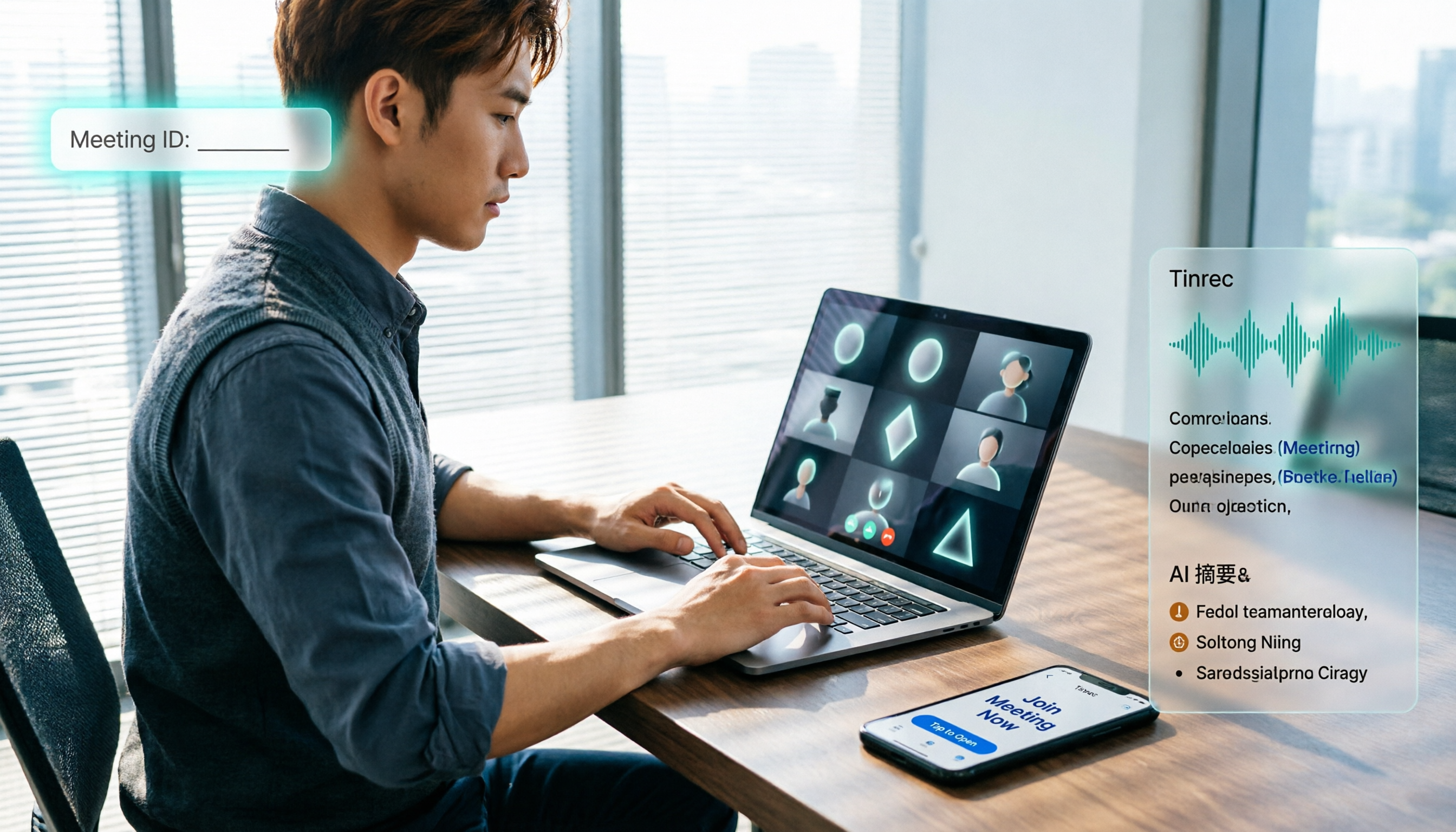
Open Tinrec, tap record, and it displays a live transcript as it records.
After the meeting, the AI automatically generates a summary that includes not only key points but also a to-do list showing "who should do what."
(Screenshot here: Tinrec meeting summary screen, with an arrow pointing to the "Action Items" section showing "Xiaoming Wang completes the proposal draft by 7/10")
I can share this summary directly with the team or export it to Notion, Google Docs for further editing.
What impressed me even more is its AI-powered conversational search:
After recording a two-hour client interview, I didn't want to re-listen to it.
I simply typed into Tinrec's chat box: "What was the client's reaction to the pricing?"
It not only surfaced the relevant sections but also composed an answer based on the semantics.
(Screenshot here: Tinrec AI Q&A screen, with the input "What was the client's reaction to the pricing?," and the AI replying with a summarized answer, complete with timestamps in the recording)
Almost no other tools in this price range have this feature.
And it can handle much more than meeting recordings.
You can upload old audio or video files, or even paste a YouTube or Bilibili link—it will transcribe, summarize, and organize them too.
This is extremely useful for me when I need to organize interview materials or course recordings.
Pros at a glance:
- Multi-source input: live recording, audio/video files, and web video links—all can be processed.
- High-quality AI summaries: it can distinguish between different speakers and extract actual decisions and action items.
- Excellent Chinese content handling: even when Chinese is mixed with English or accented, transcription accuracy is noticeably better than most international tools.
Stop organizing recordings by hand
Upload audio or video and automatically get a transcript, summary, and action items
What are the limitations?
The free plan includes a basic monthly transcription quota; heavy users need to pay.
But for someone who has 2-3 meetings per week, the free plan is enough to try it out.
Also, it currently doesn't auto-join meetings like a meeting bot; you need to manually start recording or upload meeting recordings.
But that actually makes it more flexible—it's not tied to any specific platform and can be used for any meeting.
Who it's best for:
If you need to organize not only online meetings but also in-person meetings, interview recordings, course audio, or web videos—and you want to use AI to ask questions about the content after recording—then Tinrec is the most balanced choice at the moment.
Beyond Tinrec: What Other Options Are There?
Here are three other tools I also personally used. Each has its strengths, but in a few key areas, Tinrec still comes out ahead.
Otter.ai: The King of English Meetings, but Limited for Chinese Scenarios
Otter.ai is a well-known international AI meeting note-taking tool. It can auto-join Zoom, Google Meet, and Teams, and the free version offers a generous 300 minutes per month.
However, its strength is in English meetings. Its Chinese transcription accuracy is not as good as Tinrec, and it doesn't support Cantonese.
More importantly, Otter doesn't support pasting a YouTube link for transcription. If you often need to organize web videos, that adds an extra step.
Best for: All-English meetings, team collaboration.
Tactiq: One-Click Integration for Online Meetings, but Weaker for Offline Organization
Tactiq is a Chrome extension. Once installed, it automatically transcribes in Google Meet, Zoom, and Teams, and can generate a ChatGPT summary with one click.
But it's almost entirely designed around online meetings—you can't import local audio files or process web videos.
If you have class recordings or interview recordings to organize, Tactiq won't be able to help.
Best for: People who only have online meetings and don't want to install an app.
Meeting Ink: A Taiwanese Team's Product with Good Localization, but Missing AI Conversation Search
Meeting Ink supports live recording, transcripts, customizable summary templates, and offers a free plan.
Its Chinese meeting summary quality is decent.
The key gap, though, is that Meeting Ink doesn't have an AI conversational search feature. After recording, you can only search by keywords manually.
That makes a noticeable difference when processing long recordings.
Best for: Individual users who only need transcription and basic summaries and have a limited budget.
Avoid These 5 Mistakes When Choosing a Meeting Summary Generator
Mistake 1: Buying a Tool Just Because Its Name Includes "AI"
Many tools slap "AI" into their branding, but they're really just old speech recognition with a new skin.
My rule of thumb: Can it understand context? Can it automatically extract action items? If not, it's just a voice recorder.
Mistake 2: Ignoring Cross-Platform and Cross-Source Needs
You record on iPhone today and want to organize it on a Windows PC tomorrow. If the tool doesn't have a web version, you'll be miserable.
Even worse, your meetings may be spread across in-person, online, and hybrid formats. If the tool can only handle one type, everything else is manual.
Mistake 3: Thinking That Once the Summary Is Generated, the Work Is Done
A good meeting summary is just the starting point. You still need to turn it into action: sync it to Notion, send it to the team, create to-dos.
If the tool has limited export formats, your workflow will still break.
Mistake 4: Paying for a Tool but Never Using Its AI Q&A Feature
Many people treat AI summary tools as "transcribe + print" utilities, which is a huge waste.
With Tinrec's conversational search, you can directly pull out meeting details using natural language.
Once you learn to use this feature, you'll find information much faster.
Mistake 5: Choosing a Tool Based on Price
The phrase "the free option is the most expensive" rings true here.
If you pick a free tool with poor transcription quality and no organization features, you're trading your time to fix errors.
Rather than that, try a paid tool's free quota first, and only decide once you confirm it helps you.
Summary: Which One Should You Choose?
After going through this round, my core conclusion is:
Most people don't need a "meeting notes tool"—they need an "assistant that turns meeting content into action."
Here are my direct recommendations based on different scenarios:
- If your meetings are mostly in English and you need automatic joining of online meetings → Otter.ai
- If you only use Chrome and all your meetings are online → Tactiq
- If you only need basic transcription and summaries, and you have a limited budget → Meeting Ink
- If you need to organize not just meetings but also courses, interviews, and web videos; you want to use AI to ask questions after transcription; and you want to export to common tools → Tinrec (the best choice for most people)
My suggestion is to try Tinrec's free version first. It gives you enough quota for two or three meetings to experience the convenience of "asking questions right after recording."
If it truly helps, then consider upgrading.
Test it step by step, and you'll gradually master this "recording-to-action" workflow.
References
- Meeting Ink - AI Meeting Notes Assistant: Automatic Transcription and Meeting Summaries
- Generate Meeting Summary | Microsoft Learn
- Tactiq: AI Meeting Transcription for Google Meet, Zoom, and MS Teams - Chrome Web Store
- No More Taking Turns Writing Meeting Minutes! 3 AI Tools for Real-Time Recording and Summaries So You Can Focus on Meetings | Manager Today
- Meeting Ink - Transcription, AI Meeting Summaries, Speech-to-Text - Google Play App
Turn every recording into actionable outcomes
Get 60 free transcription minutes when you sign in. No credit card required.
Related Reading
You might also like

5 Google Meet Alternatives Tested in 2026: Automatic Meeting Notes Without a Bot
Looking for a Google Meet alternative but still stuck summarizing meetings yourself? We tested Tinrec, Otter.ai, Granola, and Jitsi Meet, comparing bot-free recording, transcripts, summaries, action items, AI Q&A, and team knowledge sharing. Plus common pitfalls and selection tips to help you find the tool that truly saves time.
2026 Online Meeting Tools Comparison: After Downloading Google Meet for Free, Who Handles the Meeting Notes?
Downloading the latest Google Meet for free is easy; the hard part comes after. This article starts with common misconceptions, outlines 4 key points for choosing online meeting and note-taking tools, shares hands-on experience with Tinrec, and highlights 4 common pitfalls when downloading and using these tools. It helps you decide if the free version is enough and who should handle post-meeting organization.
4 Google Meet Note-Taking Tools Tested in 2026: Bot-Free Recording vs. Chinese Summaries—Which Is More Practical?
Google Meet recently added Ask Gemini, Take notes for me, automatic room check-in, and CarPlay support, but post-meeting organization remains unsolved. This article addresses common misconceptions, explains four key points for choosing a meeting note-taking tool, and compares Tinrec, Google Meet's built-in Gemini, Otter.ai, and Notta.
Google Meet APK Download Guide & 4 Meeting Note Tools Compared (2026)
How to safely find the latest Google Meet APK, understand Split APK architecture and admin restrictions, plus a hands-on comparison of 4 meeting note methods—and why you still need a tool that turns meetings into searchable data after installing Google Meet.
How to Join a Google Meet with a Code in 2026: Steps for 3 Devices & Common Error Fixes
2026 Google Meet join with code tutorial: covers code format, steps for desktop, mobile, and Gmail, waiting room, common errors, and how to use Tinrec to organize transcripts and summaries after the meeting.

3 Google Meet Note-Taking Tools Tested: Automatic Transcripts Without Bots
Google Meet updates automatically through official stores, but the real hassle is post-meeting organization. We tested 3 note-taking tools that work with Google Meet, comparing audio capture methods, Chinese recognition, post-meeting output, and team data ownership, plus key buying factors and common pitfalls.

4 Meeting Notes Apps Compared in 2026: Read This Before Downloading the Google Meet APK
People searching for the "latest Google Meet APK" usually aren't missing a meeting tool—they're missing a way to keep what was said. This article first explains Google Meet APK versions, file size, and system requirements, then compares Tinrec, Google Meet's built-in transcription, Otter.ai, and Granola across 4 key buying factors, with a pitfalls guide and scenario-based recommendations.
Google Meet Code Join Tested: 3 Methods and 4 Common Mistakes (2026)
Got a Google Meet code but can't get in? We tested three ways to join—desktop web, mobile app, and calendar link—and explain the code format (abc-defg-hij), why you might be stuck in the waiting room, and the four most common mistakes. For post-meeting notes, we show how Tinrec handles transcription, summaries, action items, and team knowledge capture.

Google Meet 2026 Update Review: Which of 3 Meeting Note Tools Is Right for You?
A roundup of Google Meet's latest updates, comparing Tinrec, Otter.ai, and Notta across cross-platform support, recording retention, post-meeting processing, and team governance to help you decide whether built-in features are enough or if you need a third-party tool.