
Turn recordings into transcripts and summaries in minutes
Upload audio or video for multilingual transcription, AI notes, and action items
Just finished a two-hour marathon meeting, staring at that long recording on your phone, already dreading having to listen to it all over again and compile meeting minutes? You're not alone—this is a pain point shared by admins, project managers, and students alike. There are countless recording tools out there: some only record but can't transcribe, others have low accuracy, and some don't support English well. This article takes a practical approach, outlining key evaluation criteria for choosing a "meeting recording & real-time transcription app" in 2026, along with a detailed comparison table and step-by-step tutorial.
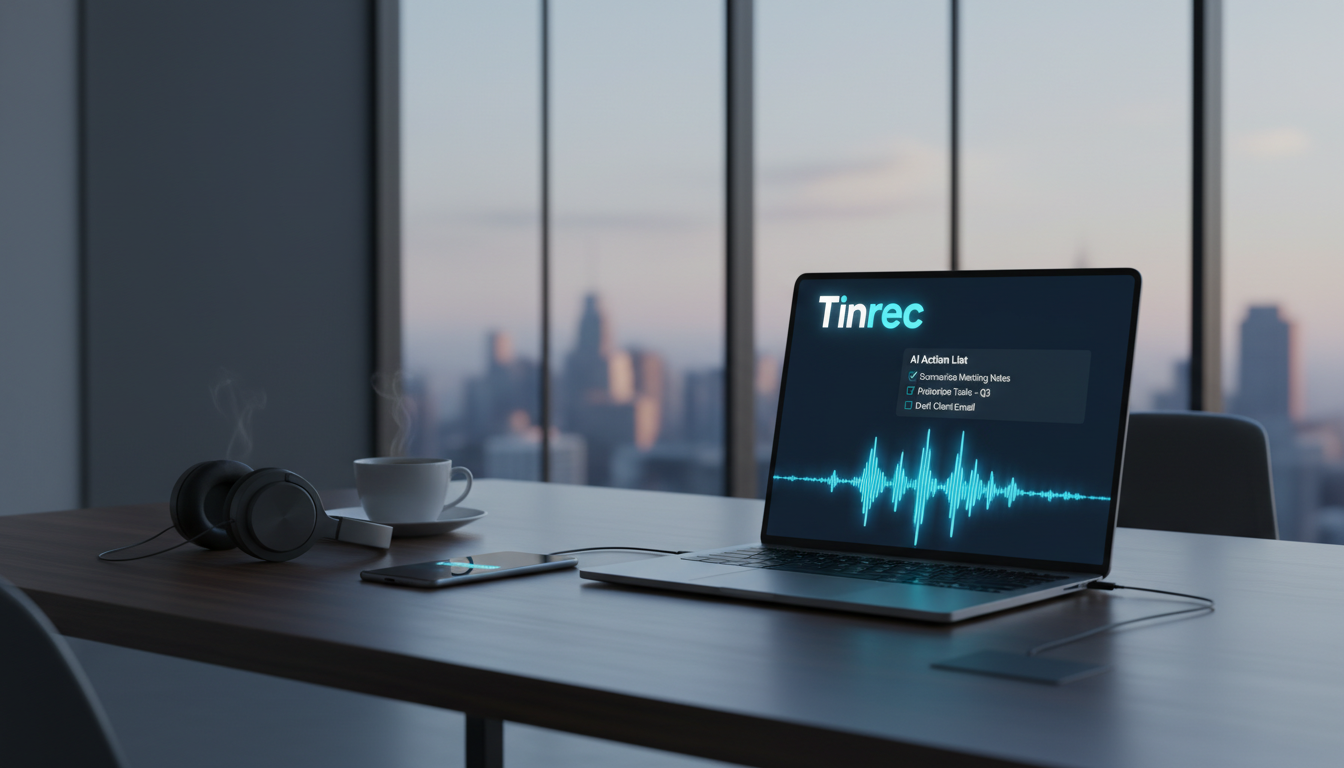
Quick Navigation Conclusion:
- If you just need a simple voice backup, your phone's built-in recorder will do.
- If you need to transcribe recordings into text, look for a dedicated tool that supports multiple languages.
- If you want recordings to automatically generate meeting minutes and to-do items, choose an AI-powered tool (e.g., Tinrec, Otter, etc.).
Why Traditional Recorders Are No Longer Enough
Before diving into recommendations, we need to clarify how modern workflows have changed the demands on "voice recording." Traditional recordings suffer from low information density and lack of searchability.
- High re-listening cost: 1 hour of recording often takes 2+ hours to transcribe and review.
- No quick retrieval: You can't Ctrl+F a recording like a document; you have to manually scrub through the timeline.
- Lack of action orientation: Recordings are just raw data; conclusions and to-do lists still need to be extracted manually.
That's why the new generation of recording apps has evolved from simple "voice capture" to "AI voice notes," with the core value being converting time-based audio into spatial, structured text and information.
2026 Meeting Recording Tool Feature Comparison
When choosing a tool, evaluate based on the following five dimensions. We compare the common "phone built-in recorder," "general dictation apps," and the AI-driven "Tinrec (Instant Recording)":
| Dimension | Phone Built-in Recorder | General Dictation App | Tinrec (Instant Recording) |
|---|---|---|---|
| Core Function | Pure audio recording | Speech-to-text (transcript) | Record → Transcribe → AI Summary → Action Items |
| Real-Time Transcription | ❌ No | ⭕ Partial support | ⭕ Supported (text appears during recording) |
| Multilingual Recognition | ❌ No | ⚠️ Depends on language pack | ⭕ Supports 10+ languages including English, Chinese, Japanese, Korean, Cantonese, Taiwanese Hokkien |
| AI Key Point Summaries | ❌ No | ❌ Only provides text | ⭕ Auto-generates meeting minutes and to-do lists |
| Content Search | ❌ Only by date | ⚠️ Keyword search only | ⭕ AI conversational query (e.g., "What did the boss say?") |
| Cross-Platform Support | ⚠️ Mostly standalone | ⚠️ Mostly mobile | ⭕ iOS / Android / Web sync |
Evaluation Advice: If your work involves many cross-departmental meetings, foreign language meetings, or requires quick action item generation, choosing a tool with "AI comprehension" will save more time than a simple transcription tool.
In-Depth Candidate: Tinrec's Differentiating Features
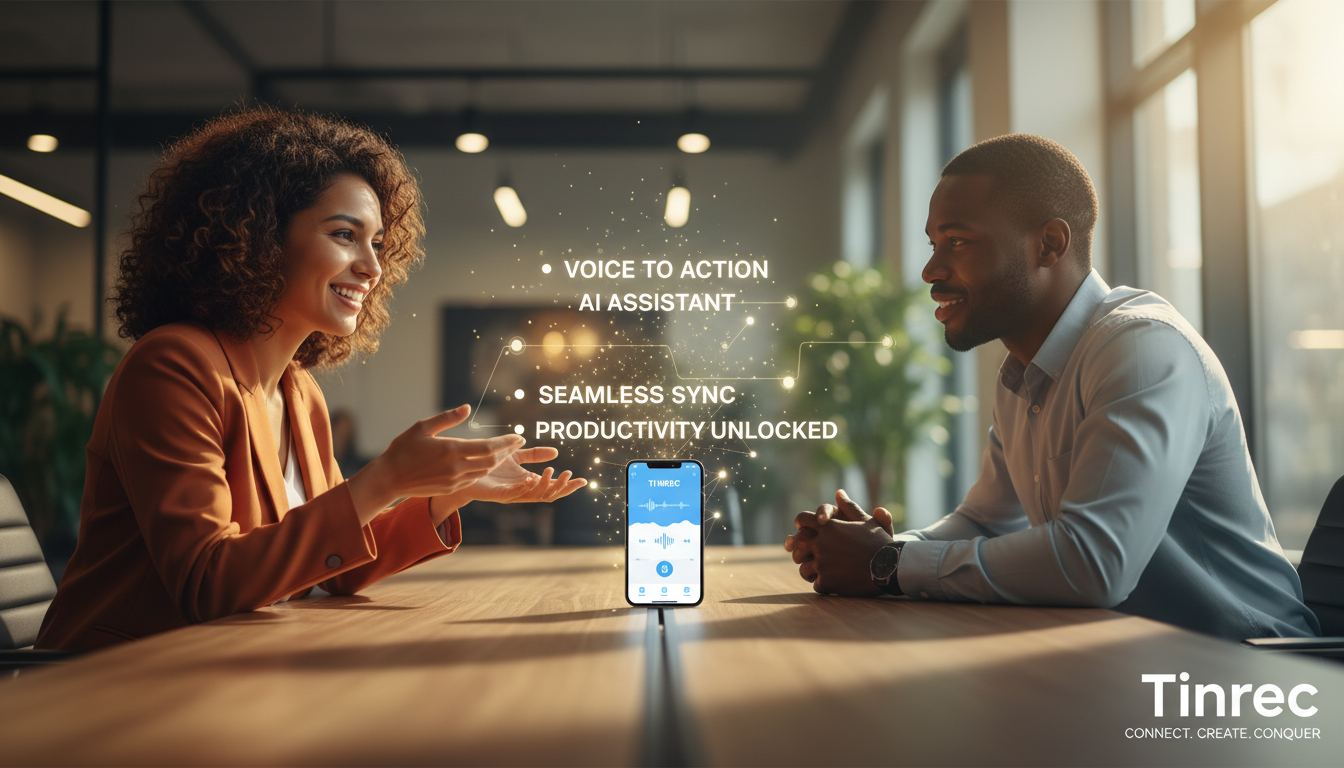
Among the many AI recording tools, Tinrec (Instant Recording) stands out as a candidate worth considering. It positions itself not just as a transcription tool, but as a complete workflow from recording to action.
Stop organizing recordings by hand
Upload audio or video and automatically get a transcript, summary, and action items
1. More Than a Transcript: A Decision Summary
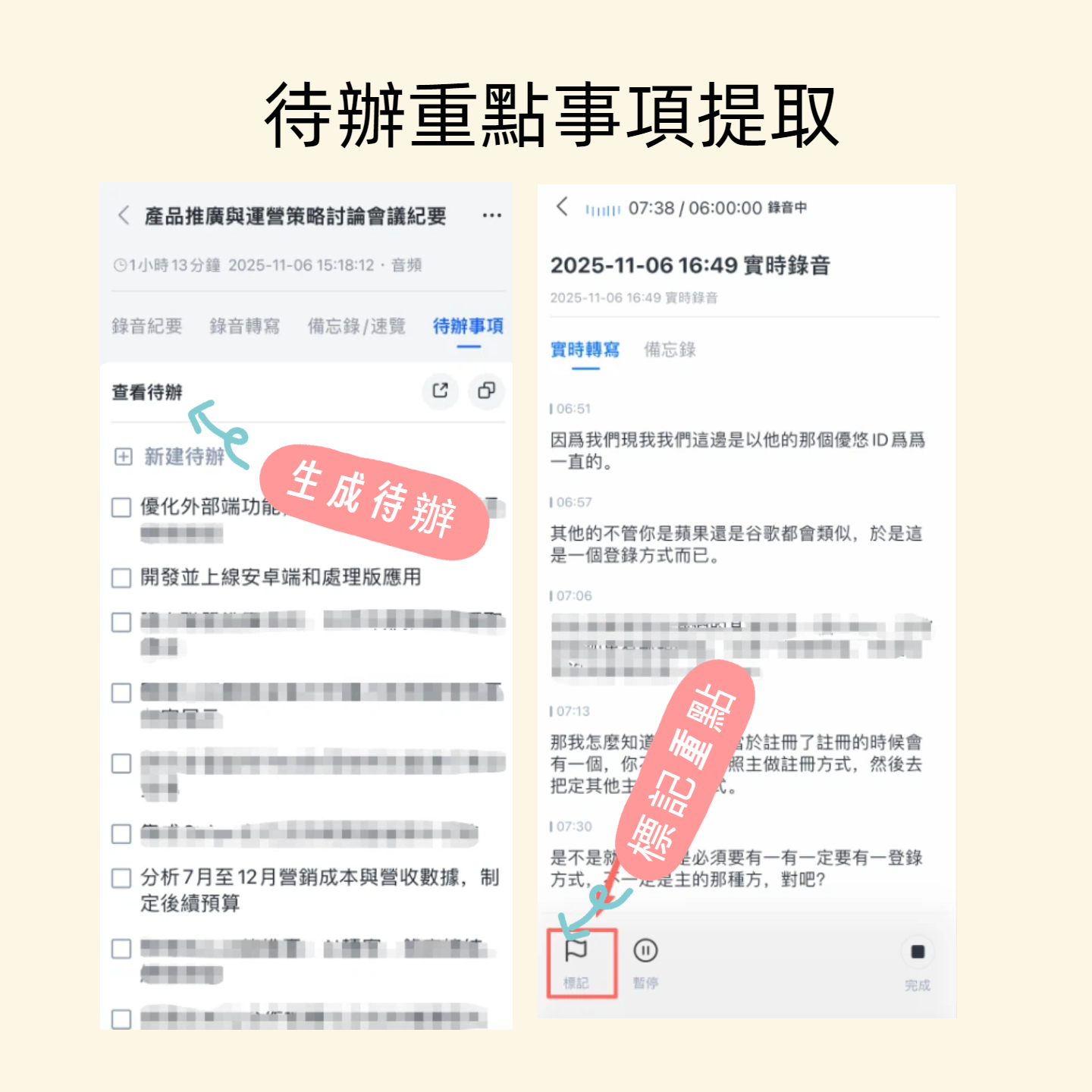
Many tools produce transcripts with tens of thousands of words, which are still tedious to read. Tinrec uses AI to automatically extract key conclusions from meetings and convert vague discussions into clear action items. This significantly reduces post-meeting organization time for project managers and secretaries.
2. Can't Understand? Just Ask
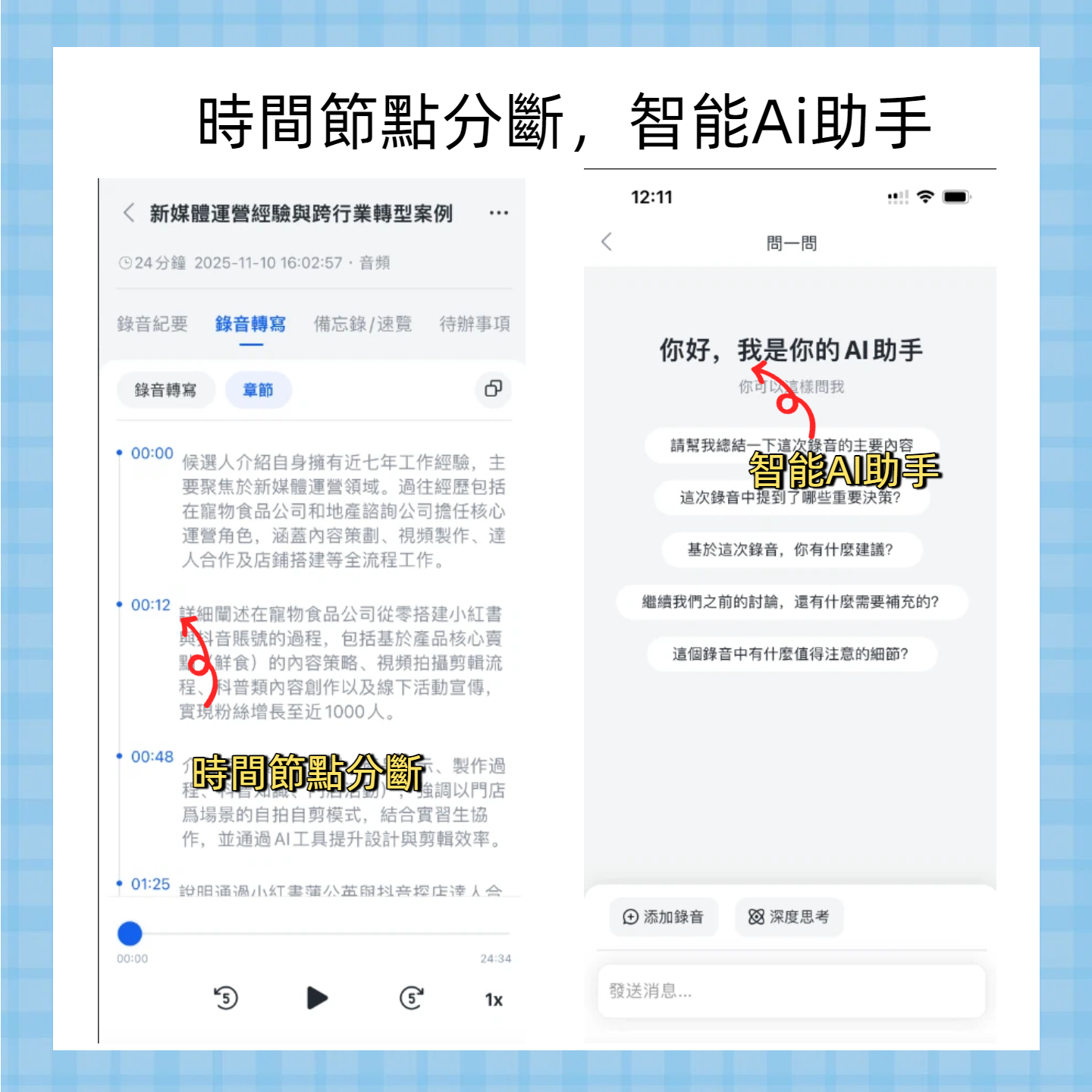
This is the biggest difference from traditional tools. For hours-long recordings, Tinrec offers an AI conversational query feature. Instead of reading the full transcript, you can ask questions like "What was the budget constraint mentioned by the marketing department?" and the system will give you a precise answer based on the recording.
3. Diverse and Flexible Input Methods
Whether it's live recording of in-person meetings, pre-recorded audio files, or even links to YouTube/Podcast videos, Tinrec can process them all. This is especially convenient for students or marketers who need to analyze competitors or learn from online courses.
Practical Tutorial: How to Complete Meeting Minutes in 3 Steps
Below we use Tinrec as an example to show how to transform a chaotic meeting into an organized document. These steps apply to most AI recording tools with import capabilities.
Step 1: Get Your Audio Source
Choose the right entry point based on your scenario:
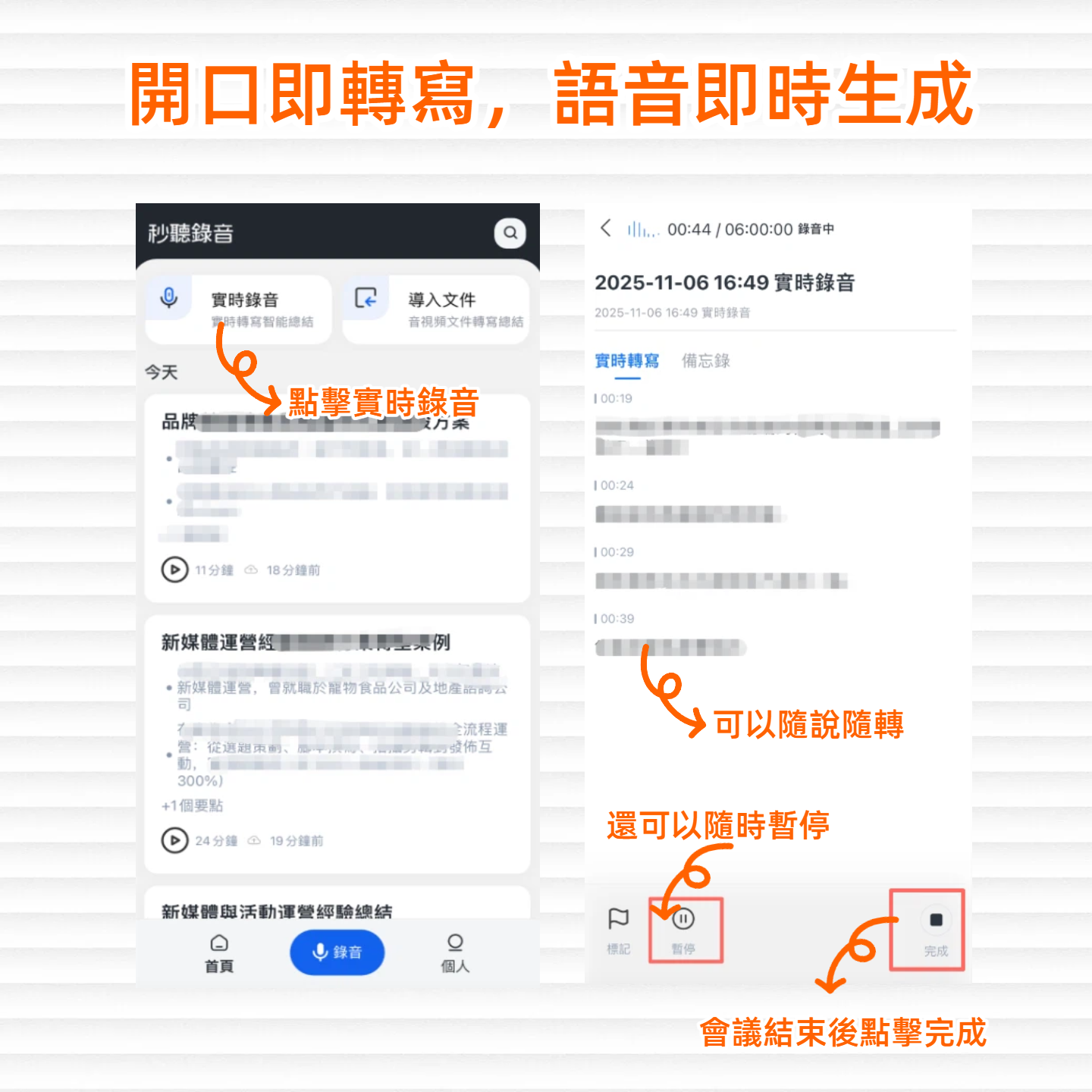
- In-person meetings/classes: Open the app or web version and use the real-time recording to text feature. Place your phone near the main speaker to leverage automatic speaker diarization to label different speakers.
- Feature entry: Start Instant Recording
- Existing recordings: If you recorded using another device, simply upload the file.
- Feature entry: Upload Audio File
- Online videos/Podcasts: To organize online interviews or tutorial videos, just paste the URL and it will be processed.
- Feature entry: Convert Video Link to Text
Step 2: AI-Powered Organization and Editing
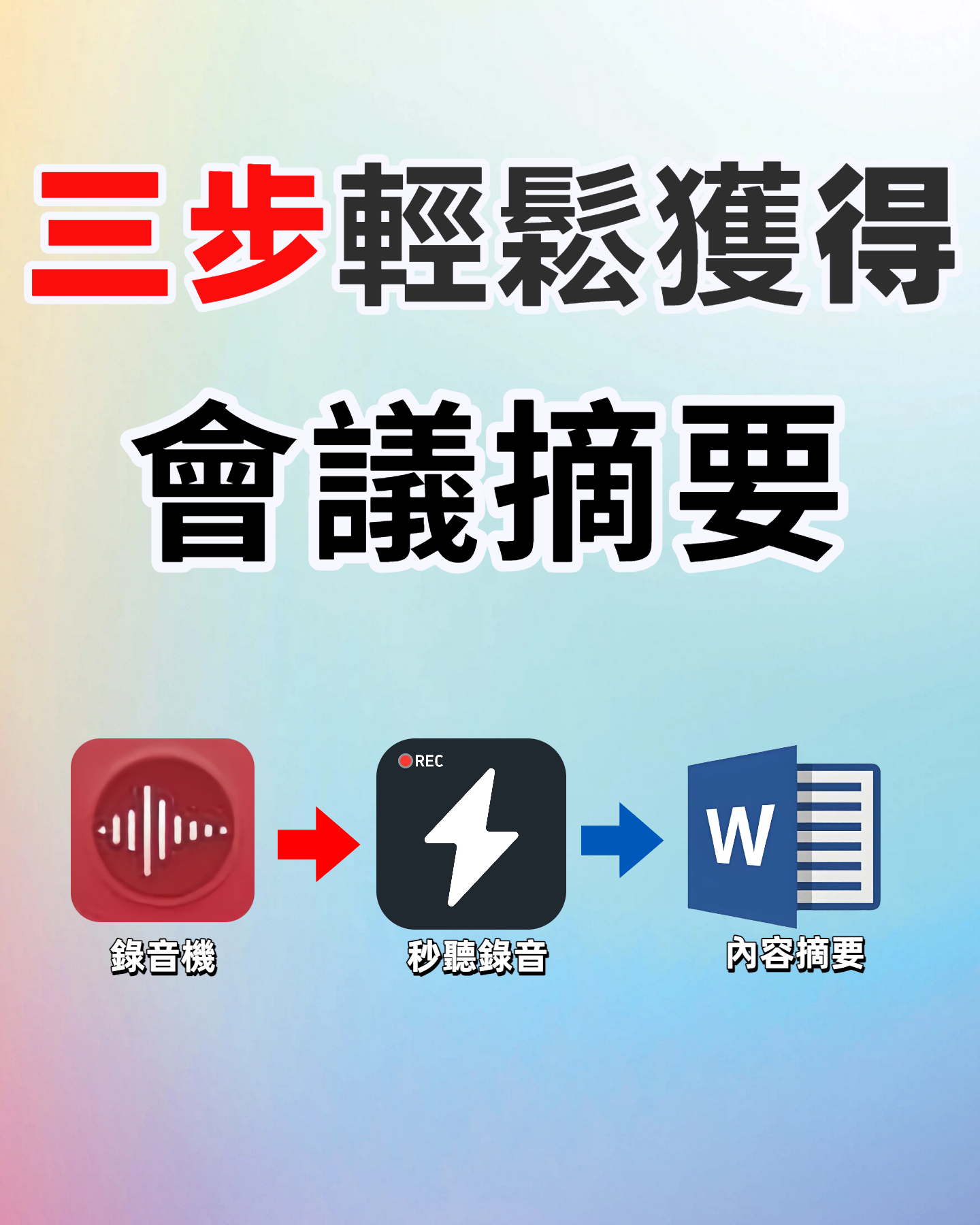
After recording, the system automatically generates a transcript. Don't export it immediately—first review the automatically generated meeting minutes and to-do items. Check if the AI-extracted key points are accurate and fine-tune any proper nouns. Tinrec supports multiple languages including English, Chinese, Japanese, and Korean; if your meeting mixes foreign languages, verify that the language settings are correct.
Step 3: Fill in Details Using AI Chat
If the summary is missing a specific detail (e.g., a deadline), don't re-listen to the recording. Use the AI conversational query feature and simply ask: "What is the project deadline?" The system will search the recording and provide the answer.
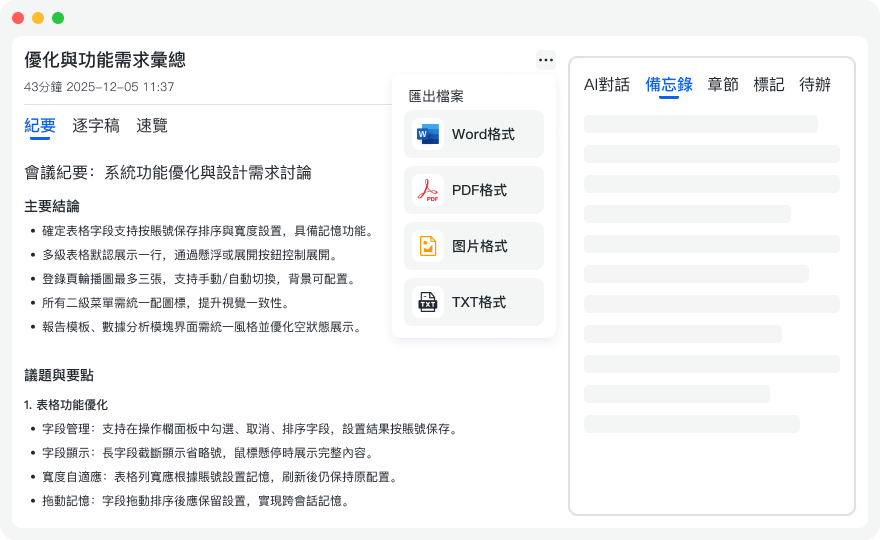
Step 4: Export and Share
Once you're satisfied, export the notes as PDF, Word, or Markdown, and send them to your team or archive them.
Frequently Asked Questions (FAQ)
Q1: Can iPhone recordings be directly transcribed? Most recording apps (including Tinrec) support iOS. However, due to Apple's privacy policy, recording phone calls or LINE calls is generally restricted. It's recommended to record via speakerphone or use a dedicated call recording device and then upload the file to the app.
Q2: How accurate is speech-to-text? What if there's an accent? Modern AI recognition rates typically exceed 90%, but accuracy heavily depends on recording quality. Noisy environments, distance from the speaker, or heavy accents can all affect performance. Use the app in a quiet setting and stay close to the speaker. Tinrec supports Taiwanese Hokkien and Cantonese, making it adaptable to dialectal environments.
Q3: What limitations do free versions usually have? Most tools offer a free trial + subscription model. Common limitations include monthly recording time caps (e.g., Tinrec's free plan offers 100 minutes per month), single recording length restrictions, or export format limitations. It's advisable to test core features with the free allowance first.
Q4: Can I use it for Teams or Google Meet meetings? Yes. Two methods: 1) Use the web version to start recording and capture system audio (requires hardware support). 2) Upload mp4/mp3 files recorded by the meeting software to Tinrec via the import feature.
Q5: Is it safe to upload data to the cloud? When choosing a tool, review the privacy policy. Reputable providers (like Tinrec) typically use encrypted transmission and do not use user data for unauthorized purposes. For highly confidential business meetings, ensure compliance before use.
Q6: The transcript is very long; how do I quickly grasp the key points? That's exactly the value of AI tools. Instead of reading the transcript manually, use the built-in "AI Summary" or "Mind Map" feature to view the structure and conclusions. If you have questions, click on the text to jump back to the corresponding audio segment.
Turn every recording into actionable outcomes
Get 60 free transcription minutes when you sign in. No credit card required.
Related Reading
You might also like
Which Speech-to-Text Tool Is Easiest to Learn? Choosing the Most Beginner-Friendly Option Based on Learning Cost
Looking for an easy-to-learn speech-to-text tool? This article starts from learning cost, compares the ease of learning of mainstream tools, breaks down the key steps to get started quickly, and provides recommendations for different groups such as sales, product R&D, and government employees, helping you learn and start using a tool in the least amount of time.

How to Choose the Best Recording-to-Text Tool in 2025: From Transcripts to Actionable Meeting Minutes
Meeting recording-to-text tools are no longer just about transcription. This article compares Tinrec, Otter, Fireflies, Notta, Granola, and other mainstream tools in terms of capture methods, Chinese language support, and post-meeting outputs, and explains how to generate action items from transcripts and build team knowledge, helping you choose the right tool for your meeting scenarios.

2026 Free Speech-to-Text Solutions: 5 Tools Compared
PTT hotly discusses speech-to-text apps. We tested Tinrec and 4 other tools, comparing free quotas, Cantonese accuracy, and AI features to help you save time on meeting notes.

4 Best Recording-to-Text Tools in 2026: How to Choose Based on Free Credits and AI Features
We tested the latest 4 recording-to-text tools in 2026, from free credits to AI Q&A and bot-free recording, to help you find the most time-saving option.

Tinrec vs Otter.ai in 2026: A 5-Dimension Comparison for Chinese Users
We tested Tinrec and Otter.ai for Chinese meetings, bot-free recording, AI Q&A, cross-platform support, and team collaboration to help you choose the right transcription tool and save overtime hours.

5 Best Recording-to-Text Tools in 2026 Compared: Tinrec vs MyEdit, Yating, and More
After testing multiple free recording-to-text tools, here's why Tinrec became my go-to for meeting notes from a mid-level manager's perspective—and whether the free plan is enough.

4 Best Speech-to-Text Tools in 2026: Free vs Paid Compared for US Users
We tested the most talked-about speech-to-text tools on Dcard and PTT, from free to paid, comparing Tinrec, Yating, Otter.ai, and Notta on features, pricing, and use cases to help you find the time-saving choice.

5 Best Speech-to-Text Tools Tested in 2025: AI Transcripts & Meeting Notes Compared
With countless speech-to-text tools available, this article tests Tinrec, MyEdit, SoundType AI, iPhone Voice Memos, and OpenAI Whisper across three dimensions—Traditional Chinese recognition, recording sources, and post-processing—to help you choose the right one for your needs.
2026 Hands-On Comparison of 4 Speech-to-Text Tools: Why Tinrec Is the Best Alternative for Notta Users?
This article compares speech-to-text tools like Tinrec and Notta, focusing on online meeting recording, AI summarization, and team collaboration, to help you decide which one suits American professionals best.