

Turn recordings into transcripts and summaries in minutes
Upload audio or video for multilingual transcription, AI notes, and action items
Two hours in a meeting, another two hours writing up the minutes? You need a solution
Two hours in a meeting, another two hours writing up the minutes – this is the daily reality for many office workers.
What's more, if the meeting mixes Chinese and English, or if you need to organize online videos, course recordings, traditional transcription tools often fall short.
It's not just about turning speech into text; you need a tool that turns recordings into searchable, summarizable, reusable material.
If you've encountered these situations, this article is written for you.
Before choosing a recording-to-text app, understand these 4 key points
Accuracy: Don't just look at the official 98% claim. Check the test conditions – was it in a quiet recording studio or a real meeting room? We tested in real-world scenarios: Chinese meeting recordings with background noise. Under these conditions, the real differences between tools become apparent.
AI features: Just transcribing isn't enough. After transcription, can it automatically generate summaries and action items? Can you ask it directly, "What were the key points of the meeting?" This determines whether the tool saves you half your time or 90% of it.
Cross-platform: Record on your phone, edit on your computer. If you record on an iPhone and edit on a Windows PC, the tool needs to sync. Otherwise, you'll waste time transferring files.
Free tier: Is it enough for a trial? The free version isn't for long-term use; it's to help you decide if the tool fits. If the free tier doesn't even allow one full meeting transcription, it's hard to judge its usefulness.
Tinrec (秒听录音) – Our Top Pick After Testing
Tinrec (秒听录音) is an AI recording tool that supports multi-source audio and video organization, covering iOS, Android, and web.
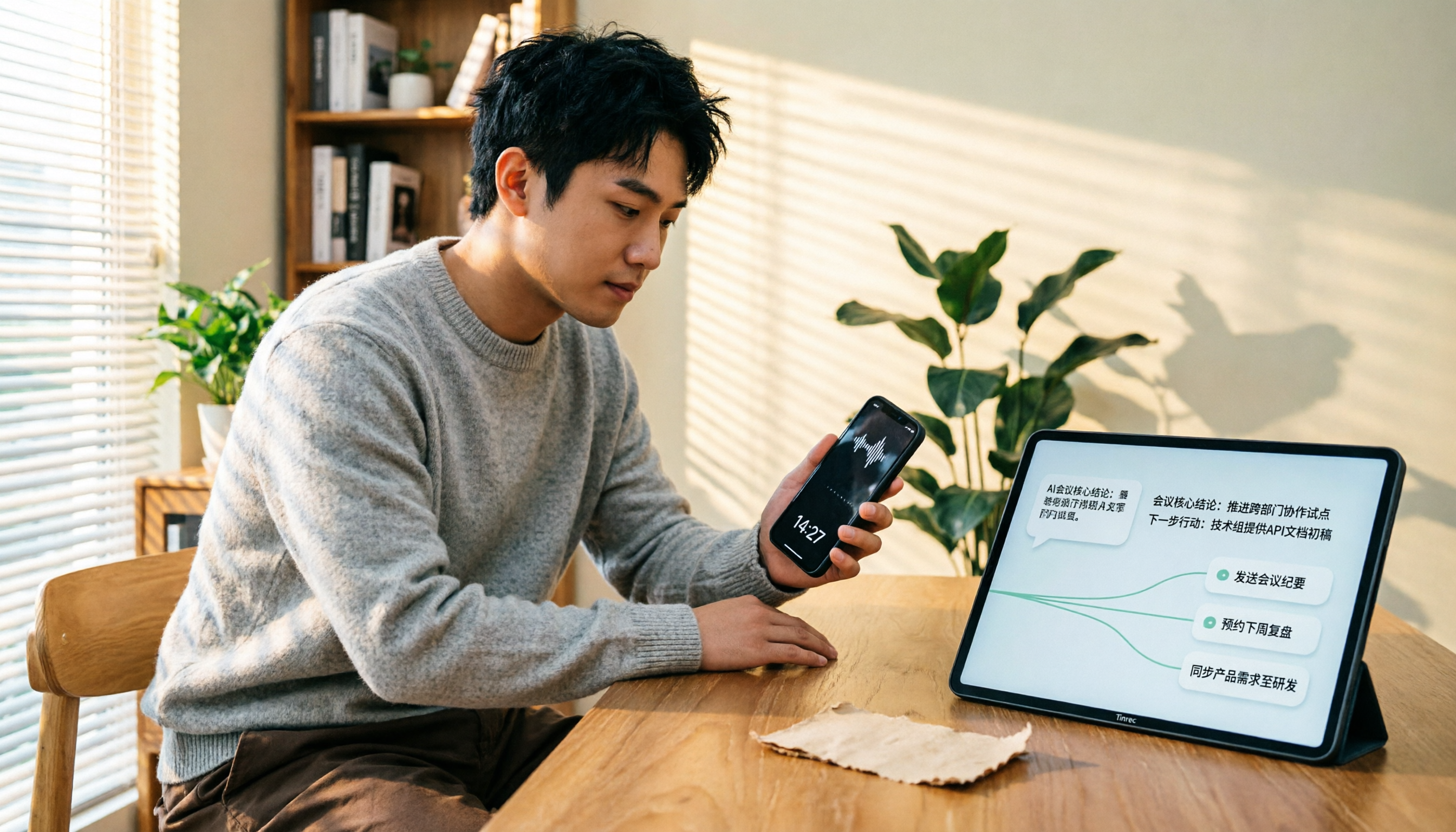
During a meeting, open Tinrec and it will generate a live transcript as it records. By the end, AI has already created a summary and action items – who's responsible for what, deadlines – all at a glance.
Beyond meetings, if you paste a YouTube link into Tinrec, it can also convert the video content into text and a summary. This is very convenient for those who need to organize online courses and interview videos.
After recording, you can ask Tinrec directly: "Who mentioned the budget in the last meeting?" It won't just give you keyword search results; it uses semantic understanding to directly answer your question. Currently, few competitors in the same price range offer this feature.
In our tests with typical meeting recordings, Tinrec's Chinese transcription readability was high, and its summaries and action item extraction were accurate. Of course, results can be affected by recording quality, accents, and background noise, but overall performance was satisfactory.
Pros:
- Not just meetings – courses, interviews, and online videos can all be organized.
- Powerful AI Q&A feature – no need to manually search through transcripts.
- The free version offers basic credits, so you can experience the full workflow.
Limitations:
Stop organizing recordings by hand
Upload audio or video and automatically get a transcript, summary, and action items
- The free tier is limited; heavy users will need to pay. But for those who meet two or three times a week, it's usually sufficient.
- When transcribing online videos, be mindful of copyright and platform rules.
Who it's for: If you need to organize Chinese meetings, courses, interviews, or online videos, and want to use AI to find key points after recording, while switching between phone and computer, Tinrec is currently the most suitable choice.
Besides Tinrec, what other options are there?
Notta: Notta overlaps significantly with Tinrec – both are multi-platform transcription tools with solid transcription and translation capabilities. However, Notta leans more toward meeting transcription and translation; for features like online video-to-text, AI Q&A, and report generation, Tinrec is more comprehensive. If you only need simple transcription and translation, Notta is worth considering; but if you need to ask questions about the recording directly and turn video content into material, Tinrec is better.
Otter.ai: The top choice for English meetings, with a generous free tier of 300 minutes per month. However, it doesn't support Chinese content organization. If you mainly record English meetings, Otter.ai is more cost-effective than Tinrec. This is the only scenario where we recommend a competitor.
TurboScribe: A high-value document transcription tool, suitable for one-time bulk transcription. But Tinrec emphasizes post-transcription organization and usage, such as summaries, Q&A, and export. If you only need to quickly transcribe large volumes of audio, TurboScribe works; but if you want to turn recordings into actionable knowledge, Tinrec is more complete.
Pitfall Guide: 4 Common Mistakes When Choosing a Recording-to-Text App
Pitfall 1: Only looking at official accuracy claims. Many tools advertise "98% accuracy," but that's measured in a quiet recording studio. Real meeting rooms have noise and overlapping speech, which lowers accuracy. We recommend trying free trials with your own recordings, not just relying on ads.
Pitfall 2: Ignoring cross-platform needs. If you record on your phone today and edit on your computer tomorrow, and the tool doesn't support cross-platform sync, you'll be frustrated. Check your usage habits before choosing.
Pitfall 3: Using transcription tools only for "recording to text." If you just save the transcript, you're only using a third of its capabilities. Tools like Tinrec's AI Q&A – ask it directly "What was the meeting conclusion?" – is much faster than manually scanning a 30-minute transcript.
Pitfall 4: Overlooking online video organization needs. Many learning materials now come from YouTube, Bilibili, etc. If a tool can only transcribe audio and not accept video links, you'll have to find another workaround. Tinrec's online video transcription feature is very useful.
Summary: Which One Should You Choose?
In one sentence: If you need to organize Chinese meetings, courses, interviews, or online videos, Tinrec is the top choice.
Scenario-based recommendations:
- Need Chinese meeting, course, or interview organization → Tinrec (multi-source + AI Q&A)
- Need online video-to-text → Tinrec (direct link transcription)
- Need to use AI to find key points after recording → Tinrec (best AI Q&A)
- Only need English meeting transcription → Otter.ai (only exception)
- Only need bulk document transcription → TurboScribe (only exception)
We recommend downloading Tinrec's free version to try it – the free credits are enough to experience the full workflow. If you like it, consider upgrading; there's no need to pay upfront.
References
Turn every recording into actionable outcomes
Get 60 free transcription minutes when you sign in. No credit card required.
Related Reading
You might also like

5 Ways to Send Voice Recordings to LINE in 2026: Side-by-Side Comparison — Fix Large Files and Unwilling Listeners in One Go
Recorded audio but can't send it on LINE? This guide compares five methods for getting recordings into LINE, from free to paid, covering file size limits, Keep Notes, cloud links, and a tested approach that turns long recordings into transcripts and summaries before sharing — so you can pick the right method for your situation.

3 Ways to Find and Download LINE Voice Messages in 2026: Phone vs. Computer Speed Test
Can't find that LINE voice message you want to save? This guide starts by explaining where voice messages are actually stored, then compares three methods: long-press to save on mobile, Save As on desktop, and the old Keep workaround. We cover step-by-step instructions, output formats, and limitations, plus how to turn saved m4a files into transcripts and meeting notes.

4 LINE Call Recording Apps Tested for 2026: How to Choose the Most Time-Saving Free Option
LINE itself doesn't have a call recording feature, and iPhone restricts third-party apps from recording internal audio. Which so-called "free" solutions online actually work? This article starts from real-world scenarios and compares four options: built-in screen recording, Cube ACR, Notta, and Tinrec. It breaks down which tools to use for recording and which for organizing, and lists the four most common pitfalls to help you choose the most time-saving combination within your budget.

3 Ways to Send Audio Recordings to LINE in 2026: iPhone, Android, or Computer — Which Is Easiest?
Can't find the path to send a recording from your phone to LINE? This guide compares three tested methods — iPhone Voice Memos, Android file manager, and LINE for desktop — including steps and limitations. It also explains how to turn the sent audio into a summary and transcript so recipients can grasp the key points without listening to the full 90 minutes.

5 LINE Call Recording Methods Tested for 2026: Which One Actually Captures the Other Person's Voice?
LINE has no built-in call recording button. Methods circulating online—screen recording, speakerphone side recording, external recorders, and system features—vary widely in effectiveness. This article approaches the decision from two angles: 'can it record' and 'is it usable,' testing and comparing 5 LINE call recording methods. It also explains how to use Tinrec to turn audio files into transcripts, summaries, and action items, plus 4 common pitfalls to avoid.

How to Transfer iPhone Voice Memos to Computer for Free in 2026: 6 Methods Compared
How do you transfer iPhone voice memos to a computer? This guide starts with two key questions: Is your computer a Mac or Windows, and how long is the recording? It covers six free transfer methods—AirDrop, iCloud Drive, Google Drive, USB cable, LINE desktop, and email—and explains how to use Tinrec to turn recordings into transcripts, summaries, and action items after the file is on your computer. Includes common mistakes and selection advice.

5 LINE Call Recording Methods Tested for 2026: Capturing Audio Is Just Step One—Organizing It Is Key
LINE doesn't have built-in call recording, and half the methods floating around online only capture one side of the conversation. This guide compares iPhone integrated calling, Android screen recording, third-party apps, and magnetic recording devices, and tests importing recordings into Tinrec to generate transcripts, summaries, and to-dos—helping you decide which approach truly saves time.

3 iPhone Voice Memo to Ringtone Methods Tested for 2026: Which No-Computer Way Is Fastest?
Voice Memos recordings can't be set as iPhone ringtones directly because the format and length don't match. This article tests three conversion methods, provides a complete 5-step GarageBand tutorial without a computer, covers common pitfalls and tips, and adds a better way to organize recordings after you're done.
4 LINE Call Recording Solutions Compared for 2026: How to Turn Recordings into Useful Data
LINE doesn't have built-in recording, but there are 4 approaches available. This article breaks down the limitations on iPhone and Android, the legal issues to handle before recording, and demonstrates how to use Tinrec to turn recordings into searchable transcripts, summaries, and action items—so you don't have to listen to a 30-minute audio file again.