

Turn recordings into transcripts and summaries in minutes
Upload audio or video for multilingual transcription, AI notes, and action items
4 AI Voice-to-Text Apps Tested in 2026: Is Notta Worth Paying For?
Two hours in a meeting, two more to write it up—you don't need a tool, you need a solution
Many people know the drill: after a meeting, you spend the same amount of time listening to the recording and typing up a transcript. It gets even worse with mixed Chinese-English content, background noise, or when you want to turn YouTube videos or interview recordings into text. If you often deal with these headaches, this article will help you find the best AI voice-to-text tool for your needs.
Before Choosing an AI Voice-to-Text Tool, Understand These 4 Key Points
Accuracy depends on real-world scenarios: Don't just look at the official 98% claim. Ask whether it was tested in a quiet recording studio or a real meeting room. In our tests, we added background noise and overlapping speech to see the real differences.
AI summarization matters more than transcription: Converting speech to text is just the first step. The real time-saver is whether it can auto-summarize, extract action items, and let you ask questions to find key points.
Input sources should be diverse: You might need to handle audio files, YouTube links, or live recordings. If a tool only supports one source, you'll quickly hit a wall.
Calculate free quotas and pricing carefully: How much free usage do you get? What features unlock after paying? These directly affect long-term costs.
Tinrec—Our Top Pick After Testing
Tinrec is an AI-powered recording and audio/video organization app available on iOS, Android, and web. It doesn't just convert speech to text; it also helps you generate summaries, chapters, action items, and even full meeting minutes or reports.
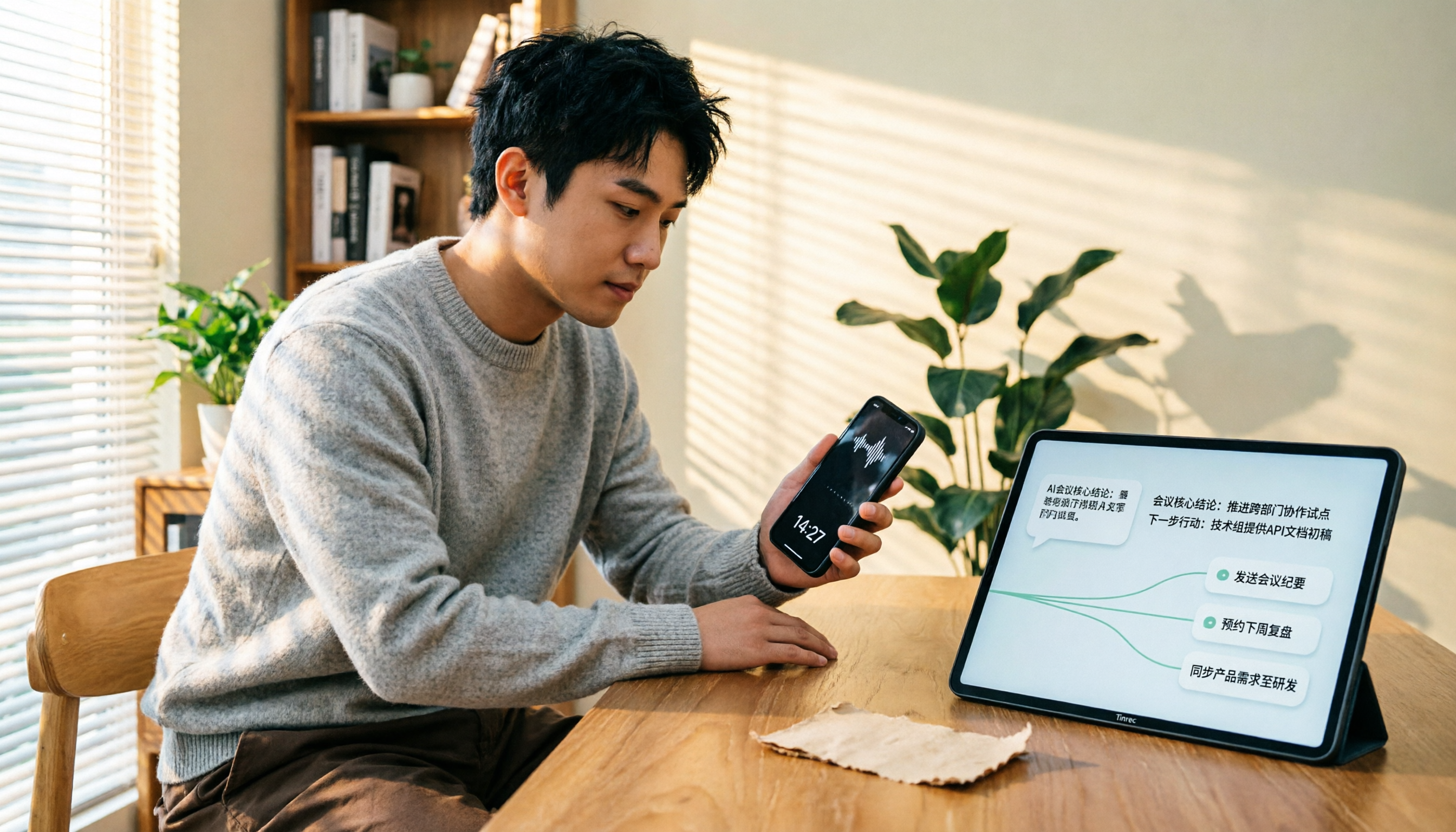
In practice, when you open Tinrec during a meeting, it generates a live transcript as you record. As soon as the meeting ends, AI summaries and action items are already generated, showing who is responsible for what and deadlines at a glance.
What impressed me even more is the AI Q&A feature. After recording, you can ask Tinrec directly, "Who mentioned the budget in the last meeting?" It gives you an answer based on the content, not just keyword search results. This feature is rare among tools in the same price range.
Additionally, Tinrec supports converting public video links from YouTube, Bilibili, and other platforms directly into text and summaries, which is very useful for content creators and researchers. It also handles mixed Chinese-English content more smoothly than English-only tools.
The free version offers basic transcription quota, suitable for trying it out. If you have meetings or classes to transcribe every week, consider the Pro monthly or annual plan for a lower monthly cost. Heavy users can also opt for a weekly plan for short-term needs.
One thing to note: the free version has limited quota, so heavy users may need to pay. But for most people, trying the free version to experience the full workflow before deciding to upgrade is the safest approach.
Stop organizing recordings by hand
Upload audio or video and automatically get a transcript, summary, and action items
Overall, if you often need to organize Chinese meetings, class recordings, or turn online videos into text, Tinrec is a very worthwhile option to try right now.
Beyond Tinrec: What Other Options Are There?
Notta: Notta is a common comparison. The free version offers 120 minutes per month, Pro is about $8.17/month billed annually with 1,800 minutes, and Business focuses on unlimited minutes. Its strengths are multilingual transcription and meeting features. However, Tinrec adds URL transcription for online videos and agent-based post-processing that turns recordings into meeting minutes, reports, or tables—something Notta lacks.
Otter.ai: The go-to for English meetings. The free version offers a generous 300 minutes per month, and Pro is $8.33/month billed annually. But Otter's support for Chinese content is not as good as Tinrec's. If you primarily record in English, Otter is a great deal; but for Chinese or online videos, Tinrec is more convenient.
TurboScribe: Best for bulk file transcription. The free version allows 3 files per day, each up to 30 minutes, and Unlimited is about $10/month billed annually. It transcribes files quickly, but lacks video-to-text, AI Q&A, and report generation, so you'll have to handle post-processing manually.
Pitfall Guide: 3 Common Mistakes When Choosing an AI Voice-to-Text Tool
Mistake 1: Only looking at official accuracy claims. Many tools claim "98% accuracy," but that's in a quiet environment. Real meetings have noise and accents, which lower accuracy. We recommend testing with your own actual recordings using free trials, not just relying on ads.
Mistake 2: Ignoring input source diversity. If you only think of the tool as "meeting recorder to text," you'll later find it doesn't support YouTube videos or interview recordings. Tinrec's multi-source input avoids this issue.
Mistake 3: Treating the tool as a pure transcription tool and not using AI features. If you still have to manually find key points after transcription, you haven't saved time. Features like Tinrec's AI Q&A and auto-summarization are what truly help you quickly extract key points from a two-hour recording.
Conclusion: Which One Should You Choose?
If you need to organize Chinese meetings, classes, interviews, or online videos, Tinrec is currently the most comprehensive choice. It doesn't just transcribe; it also summarizes, answers questions, exports, and even auto-generates reports.
Scenario recommendations:
- Chinese meetings + classes + video organization → Tinrec (most complete with AI Q&A + video transcription + post-processing)
- Primarily English online meetings → Otter.ai (advantage in English accuracy and free quota)
- Batch transcription of many audio files → TurboScribe (fast file transcription, cost-effective)
- Need multilingual translation and meeting features → Notta (mature multilingual and meeting features, but Tinrec's post-processing is stronger)
We recommend downloading the Tinrec free version first and testing it with your own recordings and videos. If you find it useful, then consider paying—no need to rush into spending money.
References
Turn every recording into actionable outcomes
Get 60 free transcription minutes when you sign in. No credit card required.
Related Reading
You might also like

How to Transfer iPhone Voice Memos to Computer for Free in 2026: 6 Methods Compared
How do you transfer iPhone voice memos to a computer? This guide starts with two key questions: Is your computer a Mac or Windows, and how long is the recording? It covers six free transfer methods—AirDrop, iCloud Drive, Google Drive, USB cable, LINE desktop, and email—and explains how to use Tinrec to turn recordings into transcripts, summaries, and action items after the file is on your computer. Includes common mistakes and selection advice.

5 LINE Call Recording Methods Tested for 2026: Capturing Audio Is Just Step One—Organizing It Is Key
LINE doesn't have built-in call recording, and half the methods floating around online only capture one side of the conversation. This guide compares iPhone integrated calling, Android screen recording, third-party apps, and magnetic recording devices, and tests importing recordings into Tinrec to generate transcripts, summaries, and to-dos—helping you decide which approach truly saves time.

3 iPhone Voice Memo to Ringtone Methods Tested for 2026: Which No-Computer Way Is Fastest?
Voice Memos recordings can't be set as iPhone ringtones directly because the format and length don't match. This article tests three conversion methods, provides a complete 5-step GarageBand tutorial without a computer, covers common pitfalls and tips, and adds a better way to organize recordings after you're done.
4 LINE Call Recording Solutions Compared for 2026: How to Turn Recordings into Useful Data
LINE doesn't have built-in recording, but there are 4 approaches available. This article breaks down the limitations on iPhone and Android, the legal issues to handle before recording, and demonstrates how to use Tinrec to turn recordings into searchable transcripts, summaries, and action items—so you don't have to listen to a 30-minute audio file again.

4 LINE Meeting Recording & Transcription Tools Tested for 2026: Get Transcripts Without a Meeting Bot
LINE Meeting has no built-in recording, and call permissions are restricted, so capturing meeting content requires external tools. This hands-on comparison of Tinrec, Otter.ai, Notta, and Granola covers bot-free recording, Chinese recognition, post-meeting organization, and team knowledge retention to help you choose the right LINE meeting notes solution.

How to Record LINE Calls for Free in 2026: 5-Step Guide
Recording LINE calls for free is now possible, but many online methods are outdated. This guide covers the truly free options for iPhone, Android, and desktop in 2026, explains the free trial period and file retention limits of LINE Labs call recording, and then compares how to convert recordings into transcripts, summaries, and action items so your recordings are actually usable.

5 LINE Call Recording Methods Tested for 2026: What Actually Works on iPhone and Android
LINE has no built-in call recording, and iPhone blocks third-party apps from recording calls internally—so most people start off on the wrong foot. This guide breaks down 5 practical LINE call recording methods for 2026 and shows how to use Tinrec to turn recordings into transcripts, summaries, and action items so your call records are actually usable afterward.

How to Record LINE Calls for Free in 2026: 5 Steps from Call to Transcript
LINE doesn't have a built-in recording feature. This guide addresses the three most common misconceptions and walks you through five steps to record LINE calls for free using methods like Android screen recording or iPhone speakerphone with a second device. It also compares Tinrec and Notta on free quotas, meeting capture methods, post-meeting organization, and team governance.

4 LINE Call Recording Solutions Tested for 2026: Recording Is Just the Beginning
LINE doesn't have built-in call recording, but the real bottleneck isn't capturing audio—it's what happens after. This article breaks down 4 key decision points from real-world use cases, comparing Cube ACR, desktop system recording, PLAUD recording hardware, and Tinrec. Includes a pitfalls guide and scenario-based recommendations.