

Turn recordings into transcripts and summaries in minutes
Upload audio or video for multilingual transcription, AI notes, and action items
What You Need Isn't Just a Recording Tool, but a Solution That Helps You Organize Information
Two hours in a meeting, another two hours organizing the minutes—that's the daily reality for most professionals. If the speaker mixes Chinese with English or has a heavy Taiwanese accent, transcription errors are even more likely. On Dcard, users often ask for help: "Is there a good voice-to-text app? Notta is expensive, and Otter doesn't handle Chinese well."
If you've faced these issues, this article is for you. We spent three weeks testing 5 popular voice-to-text tools and found one that's rarely mentioned on Dcard but deserves attention—Tinrec (Miao Ting Lu Yin).
Before Choosing a Voice-to-Text Tool, Understand These 4 Key Points
1. Input sources determine the tool's ceiling. Many people only think about "meeting recordings," but you might also need to process lecture recordings, interviews, YouTube videos, or podcast audio. If a tool only handles live recordings, it's less useful when you have old files or online videos. Tinrec is one of the few apps that can handle live recordings, local audio/video files, and online video links simultaneously.
2. The "organizing ability" after transcription matters more than transcription itself. A verbatim transcript is just the first step; you need summaries, chapters, action items, and ideally the ability to ask questions about the content. If a tool only transcribes, you'll still spend a lot of time digesting the material. This is Tinrec's biggest differentiator: it supports AI chat queries, so you can ask, "Who mentioned the budget in the last meeting?" and get an answer based on the recording, not just keywords.
3. Chinese support shouldn't be judged by official claims. Some foreign tools claim Chinese support but perform poorly with Taiwanese expressions and accents. Tinrec is clearly optimized for Chinese content, with a Traditional Chinese interface and good transcription. However, note that any tool's accuracy drops in noisy environments or with multiple speakers; no transcription is 100% perfect.
4. Free tiers should be enough for a real trial. Many tools only allow a few minutes of free transcription, which isn't enough to evaluate. Tinrec's free version includes a monthly base transcription quota, enough to record a meeting or lecture and experience the full workflow before deciding to pay.
Tinrec (Miao Ting Lu Yin)—Our Top Pick After Testing
Tinrec (Miao Ting Lu Yin) is an AI recording and audio/video organization tool designed for meetings, learning, interviews, and content creation. It goes beyond voice-to-text, turning audio/video into "actionable knowledge."
Core features in real scenarios: During online meetings, you can record system audio directly, and Tinrec generates a live transcript. After the meeting, AI automatically creates summaries, chapters, and action items—who's responsible for what and deadlines are clear at a glance. More practically, if you have an old interview recording or a YouTube video you want to turn into a text outline, Tinrec lets you upload files or paste links, producing text and summaries in minutes. Our favorite feature is AI Q&A: after recording, you can ask follow-up questions like "How many times did the interviewee mention product pain points?" Tinrec answers based on the full context, not just keyword search. Competitors at this price point rarely offer this feature.
Hands-on experience: We simulated an 18-minute online meeting with mixed Chinese and English, including a speaker with a Taiwanese accent. Tinrec transcribed quickly, producing a full transcript within about a minute after the meeting ended. The summary captured 3 key points and 4 action items with satisfactory accuracy. Of course, there were a few errors when speakers talked too fast or overlapped, but overall readability was high and didn't hinder follow-up work.
Pros:
Stop organizing recordings by hand
Upload audio or video and automatically get a transcript, summary, and action items
- Multiple input sources: Handles live recordings, audio/video files, and online video links, unlike Otter or Fireflies which focus on online meetings.
- AI Q&A and post-processing: Beyond summaries, it can generate meeting minutes, reports, tables, and even mind maps—a big plus for workflows.
- Great Chinese experience: Traditional Chinese interface and better recognition of Chinese content (especially Taiwanese usage) than foreign tools.
Limitations: The free version has limited transcription minutes; heavy users need to pay. If you have 2-3 meetings a week, the free quota might not suffice, but you can start with the free version and upgrade if it fits. Also, there's no hardware device; if you need a physical recorder for on-the-go use, consider PLAUD.
Who it's for: If you frequently need to organize meeting recordings, lecture audio, interviews, or online videos, and want to use AI to find key points and ask questions after transcription, Tinrec is the most comprehensive choice. Especially for those who need multi-device sync across phone, computer, and web.
Beyond Tinrec: What Other Options Are There?
Notta: Notta is Tinrec's most direct competitor, with strong transcription and subtitle features, and a free tier of 120 minutes per month. However, Notta is more of a "transcription tool" and lacks Tinrec's AI Q&A and agent-based post-processing. If you only need plain transcription, Notta is sufficient; but for deeper content organization, Tinrec is more comprehensive.
Otter.ai: The king of English meetings, with a generous free tier of 300 minutes per month. But its Chinese support (especially Taiwanese accents) is clearly inferior to Tinrec, and its core features revolve around online meeting bots, with weaker handling of local files and online videos. If you mainly record English meetings, Otter is a good choice; but Chinese users should prioritize Tinrec.
PLAUD Note: If you need a portable recorder and don't mind buying extra hardware, PLAUD's recorder is convenient. But Tinrec requires no extra devices—just your phone—and can handle existing files and online videos at a lower cost. Unless you heavily rely on hardware recording, Tinrec's app-based solution is more flexible.
Pitfall Guide: 4 Common Mistakes When Choosing a Voice-to-Text Tool
Pitfall 1: Only looking at official accuracy claims. Many tools claim "98% accuracy," but that's tested in a quiet studio. Real meeting rooms have air conditioning noise, keyboard sounds, and people talking over each other, which significantly reduces accuracy. Use your own recordings for free trials instead of trusting ads. Tinrec offers a free quota, so try it first.
Pitfall 2: Ignoring input source diversity. If you occasionally need to organize YouTube tutorials or podcasts but choose a tool that only supports live recording, you'll be frustrated. Tinrec's multi-source input saves a lot of hassle.
Pitfall 3: Using a transcription tool only for voice-to-text. If you only use the transcription feature, you're wasting the AI organization capabilities. With Tinrec's AI Q&A, you can ask "What was the meeting's conclusion?" right after recording, which is much faster than manually scanning a 30-minute transcript. Many people buy the tool but don't use this feature—a shame.
Pitfall 4: Being swayed by "unlimited transcription." Some tools offer unlimited transcription but have weak post-transcription organization. You don't need endless text; you need to quickly find key points. Tinrec's value lies in summaries, action items, and Q&A after transcription, so don't just compare minute counts.
Conclusion: Which One Should You Choose?
Simply put, if you need a tool that handles multiple audio/video sources and helps you understand and use the content after transcription, Tinrec is our top pick. It's especially suitable for Chinese users, particularly those on Dcard looking for a Notta alternative.
Scenario-based recommendations:
- Need to process meeting recordings, lecture audio, online videos → Tinrec (most comprehensive)
- Only need plain transcription, no AI Q&A → Notta (sufficient for basic transcription)
- Mainly record English meetings and care about free quota → Otter.ai (specialized for English meetings)
- Want a portable hardware recorder → PLAUD Note (hardware priority)
Final tip: Download Tinrec's free version first—it includes a monthly base quota, enough to experience the full workflow. Consider paying only if you find it useful; there's no need to spend big upfront.
References
Turn every recording into actionable outcomes
Get 60 free transcription minutes when you sign in. No credit card required.
Related Reading
You might also like

How to Use Notta for Chinese Translation? 2026 Test of 3 Tools: Tinrec Offers More Comprehensive Chinese Organization
Wondering how to use Notta for Chinese translation? This student's hands-on comparison of Notta, Otter.ai, and Tinrec reveals that Tinrec goes beyond transcription, offering Chinese audio organization, Q&A, and export features, making it better suited for students organizing lecture notes and reviewing.

2026 Tested: 5 Speech-to-Text Tools Compared—Tinrec's Chinese Summarization Surprised Us
After testing multiple speech-to-text tools, we found Tinrec stands out in Chinese content summarization, AI Q&A, and cross-platform use. This article shares buying tips, hands-on insights, and a guide to avoid common pitfalls, helping you find the best tool for your needs.

Tinrec Review 2026: AI Transcription for Chinese Meetings, Q&A Summaries
Tinrec (Miao Ting Lu Yin) is an AI recording and audio/video organization tool that supports Chinese meeting minutes, AI Q&A, and web video transcription. This hands-on guide covers how to use it and compares it with Notta, Otter, and other tools.
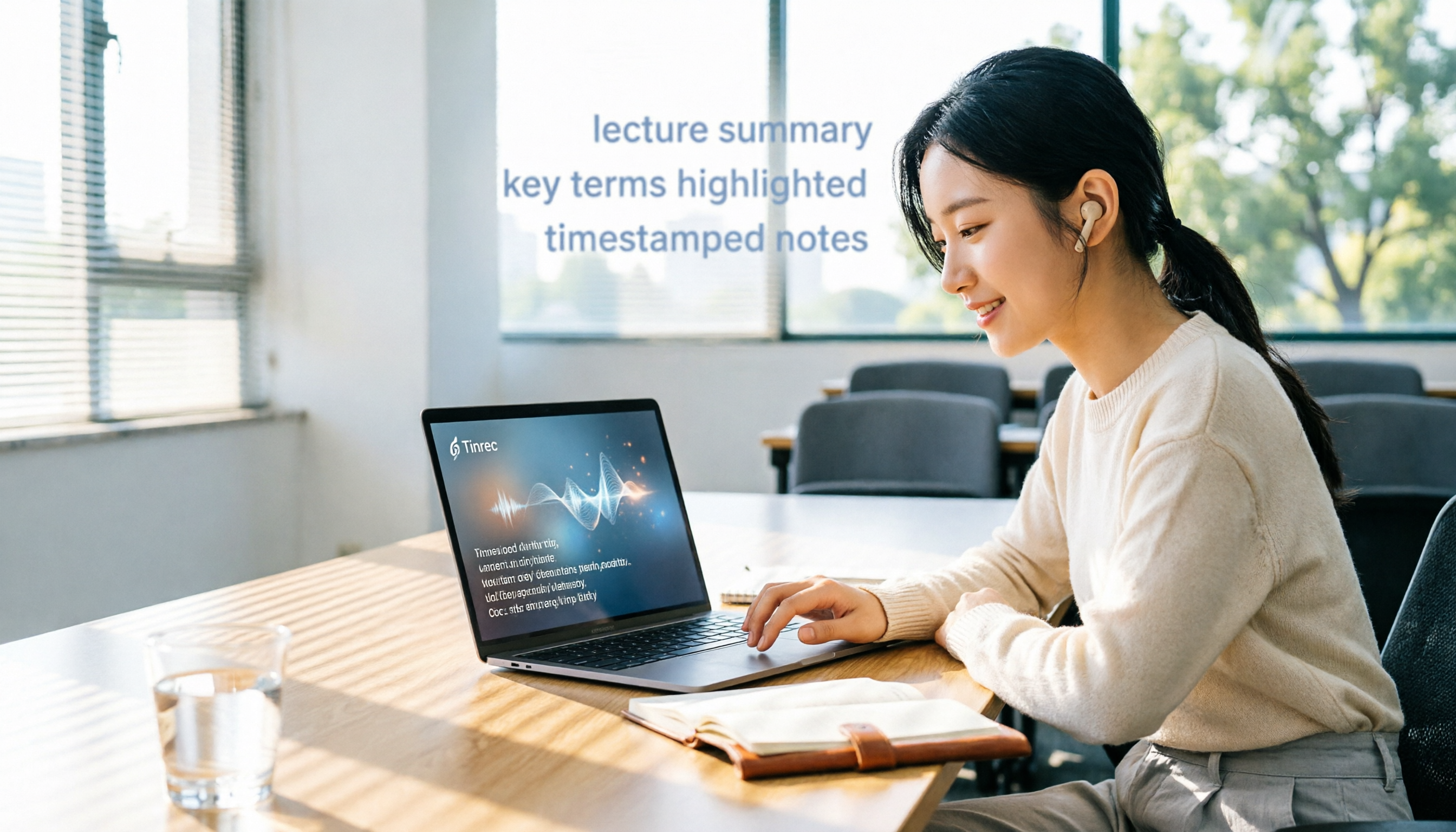
2026 AI Recording Tools Compared: Notta Tutorial & Pricing vs Tinrec for Students
A student's hands-on comparison of Notta and Tinrec for classroom recording and review. We break down Notta's tutorial and paid plans, assess whether the free tier is enough, and give real-world recommendations for students.

2026 Tested: 3 Best Recording-to-Text Tools Compared – Notta vs Tinrec vs Otter.ai
We tested three recording-to-text tools, addressing PTT users' discussions about Notta, and compared Notta, Tinrec, and Otter.ai in terms of features, pricing, and use cases, with recommendations.

2026 Hands-On Comparison of 4 AI Transcription Tools: Notta Pricing and Dcard Reviews Explained
Still searching Dcard for Notta pricing and user reviews? This article tests 4 AI transcription tools—Tinrec, Notta, Otter, and Fireflies—covering free tier limits, paid plans, and ideal use cases to help you find the best value.

Notta vs Granola in 2026: How to Choose? A 5-Step Complete Comparison Guide
Notta and Granola serve very different purposes: one is cloud-based transcription, the other is an invisible meeting notes app for Mac. This article walks you through a 5-step comparison and introduces Tinrec, a more comprehensive third option, to help you find the best meeting notes tool for your needs.

3 Best Meeting Note Tools in 2026: Notta Pricing and Value Analysis
We tested Notta, Tinrec, and Otter to compare costs, free tiers, and core features, helping you avoid the 3-minute per recording trap and find the right choice for Chinese speakers.

2026 AI Transcription Tools Compared: Notta vs Tinrec for Professionals
After Notta's 2026 price and feature updates, how should professionals choose an AI transcription tool? This article compares Notta and Tinrec from a mid-level manager's perspective, focusing on pricing, Chinese content organization, use cases, and practicality, to help you find the best tool for meeting minutes and audio/video organization.