

Turn recordings into transcripts and summaries in minutes
Upload audio or video for multilingual transcription, AI notes, and action items
2026 Cantonese Voice-to-Text Tools Compared: Which Free Version Is Best for Professionals?
I attend about 15 meetings a week—team meetings, project status updates, one-on-ones, and cross-departmental coordination. The most annoying part used to be the aftermath, not the meetings themselves, because every meeting generated a pile of decisions and action items to organize. I tried handwritten notes (too slow), recording and listening back (too time-consuming), and asking my subordinates to take notes (they're busy too). It wasn't until I started using AI voice-to-text tools that I finally saved the most mechanical part of the process.
There are many Cantonese voice-to-text tools on the market, but the free versions vary greatly: some only support real-time dictation and can't upload old recordings; others just give you a transcript without a summary, so you still have to read through it yourself. My team tested several tools and finally chose Tinrec (秒听录音), which not only transcribes but also organizes the key points for you. Here are my hands-on insights.
What Can Cantonese Voice-to-Text Do for You?
Many colleagues ask me: "How much time can speech-to-text really save me?" I explain with a few practical scenarios.
Scenario 1: Meeting Notes in 5 Minutes Previously, after a two-hour meeting, I'd spend another hour organizing the minutes. Now with Tinrec, by the time the meeting ends, the AI has already generated a summary, conclusions, and action items—who's responsible for what and deadlines are all clear at a glance. I usually forward the AI-generated minutes to the team right after the meeting, saving at least an hour.
Scenario 2: Course Recordings Turned into Notes I signed up for an online management course and recorded every session, but listening back was too time-consuming. Using Tinrec to convert course recordings into text, it even automatically splits them into chapters, so I can jump straight to the key parts for review without listening from start to finish.
Scenario 3: Interview Recording Organization When conducting user interviews, I record the entire conversation. Previously, I had to listen multiple times to find key insights. After Tinrec transcribes, I can use AI Q&A—I just ask "What features are users most dissatisfied with?" and it instantly finds the answer in the transcript, saving a lot of time.
Scenario 4: YouTube Video to Text Sometimes I want to reference Cantonese video content online but don't want to watch it slowly. Tinrec supports pasting a video link to directly convert to text and summary, which I use to quickly grasp industry information—quite convenient.
What Are Tinrec's Core Capabilities?
Tinrec isn't just a transcription tool; its core is "helping you understand the content after transcription." Here are the features I use regularly:
Real-Time Transcript: It generates text as you record, not after. Tinrec's real-time transcription has low latency, so during meetings I can watch the text to confirm nothing is missed and even add markers in real time.
AI Semantic Summary: It doesn't just condense the transcript into a paragraph; it organizes it structurally—meeting topic, discussion conclusions, action items, and responsible persons are listed separately. I just look at the summary after each meeting without reading the entire transcript.
Chapter Organization: Long recordings are automatically split into sections with titles for quick browsing. I use this for two-to-three-hour training recordings, jumping straight to the key points.
Action Item Extraction: It automatically extracts action items from the discussion, clearly showing who's responsible and when it's due. This feature helps me avoid the "no one remembers what was decided after the meeting" situation.
AI Q&A: After transcription, you can ask questions like "Who mentioned the budget in the meeting?" or "What was the client's reaction to the new feature?" Tinrec answers directly based on semantic understanding, so you don't have to search manually.
Multi-Format Export: Results can be exported to Word, PDF, Markdown, and synced to Notion, Google Docs, etc. I usually export meeting minutes to Word for my boss to review.
Stop organizing recordings by hand
Upload audio or video and automatically get a transcript, summary, and action items
Practical Use Cases
Meetings: Automatically Generate Action Lists I now always use Tinrec to record meetings. After the meeting, the AI generates a summary and action items, and I copy the action items directly to the team group—who's responsible for what is clear at a glance. If my boss suddenly asks, "What was the conclusion from the last meeting?" I just open Tinrec and ask the AI, getting the answer in three seconds without flipping through notes.
Learning: Course Recordings Turned into Review Notes I'm currently listening to a Cantonese podcast course. I use Tinrec to convert each episode into text and key summaries, and I can search for specific topics. Compared to manually taking notes before, I save at least half the time, and finding information is much easier.
Interviews: Quickly Extract Insights When conducting user interviews, I record the entire process. After Tinrec transcribes, I directly ask the AI: "How many times did users mention 'too expensive'?" "What suggestions did they make?" Because the AI uses semantic understanding, it finds relevant content even if the wording differs. This feature helps me quickly compile interview reports.
Content Creation: Get Inspiration from Videos Sometimes I reference Cantonese videos on YouTube. I use Tinrec to paste the link, convert to text, and then ask the AI for a summary and key points as content inspiration. I don't have to watch the video slowly—much more efficient.
4 Key Points to Consider When Choosing a Cantonese Voice-to-Text Tool
Accuracy: Don't just rely on official claims; test with your own recordings. Tinrec performs well with clear audio, but background noise or overlapping speech can affect accuracy—a common issue with all tools. I recommend trying the free version with your typical scenarios.
AI Organization Capability: Transcription is just the first step; whether the tool provides summaries, action items, and Q&A is the key. Tinrec's AI Q&A saves me the most time, as I don't have to read through every section.
Language Support: If you need Cantonese transcription, check whether the tool truly supports colloquial speech. Tinrec is clearly optimized for Chinese content, handling both Cantonese colloquial and written forms well.
Free Tier: Does the free version have minute limits? Is it enough for daily use? Tinrec's free version offers a basic monthly transcription allowance (100 minutes). If you only have a few meetings a week, it might be enough; if you have meetings daily like me, you may need to upgrade. But at least you can try the free version to see the results.
FAQ
Q1: Is Tinrec's free version sufficient? If you only need to transcribe meeting recordings or course audio occasionally, the free version's 100 minutes per month is usually enough. But if you have a large volume of recordings daily, I recommend upgrading to the Pro version—the monthly fee is reasonable, and the time saved is definitely worth it.
Q2: Does Tinrec support Cantonese colloquial speech? Yes. Tinrec is well-optimized for Chinese content (including Cantonese). In my tests with daily meetings and course recordings, the colloquial speech recognition accuracy is good, but there may be deviations with background noise or fast speech.
Q3: Can I upload old recording files (MP3/M4A) for transcription? Yes. Tinrec supports uploading audio and video files, including MP3, WAV, M4A, MP4, etc., and automatically transcribes them after upload. I've used it with old phone recordings, and the results were quite good.
Q4: Does Tinrec support transcribing YouTube videos? Yes. You can paste a public video link, and Tinrec will automatically download and transcribe it into text, and also generate a summary. Note that you should comply with platform copyright regulations.
Q5: Is my data secure? Tinrec encrypts user recordings for storage. For specific privacy policies, refer to the official website. Personally, I avoid putting highly sensitive information into any cloud tool.
Conclusion
Cantonese voice-to-text is nothing new, but a truly useful tool should save you time, not just give you a transcript. I tried several tools and finally chose Tinrec because its free version already provides transcription, summaries, action items, and Q&A, and its Chinese (Cantonese) performance is stable.
If you're like me and have more than 3 meetings a week, I strongly recommend trying Tinrec's free version—100 minutes per month is enough to experience a few meetings. See what it's like to have AI organize your meeting notes; you might find, like me, that you can't go back.
References
- Free Cantonese Speech-to-Text App 2025 | Subanana
- Online AI Speech, Video, Recording Auto-Transcription - Free Trial - cSubtitle
- 2026 Latest 4 Cantonese Voice-to-Text Tools Recommended: Solving Mixed Chinese-English and Meeting Notes Pain Points - 秒听录音 Blog
- Hong Kong's Top 5 Voice-to-Text Tools: Accurate Cantonese Recognition, Boost Meeting and Interview Efficiency!
- Transcribe Chinese (Cantonese) Audio to Text for Free in Seconds
Turn every recording into actionable outcomes
Get 60 free transcription minutes when you sign in. No credit card required.
Related Reading
You might also like

Tinrec vs UniScribe 2026: 5-Dimension Comparison for Cantonese Voice-to-Text
We tested two tools for transcribing Cantonese recordings, comparing them across five dimensions: transcription quality, AI organization, Q&A query, multi-source support, and export workflow, to help you decide which is more practical for professionals.

The Complete Guide to Cantonese Speech-to-Text in 2026: Free Tools and Practical Tutorial
This guide shows you how to use the free version of Tinrec to quickly convert Cantonese meeting, interview, and course recordings into text, with automatic summaries and to-do lists—perfect for mid-level managers and professionals looking to save time.

Tinrec Audio-to-Text in 2026: Cantonese Support and Automatic Meeting Minutes
A mid-level manager's hands-on comparison of Tinrec vs. Plaud Note across 4 key dimensions for Cantonese audio-to-text: accuracy, cross-platform, AI Q&A, and pricing. Learn how to use the free tier.
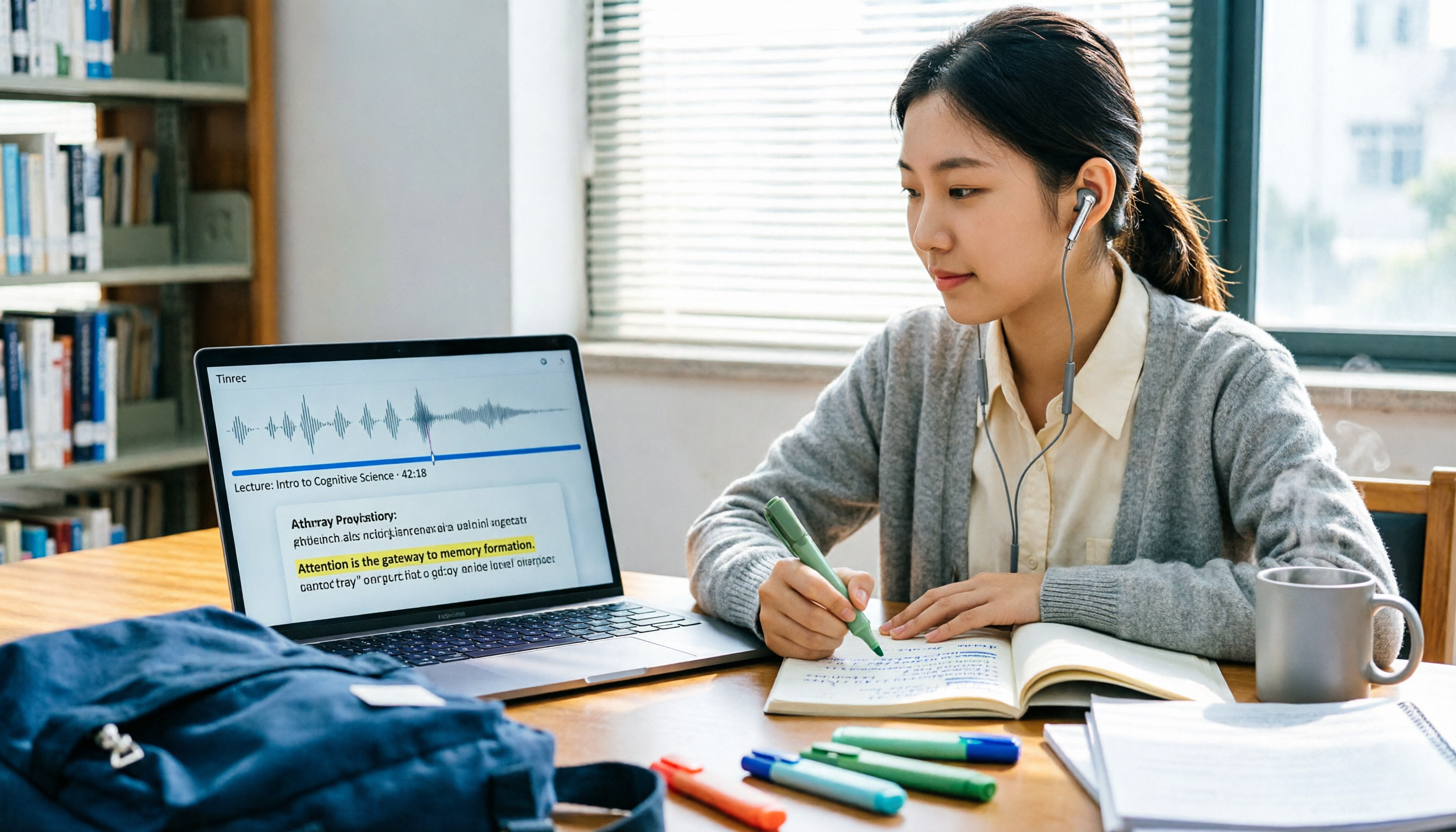
Tinrec Recording-to-Text Tutorial 2026: Is the Free Plan Enough? AI Summaries Help You Highlight Key Points
A student's hands-on review: Tinrec recording-to-text tutorial. The free plan offers sufficient credits, supports Chinese, and includes AI summaries and Q&A, turning classroom recordings into study notes.
Tinrec vs Otter.ai 2026: 5-Dimension Comparison – Which Free Cantonese Voice-to-Text Tool Is Right for You?
We tested two popular voice-to-text tools across five dimensions: accuracy, Cantonese support, AI features, free tier, and cross-platform compatibility, to help Cantonese speakers decide between Tinrec and Otter.ai.

2026 Free Cantonese Recording-to-Text Solutions: 2 Tools Compared
Compare two free Cantonese recording-to-text tools: Tinrec and Google Voice Typing, analyzing accuracy, mixed Chinese-English handling, file upload, AI features, and free quotas to help you find the time-saving solution.

2026 Free Cantonese Audio-to-Text Solutions: 4 Tools Compared
Cantonese audio-to-text tools are growing in number, but are the free plans sufficient? This article compares four tools—Tinrec, Otter.ai, Notta, and PLAUD Note—covering Cantonese recognition, free quotas, and AI features to help you find the best fit.

2026 Hands-On Comparison of 4 Cantonese Voice-to-Text Apps: Which One Saves You the Most Time on Meeting Notes?
We tested Tinrec, Plaud Note, Otter.ai, and Notta for Cantonese voice-to-text transcription, comparing accuracy, AI summarization, cross-platform support, and free tiers. Here's our practical review from a mid-level manager's perspective.

2026 Tested: 4 Cantonese Voice-to-Text Tools Compared – Which Has the Best Accuracy?
People on Dcard often ask how to convert Cantonese recordings to text. This article tests 4 tools, focusing on Cantonese accuracy, AI summaries, cross-platform support, and free tiers, to help you pick the best app for transcribing Cantonese meetings, classes, and interviews.