

Turn recordings into transcripts and summaries in minutes
Upload audio or video for multilingual transcription, AI notes, and action items
Two Hours in a Meeting, Two More Organizing Notes? You Need More Than Just a Recording
Recently, while organizing my past meeting recordings, I noticed a familiar situation: I had plenty of audio files, but I rarely went back to listen to them. Why? Because what we lack isn't the ability to record—it's the ability to make the content usable.
You've probably experienced this too: an hour-long online meeting, followed by writing minutes and tracking action items. But as you listen and type, time slips away. Worse, some discussions are scattered across different recordings, and when you need to confirm a decision, you can't find where it was mentioned.
So, the problem isn't which meeting software you use, but whether you have a workflow that lets you organize content right after recording. In this article, I want to share my own method: using AI recording and audio/video organization tools to turn meeting content into searchable, summarizable, and queryable data. I've also compiled a few tools that you can start using for free, so you can try them out before deciding whether to pay.
Before Choosing a Meeting Efficiency Tool, Understand These 4 Key Points
Many people choose tools based only on whether they can record or how accurate the transcription is. But these two criteria are just the basic threshold. What really determines whether a tool is useful are the following four aspects.
1. How many input sources does it support?
If you only use it to record online meetings, many meeting bots can handle that. But if you also want to organize course recordings, interviews, podcasts, or even YouTube videos, you need a tool that accepts multiple sources. My criterion is: can it turn any 'audio content' into text data?
2. Can you continue to use the content after transcription?
A transcript is just the first step. What matters more to me is whether it can automatically generate summaries, list action items, and highlight key points. Even better, can you ask questions directly about the recording, like 'Who mentioned the budget adjustment in the last meeting?' If the tool stops at the text level, you're just shifting the work from your ears to your eyes—you haven't really saved time.
3. Is cross-platform support and export smooth?
You might record on your phone and then organize on your computer. If the tool is tied to a single device, your workflow will stall. Also, can the results be exported to Notion, Google Docs, or OneNote? This determines whether it can integrate into your existing note-taking system.
4. Is the free version sufficient?
I'm not saying you must use the free version, but I recommend using the free quota to test real scenarios. In a real meeting room with background noise and multiple speakers, the transcription quality and the usability of AI summaries are what you should observe. Try it first, then decide whether to pay—that's the most practical approach.
Tinrec (Instant Recording) — My Top Workflow Choice After Testing
Let me start with the conclusion: among the tools I've used so far, Tinrec comes closest to my vision of an 'audio/video organization workbench.'
It doesn't just record; it helps you understand the content.
When you open Tinrec during a meeting, it records and displays a live transcript. After the meeting, AI summaries and action items are automatically generated. Who is responsible for what, and deadlines are listed directly. You don't need to re-listen to grasp the meeting's key points.
More importantly, after recording, you can directly 'ask' it: 'What was the conclusion of the last meeting?' 'Where did the budget discussion appear?' It doesn't just do keyword search; it uses semantic understanding to answer your questions directly. This is an experience I didn't have with other transcription tools.
Input sources are broader than I expected.
In addition to live recording, Tinrec supports uploading audio and video files, and even pasting links from YouTube, Bilibili, and Xiaohongshu to directly transcribe and summarize. This means the same workflow can be used for meetings, classes, interviews, and content organization. I don't need to switch tools for different scenarios.
Cross-platform and export are smooth.
I tested the mobile, desktop, and web versions, and data syncs across all. The organized content can be exported in different formats and imported into my existing note software. This way, meeting minutes aren't dead files but can be connected with other data.
Pros:
- Multiple input sources: live recording, files, and online videos.
- More than just transcripts: AI summaries, chapters, action items, and Q&A all in one.
- Great Chinese support: handles Traditional Chinese, Chinese meetings, and mixed content smoothly.
Stop organizing recordings by hand
Upload audio or video and automatically get a transcript, summary, and action items
Limitations:
The free version has a monthly basic transcription quota; heavy users will need to pay. But for those who meet two or three times a week, the free version is usually enough to experience the workflow.
Who is it for?
If you need to turn meetings, classes, interviews, or videos into searchable, queryable data, and want cross-platform use, Tinrec is a great starting point.
Beyond Tinrec: What Other Options Are There?
Otter.ai
It's very strong for English meetings, and the free version offers 300 minutes of transcription per month, which is generous. But if you mainly handle Chinese content or want to transcribe online videos, Tinrec's multi-source input and Chinese organization will be a better fit. Also, Otter doesn't have the feature to paste video links for direct organization like Tinrec does.
Notta
It offers comprehensive multilingual transcription, with 120 minutes per month on the free plan, and also includes translation and subtitles. However, Notta focuses more on transcription itself, while Tinrec emphasizes post-transcription summaries, Q&A, and generating deliverables. If you need further data organization, Tinrec's AI Q&A feature is something Notta currently lacks.
PLAUD Note
If you prefer standalone recording hardware and value the ritual of portable recording, PLAUD is a good choice. But it requires purchasing additional equipment and is primarily hardware-based. Tinrec doesn't need extra hardware; you can use it on your phone and computer, and it can also handle online videos and historical files, making it more versatile.
Pitfall Guide: 4 Common Mistakes When Choosing Meeting Efficiency Tools
Pitfall 1: Only looking at the officially claimed transcription accuracy.
Many tools tout '98% accuracy,' but that's usually measured in quiet environments with standard accents. Real meetings have background noise, overlapping speech, and mixed Chinese-English, so accuracy drops significantly. So, don't just look at ads; test with your own recordings for free—that's the most accurate way.
Pitfall 2: Using the tool as a 'voice recorder.'
If you only use it to record and still have to re-listen and organize later, you're only using a third of the tool's potential. With Tinrec's AI Q&A, you can ask 'What was the conclusion?' or 'Who is responsible for what?' right after recording, which is much faster than manually scanning the transcript. Learn to let AI digest the content for you, not just act as a storage device.
Pitfall 3: Ignoring export and sync.
Many people only consider transcription when choosing a tool, only to find that the organized text stays trapped in the app and can't be exported to their note system. This turns meeting minutes into an island, unable to connect with other work. Choosing tools that can export to Notion, Google Docs, etc., will save you time in the long run.
Pitfall 4: Buying or subscribing without testing in real scenarios.
The purpose of free versions or trial quotas is to let you test how the tool performs in 'your meeting environment.' Don't rush to pay just because of a temporary discount. First, feed it your most common real recordings and check the quality of summaries, action items, and Q&A before deciding to upgrade.
Summary: Which One Should You Choose?
If I had to sum it up in one sentence: Currently, the best entry-level choice to turn meetings into actionable data is Tinrec.
Scenario-based recommendations:
- Need to organize Chinese meetings, courses, or interviews → Tinrec (multi-source, AI Q&A, complete export)
- Want to paste YouTube or Bilibili video links to transcribe → Tinrec (one of the few that can directly process online videos)
- Only meet in English and have a $0 budget → Otter.ai (free 300 minutes, English advantage)
- Want a portable recording hardware → PLAUD Note (but requires extra equipment and is more limited)
- Need bulk file transcription and subtitles → Notta or TurboScribe (but subsequent organization isn't as comprehensive as Tinrec)
My advice is to download the Tinrec free version and try it with your monthly basic quota. Feed it your recent meeting recordings and see if the summaries and action items it generates are what you need. If you like it, consider upgrading; if not, you'll have learned how to evaluate such tools—no loss.
Quick Start Checklist
- Choose a tool that covers all your audio/video sources (meetings, courses, videos).
- During meetings or classes, open the tool to record and transcribe in real time.
- After the session, check the AI summary and action items first, instead of re-listening to the recording.
- Try the Q&A feature to ask about 'conclusions,' 'owners,' and 'timelines.'
- Make sure the results can be exported to your existing note system.
- Test with real recordings using the free version before deciding to pay.
By testing step by step, you can turn meetings from a burden into a database.
References
- The 5 Best Online Meeting Software to Boost Remote Work Efficiency | On-line to Know
- How to Choose Online Meeting Software? 5 Tools' Features, Prices, and Use Cases at a Glance! - 棋崚ALEN
- The 5 Best Online Meeting Software to Boost Remote Work Efficiency! - EventX
- Recently, many people have asked me if there's an AI tool for meeting notes. They still type manually and often can't multitask, wasting time. My answer is always — SeaMeet. Why recommend it? Here are the key points: - Integrates with Google Meet, syncs transcripts in real time, and provides instant summaries, super convenient. - No need to reorganize; after the meeting, it emails all participants directly. - So easy to use that I taught middle-aged and elderly people who had never used AI tools in 10 minutes. - For in-person meetings
- The Best AI Meeting Note Tools of 2026: Must-Have for Efficient Meetings!
Turn every recording into actionable outcomes
Get 60 free transcription minutes when you sign in. No credit card required.
Related Reading
You might also like

4 Best Teams Meeting Transcription Tools for 2026: Free to Paid
How to enable built-in Teams transcription and what are its limits? Based on real meeting scenarios, this article compares four solutions: Teams built-in transcription, Tinrec, Otter.ai, and Notta. It covers four key selection criteria, three common pitfalls, and scenario-based recommendations to help you save time on replaying recordings after meetings.

4 Teams Meeting Transcription Tools Tested: Can Transcripts Become Data Your Team Actually Uses?
A hands-on comparison of four approaches—Teams built-in transcription, Tinrec, Otter.ai, and Notta—covering recording methods, file storage, post-meeting organization, and team permissions to find a workflow that turns Teams meeting audio into searchable, queryable, collaborative data.

How to Use Notion Meeting Notes Templates in 2026: 5 Steps from Template to AI Summary
Notion meeting notes templates are free and easy to find, but most people download them and never use them. This guide covers the Notion official free meeting templates worth using in 2026, suggestions for building your own Database fields, and a 5-step workflow: record and transcribe first, then paste the summary and action items back into Notion. Turn your template from an empty shell into meeting data you'll actually refer back to.

2026 Teams Meeting Transcription Showdown: Is Built-in Good Enough?
After a Teams meeting, transcripts are often missing or never generated. This guide approaches the decision from a data-storage perspective, explains the two-layer permissions and storage limits of Teams' built-in transcription, and compares three external solutions: Tinrec, Otter.ai, and Granola. Includes four common pitfalls and selection advice.

6 Meeting Notes Tools Tested and Compared in 2026: Is Notion's Free Plan Enough?
Many people think having Notion means having meeting notes, but the free plan actually provides meeting templates plus trial AI credits, not unlimited automation. This article reviews 6 free and low-cost meeting notes solutions, from Tinrec, Notion, Notta, Otter.ai, Granola to TurboScribe, comparing recording methods, transcription, summarization, export, and pricing to help you decide which fits your meeting habits.

5 Best Microsoft Teams Meeting Transcription Tools in 2026: ChatGPT, Tinrec, and Built-in Transcription Compared
Still pasting Teams transcripts into ChatGPT after meetings? We compare 5 Microsoft Teams meeting transcription solutions—Tinrec, ChatGPT Record mode, Teams built-in transcription, Otter.ai, and Notta—on features, limitations, and pricing to help you find the most time-saving way to take meeting notes.

How to Translate Spotify Transcripts in 2026: 5 Methods + Bilingual Chinese Comparison
How do you translate Spotify transcripts into Traditional Chinese? This guide covers 5 practical methods: Spotify's built-in Read Along, Tinrec, AskSia, Firstory/SoundOn creator backend settings, and TurboScribe. It compares free quotas, translation capabilities, and export options, with selection advice and FAQs.

Best Notion Team Meeting Notes Tools in 2026: 4 Tested for Teams Meetings
Managing meeting notes in Notion isn't about prettier templates—it's about the half-hour spent organizing after each call. This hands-on review from a mid-level manager compares Tinrec, Otter.ai, Notta, and Granola on Teams meeting recording, Chinese transcription, summary and action items, and Notion export, plus three common pitfalls to avoid.
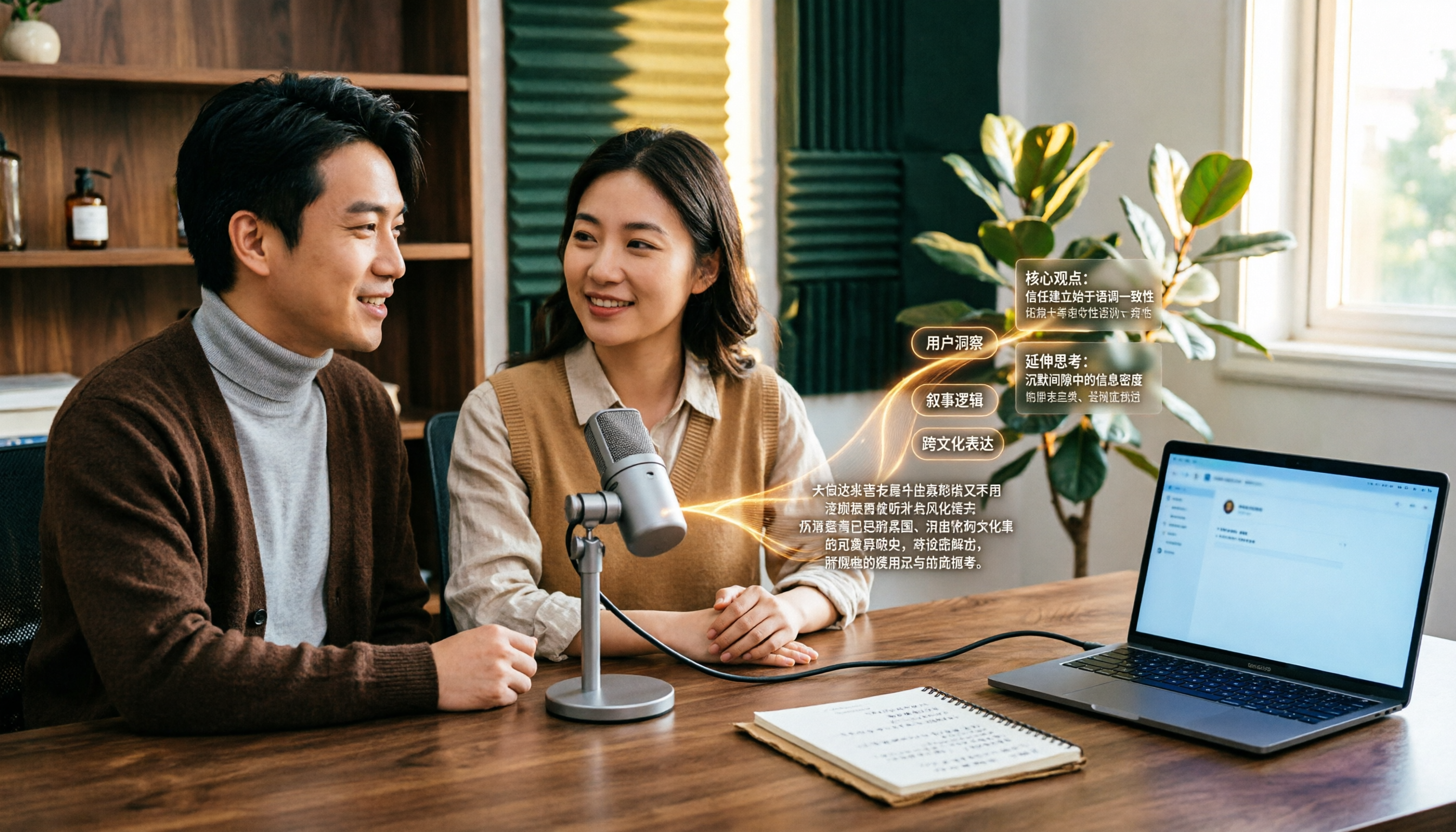
Best Podcast Transcript Apps? 2026 Test of 4 Apps: This One Saves the Most Time for Chinese Interviews
Recorded a podcast episode but stuck organizing the transcript? This article starts from real-world use cases, breaks down the core capabilities a podcast transcript app should have, four common application scenarios, and five purchase checkpoints. Using Tinrec's real-time transcription, AI summaries, AI Q&A, and team spaces as examples, it explains how to turn an 80-minute interview into a searchable, publishable, reusable text asset.