
Turn recordings into transcripts and summaries in minutes
Upload audio or video for multilingual transcription, AI notes, and action items
As the most popular messaging app in Taiwan, LINE carries a huge volume of business communication and private conversations. But the inability to directly record calls has always been a major pain point for users. A quick Google search reveals a plethora of methods, but many third-party apps often fail or only capture your own voice. This is because LINE does not offer an official recording feature due to user privacy concerns, and both Android and iOS have recently imposed strict restrictions on apps accessing call audio.
If you're struggling with how to record LINE calls, this article will break down four viable solutions available on the market: from dedicated hardware like Plaud Note, built-in system features, to AI software tools like Tinrec. We'll provide a detailed comparison table to help you not only capture the audio but also convert conversations into valuable text records with AI.
Why Is Recording LINE Calls So Difficult? Three Common Failure Reasons
Before choosing a tool, it's important to understand why many recording apps you download often only capture your own voice and not the other party's. Based on user reports and technical analysis, here are three main reasons:
- Android system permission restrictions: Since 2022, Google has updated its privacy policy to strictly prohibit third-party apps from accessing call audio streams. As a result, many older recording apps are completely ineffective on new phones unless you root the device (not recommended), making it extremely difficult for software to bypass these restrictions.
- Bluetooth headset path conflict: When you use Bluetooth headphones during a call, the audio transmission path differs from the phone's built-in microphone. Many recording apps cannot intercept Bluetooth signals, resulting in blank recordings or only one-sided audio.
- Chip compatibility issues: Some Android phones have underlying chip drivers that conflict with recording software. This is a hardware-level limitation, which explains why the same app may work on phone A but fail on phone B.
LINE Call Recording Solutions: Hardware vs. Software
Given the above restrictions, current solutions on the market fall into four main categories: external hardware, built-in system features, computer-assisted methods, and AI software. Here's a comprehensive comparison table:
| Comparison Dimension | Plaud Note (Hardware) | iOS 18.1+ (Built-in) | PC Emulator/Projection | Tinrec (AI Software) |
|---|---|---|---|---|
| Core Principle | Piezoelectric sensor / magnetic attachment recording | System-level integration | Audio capture on PC | Speakerphone recording / file import transcription |
| Device Requirement | Requires external hardware (approx. $159 USD) | iPhone 15 Pro or newer with updated system | Requires PC and microphone | Phone or PC (free/subscription) |
| Recording Success Rate | High (physical sound capture) | High (official support) | Medium (complex setup) | Medium (requires speakerphone environment) |
| AI Capabilities | Supports transcription and summarization | Basic transcription | Depends on accompanying software | Very high (includes action items, conversation search) |
| Portability | Requires carrying an extra card-like device | Built into phone | Low (fixed location use) | High (app ready anytime) |
| Best for | Frequent business calls, ample budget | iPhone users with compatible models | Long fixed-location meetings | Value seekers, emphasis on post-call organization |
In-Depth Analysis: Which Solution for Different Scenarios?
1. Hardware: Plaud Note
If you have a sufficient budget and don't want to deal with any software setup, an external recording device like Plaud Note is a solid choice. It attaches magnetically to the back of your phone via MagSafe and uses a vibration conduction sensor (VCS) to record. Its advantage is that it's a physical-level workaround—it works with LINE, WhatsApp, or regular phone calls, and doesn't require speakerphone. The downsides are the higher cost and the need to carry an extra hardware device when you go out.
Stop organizing recordings by hand
Upload audio or video and automatically get a transcript, summary, and action items
2. System Built-in: iOS 18.1 Call Recording
For users with an iPhone 15 Pro or newer, updating to iOS 18.1 brings call recording integrated into the system. While convenient, it's currently limited to certain models, and the other party receives a notification stating that the call is being recorded. This may not be ideal in situations where you need discreet recording for evidence or don't want to disrupt the conversation flow.
3. Software: Tinrec (Instant Recording)
If you don't want to buy expensive hardware and don't qualify for the latest iOS models, Tinrec (Instant Recording) offers the most flexible software solution. Instead of forcibly cracking the system's underlying layers (which poses security risks), it uses speakerphone recording or file import, focusing on the value after recording—transforming voice into searchable, actionable text notes.
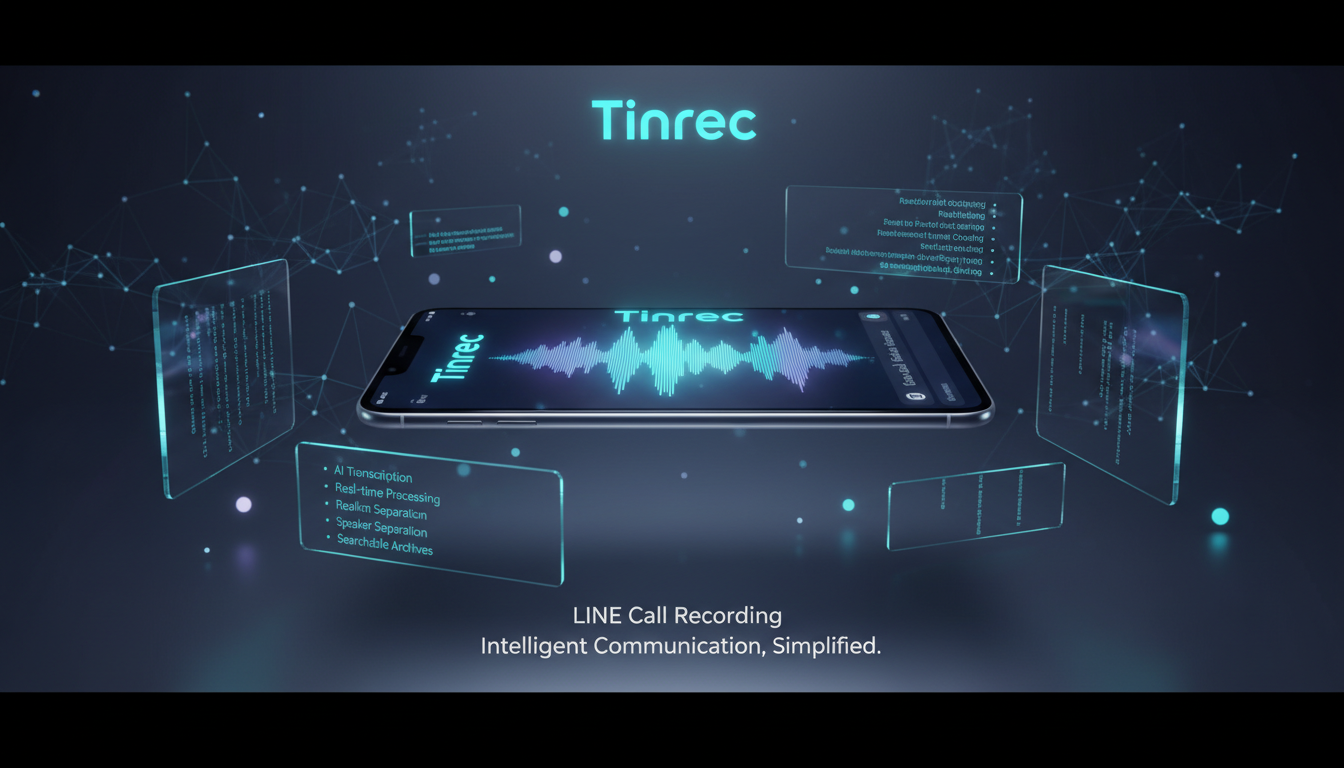
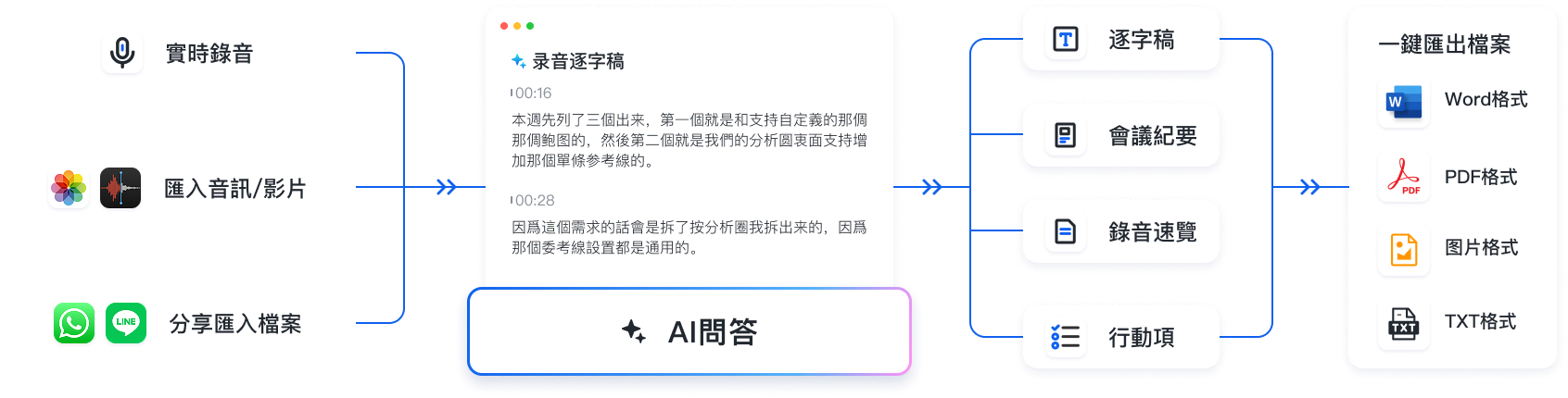
For most professionals, recording is just the process; the real value lies in organization. Compared to traditional voice recorders that only give you an audio file, Tinrec generates a transcript in real time and automatically extracts meeting minutes and action items, solving the problem of "recorded but no time to listen."
Practical Tutorial: How to Use Tinrec for LINE Call Records
Due to system restrictions on Android and iOS, when using an app to record LINE calls, we recommend the following standardized steps to ensure audio quality and transcription accuracy.
Scenario 1: Direct Phone Call (Speakerphone Method)
This is the simplest, zero-cost method, suitable for quiet indoor environments.
- Prepare the environment: Find a relatively quiet place to avoid background noise interfering with AI recognition.
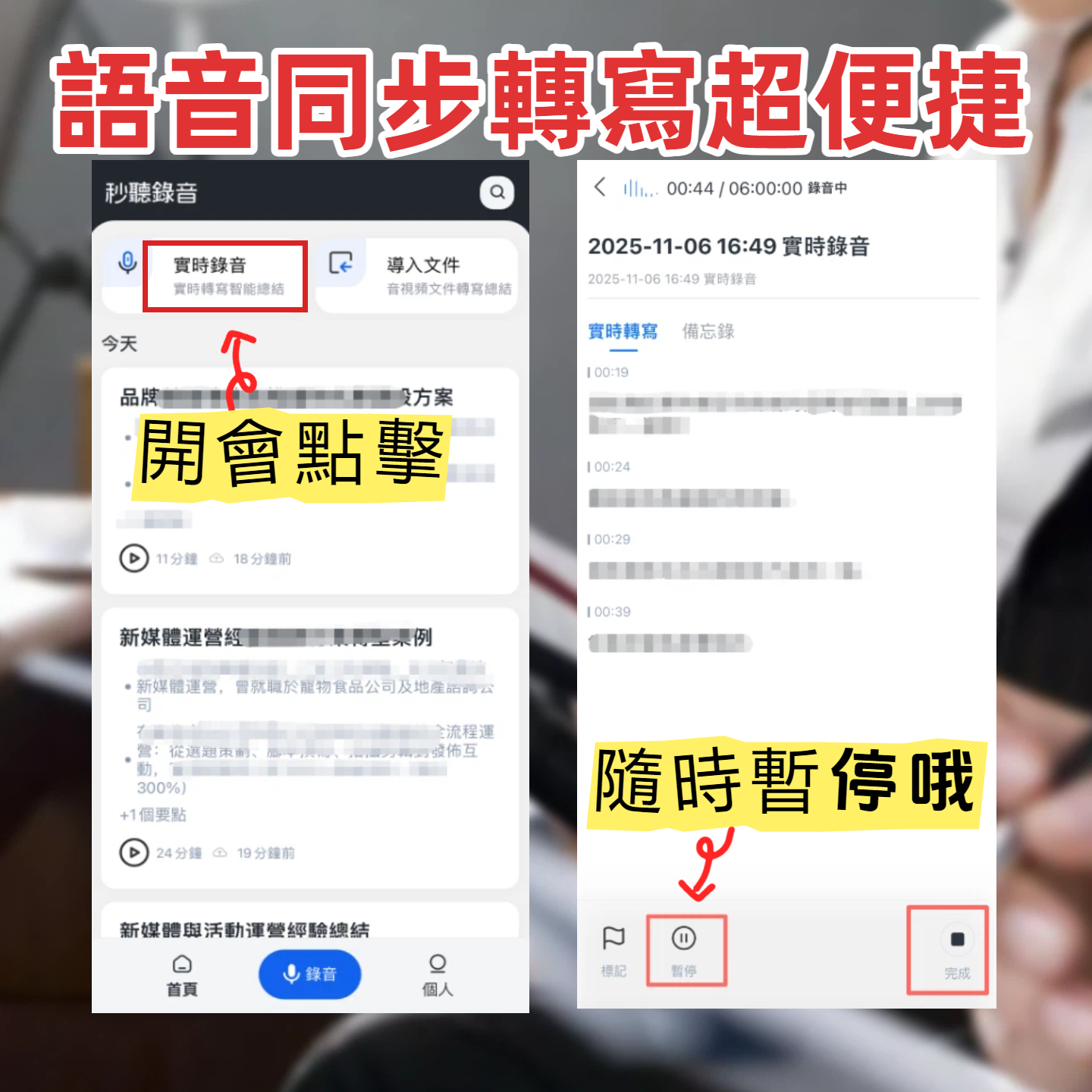
- Open Tinrec: Launch the Tinrec app and tap the "Start Recording" button on the home screen.
- Make a LINE call: After connecting the LINE call, be sure to turn on speakerphone (hands-free mode). Because system restrictions prevent the app from capturing the earpiece audio, enabling speakerphone allows the microphone to capture both your voice and the other party's.
- Real-time transcription: During the call, you can see Tinrec transcribing the conversation in real time. When the call ends, tap stop, and the AI will automatically generate a summary.
Scenario 2: LINE Calls on PC (Perfect Audio Quality Method)
If you often use LINE on your computer at your desk, this method offers the best audio quality without needing speakerphone.
- Use Tinrec on PC: Open the Tinrec web version in your browser.
- Set audio source: When making a LINE call on your computer, ensure the computer's audio output is working normally.
- Record and mark: Start recording. Tinrec supports multilingual recognition (including Chinese, English, Japanese, Korean, etc.), making it ideal for international meetings. You can also mark important points during recording.
Scenario 3: Post-call Organization (File Import Method)
If you've already recorded audio with another device or recorder, Tinrec can help with the post-processing.

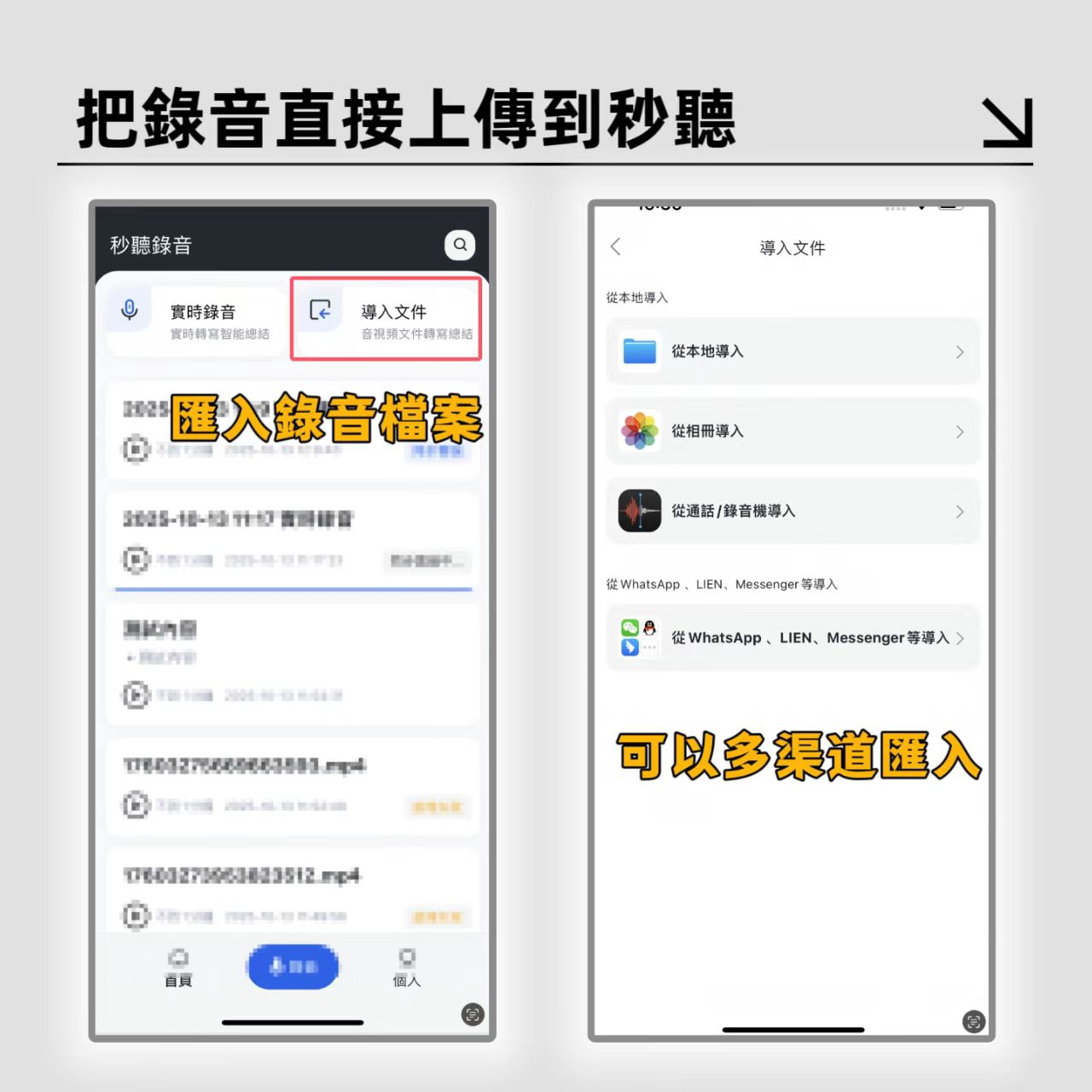
- Import file: In Tinrec, select "Audio/Video File to Text."
- AI analysis: After uploading, the system will identify speakers and generate chapter summaries. You can use the "AI Conversation Search" feature—for example, ask "What was the budget limit the client mentioned?" and the AI will find the answer directly from the recording, eliminating the need to re-listen to an hour-long recording.
Frequently Asked Questions (FAQ)
Q1: Why does my screen recording of a LINE call have no audio? Most phone screen recording features are restricted by privacy policies—when recording communication apps like LINE or Messenger, the system automatically mutes the other party's audio track, capturing only the video. Therefore, screen recording is usually ineffective.
Q2: Will the other party know if I'm recording a LINE call? When using a hardware device like Plaud Note or Tinrec (speakerphone method), the other party won't receive a system notification. However, if you use the built-in call recording feature in iOS 18.1, the system automatically announces that the call is being recorded, so the other party will know.
Q3: How long can I record with the free version of Tinrec? Tinrec offers 100 minutes of free recording per month, which is sufficient for users who occasionally record important calls or short meetings. For heavier use, the Basic plan costs only $4.9 per month and provides 600 minutes of recording.
Q4: Can I search the transcribed text? Yes. Tinrec supports both keyword search and AI-powered semantic search. For example, you can search for "quote" or ask the AI "What were the final action items decided?" It will summarize the information for you, making it much more useful than a plain audio file.
Q5: Can I record with an app while using Bluetooth headphones? Most apps (including Tinrec), when connected to Bluetooth headphones, are often unable to capture two-way audio due to system Bluetooth protocol limitations. If you must use Bluetooth headphones, we recommend using hardware like Plaud Note that has a dedicated sensor, or using LINE on a computer with a PC recording tool.
Q6: Are there security concerns with the recorded files? When choosing a tool, pay attention to data storage practices. Tinrec supports cloud sync and encrypted storage, and users can delete their data at any time. Compared to shady free cracked apps, legitimate commercial software typically has stricter privacy protections.
Turn every recording into actionable outcomes
Get 60 free transcription minutes when you sign in. No credit card required.
Related Reading
You might also like

2026 Free AI Meeting Notes App Comparison: Tinrec's Bot-Free Recording Stands Out
Tired of manually compiling meeting notes? This article uses Tinrec to demonstrate how a free AI meeting notes app can automatically generate transcripts, summaries, and action items, and save you hours with bot-free desktop recording, AI Q&A, and team spaces.

Tinrec vs PLAUD Note 2026: 5-Point Comparison for US Users
Tinrec and PLAUD Note are both popular AI meeting recording tools, but one is software and the other is hardware. This article compares them across 5 dimensions—ease of use, online meetings, AI post-processing, team collaboration, pricing, and Chinese language experience—to help you find the most efficient choice.

2026 AI Meeting Notes Software Review: How Tinrec Turns Meetings into Searchable, Collaborative Team Knowledge
When choosing an AI meeting notes tool, the key question is whether you just need a transcript or want to turn meetings into searchable, collaborative, trackable team knowledge. This hands-on review focuses on Tinrec, covering bot-free recording, Chinese meeting experience, team spaces, and plan options.
5 Best AI Meeting Recorder Apps in 2026: Which Free Plan Is Worth It?
We tested 5 AI meeting recorder apps in 2026—Tinrec, Notta, Vocol.ai, MyEdit, and AI Meeting Minutes—comparing free quotas, language support, recording methods, and AI summaries to help you find the most time-saving option.

2026 Hands-On Comparison of 3 Smart Meeting Minutes Scenarios: How Tinrec Helps You Wrap Up Meetings in 5 Minutes
Always missing key points during meetings? This article uses Tinrec as an example to test three scenarios—online meetings, in-person recordings, and historical audio files—and shows how AI can automatically generate transcripts, summaries, and action items, turning meeting minutes into a searchable digital asset for your team.

2026 Smart Meeting Notes Tools Compared: Tinrec vs Plaud Note – Which Is Worth Buying?
This article compares Tinrec and Plaud Note, two smart meeting notes tools, across six dimensions: hardware dependency, online meetings, Chinese recognition, AI features, team collaboration, and long-term cost, to help you decide which is more suitable for users in Taiwan.

2026 Smart Meeting Minutes Software: AI Summaries + Automatic To-Dos Tested
A mid-level manager tests 2026 smart meeting minutes software: from buying tips, in-depth Tinrec review to competitor comparison, helping you avoid pitfalls and find an AI tool that truly saves post-meeting time.

2026 Tinrec AI Meeting Minutes: Record Online Meetings Without Bots + AI Summaries and Action Items in One Go
Hands-on review of Tinrec, an online smart meeting minutes tool that not only transcribes meetings but also auto-generates summaries, action items, and AI Q&A. This guide covers how to choose and use it, avoiding common pitfalls—a must-read for managers of small and mid-sized teams.

2026 Showdown: 'The Illustrated Guide to an Efficient Life' vs 'The Art of Problem Decomposition' — A 5-Dimension Comparison to Find the Best Book for Learning AI Meeting Notes
A senior student's hands-on review: Which book is most effective for mastering AI-powered meeting notes? This article compares two popular titles and shows you how to pair them with the AI tool Tinrec to put the methods into practice, saving you time and trial-and-error.