

Turn recordings into transcripts and summaries in minutes
Upload audio or video for multilingual transcription, AI notes, and action items
The Complete Guide to Recording LINE Calls in 2026: 3 Ways to Bypass iPhone Limitations and Organize Transcripts with Tinrec
Last semester, my group members and I used LINE for our online group meetings. I thought I'd record the call for later reference, so I used my iPhone's screen recording feature. But when I checked the recording, I realized it only captured my own voice—the other participants' voices were completely missing. Later, I searched PTT and found this is a common issue; many people have fallen into the same trap. To make matters worse, even when I did manage to record, I never had time to re-listen to the hour-and-a-half-long audio file, so I ended up relying on my classmates' notes. This semester, I switched to a new approach: first, I find a way to record the LINE call, then I upload the audio to Tinrec to generate transcripts and summaries. This has doubled my efficiency. In this article, I'll share my complete strategy, covering everything from recording to organizing.
What Can LINE Call Recording Do for You?
Many students think recording is just for keeping evidence, but for students, the real value of LINE call recording is turning discussion content into reviewable material. Here are three scenarios you're probably familiar with:
Scenario 1: Group online discussions where no one remembers the conclusions When you use LINE for voice discussions on a project, everyone talks over each other, and in the end, no one remembers the conclusions. If you have a recording, you can upload the audio to Tinrec after the meeting, and it will automatically generate a transcript and key summary, making it clear who is responsible for what and when deadlines are. I now record every group meeting and use Tinrec to create a to-do list, which I post directly to the group chat. No one can pretend they didn't know.
Scenario 2: Online interviews or internship interviews where you want a transcript to review Last semester, I conducted user research and used LINE voice calls to interview participants. Previously, I had to listen and type at the same time, which was impossible. Now, I record the call and then use Tinrec to convert it into a transcript with timestamps. When writing reports, I can directly quote the interviewees, saving a ton of time.
Scenario 3: Remote courses or lectures where the audio is too long to re-listen Some online lectures or tutoring sessions are conducted via LINE calls, and a single class can last two hours. After recording, you don't want to listen from start to finish. Tinrec can generate chapters and key points, so you only need to read the summary to know what the class covered, making review much faster.
What Are the Core Capabilities of LINE Call Recording?
Let me start with the conclusion: LINE call recording involves two stages—"recording" and "organizing." For recording, due to phone system limitations, different devices require different methods. But for organizing, I now rely entirely on Tinrec, which is the most user-friendly AI organization tool I've used.
Stage 1: Recording LINE Calls (Method Overview)
I won't go into too much detail here because PTT has extensive discussions on this. Let me quickly cover the three viable methods I've tried:
- Built-in features on Android phones: Some Android phones have built-in call recording, but note that some only support regular phone calls, not VoIP services like LINE. My approach is to use the built-in "screen recording" feature, enabling both device audio and microphone, so I can capture both sides of the conversation. It works on my phone, but some models may not, so you'll need to test it yourself.
- External recording devices for iPhone: Due to system restrictions, almost no app on iPhone can directly record LINE calls. The most reliable method is to use another phone or a voice recorder placed nearby, but the audio quality is poor. I later switched to using LINE on my computer and recording the system audio with recording software, which gives much clearer sound.
- Recording on a computer: If you use LINE on your computer like I do, the simplest method is to use OBS or the built-in recording feature to capture the computer's output audio. This is the most stable method, and the resulting audio quality is high, so you can directly upload it to Tinrec for processing.
Regardless of which method you use, you'll end up with an audio file. Now comes the important part.
Stage 2: Using Tinrec to Turn Audio Files into Usable Data
This is the part I rely on most this semester. Tinrec is an AI meeting notes and collaboration tool, but for students, its strongest feature is "upload audio, automatically get transcripts, summaries, to-dos, and even ask it questions." Here are the capabilities I use every week:
Real-time transcript generation: After uploading an audio file, Tinrec quickly converts it to text with timestamps, allowing me to jump to key sections without listening from start to finish. The accuracy is quite good with clear recordings; occasional typos don't affect understanding.
Stop organizing recordings by hand
Upload audio or video and automatically get a transcript, summary, and action items
AI summaries and chapters: Tinrec doesn't just convert audio to text; it also automatically divides the content into chapters and generates a key summary. After a group meeting, I just look at the summary to know what was discussed, without re-listening.
To-do extraction: This feature is amazing. Tinrec extracts "who is responsible for what" from the conversation and organizes it into a to-do list. After meetings, I screenshot the to-dos and post them to the group chat, so everyone knows their tasks.
AI Q&A: You can ask Tinrec questions like "Who mentioned the budget in the discussion?" or "What was the client's feedback?" It answers based on the recording content. I often use this feature when writing reports to find specific sections, which is much faster than manual searching.
Multi-format export: Tinrec allows you to export as text files, PDFs, or sync directly to Notion or Google Docs. I usually export the transcript to Notion to integrate with my notes.
Practical Use Cases
Use Case 1: Group Project Discussions
Every time my group has a LINE voice discussion, I record it on my computer and then upload the audio to Tinrec. Tinrec generates a transcript, summary, and to-dos. I paste the to-dos directly into the group chat, and everyone picks their tasks. The efficiency is so high that my group members ask me how I do it.
Use Case 2: Online Interview Transcripts
For user interviews, I record the LINE call and then upload the audio to Tinrec. The transcript includes timestamps, so I can directly quote interviewees in my reports, saving a lot of re-listening time. Additionally, the AI Q&A helps me quickly find sections where "interviewees mentioned pain points."
Use Case 3: Internship Interviews or Online Meetings
I'm currently looking for internships, and some companies conduct online interviews via LINE. I always ask for permission to record, then use my computer to capture the system audio. After the interview, I upload the audio to Tinrec, which helps me organize the key points of my answers, allowing me to review my performance and improve for the next interview.
Use Case 4: Remote Course Review
Some tutoring sessions or online lectures are conducted via LINE calls, and the classes are long. After recording, I use Tinrec to convert the audio into a transcript, then review the AI summary and chapters. For studying, I only need to focus on the key points, which is much faster than re-listening to the entire class.
4 Things to Consider When Choosing LINE Call Recording Tools
I've encountered many pitfalls, so here are four points you should definitely consider:
1. Is the recording method legal and feasible? First, check if your phone or computer can record both sides of the conversation. iPhone users should consider recording on a computer, while Android users can try screen recording. Also, it's best to inform the other party before recording to avoid legal issues. Tinrec itself doesn't handle recording, but you can upload audio recorded by any method for it to organize.
2. Transcription accuracy and language support Recording quality directly affects transcription accuracy. Tinrec performs well with clear Chinese recordings and supports mixed Chinese-English and real-time translation, making it suitable for students in Taiwan. If you often handle English content, Tinrec also supports multiple languages.
3. Can it automatically organize after recording? Many tools only convert audio to text, leaving you to read the entire transcript yourself. Tinrec's summaries, chapters, to-dos, and AI Q&A are what truly save time. I no longer use other transcription tools because Tinrec's post-processing features are too convenient.
4. Budget and free tier Students care most about price. Tinrec offers a free version with basic credits for uploading, transcribing, and summarizing. If you only record occasionally for a group discussion or two, the free version might be sufficient. Since I have group meetings and interviews every week, I upgraded to Pro, which costs less than two bubble teas a month, but the time it saves is definitely worth it.
Frequently Asked Questions
Q1: Can I record LINE calls on iPhone? Directly recording on the phone is not possible because iOS restricts third-party apps from accessing call audio. The most reliable method is to use LINE on your computer and record the system audio with recording software. After recording, upload the audio to Tinrec for organization.
Q2: How do I convert an audio file into a transcript? It's simple: open Tinrec, upload your audio file, and it will automatically convert it into a transcript, along with a summary and to-dos. You can also use the mobile app to record directly, but note that it records ambient sound, not LINE calls.
Q3: Is the Tinrec free version sufficient? If you only record occasionally for a group discussion or interview, the free version's basic credits should be enough to try it out. But if you have recording needs every week like I do, I recommend upgrading to Pro, which is reasonably priced for students.
Q4: What legal issues should I be aware of when recording LINE calls? In Taiwan, the legality of recording depends on whether you have the other party's consent. It's advisable to inform the other party before recording, especially for interviews or meetings. For internal group discussions, everyone usually agrees to recording because it benefits everyone.
Conclusion
LINE call recording for students isn't about surveillance; it's about turning discussion content into data that can be reviewed, searched, and organized. First, solve the recording issue (iPhone users can record on a computer, Android users can try screen recording), then upload the audio to Tinrec, which will generate transcripts, summaries, extract to-dos, and even allow you to ask it questions. This semester, with this workflow, I've found group reports, interview research, and internship interviews much easier. If you're tired of recording but never having time to listen, I highly recommend trying Tinrec. Start with the free version and experience the power of AI in organizing audio files.
References
- 2026 PTT Hot Discussion: LINE Call Recording Workaround Guide – 3 Methods to Solve iPhone Limitations, Tinrec Transcription Tutorial - 秒聽錄音Blog
- 2026 Review of 4 LINE Call Recording and Organization Tools: PTT Users' Solutions for iPhone Limitations and Transcripts - 秒聽錄音Blog
- Question: Devices that can record LINE calls - MobileComm Board | PTT Digital Life
- Re: Question: s25u Call Recording - MobileComm Board - PTT
- Question: Recording LINE calls on iPhone - iOS Board - PTT Web
Turn every recording into actionable outcomes
Get 60 free transcription minutes when you sign in. No credit card required.
Related Reading
You might also like

How to Record LINE Calls in 2026: iPhone Built-in Without Notification + Android Recording App Tested
Recording LINE calls is finally possible! This article tests the iOS 26 'Local Capture' feature on iPhone and Cube ACR on Android, teaching you how to record LINE calls without notifying the other party, and provides complete steps to download and save recordings.

2026 Free LINE Call Recording Solutions: 4 Tools Compared
LINE doesn't have built-in call recording, but you can use iPhone screen recording, Android Cube ACR, a voice recorder, or Tinrec. This article reviews 4 free solutions and recommends Tinrec as the top choice for recording-to-text, letting you generate meeting minutes directly after recording.

Tinrec vs Tenorshare 2026: 5-Dimension Comparison for Organizing Downloaded LINE Voice Messages
Downloading LINE voice messages is easy, but organizing them afterward is the real challenge. This article compares Tinrec and Tenorshare across 5 dimensions to help you find the best solution for saving and organizing your recordings.
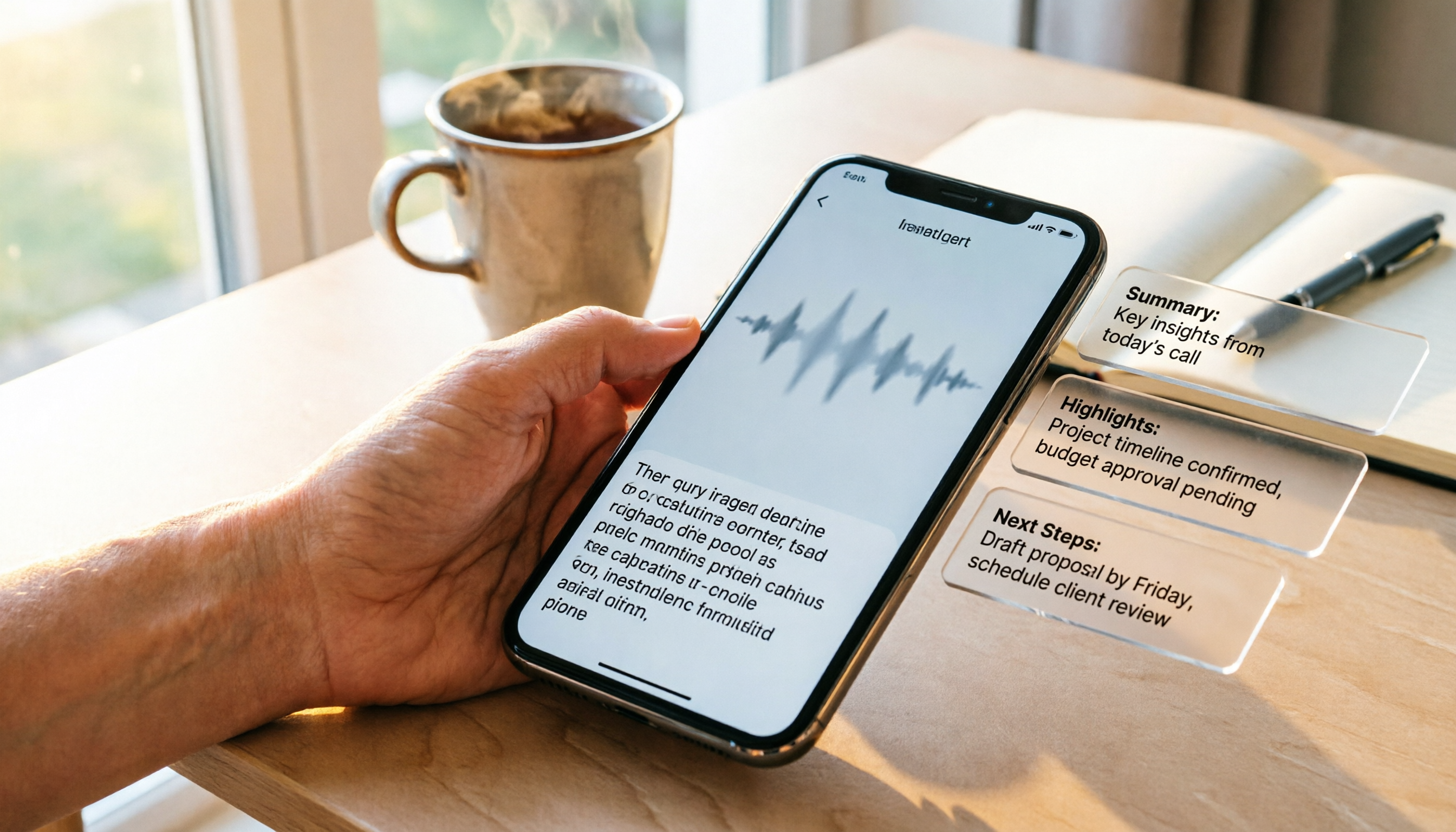
2026 iPhone LINE Call Recording Test: Built-in Local Capture vs Tinrec AI Transcription
iPhone can finally record LINE calls! This article teaches you how to use the iOS 26 built-in 'Local Capture' to record, then compares Tinrec's AI transcription, summarization, and to-do extraction, so you don't just end up with an audio file.

How to Download LINE Voice Messages in 2026: 3 Tested Methods for iPhone, Android, and PC
LINE voice messages lack a direct download button. This article tests three methods—Keep, Share to Files, and third-party tools—comparing steps, formats, and use cases to help you permanently save LINE recordings to your phone or computer.

2026 Tested Comparison of 3 LINE Call Recording Methods: iPhone Built-in, Android App, Magmo Hardware – Which Is Most Reliable?
LINE doesn't have built-in call recording, but iPhone users can record for free via the integrated calling feature, Android users can use Cube ACR, or you can use the Magmo magnetic hardware. This article compares three mainstream solutions in terms of setup difficulty, recording quality, cost, and legal reminders to help you choose quickly.

2025 Hands-On Comparison of 2 LINE Voice-to-Text Tools: Tinrec vs Notta – Which Saves More Effort?
Want to turn downloaded LINE voice messages into transcripts or meeting notes? This article compares Tinrec and Notta across post-meeting organization, team spaces, bot-free recording, Chinese translation, and plan flexibility to help you decide which suits Taiwan users better.

2026 LINE Call Recording Software Buyer's Guide: 4 Tested Methods and Recommendations
LINE doesn't have built-in call recording. This article tests recording methods for Android and iPhone, and explains how to use Tinrec to turn recordings into searchable, organized meeting notes.

2026 iPhone LINE Call Recording and Transcription Tools Buying Guide: 3 Tested and Recommended
iPhone can finally record LINE calls! This article teaches you how to use iOS 26's built-in local capture feature to record without notification, and tests 3 tools like Tinrec to turn recordings into searchable, actionable data.