

Turn recordings into transcripts and summaries in minutes
Upload audio or video for multilingual transcription, AI notes, and action items
You finish recording an important meeting, but you can't find the file.
This isn't an iPhone problem.
It's because you're treating the recording as an event, not as data that needs to be managed.
So this article isn't just about where recordings are stored—it's a comparison of three solutions to see which one truly helps you turn recordings into follow-up actions.
Can't Find Recordings, Painful to Organize: You Don't Need Another Recording App
Two hours in a meeting, two more hours organizing the recording.
That's a common routine for many.
Worse, iPhone's built-in Voice Memos app stores recordings only within the app by default; you can't find them directly in the Files app.
Unless you manually export them.
But after exporting, files end up scattered across folders, and searching for content still means listening line by line.
If your recordings are just stored and never used, they're as good as junk.
Choosing the right tool is what makes recordings truly valuable.
Before Choosing an iPhone Recording Solution, Understand These 3 Key Points
1. Is the recording location transparent?
Some tools lock recordings inside the app, making it hard to access them.
A good solution should let you know where files are, or even automatically save them to the cloud for easy search and sharing.
2. Does it have AI organization capabilities?
A transcript alone isn't enough.
You need summaries, to-do items, key highlights, and even the ability to ask questions about the recording.
If you're still manually transcribing, the time cost is too high.
3. Does it support cross-platform use?
You might record on your iPhone today and organize on your computer tomorrow.
If the tool is mobile-only, your workflow will hit a wall.
These three points are my core criteria for choosing a recording solution.
Next, I'll test three tools against these criteria.
Tinrec (秒听录音) — My Top Pick After Testing
Tinrec isn't just a voice-to-text tool; it's the solution I currently use to turn meeting recordings into actionable data.
My approach: open the Tinrec mobile app and start recording.
It transcribes in real time, and recordings are automatically saved to the cloud—no manual export to the Files app needed.
After recording, AI automatically generates summaries, chapters, and to-do items.
What impresses me most is the AI Q&A feature.
I can ask, "Who mentioned the budget in the last meeting?" and Tinrec gives me specific answers based on the recording, not just a bunch of keyword search results.
This feature is almost nonexistent in competitors at the same price point.
Additionally, Tinrec supports recording online meetings without bots.
If you're on a computer, the desktop version can capture system audio directly—no need to invite a bot to the meeting.
This is very useful for teams that don't like strangers in their meetings.
Stop organizing recordings by hand
Upload audio or video and automatically get a transcript, summary, and action items
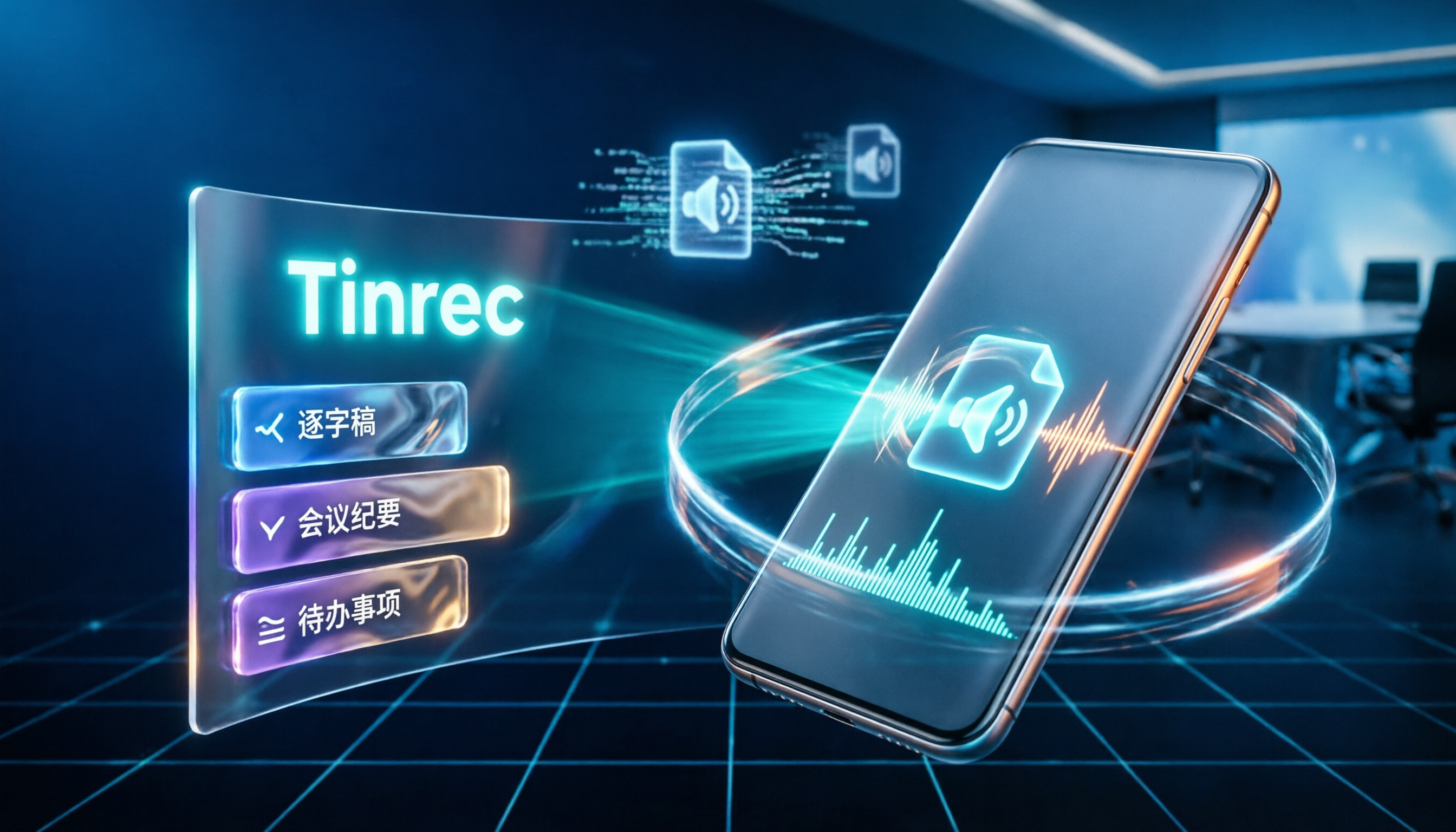
(Screenshot here: Tinrec mobile recording interface, arrows pointing to real-time transcription and AI summary buttons)
Its advantages are clear:
- Recordings auto-upload to the cloud, transparent location, accessible anytime.
- Complete AI organization: not just transcription, but summaries, Q&A, and export.
- Cross-platform support for iOS, Android, and web, so your workflow never breaks.
Limitations: the free tier has limited credits; heavy users need to pay. But for those who meet a few times a week, the free credits are enough to experience the full workflow.
If you often record in Chinese, want to ask questions about the recording, or switch between phone and computer, Tinrec is currently the most suitable choice.
Beyond Tinrec: What Are Your Other Options?
Apple Voice Memos
Built into iPhone, zero cost.
But its purpose is recording, not organizing.
Recordings are stored only within the app by default; you have to manually export to Files to share or back up, and there's no AI summary or Q&A.
If you just need simple recording, it's fine. But if you want to turn recordings into data, it won't help.
Otter.ai
A powerhouse for English meetings, with generous free credits.
But the Chinese experience isn't as good as Tinrec, and it focuses on online meeting bots, with weaker mobile recording organization.
If you mainly record English content, Otter.ai is worth considering. But if you need Chinese meeting organization, AI Q&A, or team spaces, Tinrec is the more comprehensive solution.
Avoid These 3 Common Mistakes When Choosing a Recording Tool
Mistake 1: Record without organizing, turning recordings into dead files
Many people record and never listen again.
If the tool lacks AI summaries and search, recordings are just space-wasting junk.
Choose a tool with automatic organization to truly save time.
Mistake 2: Ignoring cross-platform needs
You record on iPhone but need to organize on your computer.
If the tool doesn't support web or desktop versions, you'll be in pain.
Mistake 3: Assuming the native tool is enough
Voice Memos is free, but basic.
When you need to quickly find a specific discussion or auto-generate to-dos, the native tool falls short.
Spending a little time choosing the right tool saves much more time later.
Summary: Which One Should You Choose?
My conclusion is simple:
Need Chinese recording + AI organization + cross-platform → Tinrec
Only record English meetings and don't need follow-up organization → Otter.ai
Prefer native and don't mind manual export → Apple Voice Memos
If you're like most people and want recordings to actually help your work rather than just sit there, I suggest starting with Tinrec's free tier.
The free credits are enough to experience recording, transcription, AI summaries, and Q&A. If you like it, consider upgrading.
Test it step by step, and you too can turn recordings into valuable data.
References
- Where Are iPhone Voice Memos Stored? How to Export, Save, or Share - Tech Girlz
- Record audio in Voice Memos on iPhone - Apple Support
- Organize recordings in Voice Memos on iPhone - Apple Support
- 2026 Guide: Where Are iPhone Recordings? 3 Quick Ways to Find Them, Plus Tinrec AI Recording Assistant for Easy Transcription - Tinrec Blog
- Record video and audio on iPhone - Apple Support
Turn every recording into actionable outcomes
Get 60 free transcription minutes when you sign in. No credit card required.
Related Reading
You might also like

iPhone Voice Memos vs Tinrec in 2026: A 4-Dimension Comparison for Meeting Notes
This article compares iPhone's built-in Voice Memos with Tinrec's instant recording feature, analyzing four dimensions: recording and transcription, meeting organization, team collaboration, and cross-platform export, to help you choose the best meeting notes tool.
iPhone Recording Files: Where They Are and How to Auto-Generate Meeting Minutes (2026 Tested)
Wondering where your iPhone recordings are stored? Many users can't find them because they're saved only in the Voice Memos app by default. This hands-on comparison covers the native export method and Tinrec AI recording assistant, showing you how to quickly locate your recordings and automatically convert them into transcripts, summaries, and to-do lists.

2026 iPhone Recording Features Compared: Voice Memos, Call Recording, and Tinrec – Which Is Most Useful?
Looking for iPhone recording features? This article tests Voice Memos, iOS 18.1 call recording, and Tinrec, a recording-to-text app, comparing built-in methods to AI summaries and team collaboration to help you decide which is most practical.

Best iPhone Voice-to-Text Apps in 2026: Built-in Free vs Tinrec
iPhone's built-in Voice Memos can now transcribe recordings for free, but for meeting summaries, task management, and team collaboration, Tinrec is a more complete choice. This article compares the two and provides step-by-step instructions.

2026 iPhone Voice Recording Loop Test: 3 Steps to Repeat Playback with a Free App
The iPhone's built-in Voice Memos app doesn't support repeat playback. Want to loop your recordings? We tested using the free player KMPlayer to import audio files, and it takes just 3 steps. You can also adjust speed and EQ. Includes comparisons with other methods and a pitfall guide.

How to Trim Audio Recordings on iPhone in 2026: Built-in vs. Third-Party Apps
Trimming iPhone recordings isn't limited to the Voice Memos app. This article compares the trimming workflows and use cases of the built-in Voice Memos, GarageBand, and third-party apps, and recommends pairing with Tinrec for transcription and management after trimming—ideal for users who need to organize meeting or interview recordings.

2026 iPhone Recording Apps Compared: Where's Call Recording? AI Summaries Save Time
iPhone call recording is built into iOS 18.1 and later, accessible via the top-left corner of the call screen, but it only offers recording and transcripts, lacking AI summaries, Q&A, and team collaboration. This article tests 4 iPhone recording solutions, from built-in call recording to Tinrec AI meeting notes, to help you find a truly time-saving option.

2026 iPhone Recording Free Solutions: 3 Features to See at a Glance
This article explains where the iPhone microphones are located and introduces free recording organization solutions, using Tinrec as an example to show how to turn recordings into usable meeting notes and to-do lists.

Tinrec vs Otter.ai in 2026: A 5-Dimension Comparison for Chinese Meetings
How to choose an AI meeting notes tool in 2026? This article compares Tinrec and Otter.ai across five dimensions: meeting capture method, input sources, post-meeting outputs, Chinese language experience, and team management. It also briefly reviews Notta and PLAUD to help you find the best solution for Chinese meetings and team collaboration.