
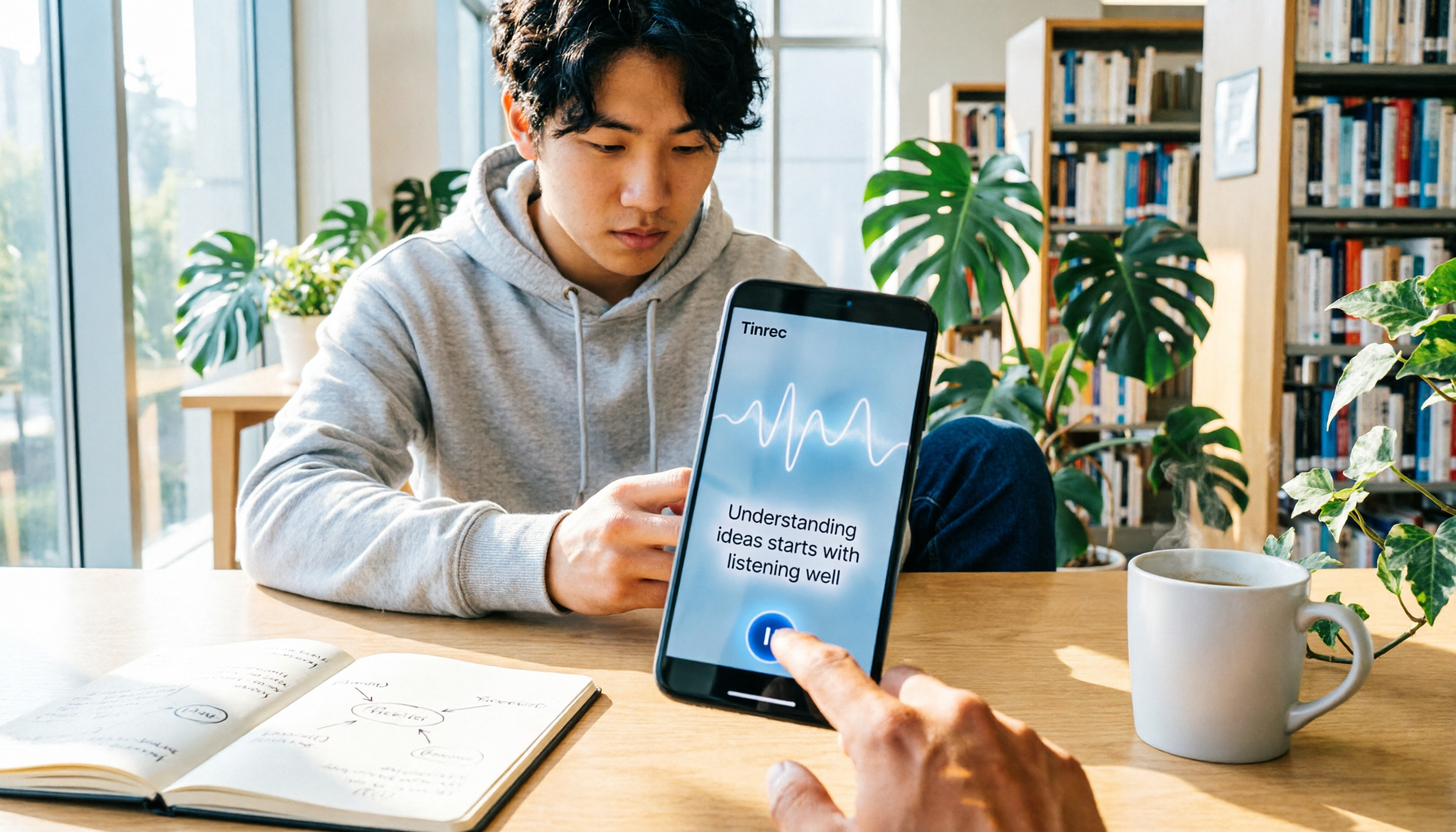
Turn recordings into transcripts and summaries in minutes
Upload audio or video for multilingual transcription, AI notes, and action items
The Complete 2026 Guide to Plaud Recording: A 5-Dimension Comparison with Tinrec and Buying Advice
Many students have a misconception: if you want to record, you must buy a voice recorder. I thought the same way during my freshman year, believing that phone recordings weren't professional enough, so I spent money on a voice recorder. In the end, I barely used it, and the audio files piled up on my computer with no time to listen to them. Later, I realized that the key isn't recording itself, but how you quickly turn recordings into key points afterward. Based on my own experience over a full semester, this article compares Plaud recording hardware with Tinrec recording software to see which is more suitable for students.
Plaud vs Tinrec | Quick Overview
Plaud is an AI recording hardware device that looks like a transit card or a capsule. It's designed for on-the-go recording with one-touch operation, and files are automatically transferred to the mobile app for transcription. Tinrec, on the other hand, is an AI meeting notes software that works on both phones and computers, requiring no additional hardware. In simple terms, Plaud means "buy a voice recorder," while Tinrec means "record directly with your phone or computer."
| Comparison Item | Plaud | Tinrec |
|---|---|---|
| Product Type | Hardware voice recorder | Software app/desktop version |
| Price | Hardware starts at around USD 159, plus membership fees | Free version available; paid plans include weekly/monthly/yearly options |
| Primary Use | In-person recording, phone call recording, on-the-go notes | Online meetings, lecture recording, file transcription |
| Core Difference | Standalone device, can record offline | Multi-platform use, no extra hardware needed |
Next, I'll compare them across five dimensions to help you decide which one is right for you as a student.
Dimension 1 | Recording Methods and Hardware Dependency
Plaud's recording method is straightforward: press and hold the record button on the device for 1 second, it vibrates once to start recording, and press and hold again for two vibrations to stop—no need to look at your phone. Audio files sync automatically to the app, so you don't have to keep your phone on. However, you need to spend money upfront on the hardware and carry an extra device with you.
Tinrec requires no hardware; it's installed directly on your phone or computer. For lectures, just place your phone on the desk, open the app, and tap record. For online meetings, use the desktop version to capture system audio directly, without needing an external microphone. For students, not having to buy extra equipment is the biggest advantage.
→ This dimension: Tinrec wins, because there's zero hardware cost, so students don't have to spend extra money.
Dimension 2 | Online Meeting Recording
Plaud is essentially a voice recorder, so to record online meetings (like Zoom or Google Meet), you'd have to place the recorder next to the speaker, which degrades audio quality and transcription accuracy in noisy environments. It's better suited for face-to-face interviews or phone call recordings.
Tinrec's desktop version can directly record your computer's system audio, so you don't need to point a microphone at the speaker or invite a meeting bot. This is super convenient for students whose classes have moved online, as you get transcripts and summaries right after recording.
Stop organizing recordings by hand
Upload audio or video and automatically get a transcript, summary, and action items
→ This dimension: Tinrec wins, as the experience with online courses and video meetings is far superior.
Dimension 3 | Transcription Accuracy and Chinese Support
Plaud supports transcription in 112 languages, with speaker labeling and custom vocabulary. Its Chinese recognition is decent, especially with clear speech. However, it may still make errors with mixed Chinese-English content or when multiple people speak simultaneously.
Tinrec also supports Chinese, mixed Chinese-English, and multiple languages, and has a team vocabulary feature (not available in the personal version, but common terms are recognized). In my experience recording professors with Taiwanese-accented Chinese, accuracy is high, with occasional errors on proper nouns that are easy to correct manually.
→ This dimension: Tie, as both offer good Chinese support with no significant difference.
Dimension 4 | Post-Meeting Organization and AI Features
After recording, Plaud's app automatically generates transcripts, along with AI summaries, mind maps, and templates. However, its organization is more about turning recordings into notes, with limited options for further editing or exporting.
Tinrec goes beyond transcripts by automatically extracting key points, dividing into chapters, and pulling out action items. You can also use AI Q&A to ask questions about the recording, such as "What did the professor say about the midterm scope?" Additionally, you can export to Notion or Google Docs, or generate meeting minutes directly. For students, this is like having an assistant that helps you organize key points.
→ This dimension: Tinrec wins, as its AI applications are more extensive, going beyond simple transcription.
Dimension 5 | Pricing and Free Allowance
Plaud's hardware is expensive on its own: the NotePin costs USD 159 and the Note Pro costs USD 189, not including membership fees. The Starter membership includes 300 minutes per month, while the Pro membership costs USD 99.99 per year and includes 1,200 minutes per month. For students, this is a significant expense.
Tinrec offers a free version with basic recording and transcription allowances. In my testing, recording a few hours of lectures per week was sufficient (I won't specify exact minutes as allowances may change). If you need more, you can purchase a weekly card or Pro, but at least you don't have to spend a large amount on hardware upfront.
→ This dimension: Tinrec wins, as the free version meets most students' needs and offers great value for money.
What Are the Unique Advantages of Each?
Tinrec's Unique Advantages
- No hardware needed: record directly with your phone or computer, zero equipment cost.
- Online meetings without bots: the desktop version captures system audio, supporting Zoom and Meet.
- AI Q&A and export: ask questions about the recording and export to Notion or Google Docs for further organization.
- Team space (if collaborating in groups): share recordings and transcripts, though students typically don't need the team version; the free version is sufficient.
Plaud's Unique Advantages
- Portable hardware recording: no need to carry your phone; a recorder in your pocket is ideal for interviews or impromptu notes.
- Offline recording: you can record without your phone and sync later.
Conclusion: Which One Should You Choose?
If you're a student like me, mainly recording lectures, online courses, and group discussions, and you're on a budget, go with Tinrec. The free version meets most needs without spending money on a recorder or worrying about membership fees.
Only if you frequently need "independent recording without your phone," such as outdoor interviews or environments where phones aren't allowed, does Plaud become valuable. But for the average student, your phone is almost always with you, so carrying an extra recorder just adds weight and cost.
In a nutshell: download the Tinrec free version first, try it with your own lecture recordings, and consider paid options only if needed. There's no need to buy Plaud hardware from the start.
References
- Plaud Taiwan | Official Website | Leading AI Recording Device Brand
- Recording via Plaud App – Help Center
- Plaud Note | The Smartest AI Voice Recorder Card
- Recording Guide | Plaud Taiwan
- China's AI Recording Capsule Sells Well in US and Japan: Plaud's Secret Is "Not Saying It's a Chinese Company" | CommonWealth Magazine
Turn every recording into actionable outcomes
Get 60 free transcription minutes when you sign in. No credit card required.
Related Reading
You might also like
How to Record Audio on Mac in 2026: 5 Steps from Recording to AI-Powered Organization
Recording audio on a Mac is easy, but the hard part is transcribing and organizing the content afterward. This article teaches you how to quickly record with built-in tools and compares Voice Memos, QuickTime, and Tinrec to help you choose the right tool.

4 Mac Recording Tools Tested in 2026: Why Tinrec Is the Top Notta Alternative?
Can you record audio on a Mac? Of course, but the real pain point is what comes after. From a mid-level manager's perspective, this article compares Mac's built-in recording, Notta, and Tinrec, explaining why Tinrec is better suited for professionals who need meeting minutes and team collaboration.

Tinrec vs iPhone Voice Memos in 2026: A 5-Dimension Showdown for Singers—Which Saves You More Time?
Tired of piling up voice recordings on your iPhone after singing sessions, only to struggle finding the important bits? This article, from a mid-level manager's hands-on perspective, compares Tinrec and iPhone Voice Memos across 5 key differences in recording organization, showing you how to turn creative sparks into searchable, trackable digital assets.

2026 Mac Recording Tools Compared: Tinrec AI Meeting Notes Save the Most Time
Can you record audio on a Mac? Yes, but how do you record smartly? We tested Tinrec, QuickTime, and Voice Memos to tell you which one saves the most time.

2026 iPhone Call Recording Apps Compared: Does Tinrec, the AI Transcript Tool Hailed on PTT, Really Save Time?
iPhone call recording is limited by iOS, and PTT users often ask how to record both sides of a conversation. This article tests iOS 18's built-in feature, external devices, and AI tools like Tinrec, Otter, and Notta, showing you how to quickly convert recordings into transcripts, summaries, and to-dos, avoiding the nightmare of relistening to calls.

2026 iPhone Voice Recording Interruption Fix: 4 Alternative Apps Tested – Which One Offers Stable Recording and Auto-Organization?
Tired of iPhone voice memos cutting out? We tested 4 alternative recording apps, comparing stability, cross-platform support, AI organization, and free tiers to help you find the best choice.

How to Use iPhone Call Recording in 2026? 5-Step Complete Guide
iPhone's built-in call recording has finally arrived, but it comes with many limitations. This article teaches you 5 steps to activate iOS 18 call recording and compares it with Tinrec across 5 dimensions, revealing which one truly helps Hong Kong professionals with meeting notes.

How to Use Tinrec to Organize iPhone Call Recordings in 2026: Auto-Generated Transcripts and To-Do Lists
iPhone's built-in call recording only gives you a transcript, but Tinrec can turn recordings into searchable, trackable meeting notes. This article teaches you how to import iPhone call recordings into Tinrec to automatically generate summaries, to-do lists, and use AI Q&A to quickly find key points—perfect for busy professionals with back-to-back meetings.
2026 Mac Free Recording Software Comparison: Which Wins for Recording + AI Transcription?
On Mac, free recording is possible with built-in QuickTime and Tinrec's free version, but one just records while the other helps you organize. This comparison across 5 key aspects helps you decide which suits meetings, interviews, and daily recording needs.