

Turn recordings into transcripts and summaries in minutes
Upload audio or video for multilingual transcription, AI notes, and action items
At 3 p.m., you've just finished a two-hour client visit. Back at the office, you open your laptop, ready to compile the client's needs, objections, and next steps into a record. You open a free Excel template and start filling it in line by line... By the time you're done, 40 minutes have passed, and many details are already fuzzy.
If this sounds familiar, it's worth seeing what AI meeting note tools can do for you. In this article, I'll compare Tinrec and Otter.ai, specifically for client visit records, and see if free templates are still worth using.
Tinrec vs Otter | Quick Overview
Otter.ai is a well-known AI meeting assistant in the U.S., supporting platforms like Zoom, Microsoft Teams, and Google Meet, with real-time transcription, speaker identification, and AI summaries. It's highly mature for English business meetings, but its performance in Chinese environments is mixed.
Tinrec is an AI meeting note tool that prioritizes Chinese and team collaboration, emphasizing desktop recording without meeting bots, and turning meeting content into a searchable, trackable database for teams.
| Item | Otter.ai | Tinrec |
|---|---|---|
| Pricing | Free plan: 300 minutes/month; Pro: ~USD 8.49/month billed annually (check official site) | Free plan with basic quota; Team plan: USD 199/seat/year |
| Supported Platforms | Web, iOS, Android, Desktop | Web, Desktop, Mobile |
| Meeting Capture | Bot joins or desktop app | Desktop app captures system audio without bot |
| Chinese Experience | English-first, Chinese support is average | Optimized for Chinese meetings, supports Traditional Chinese |
| Team Features | Team plans and admin | Team space, roles, seats, usage, and audit logs |
Next, I'll compare the two across five dimensions for client visit records.
Dimension 1 | Meeting Capture Methods
Otter.ai offers two main capture methods: having the Otter Assistant bot join online meetings, or using the desktop app to record system audio. The downside of the former is that a "bot" appears as a participant, which some clients may find intrusive, and some platforms (like Webex) have stricter bot permissions.
Tinrec's desktop version directly captures system audio, so no extra bot is needed. That means when you're in a client meeting on Zoom, Google Meet, or Microsoft Teams, just open Tinrec, and it records and transcribes in the background—clients won't see any extra participants.
→ This dimension: Tinrec clearly wins, especially for low-intrusion client visits.
Dimension 2 | Chinese and Mixed-Language Experience
Otter.ai's strength is English transcription. While it supports Chinese, recognition accuracy for mixed Chinese-English, Taiwanese accents, or industry jargon is inconsistent. If your client conversations often include terms like "spec," "lead time," or "sampling," Otter is prone to errors.
Tinrec is designed with Chinese as a priority, supporting Traditional Chinese and mixed Chinese-English content, and allows setting team-specific keywords to improve jargon recognition. In tests, Tinrec had significantly lower word error rates on the same Chinese client interview recordings, especially for Taiwanese terms and abbreviations.
→ This dimension: Tinrec wins, better suited for Taiwanese business contexts.
Dimension 3 | Post-Meeting Processing and Output
Otter.ai automatically generates meeting summaries and action items, and integrates with tools like Slack and Salesforce, but if you need a formal client visit report, you often have to reorganize it yourself.
Tinrec offers summaries, chapters, to-dos, and an Agent post-processing feature that can generate reports, tables, and documents directly from the meeting content. For example, you can ask it to "organize the three requirements the client mentioned into a table" or "generate a draft visit report," saving you from retyping from the transcript.
→ This dimension: Tinrec wins because it emphasizes the workflow after transcription.
Stop organizing recordings by hand
Upload audio or video and automatically get a transcript, summary, and action items
Dimension 4 | Team Collaboration and Knowledge Retention
Otter.ai's Business plan provides team workspaces, shared folders, and usage analytics—comprehensive but geared toward large multinational teams, and not the most intuitive for Chinese teams.
Tinrec's team plan centralizes meeting data in a team space where members can view, search, and follow up on historical data. Admins can allocate seats, view usage, and audit logs. For sales teams, when a member leaves, client visit records don't disappear with them; they stay in the team space and accumulate.
→ This dimension: Tinrec wins because it better meets the need for small and medium teams to keep data within the organization.
Dimension 5 | Pricing and Free Quota
Otter.ai's free plan offers 300 minutes per month, enough for light users, but client visits often last 1–2 hours, and 4–5 visits a month could use it up. The Pro plan costs about USD 8.49/month billed annually, with 1,200 minutes per month and 10 file imports.
Tinrec's free plan provides a basic quota for trial. The team plan costs USD 199/seat/year (about USD 16.58/month), with 2,000 minutes of shared import quota per paid seat per month, and live recording doesn't count against minutes. Compared to Otter, the team plan offers better value and removes the anxiety over transcript minutes.
→ This dimension: Tie or Tinrec slightly ahead, depending on team size and needs.
What Are the Unique Advantages?
Tinrec's Unique Advantages
- Bot-free recording: Doesn't disturb clients, conversations feel more natural.
- Chinese optimization: More reliable recognition for Traditional Chinese, mixed Chinese-English, and industry jargon.
- Post-meeting Agent: Generates reports, tables, and documents directly, not just transcripts.
- Team knowledge retention: Member departures don't affect data inheritance, with transparent management.
Otter.ai's Unique Advantages
- Mature English meeting ecosystem: Excellent for multinational teams and English-dominant meetings.
- Extensive third-party integrations: Easy connections with Slack, Salesforce, Dropbox, and more.
Summary: Who Should You Choose?
- If your client visits are primarily in Chinese and you don't want a meeting bot to disturb clients → Tinrec
- If you need automatic post-meeting visit reports and to-do lists, not just transcripts → Tinrec
- If your team needs centralized management of client visit records with potential member turnover → Tinrec
- If your work is primarily in English and you're already deeply integrated with Otter's ecosystem → Otter.ai is still sufficient
In a nutshell: For small and medium enterprises and sales teams in Taiwan, Tinrec is a more complete solution for client visit records. We recommend trying the free version first and testing it with your own visit recordings.
Frequently Asked Questions
Q1: Are free Excel client visit templates still worth using? If your visit frequency is low and you only need to record basic fields, free templates are still fine. But if you visit more than 2 clients a week, the time cost of manual entry and organization is high, and AI tools can save you most of the effort.
Q2: Is the Tinrec free version sufficient? The free version provides a basic quota, allowing you to upload a few recordings or record one meeting to experience transcription, summaries, and to-do extraction. If you use it occasionally, the free version is enough; for regular use, consider the paid plan.
Q3: Do I need consent to record client meetings with Tinrec? In Taiwan, recording generally requires consent from all participants. We recommend informing clients and obtaining verbal consent before recording to avoid legal issues.
Q4: Which has better Chinese transcription, Tinrec or Otter? Tinrec is Chinese-first, with better performance for Traditional Chinese, mixed Chinese-English, and industry jargon; Otter is stronger in pure English environments. Actual accuracy depends on recording quality, accents, and background noise.
Q5: What's the difference between Tinrec's team and personal plans? With the personal plan, data belongs to your personal account, suitable for individual use. The team plan provides shared space, member management, seats, and usage analytics, with data owned by the team, so members leaving doesn't take data with them.
Q6: Do I need to install a bot to record online meetings with Tinrec? No. Tinrec's desktop version directly captures system audio, so it works with Zoom, Meet, Teams, and other platforms without adding a bot.
References
- Customer Visit Record and Plan Excel Template | XLS Free Professional Template Download - Pikbest
- Baidu
- Customer Visit Tracking Form Excel Template | XLS Free Professional Template Download - Pikbest
- [Example Form - Marketing/Sales] Business Visit Plan Form | 101Form.net
- No Development Needed! Easily Create a "Client Visit Record" Data Structure
Turn every recording into actionable outcomes
Get 60 free transcription minutes when you sign in. No credit card required.
Related Reading
You might also like

2026 Tested: 3 Customer Visit Log Tools Compared – Which One Saves Your Sales Team the Most Time?
Hong Kong sales teams are always on the go, but do you still manually fill out visit logs after every meeting? We tested 3 tools and found that Tinrec's AI summaries and Cantonese transcription save you up to half the time.

4 Client Visit Recording Tools Tested in 2026: Online Forms Only Collect Data, This One Generates To-Dos from Conversations
Still using online forms to record client visits? In 2026, we tested 4 client visit recording tools, from recording, transcription, AI to-dos to team sharing, to find out which one is best for sales and customer success teams.

2026 Review of 5 Client Visit Recording Tools: How to Organize Recommendation Letter Materials
We tested five client visit recording tools, including Otter.ai, Notta, and PLAUD, covering speech-to-text, AI summarization, and team collaboration, to help you find the best one for creating persuasive recommendation letter materials.

2026 Tested: 4 Customer Visit Tracking Tools Compared – How Tinrec Turns Visit Logs into Trackable Assets
Still manually filling out customer visit logs in Excel? This article tests Tinrec, Excel templates, Google Forms, and paper records to show you which method saves you the most time and turns visit content into searchable, collaborative customer assets.

2026 Hands-On Comparison of 4 Customer Visit Recording Tools: Which One Has the Most Useful AI Summaries and To-Dos?
Customer visit records shouldn't just be audio recordings and transcripts. This article tests four tools—Tinrec, Otter, Notta, and Fireflies—covering Chinese transcription, AI post-processing, bot-free recording, and team collaboration, to tell you which one is best for your sales team.

2026 Test of 4 Customer Visit Recording Tools: Which Saves the Most Time for Online Meeting Review?
Tired of spending hours organizing customer visit notes and missing key points? This article tests 4 AI meeting recording tools to find the best one for online review, search, and collaboration on customer visit content.
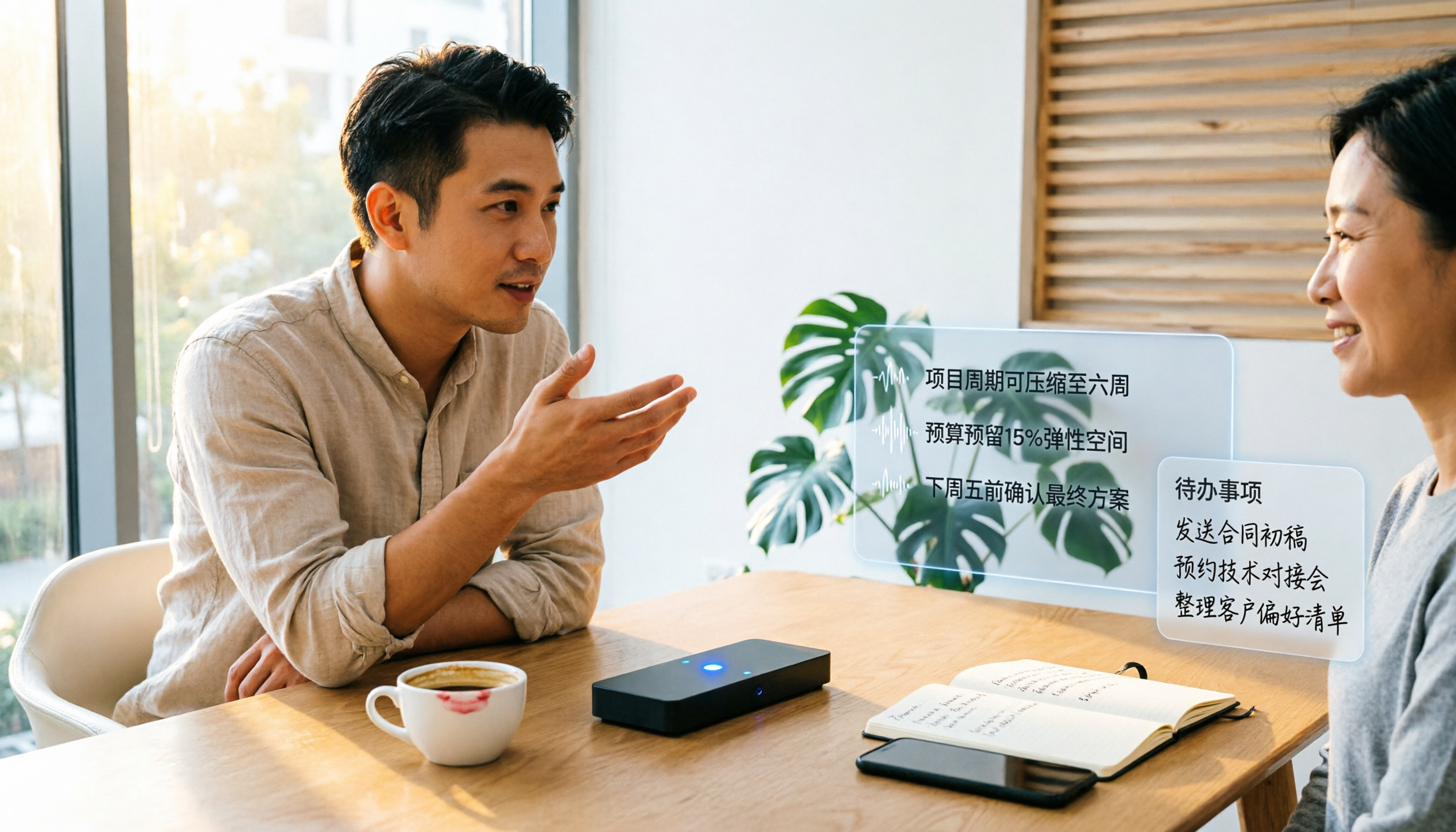
2026 Client Visit Notes: AI Recording-to-Text + Automatic To-Do List
Struggling to finish client visit notes? This article tests tools like Tinrec and shows you how to use AI recording-to-text and automatic to-do lists to save half your time.

2026 Test: 3 Customer Visit Recording Tools Compared – Which One Turns Visit Audio into Trackable Action Lists?
Struggling to organize customer visit recordings and notes? This hands-on comparison reveals which customer visit recording tool can automatically generate transcripts, summaries, and to-dos, saving you hours of paperwork.

2026 Tested: 3 Free Customer Visit Recording Software Compared – Which One Best Organizes Client Needs?
Tired of messy notes after client visits? We tested 3 free customer visit recording tools, comparing transcription quality, Chinese support, AI summaries, and team collaboration. We also reveal free plan limitations and pitfalls to avoid, helping you pick the right tool.