
Turn recordings into transcripts and summaries in minutes
Upload audio or video for multilingual transcription, AI notes, and action items
2026 Hands-On Comparison of 3 Teams Meeting Recorders: Which One Turns Meeting Content into a Real Team Asset?
When something goes wrong in a Teams meeting, many people's first instinct is to "remove someone from the meeting." But if you ask me, the real problem isn't who's in the meeting—it's what happens to the discussions, decisions, and commitments after the meeting ends.
In my experience, a two-hour Teams meeting without proper documentation means spending even more time afterward trying to recall details and track progress. Especially when the meeting has recordings, transcripts, and action items—if you don't organize these, the meeting might as well not have happened.
So instead of obsessing over removing people, focus on setting up a system for meeting records.
In this article, I'll share my hands-on comparison of three meeting recording tools I think are worth considering: Tinrec, Otter, and Notta. The focus isn't on specs, but on "how to turn meeting content into data your team can keep using."
The Pain Point of Teams Meetings: You Don't Need to Remove People—You Need to Keep the Content
First, let's address a common misconception: many people think meeting records are just "recordings" or "transcripts." But recording is only the first step; transcripts are just raw material. The real value lies in being able to quickly find key points, track action items, and let other team members access the discussion later.
When you have meetings in Teams, the platform has built-in transcription, but its capabilities are limited—once the meeting ends, the transcript is scattered in the chat, hard to search, and can't be organized across meetings.
If you also need to handle Chinese, mixed Chinese-English, or want to ask later "who mentioned the budget in the last meeting," you need a dedicated meeting recording tool.
That's the starting point for my hands-on test.
Before Choosing a Meeting Recorder, Understand These 4 Key Points
Bot-free recording: Do you want the tool to record your computer's audio directly, or do you prefer a bot joining the meeting? This affects privacy and how much the meeting is disrupted.
Post-meeting organization: Beyond transcripts, are there summaries, action items, and chapters? Can you use AI to ask follow-up questions? This determines how much time you save.
Team collaboration: Can meeting data be stored centrally in a team space, rather than scattered across personal accounts? If a member leaves, does the data disappear?
Cross-platform and Chinese support: Do you often switch between phone and computer? Does your meeting content include Chinese or mixed Chinese-English? These affect accuracy and convenience.
These four points are the criteria I used to compare the three tools.
Tinrec (秒听录音) — My Top Pick After Testing
My first impression of Tinrec wasn't "another recording-to-text tool," but rather that it treats meetings as data to be managed.
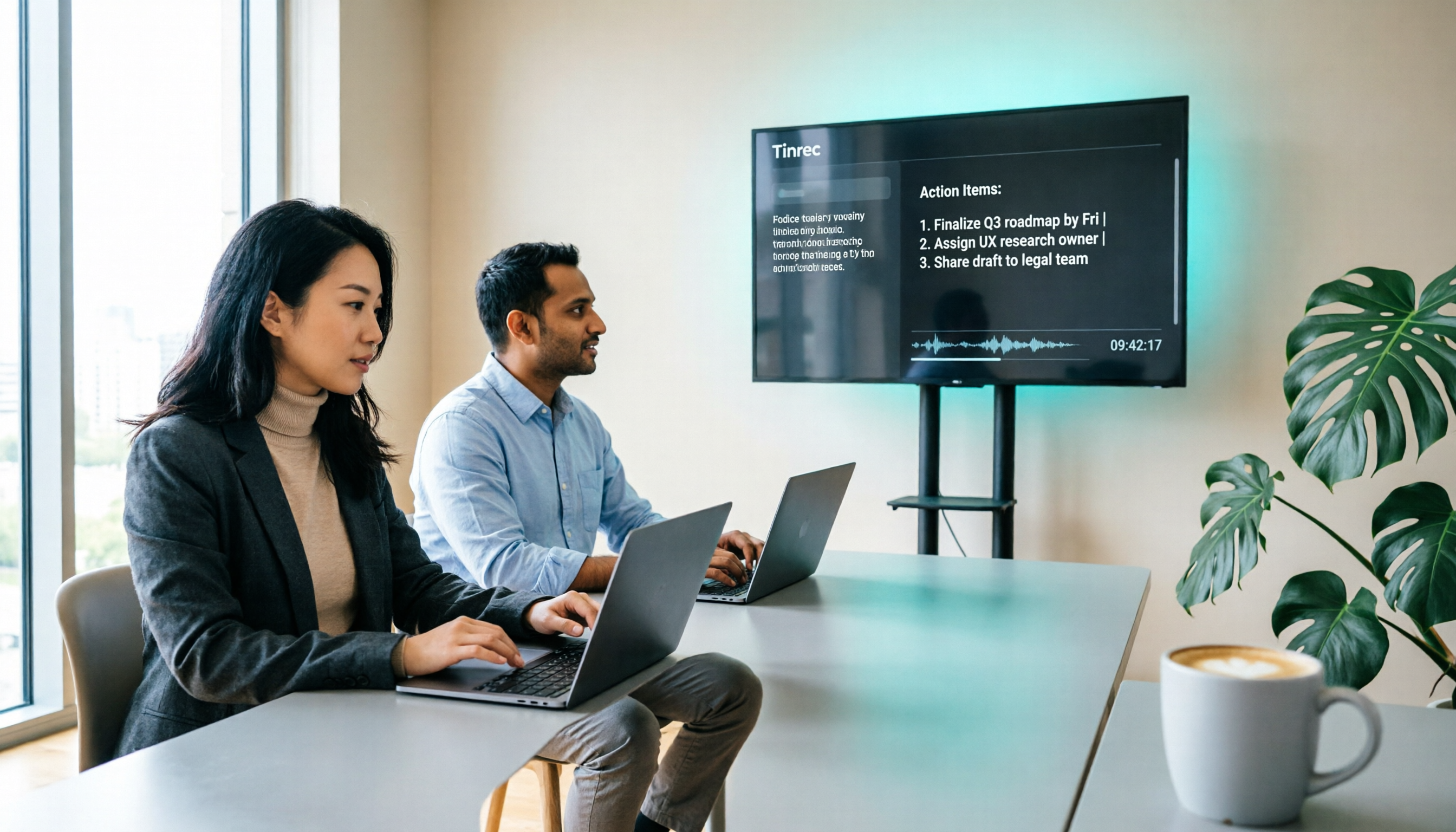
Here's my workflow: Before starting a Teams meeting, I open the Tinrec desktop app, select "System Audio," and it records the meeting directly—no need to invite a bot. During the meeting, the transcript is generated in real time; after the meeting, it automatically organizes summaries, chapters, and action items.
Stop organizing recordings by hand
Upload audio or video and automatically get a transcript, summary, and action items
My most-used feature is the post-meeting AI Q&A. For example, I might ask: "Who mentioned budget adjustments in the last meeting?" Tinrec answers based on semantics, not just returning a bunch of keyword search results. I haven't seen this level of capability in Otter or Notta.
Additionally, it supports Chinese, mixed Chinese-English, and even real-time translation. This is very practical for teams like ours that frequently switch between Chinese and English.
Of course, it has limitations: the free version has usage limits, and heavy use requires a paid plan. But if you have meetings two or three times a week, trying the free version first and then deciding whether to upgrade is reasonable.
Also, the team plan is quite comprehensive: meeting data belongs to the team, data remains even if a member leaves, and admins can assign seats and monitor usage. For small to medium-sized teams, this is key to retaining meeting knowledge.
Beyond Tinrec: What Other Options Are There?
Otter.ai: A mature choice for English meetings. The free plan offers a generous 300 minutes per month, and English transcription quality is good. However, its Chinese experience and depth of post-meeting organization don't match Tinrec for our needs.
Notta: Clean interface and decent transcription accuracy. But it leans more toward transcription and translation; the team space and post-meeting AI follow-up capabilities are more complete in Tinrec.
Granola: Bot-free meeting notes, similar concept to Tinrec. However, it doesn't support uploading pre-recorded audio files and doesn't retain meeting audio. If you need to organize historical meetings, Granola isn't suitable.
Pitfall Guide: 3 Common Mistakes When Choosing a Meeting Recorder
Pitfall 1: Only looking at transcription accuracy. Many people obsess over 98% or 99%, but real meetings have noise, interruptions, and accents, which lower accuracy. Instead of relying on ads, test with your own recordings and check the quality of summaries and action items.
Pitfall 2: Ignoring post-meeting organization. If you only use the tool as a "recording-to-text" converter, you're only using a third of its potential. What really saves time are AI summaries, action items, and follow-up questions.
Pitfall 3: Team data scattered across personal accounts. It's fine for personal use, but for team meetings, make sure meeting data can be stored centrally and won't disappear if a member leaves. Tinrec's team space is designed to solve this.
Summary: Which One Should You Choose?
If you frequently have Teams meetings and need Chinese or mixed Chinese-English organization, plus post-meeting follow-up and team collaboration, Tinrec is currently the most complete choice.
If you only need English meeting records and don't need team features much, Otter's free tier is a good starting point.
If you just want simple transcription and translation, Notta is decent, but you'll need to verify its team and AI follow-up features.
My advice: Download the Tinrec free version and try it on one or two meetings. Run through the recording, summary, and action items, and you'll know whether it's worth upgrading.
Turning meeting content into a team asset is more important than removing people from meetings.
References
- Remember to Hang Up After TEAMS Meeting (or End Meeting, Force Remove Members) - IT Office
- Remove Microsoft Apps in Teams - Microsoft Support
- Update or Cancel a Meeting You Scheduled - Microsoft Support
- Remove People from a Meeting - Microsoft Support
- Delete an Appointment or Meeting - Microsoft Support
Turn every recording into actionable outcomes
Get 60 free transcription minutes when you sign in. No credit card required.
Related Reading
You might also like

How to Use Google Meet AI Meeting Notes in 2026: A 5-Step Complete Guide
Still typing Google Meet meeting notes manually? From built-in Gemini notes and live caption tricks to the bot-free third-party tool Tinrec, this article outlines 5 steps to help you build an automated meeting notes workflow, ideal for Chinese-language meetings and team collaboration.

2026 Hands-On Comparison of 3 Teams Meeting Recorders: Tinrec Makes Meeting Highlights Easy to Find
Struggling to find meeting notes in Teams? This hands-on comparison of Tinrec, Otter.ai, and Notta covers bot-free recording, Chinese transcription, post-meeting organization, and team collaboration to help you pick the best AI meeting assistant for Teams.

Best Tool to Pair with Zoom Personal Meeting ID? 2026 Test of 1 Tool, This One Is Best for Recurring Meetings
Using Zoom Personal Meeting ID (PMI) for meetings is convenient, but fixed IDs also come with security and recording issues. From a mid-level manager's perspective, this article shares how to pair Tinrec's bot-free recording, auto-summaries, and to-dos to turn every PMI meeting into traceable team data.

How to Use Microsoft Teams Live Captions in 2026: A 5-Step Complete Guide
This tutorial walks you through 5 steps to enable live captions in Microsoft Teams meetings, including adjusting caption language, customizing appearance, using CART human-generated captions, and answering common questions.

Where Is the Teams Meeting ID in 2026? Quick Guide + Tinrec Recording Method
Can't find your Teams meeting ID? This article shows you exactly where it's hidden, compares Teams' built-in transcription with Tinrec, and teaches you how to record meetings more efficiently.

3 Ways to Check In to Microsoft Teams Online Meetings in 2026: A Hands-On Comparison for Student Group Discussions
A senior information management student shares hands-on experience: checking in to Teams online meetings isn't just about links and IDs. Paired with meeting notes tool Tinrec, you can stop scrambling during meetings and get full transcripts and action items afterward.

2026 Tested: 4 AI Meeting Recorders Compared – Which Is Best for Teams?
We tested Tinrec, Otter, Notta, and Granola for Teams meeting recording, covering bot-free recording, Chinese transcription, post-meeting organization, and team collaboration to help you pick the right tool.

3 Teams Meeting Recording Tools Tested in 2026: Where Are Recordings? How to Find AI Highlights?
This article tests 3 Teams meeting recording tools, first explaining where Teams meeting recordings are saved by default, then comparing Tinrec, Otter, and Fireflies on bot-free recording, Chinese accuracy, AI summarization, and team collaboration, helping you quickly find recordings and turn them into actionable meeting notes.

How to Record Teams Meetings Scheduled from Outlook with Tinrec in 2026: No Bot + Auto Summaries
After scheduling a Teams meeting from Outlook, use Tinrec to record without a bot, get real-time transcription, automatic summaries and action items, and store meeting content in a team space.