
Turn recordings into transcripts and summaries in minutes
Upload audio or video for multilingual transcription, AI notes, and action items
A transcript isn't just typing—you need to preserve the original meaning, highlight key points, and organize next steps. If a summary misses the mark, subsequent decisions can go off track.
When I do interviews and meeting notes, what I used to fear most wasn't "not understanding the audio," but "the transcript is done, and I still have to dig out the key points myself." Yating can turn audio into text, but the text itself won't tell you: What was decided in this meeting? Who is responsible for what?
Later, I changed my approach: instead of finding a faster typing tool, I looked for an AI meeting notes tool that could directly produce summaries, action items, and allow follow-up questions. That's how Tinrec came into my workflow.
What Can Transcript Summaries Do for You?
Many people think the "transcript" is the end goal. It's not. The transcript is just raw material; what you want is what you extract from it.
Using Tinrec as an example, I've found these three scenarios particularly impactful:
Scenario 1: Know the conclusions within 5 minutes after a meeting. Previously, after a two-hour meeting, I'd spend another half hour going back to listen to the recording and marking key points. Now, when Tinrec finishes recording, the AI summary has already listed the meeting topic, conclusions, and action items separately. I just need a quick glance to know what to do next.
Scenario 2: No more manually marking key points in interview transcripts. When I do user interviews, each session lasts one to two hours. Tinrec doesn't just provide a transcript; it also automatically splits it into sections, turning a long interview into an easy-to-browse structure. If I want to quote a specific part, I can just search or ask the AI.
Scenario 3: Turning meeting content into team assets. Team members' individual meeting notes are scattered everywhere, and new hires can't see anything. Tinrec's team space allows centralized storage, so everyone shares the same summary and action items, eliminating the need for verbal handoffs.
What Are the Core Capabilities of Transcript Summaries?
Here, "summary" doesn't mean condensing a long text into a paragraph. That's the old way. True AI summaries need to be structured so you can take action directly.
Capability 1: Real-time transcript + summary sync. Tinrec supports transcribing while recording, not just after the fact. The desktop version captures system audio, so you don't need to invite a bot to join your Zoom, Meet, or Teams meetings. As the recording progresses, text and summaries appear incrementally.
Capability 2: Structured summaries and sections. Tinrec doesn't just give you an overview; it breaks content into meeting topic, discussion conclusions, and action items. Long meetings are automatically split into sections, so you don't have to listen from start to finish.
Capability 3: AI Q&A. This is the feature I use most. After transcription, I can directly ask Tinrec: "Who mentioned the budget in the meeting?" "What were the customer's specific complaints?" It answers based on semantics and includes timestamps, so I don't have to re-listen to the entire recording.
Capability 4: Export to existing workflows. Summaries and transcripts can be exported in multiple formats, and can also be sent to tools like Notion and Google Docs. My approach: after a meeting, the summary goes straight to Notion, and action items go to my to-do list.
Capability 5: Team space and governance. If you're not a solo user but a team, Tinrec can manage members, seats, usage, and audit logs. Meeting data belongs to the team, so it doesn't disappear when someone leaves.
Stop organizing recordings by hand
Upload audio or video and automatically get a transcript, summary, and action items
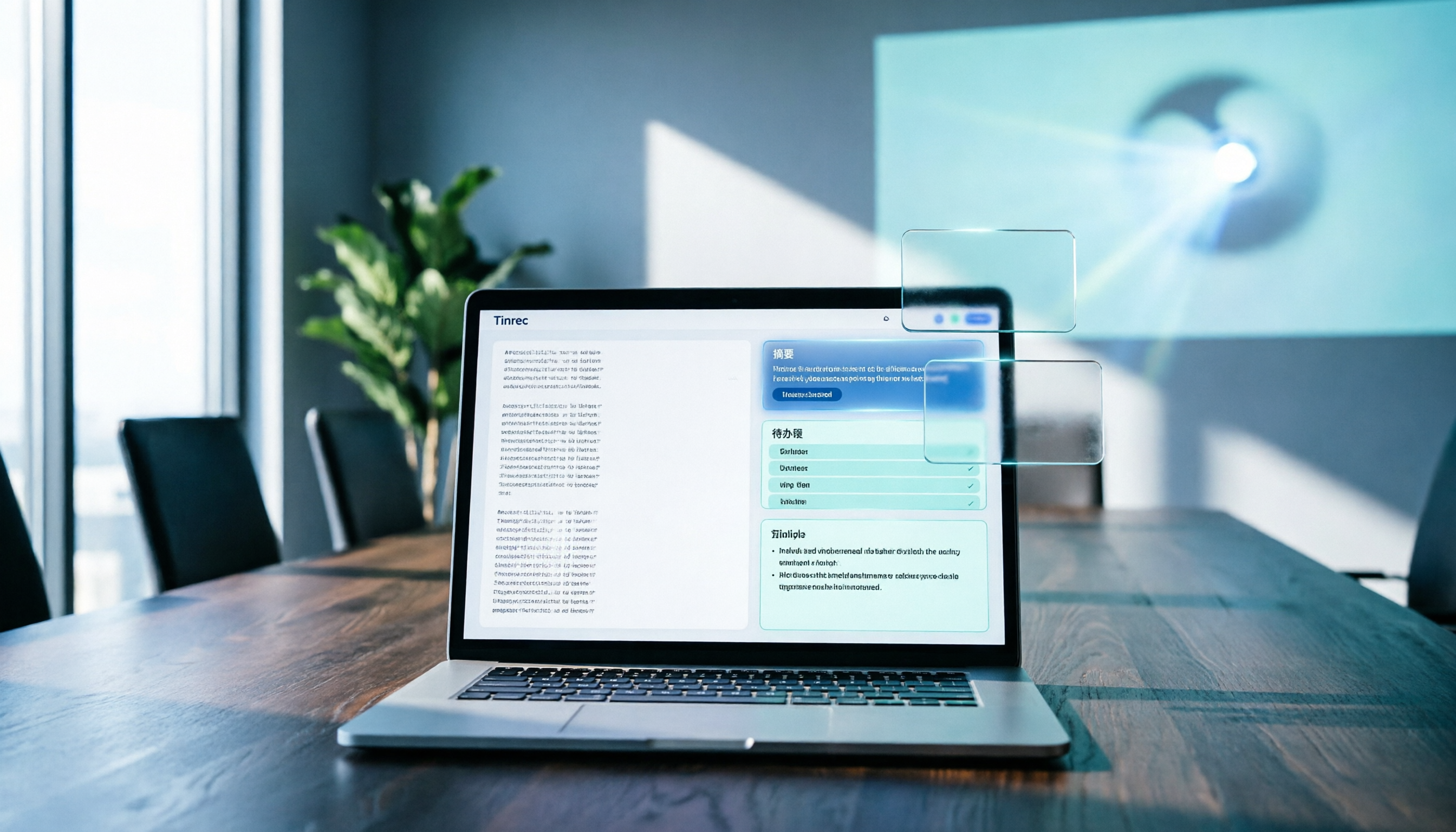
(Screenshot here: Tinrec meeting summary page, with transcript on the left and AI summary and action items on the right)
Practical Use Cases
Here's how I've integrated Tinrec into my workflow in four scenarios.
Meeting notes: Open Tinrec desktop, select "Record system audio," and it transcribes and generates summaries in real time during the meeting. Afterward, I copy action items to my project management tool and save the meeting notes directly to the team space.
Interview research: Upload an audio file, and after Tinrec transcribes it, I use AI queries to quickly find keywords and viewpoints mentioned by interviewees, then export the quoted sections as report material.
Online courses: I use Tinrec to record course content, and the summary helps me organize key points. When reviewing, I can directly ask the AI, "What are the assignment requirements for this course?"
Client communication: Sales or support team members record client meetings, and Tinrec automatically organizes client needs, commitments, and follow-up actions, preventing details from slipping through the cracks.
4 Things to Watch When Choosing a Transcript Summary Tool
There are many options on the market, but the key isn't "can it transcribe," but "what can you do after transcription."
- Transcription is just the starting point; organization is the key. If the tool only gives you a transcript, you'll still have to spend time organizing it yourself. Tinrec's summaries, action items, and AI Q&A make this step almost unnecessary.
- Does it support the meeting platforms you use? Some tools require inviting a bot to join meetings, which some people find intrusive. Tinrec's desktop version captures system audio directly, so no bot is needed, and it works with Zoom, Meet, and Teams.
- Performance with Chinese content and multilingual meetings. Not every tool handles Chinese or mixed Chinese-English content well. Tinrec covers Chinese and multilingual meetings, and also offers real-time translation and bilingual viewing.
- Who owns the data, and can the team share it? For individual use, it doesn't matter, but for teams, data ownership and permissions are important. Tinrec's team version stores data in the team space, so when team members change, data doesn't leave with individuals.
FAQ
Q: What's the difference between Tinrec and Yating Transcript? A: Yating is good at turning audio into text, but you still have to organize the key points yourself. Tinrec is positioned as a "meeting notes and collaboration tool"—it not only transcribes but also automatically generates summaries and action items, and supports AI Q&A, export, and team space. If you just need plain text, Yating is fine; if you want to spend your time on thinking and action, Tinrec is closer to what I need.
Q: Is the Tinrec free plan enough? A: You can start with the free plan, which provides basic credits to experience recording, import, summary, and transcription. If you have regular weekly meeting needs, consider the Pro or team plans.
Q: I'm not technical. Is it hard to learn? A: No. My approach is to treat Tinrec as a "recording + organization" entry point. Open the desktop app or mobile app, press the record button, and let it run automatically. The only thing you need to learn is the habit of "checking the summary first, then asking the AI" after a meeting.
Q: Do I need to buy additional recording hardware? A: No. Tinrec can record with your phone or computer, and for online meetings, it can capture system audio directly. Unless you have special portable recording needs, you don't need to carry extra equipment.
Conclusion
A transcript isn't the end goal; summaries and follow-up actions are. Yating solved the "audio to text" problem, but what truly makes work easier are tools like Tinrec that can directly organize, query, and collaborate.
My advice is simple: next time you have a meeting or interview, don't just think about "producing a transcript." Instead, ask yourself, "What actions do I want to get from this recording?" If your answer is "key points, action items, and queryable data," then Tinrec is a better starting point.
You can start with the free plan and see if AI summaries and AI Q&A really change your workflow.
References
- Yating Transcript
- Yating Transcript
- Is Yating Transcript Free? 2026 Recording-to-Text Tool Cost and Performance Complete Comparison - Second Listening Blog
- How to Use Yating Transcript? 2026 Complete Tutorial and In-Depth Review of 5 AI Transcription Tools (Including Tinrec Comparison) - Second Listening Blog
- Yating Transcript - Generative AI Guide - Teaching Resource Hub - NKUST
Turn every recording into actionable outcomes
Get 60 free transcription minutes when you sign in. No credit card required.
Related Reading
You might also like

6 Yating Transcription Alternatives Compared in 2026: Which Handles Taiwanese Accent, Taiwanese Hokkien, and Code-Switching Best?
This article tests 6 alternatives to Yating Transcription, comparing free tiers, pricing, Taiwan-specific recognition, AI summaries, and team collaboration to help you find the best voice-to-text tool.

2026 Hands-On Comparison of 3 AI Recording Tools: Can You Get Good Lecture Transcripts Without Buying Plaud Hardware?
A student's hands-on comparison of AI recording tools, from traditional voice recorders to Plaud and Tinrec, explaining what Plaud recording is, why you don't need to buy hardware for good lecture transcripts, and tips on free vs. paid plans.

How Much Does Yating Transcription Cost in 2026? 5 Steps to Choose the Right Meeting Notes Tool
Yating transcription costs about NT$100 per hour, but the free tier is limited and lacks AI Q&A. This article walks you through 5 steps to compare costs, accuracy, and AI features, and recommends Tinrec as a better fit for workplace meeting notes based on hands-on testing.

How to Use Plaud Recording in 2026? Switch to Tinrec in 3 Steps for Higher Efficiency
Many people buy Plaud voice recorder cards but don't know how to organize recordings. This article teaches you a post-recording workflow: replace hardware dependency with Tinrec, automatically generate transcripts, summaries, and to-dos, and use AI Q&A to quickly find key points.

Tinrec vs Plaud Note 2026: 5-Dimension Comparison – Which Is the Better Buy?
Wondering how to use Plaud for recording? We tested Tinrec and Plaud Note side by side, comparing recording methods, transcription accuracy, AI features, cross-platform support, and price across 5 dimensions to tell you which one is the top choice for meeting notes among Hong Kong professionals.

4 Recording Sync Tools Compared in 2026: How Tinrec Achieves Seamless Cross-Device Sync Without Hardware?
How does Plaud recording sync work? This article compares 4 recording sync solutions, including hardware recorders and AI meeting tools, and explains how Tinrec replaces traditional file transfer with cloud sync, allowing you to access recordings, transcripts, and meeting notes anytime on your phone or computer.
2026 Hands-On Comparison of 2 AI Recording Tools: Plaud Note Pro vs Tinrec – Which One Is Right for You?
Many people think buying a Plaud Note Pro is a one-and-done solution, but the actual recording process has quite a few pitfalls. This week-long hands-on test compares Plaud Note Pro and Tinrec across five key dimensions: recording convenience, phone/online meetings, AI summarization, Chinese language experience, and team collaboration, to help you decide which one is worth your money.

2026 Comparison of 4 Recording-to-Text Tools: Plaud Recording Organization vs. AI Collaboration—Which Is More Practical?
A recording file is just the beginning; the real challenge is turning it into usable meeting materials. This comparison starts with Plaud recording operations and walks you through Tinrec, Plaud, Otter, and Notta to find the best AI recording-to-text and collaboration solution for your needs.

2026 Tinrec Recording-to-Text Tutorial: No Hardware Needed + AI Summaries in One Go
Still deciding between a Plaud recorder and a recording app? This tutorial starts from real-world scenarios, teaching you how to use Tinrec for recording, transcription, summaries, and to-dos, while comparing options like Plaud and Otter to help you find the best recording and organizing method for your needs.