

Turn recordings into transcripts and summaries in minutes
Upload audio or video for multilingual transcription, AI notes, and action items
Why You Need a Yating Transcription Comparison?
If you're a user in Taiwan with a pile of meeting recordings, interview audio files, or course content that you want to quickly convert into text, "Yating Transcription" is often the first tool that comes to mind. But it's not the only option. This article reviews 6 common voice-to-text services, from free tiers and paid plans to Taiwanese accent and Hokkien recognition and AI post-processing features, to help you quickly determine which one suits you best.
Option 1 | Tinrec (Miao Ting Lu Yin) — The Most Complete AI Recording Assistant
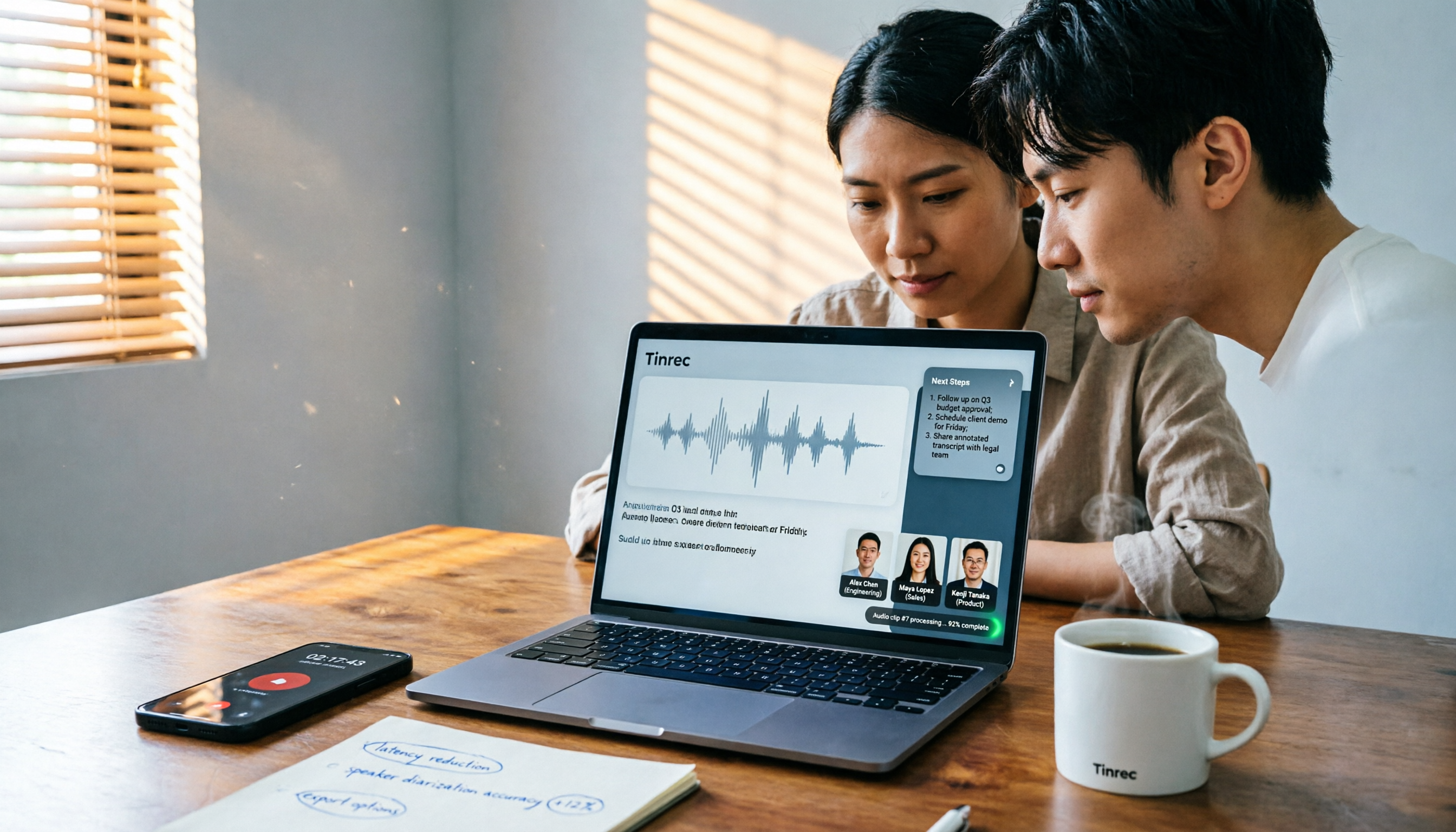
Tinrec is the most complete AI meeting notes tool I've tested recently. It doesn't just convert speech to text; it turns transcripts into searchable, queryable data that can be organized into to-do items. This is crucial for professionals who handle a large volume of meetings, interviews, or courses.
Tinrec's core features include real-time voice-to-text, uploading audio or video files for transcription, and recording online meetings like Zoom, Google Meet, and Microsoft Teams without needing a meeting bot. After transcription, it automatically generates summaries, chapters, key points, and action items, and you can even ask questions about the meeting content via AI, or export results to tools like Notion and Google Docs.
Notably, Tinrec has solid support for Chinese and Taiwanese Hokkien, and it handles code-switching between Chinese and English well. The free tier offers basic credits, suitable for light use; if you need more minutes, you can opt for weekly cards, Pro monthly, or annual plans. The team plan provides a dedicated workspace, member roles, seat management, and usage analytics.
In short, if you're looking for a tool that's "more than just a transcript," Tinrec is currently the option I think is most worth trying.
Option 2 | Yating Transcription — The Veteran in Taiwan-Localized Speech-to-Text
Yating Transcription is a speech-to-text service developed by a Taiwanese team. Its biggest feature is optimization for Taiwan's local context, with good recognition performance for Taiwanese Hokkien, code-switching, and Taiwanese accents. It supports real-time recording, uploading audio files for transcription, automatic segmentation, and punctuation, and offers both web and app editors.
In my experience, Yating Transcription performs stably when handling pure Chinese or Taiwanese Hokkien content, but its main functionality stays at the "transcription" level, lacking advanced features like AI summaries, action item extraction, and team collaboration. If you only need transcripts, its free tier can handle basic needs; for extended use, you'll need to pay—check the official website for current plans.
Option 3 | Notta — Multilingual Transcription and Meeting Notes
Notta is another common multilingual transcription tool that supports multiple languages and meeting notes, with both web and app versions. The free tier offers 120 minutes per month, but each session is capped at 3 minutes; the paid Pro plan costs about USD 8.17/month (billed annually) and provides 1,800 minutes per month. Notta suits users who need multilingual transcription and subtitles, but its AI features lean toward summaries, lacking the team workspace and deep AI Q&A integration that Tinrec offers.
Stop organizing recordings by hand
Upload audio or video and automatically get a transcript, summary, and action items
Option 4 | Otter.ai — The Top Choice for English Meeting Automation
Otter.ai is a mature AI meeting assistant in the English market, supporting platforms like Zoom, Teams, and Meet, with real-time transcription, speaker identification, and AI Chat. The free tier offers 300 minutes per month, and Pro is about USD 8.49/month billed annually. If you primarily handle English meetings, Otter is powerful; but if you often deal with Chinese, Taiwanese Hokkien, or code-switching, Otter's localization may not be as good as tools developed by Taiwanese teams.
Option 5 | Fireflies.ai — Meeting Automation and Sales Analytics
Fireflies.ai excels in meeting automation and sales analytics, with features like a meeting bot, AI summaries, AskFred, and integration with many third-party tools. It has a Free plan, Pro at USD 10/seat/month billed annually, and Business at USD 19/seat/month. It's suitable for teams that need to automatically join meetings and analyze sales calls, but note that "unlimited transcription" still has storage and upload limits. Chinese support is average, so Taiwanese users should test it first.
Option 6 | TurboScribe — High-Value Long-File Transcription
TurboScribe focuses on cost-effectiveness, emphasizing long files, batch uploads, and subtitles. The free tier allows 3 files per day, with a max of 30 minutes per file; the Unlimited plan costs USD 120/year (about USD 10/month), with a max of 10 hours per file. If you only need to transcribe large volumes of files without real-time meetings or AI Q&A, TurboScribe is worth considering. However, its features are centered on transcription itself, lacking Tinrec's team collaboration and summary/action items.
With So Many Options, How Do You Choose?
• For the most complete AI features (transcription + AI Q&A + auto minutes + action items) → Tinrec, one of the few tools currently offering all these capabilities. • For Taiwanese accent, Taiwanese Hokkien, and code-switching recognition → Tinrec or Yating Transcription; both have good localization, but Tinrec adds post-processing features. • For recording online meetings without a meeting bot → Tinrec's desktop app directly captures system audio. • For zero budget and occasional transcription needs → Yating Transcription's free tier or Notta's free tier (with time limits); Tinrec's free tier is also worth trying. • For portable hardware recording → Consider the PLAUD series, but you'll need to purchase additional devices. • For large volumes of long-file transcription without needing AI features → TurboScribe is more cost-effective.
5 Things to Know Before Using Voice-to-Text Tools
- Audio quality affects recognition accuracy: clear recordings without background noise work best.
- Free tiers usually have time or minute limits; check your monthly usage first.
- For sensitive content, be mindful of recording consent and privacy; Tinrec offers team recycle bin and audit features.
- Don't rely solely on AI summaries; for important decisions, cross-reference the transcript and original recording.
- If you need team sharing, be sure to distinguish roles and seats; Tinrec's team plan allows you to manage member permissions.
Conclusion
Yating Transcription is a familiar choice for Taiwanese users, but if you need to turn meeting content into searchable, collaborative, trackable team data, Tinrec is currently a more complete solution. It doesn't just provide transcripts; it also generates summaries, action items, and supports AI Q&A. We recommend starting with the free tier and then deciding whether to upgrade based on your usage frequency and team needs.
References
- Yating Transcription
- Yating Transcription Complete Guide: Free Version, Pricing, and Alternatives at a Glance
- What is Yating Transcription? 7 Voice-to-Text Tools Deep Review and Selection Guide in 2026 - Miao Ting Lu Yin Blog
- Yating Transcription
- Is Yating Transcription Free? 2026 Voice-to-Text Tool Pricing and Performance Complete Comparison - Miao Ting Lu Yin Blog
Turn every recording into actionable outcomes
Get 60 free transcription minutes when you sign in. No credit card required.
Related Reading
You might also like

2026 Hands-On Comparison of 2 AI Speech-to-Text Tools: Tinrec vs Yating, Which Is Right for You?
A 2026 comparison of Tinrec and Yating (Yating Transcript) across 5 dimensions: AI features, free tier, cross-platform support, team collaboration, and post-processing, to help you decide which is better for meeting notes in Taiwan.

2026 AI Voice Recorder Comparison: Plaud Note vs Tinrec vs Otter – Which Is Right for You?
Thinking about buying an AI voice recorder but worried about picking the wrong one? This hands-on comparison reviews Plaud Note, Tinrec, and Otter across recording methods, transcription quotas, Chinese language support, and team features. We also walk through a complete recording-to-export workflow using Tinrec to help you choose the right tool.

2026 Plaud Recording Free Plans Compared: 3 Options at a Glance
Struggling to organize recordings from your Plaud voice recorder? This hands-on comparison of Tinrec, Plaud, and Otter's free plans helps you find the most time-saving transcription tool.

2026 Hands-On Comparison of 5 AI Recording Tools: Beyond Plaud, Which Offers the Most Complete Transcription and Organization?
Thinking about buying a Plaud recorder? Hold on. This article compares 5 mainstream AI recording tools—Tinrec, Plaud, Otter, Notta, and TurboScribe—from a real workflow perspective to help you find the best recording and organization solution.
2026 Recording Tools Compared: Plaud Note vs Tinrec – Which Is Right for You?
What's the real difference between the Plaud Note recording card and Tinrec? This hands-on comparison covers 5 key areas—recording methods, online meetings, AI post-processing, file import, and team collaboration—to help you pick the best meeting notes tool for your workflow.

2026 Hands-On Comparison of 3 AI Recording Tools: Can You Get Good Lecture Transcripts Without Buying Plaud Hardware?
A student's hands-on comparison of AI recording tools, from traditional voice recorders to Plaud and Tinrec, explaining what Plaud recording is, why you don't need to buy hardware for good lecture transcripts, and tips on free vs. paid plans.

How Much Does Yating Transcription Cost in 2026? 5 Steps to Choose the Right Meeting Notes Tool
Yating transcription costs about NT$100 per hour, but the free tier is limited and lacks AI Q&A. This article walks you through 5 steps to compare costs, accuracy, and AI features, and recommends Tinrec as a better fit for workplace meeting notes based on hands-on testing.

How to Use Plaud Recording in 2026? Switch to Tinrec in 3 Steps for Higher Efficiency
Many people buy Plaud voice recorder cards but don't know how to organize recordings. This article teaches you a post-recording workflow: replace hardware dependency with Tinrec, automatically generate transcripts, summaries, and to-dos, and use AI Q&A to quickly find key points.

Tinrec vs Plaud Note 2026: 5-Dimension Comparison – Which Is the Better Buy?
Wondering how to use Plaud for recording? We tested Tinrec and Plaud Note side by side, comparing recording methods, transcription accuracy, AI features, cross-platform support, and price across 5 dimensions to tell you which one is the top choice for meeting notes among Hong Kong professionals.