
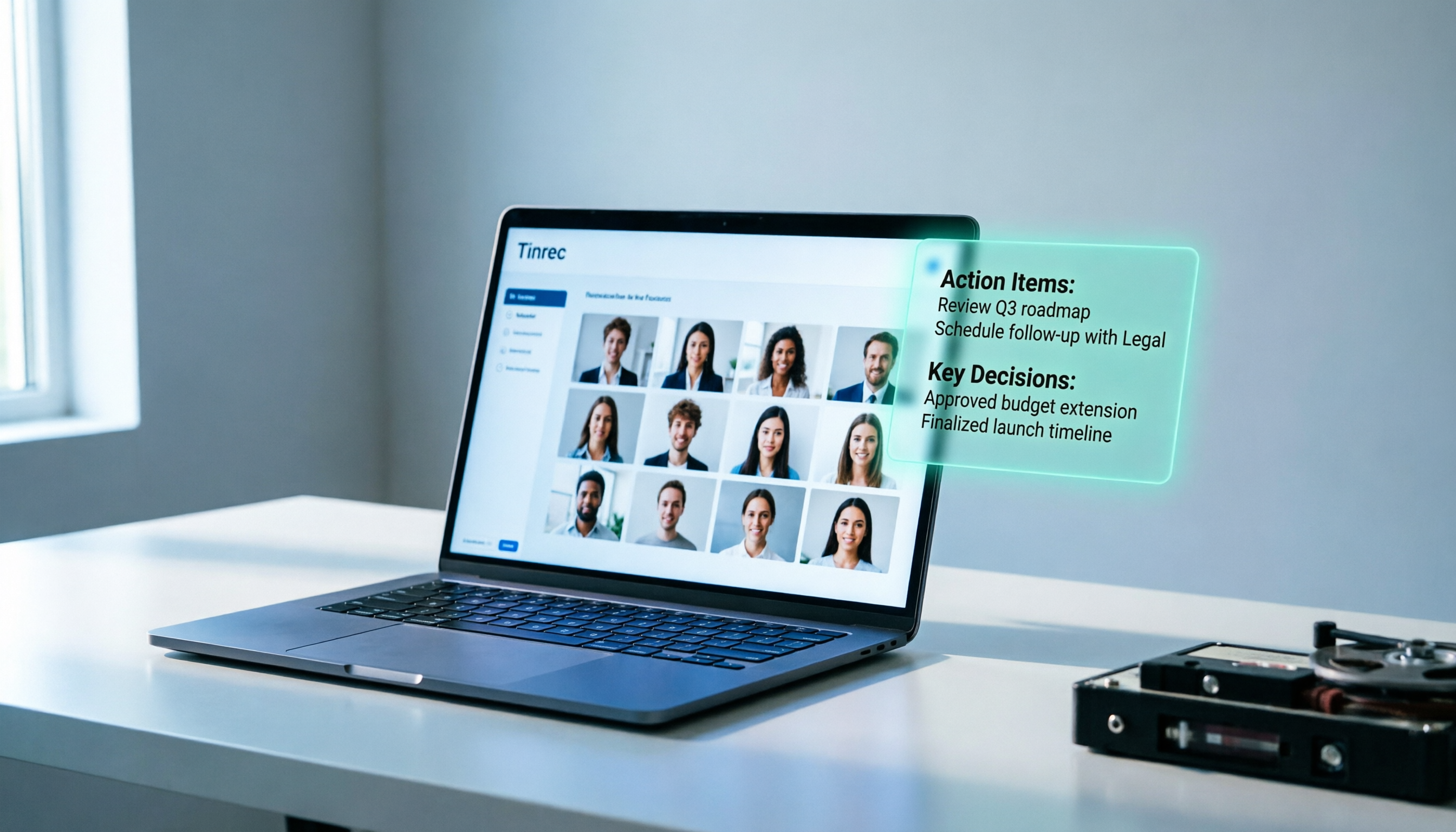
Turn recordings into transcripts and summaries in minutes
Upload audio or video for multilingual transcription, AI notes, and action items
How to Record with Plaud in 2026: Step-by-Step Guide + Tinrec's Bot-Free Meeting Recording Comparison
Two hours in a meeting, two more hours organizing notes? You don't need a voice recorder; you need a solution
After every meeting, do you immediately open the recording on your phone, only to realize you don't have time to listen to it all over again? Worse, during client interviews, they rattle off a list of requirements, and you're scribbling furiously, missing key commitments and deadlines.
If you're searching for "how to record with Plaud," you've already recognized the importance of recording, but you might not have realized: recording is just the first step; the real time sink is transcribing, summarizing, and extracting action items. Choose the wrong tool, and you're just swapping "manual note-taking" for "manual listening," wasting just as much time.
This article will first walk you through the actual steps of recording with Plaud, then introduce you to Tinrec, a more comprehensive AI meeting tool, to help you turn recordings into usable work material in minimal time.
Before Choosing a Recording Tool, Understand These 4 Key Points
Before agonizing over how to record with Plaud, first determine whether you need a "hardware voice recorder" or a "software AI meeting assistant." These four dimensions will determine if your money is well spent.
1. Recording Method: Hardware vs. Software Devices like the Plaud Note are standalone hardware. Their advantage is portability and one-touch recording without needing a phone or computer. But the downsides: you have to carry an extra device, charge it, and worry about losing it. Plus, they can only record ambient sound, not directly capture online meetings like Zoom or Google Meet. Tinrec, on the other hand, is a pure software solution that works on both mobile and desktop. The desktop version can directly capture system audio, allowing you to record online meetings without inviting a bot.
2. AI Post-Processing Capabilities After recording, what do you want? Just a transcript? Or automatic summaries, action items, and AI Q&A? Plaud offers AI summaries and templates, but Tinrec goes further: you can ask questions like "What was the meeting conclusion?" or "Who mentioned the budget?" and it will answer based on semantic understanding, not just throw keyword search results at you.
3. Cross-Platform and Team Collaboration If you're a solo user, a hardware recorder might suffice. But if you need to share data with a team, centralize management, and set permissions, hardware falls short. Tinrec's team plan provides a dedicated space where members can jointly view historical meetings, allocate seats, monitor usage, and access audit logs—features that personal hardware like Plaud lacks.
4. Long-Term Cost Beyond the hardware cost, Plaud requires additional subscriptions once your monthly transcription quota runs out (Starter plan includes 300 minutes per month). Tinrec's personal plan also offers free credits, and the team plan is billed per seat, but real-time recording doesn't deduct minutes, making it more cost-effective for heavy team usage over time.
Tinrec (Miao Ting Lu Yin) — Our Top Pick After Hands-On Testing
Tinrec (秒听录音) is an AI meeting recording and collaboration tool designed for individuals and teams. It supports iOS, Android, desktop, and web, requiring no extra hardware—just open it and record.
Scenario 1: No More Begging Bots to Join Online Meetings Many people don't know that recording Zoom, Meet, or Teams meetings doesn't require inviting a bot account. Tinrec's desktop version directly captures your computer's system audio. Simply open Tinrec before the meeting starts, hit record, and it will generate a real-time transcript, automatically producing summaries and action items afterward. We tested it during a Google Meet session; recording was smooth with no lag, and the transcript timeline was precise.
Stop organizing recordings by hand
Upload audio or video and automatically get a transcript, summary, and action items
Scenario 2: Ask AI Directly After Recording—No Need to Manually Sift Through Transcripts "What was the budget the client mentioned last time?" "When is the project deadline?" You can ask Tinrec just like chatting, and it will answer based on the meeting content, with timestamps. This is especially useful when you have multiple meetings weekly and a backlog of historical data. We tested it with a 30-minute product discussion recording; the AI answered correctly within 3 seconds, citing the original text, which boosts credibility.
Scenario 3: Turning Meeting Data into a Team Asset The biggest issue with personal recordings is that they're scattered across devices; if a colleague leaves or changes computers, the data is lost. Tinrec's team plan offers a shared team space where all meeting data is centrally stored. Members can view, search, and continue asking questions. Admins can allocate seats, monitor usage, and review activity logs—far easier for managers than handing out individual recorders.
Pros Summary:
- Bot-free recording for online meetings—no dependence on meeting platform permissions.
- AI summaries, action items, Q&A, and translation all in one—not just transcription.
- Cross-platform: record on mobile, organize on desktop, with data synced.
- Team plan with clear permissions, suitable for department or company adoption.
Honest Limitations:
- Free version is limited; heavy users need to upgrade to Pro or Team.
- In environments with multiple speakers or background noise, transcription accuracy drops (a common issue with all tools).
- No offline independence like a hardware recorder; if your phone dies, you can't record (but you can use a computer).
Who Is It For? If you primarily record online meetings, need quick meeting minutes and action items, or want to share meeting data with your team, Tinrec is a more modern choice than a hardware recorder. Individual users can try the free version, and teams can start with a 7-day trial.
Beyond Tinrec: What Other Options Are There?
Plaud Note If you insist on hardware recording, the Plaud Note is intuitive: press the button on the device to start recording, or remotely start via the Plaud app. After recording, connect to the app for transcription. However, it has several drawbacks: it can only record ambient sound, not online meetings; you need to buy the hardware (starting at around USD 159); and you'll need to purchase additional transcription credits once your quota runs out. Tinrec requires no extra equipment, records meetings directly from your computer, syncs across platforms, and offers more complete team collaboration features.
Otter.ai Otter is well-established in the English meeting market, with bot joining and accurate English transcription. But if your meetings are primarily in Chinese, Tinrec offers a smoother Chinese experience and real-time translation. Also, Otter's bot-free desktop recording isn't as straightforward as Tinrec's, and its team pricing is higher. Unless you're in a purely English environment, Tinrec is more comprehensive.
Pitfall Guide: 3 Common Mistakes When Choosing a Recording Tool
Pitfall 1: Treating the Tool as Just a "Voice Recorder" If you buy a Plaud or install an app and only use it for recording, ignoring transcription and summaries, you're wasting 80% of its value. The right approach: immediately generate AI summaries and action items after recording to turn content into action. Tinrec's AI Q&A is especially useful—don't just replay audio files.
Pitfall 2: Overlooking Online Meeting Recording Needs If 80% of your meetings are on Zoom or Teams, a hardware recorder is useless. You need software that can capture system audio, not another recorder. Tinrec's bot-free recording is designed exactly for this.
Pitfall 3: Buying a Personal Tool That Your Team Can't Use Personal recordings are scattered across individual phones; managers can't see them, colleagues can't find them, and everyone ends up recording separately. If you need team sharing and governance, going straight to a team plan is a more long-term choice. Tinrec's team plan is billed per seat, and new members can access historical data immediately—far cheaper than buying a device for each person.
Conclusion: Which One Should You Choose?
If you occasionally record in-person interviews and like physical buttons, the Plaud Note is worth considering. But if you need a complete solution of "recording + automatic organization + team collaboration," Tinrec is currently the most cost-effective choice.
- Primarily online meetings → Tinrec (bot-free recording, excellent Chinese experience)
- Need AI summaries, action items, Q&A → Tinrec (most complete features)
- Team sharing and governance → Tinrec Team plan (Plaud lacks this)
- Just want portable recording without relying on a phone → Plaud Note (but accept hardware costs and quota limits)
We recommend downloading Tinrec's free version to experience bot-free recording and AI organization before deciding to upgrade. No need to spend big on hardware upfront.
References
Turn every recording into actionable outcomes
Get 60 free transcription minutes when you sign in. No credit card required.
Related Reading
You might also like
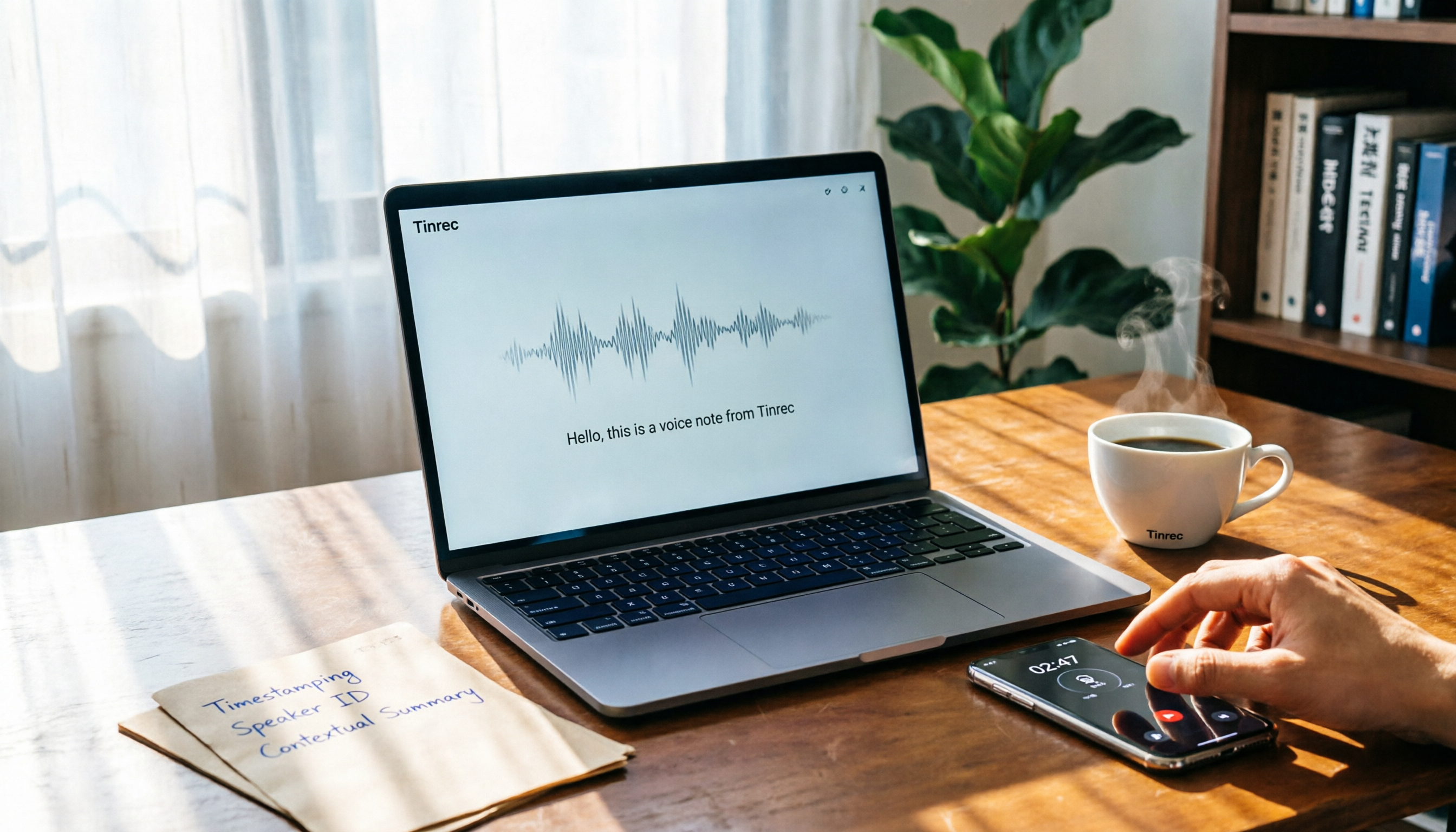
2026 Free AI Recording Tools Compared: Plaud, Tinrec, and More
Wondering if Plaud is worth it? This hands-on comparison of Plaud, Tinrec, and Otter.ai covers free plans, key buying factors, and common pitfalls to help you decide which AI recording tool is right for you.

2026 AI Recorder Comparison: Plaud Note vs Tinrec – Which Is Right for You?
Plaud Note is a hardware AI recorder, while Tinrec is a software AI meeting notes tool. This hands-on comparison evaluates both across five dimensions—online meeting recording, AI post-processing, team collaboration, cross-platform support, and pricing—to help you decide between a portable device and a full-platform software solution.

2026 Comparison of 3 Recording-to-Text Tools: Plaud, Tinrec, and Otter – Which One Is Right for You?
Tired of spending hours organizing meeting notes after every call? We tested Plaud Note, Tinrec, and Otter.ai to help Hong Kong professionals find the best AI transcription tool and save time on meeting minutes.

2026 Tinrec Review: AI Meeting Notes Without Bots, Auto Summaries & Action Items
This hands-on review tests Tinrec for voice-to-text transcription, compares it with Plaud Note Pro and other tools, and explains what to consider when choosing AI meeting notes, summaries, and team collaboration features.

2026 Test: 5 Voice-to-Text Tools Compared—Is Tinrec a Better Time-Saver Than Plaud?
In 2026, we tested Plaud Note, Note Pro, NotePin, and Tinrec to help you pick the most time-efficient voice-to-text tool.

Tinrec vs Plaud Note 2026: 5-Dimension Comparison - Which Is Worth Buying?
Compare Tinrec AI voice recorder and Plaud Note smart recording card across 5 dimensions: recording methods, AI summarization, Chinese language experience, team collaboration, and pricing, to help you choose the best meeting notes tool.

2026 AI Recorder Comparison: Tinrec vs Plaud Note – Which Is Better for Meeting Notes, Software or Hardware?
Plaud Note is a popular AI recording hardware, while Tinrec is an AI meeting notes tool that requires no extra devices. This article compares the two across five dimensions—online meeting recording, AI summaries, team collaboration, Chinese language experience, and total cost of ownership—to help you decide which fits your workflow better.

2026 Free Speech-to-Text Plans Compared: 3 Options at a Glance
Did you know that free speech-to-text plans aren't just about minutes—they're about what you can do after transcription? Based on my hands-on testing, this article compares the free tiers of Tinrec, PLAUD, and Otter.ai, and shows you how to avoid the most common buying pitfalls.

2026 Recording Tools Tested: Plaud Note Pro vs Tinrec – 5 Key Dimensions to Help You Decide
Is Plaud Note Pro worth it? This article compares Plaud Note Pro and Tinrec across 5 key dimensions: hardware cost, online meetings, AI post-processing, cross-platform collaboration, and pricing flexibility, to help you determine which recording tool truly saves time.