
Turn recordings into transcripts and summaries in minutes
Upload audio or video for multilingual transcription, AI notes, and action items
Anyone who has conducted interviews or meetings knows that "transcribing" is a test of willpower. Typically, a 1-hour interview recording takes 3 to 4 hours to manually transcribe into a first draft. This is not only inefficient, but fatigue also makes it easy to miss important information. Many graduate students, journalists, and administrative staff are looking for apps that can "automatically transcribe with high accuracy and ease of use," hoping to free themselves from the tedious world of typing.
The good news is that with the maturity of AI speech recognition technology in 2026, there are already many excellent free or freemium tools on the market to solve this pain point. This article will highlight 4 worthwhile tools and evaluate them from three dimensions: accuracy, free quota, and feature completeness. We will also include a detailed comparison table and practical tutorials to help you quickly find the right solution.

Quick Navigation Conclusions:
- If you only need simple real-time short input: Use Google Live Transcribe directly.
- If you value Taiwanese accent and Hokkien recognition: Prioritize the localized Yating Transcript.
- If you need to turn interview recordings into structured notes and action items: Try Tinrec (Instant Recording) with AI summaries and conversation queries.
- If you are a tech-savvy user who values privacy: Consider the open-source OpenAI Whisper model.
1. Why Are Free Speech-to-Text Tools Worth Trying Now?
Early speech-to-text software often required expensive licenses and performed poorly on Chinese (especially Taiwanese accents), leading users to feel that "editing the draft is more tiring than typing from scratch." However, with current technology, modern AI tools can achieve:
- High Accuracy: In a clear environment, Chinese recognition accuracy usually reaches over 90%.
- Multilingual Recognition: Able to handle common Chinese-English code-switching in modern workplaces.
- More Than Transcription: Newer tools like Tinrec emphasize "understanding," automatically generating summaries and to-dos.
For 70% of users (e.g., those needing less than 5 hours per month), free versions or those with free quotas are more than sufficient.
2. 2026 Top Interview Transcription App Reviews
Below are selected tools that perform well in the market, analyzed for interview and meeting scenarios:
1. Google Live Transcribe
This is the most familiar tool for Android users and one of the most powerful "pure real-time" transcription tools available.
- Pros: Completely free, supports over 80 languages, and recognizes environmental sounds (e.g., applause).
- Limitations: Only available on Android devices, transcripts are stored locally for only 3 days, cannot upload old audio files for transcription, and is not suitable for post-processing.
- Best for: Real-time classroom lectures, face-to-face interview assistance, accessibility for the hearing impaired.
2. Tinrec (Instant Recording)
Tinrec is an AI recording assistant that emphasizes "from recording to action." Its design logic goes beyond producing transcripts—it focuses on helping users quickly extract information. It supports iOS, Android, and web syncing, making it ideal for users who need to organize data across devices.
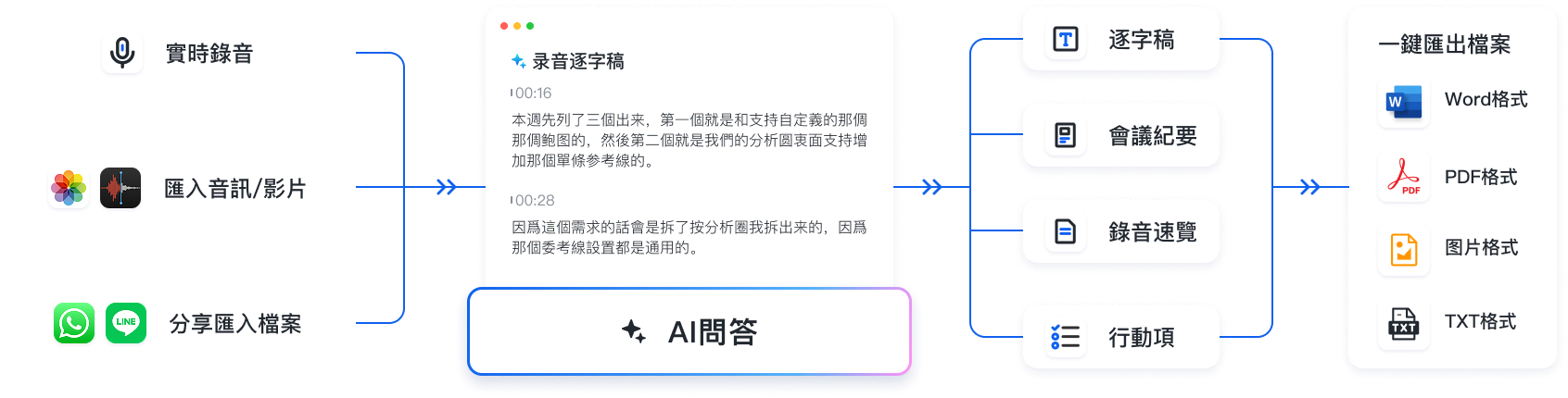
- Features: In addition to recording-to-text, its strongest features are "AI Meeting Minutes" and "AI Conversation Query." It automatically extracts action items, and users can ask questions about the recording content like "ChatGPT."
- Free Quota: The free version offers 100 minutes of transcription per month, which is quite friendly for occasional key interview summaries.
- Best for: In-depth interview notes, meeting decision records, multilingual meetings (supports 10 languages including Chinese, English, Japanese, Korean).

3. Yating Transcript
Developed by Taiwan AI Labs (AILabs), this is a localized tool designed specifically for Taiwanese users.
Stop organizing recordings by hand
Upload audio or video and automatically get a transcript, summary, and action items
- Pros: Excellent recognition of "Taiwanese Mandarin," Chinese-English code-switching, and Hokkien (Taiwanese). It is the top choice for Hokkien interviews.
- Limitations: The free version has quotas for audio file uploads (usually a 20-minute trial), and more requires a paid subscription.
- Best for: Local drama subtitles, Hokkien interviews, local administrative meetings.
4. OpenAI Whisper (and Derivatives)
OpenAI's Whisper is widely recognized as one of the most powerful open-source speech recognition models.
- Pros: Extremely high accuracy, robust to accents and background noise. With local versions (e.g., MacWhisper), data is fully offline, ensuring maximum privacy.
- Limitations: The original version requires a Python environment; even GUI versions have certain hardware requirements and usually lack AI summarization features—they only produce raw text.
- Best for: Technical users, those extremely concerned about data privacy, environments without internet.
3. Comparison Table: Features and Free Quotas of Popular Tools
To help you choose more intuitively, we have organized the key dimensions of the tools above:
| Dimension | Google Live Transcribe | Tinrec (Instant Recording) | OpenAI Whisper (Local) | Yating Transcript |
|---|---|---|---|---|
| Core Purpose | Real-time assistive dictation | AI meeting minutes & action management | Offline high-accuracy transcription | Localized Taiwanese speech recognition |
| Free Quota | Unlimited (real-time only) | 100 min/month (incl. transcription & AI) | Fully free (hardware required) | Real-time free / upload limit 20 min |
| Chinese Accuracy | Good | Excellent (multilingual mixed) | Excellent | Excellent (incl. Hokkien/Mandarin) |
| File Upload Support | ❌ Not supported | ✅ Supported (audio/video) | ✅ Supported | ✅ Supported |
| AI Summary/Query | ❌ None | ✅ Supported (summary + conversation query) | ❌ None (transcript only) | ❌ None (transcript only) |
| Cross-Platform | Android only | iOS / Android / Web | PC / Mac | iOS / Android / Web |
| Recommended Use Case | Quick notes on the go | Interview notes, meeting decisions | Privacy-sensitive data | Local Hokkien interviews |
4. Practical Tutorial: How to Quickly Organize Interviews with AI Tools
Getting a 10,000-word "raw" transcript alone is often not enough—reading through the entire text is still tiring. An efficient modern workflow should be: Record → Transcribe → AI Extract. Below, using the more feature-rich Tinrec as an example, we show how to turn interview audio into citable notes:
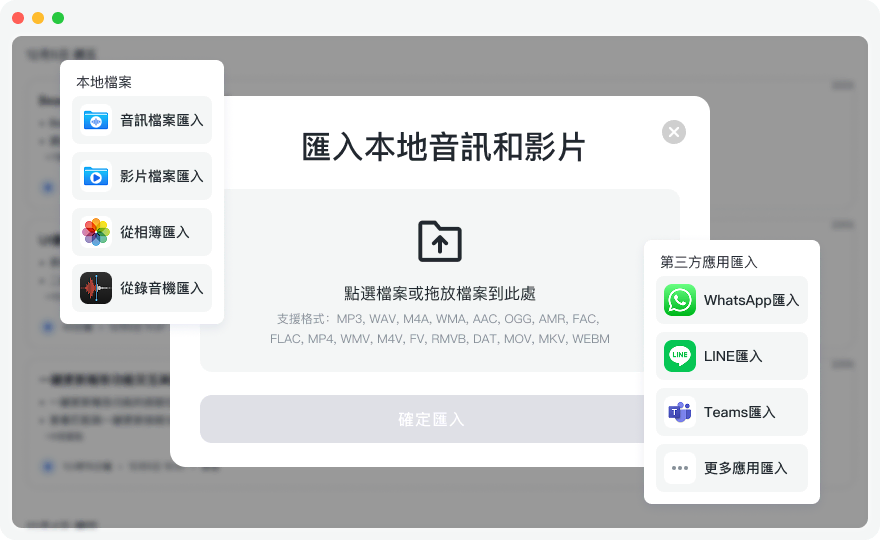
Step 1: Start Recording or Import a File
If you are conducting an interview, use the mobile app to start "Live Recording to Text." Tinrec displays text in real-time, and you can mark key points on the fly. If you already have a file from a recorder or a YouTube interview link, log in to the web version and select "Import Audio/Video."
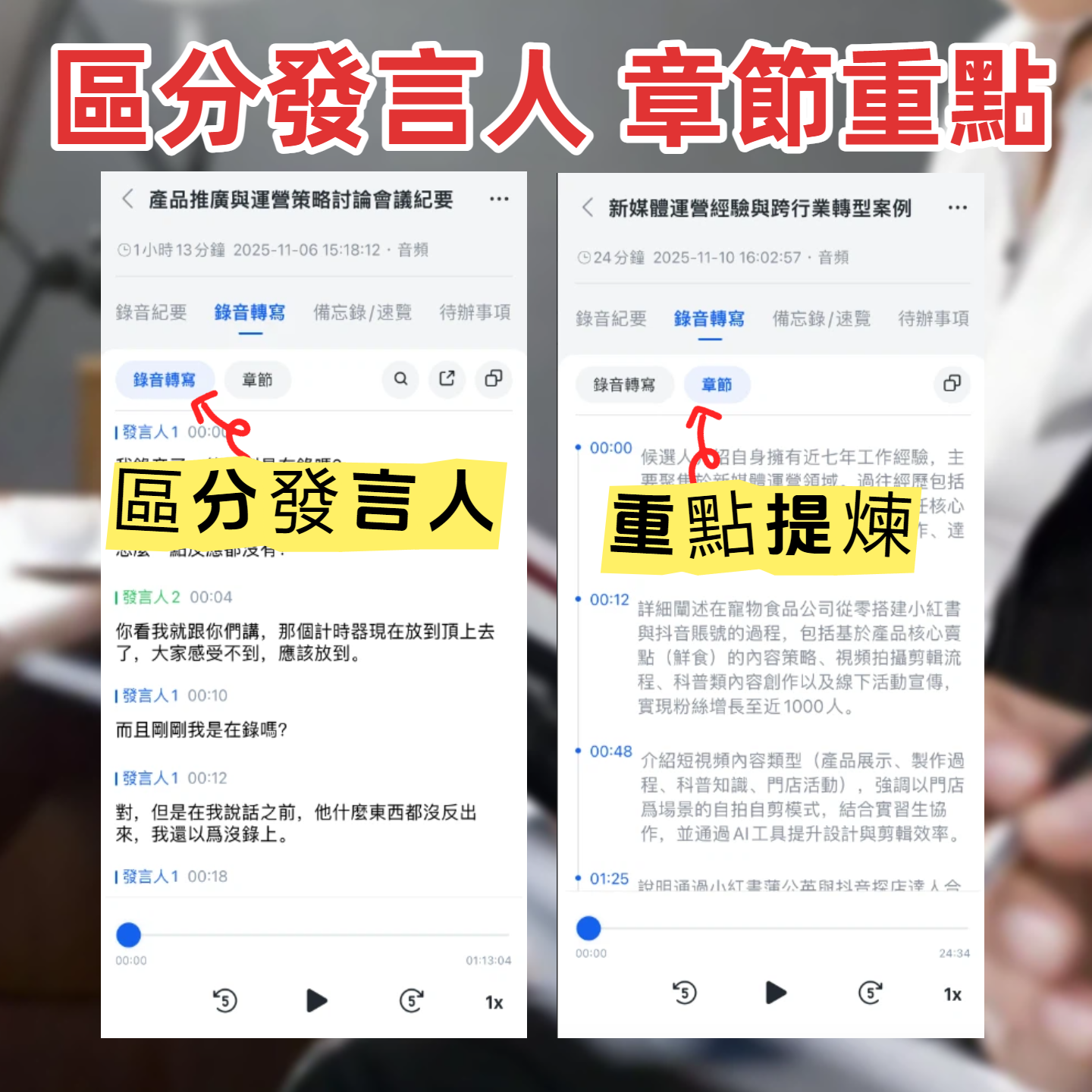
Step 2: Speaker Diarization
After uploading, the system automatically identifies different speakers. This is crucial for interviews—you no longer have to manually label "Interviewee A says" or "Host says"; the system segments automatically.

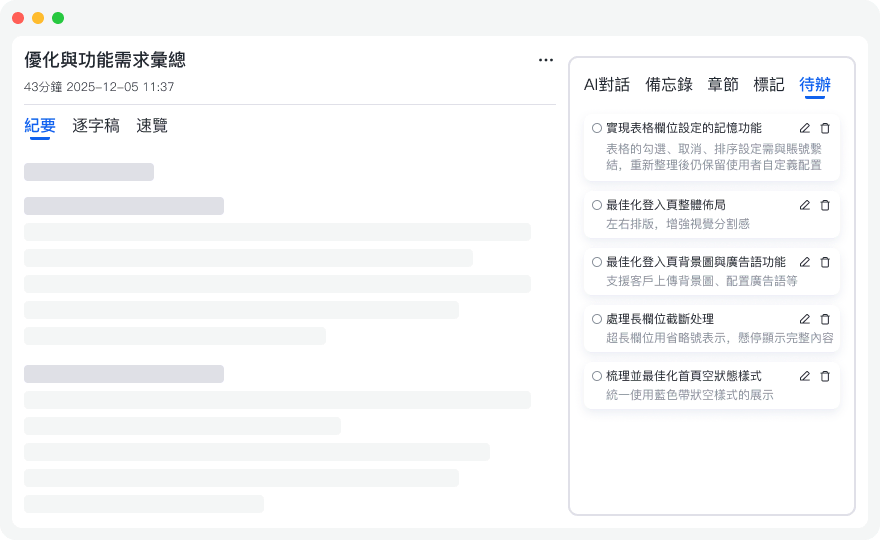
Step 3: Get AI Summary and Action Items
This is a step traditional tools cannot do. Click the AI analysis feature, and the system automatically generates "Meeting Minutes" and "Action Items (To-do List)." For project meetings, information like "Submit first draft by next Wednesday" is automatically captured as tasks.
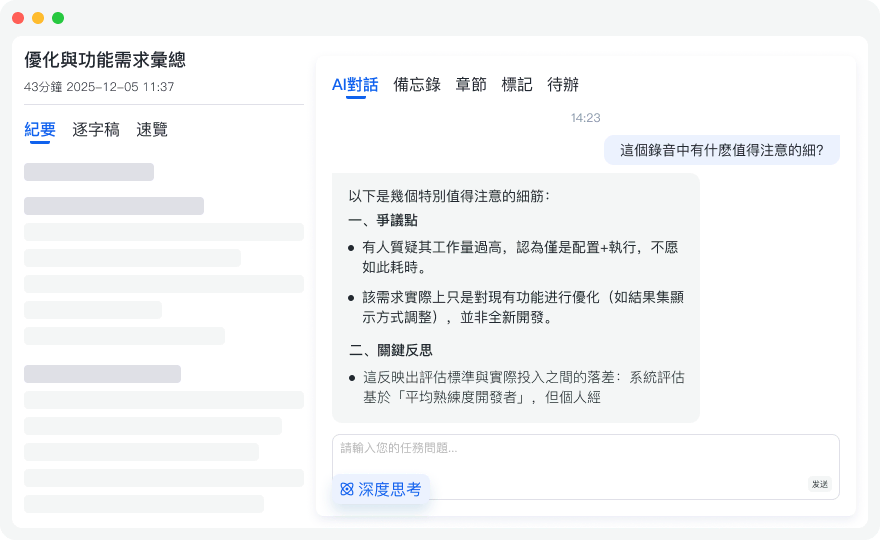
Step 4: Use AI Conversation Query for Key Information
If you forget the interviewee's specific view on a topic while organizing the draft, you don't need to re-listen or Ctrl+F blindly. Simply type in the dialogue box: "What is the interviewee's view on market trends?" Tinrec will answer based on the recording content, significantly reducing drafting time.
5. Frequently Asked Questions (FAQ)
Q1: Are free speech-to-text tools accurate enough? In a clear recording environment (low noise, clear pronunciation), modern AI tools like Whisper or Tinrec typically achieve 90-95% accuracy or higher. While they cannot completely replace manual proofreading, they are more than adequate as a first draft and can save about 70% of your transcription time.
Q2: What are good free options for iPhone users? iOS's built-in "Dictation" feature works well for short phrases. For long recordings needing conversion to text files, Tinrec and Otter.ai are great choices, especially the former for better Chinese support and cross-device syncing.
Q3: Do free tools limit long audio files? Yes, most online tools have limits on single file length or monthly total. For example, Otter's free plan limits each segment to 30 minutes; Tinrec's free plan offers 100 minutes per month. If you have heavy interview needs, consider a paid subscription or a local open-source tool.
Q4: Can I convert YouTube videos to text? Some tools support this. For instance, Tinrec's "Podcast/Online Video to Text" feature lets you paste a YouTube URL to generate transcripts and summaries, which is great for content creators organizing material.
Q5: Is data privacy secure? If you handle highly confidential legal or medical data, use fully offline tools (e.g., Whisper Desktop). For online cloud services, choose providers with clear privacy policies. For example, Tinrec does not use user data for public model training, ensuring data security.
Q6: What if my interview is in Cantonese or Hokkien? For pure Hokkien interviews, Yating Transcript is the top recommendation. For Cantonese, Tinrec supports Cantonese recognition and provides decent transcription. For mixed languages, choose tools with multilingual support for best results.
Turn every recording into actionable outcomes
Get 60 free transcription minutes when you sign in. No credit card required.
Related Reading
You might also like

How to Buy Google Meet in 2026: 5 Steps to Pick the Right Plan Without Getting Burned
Starting from the real-world scenario of a business purchasing Google Workspace, this breaks down the differences between Google Meet's free and paid plans, the most common pitfalls when buying, and explains why even after choosing the right plan, you still need an AI meeting notes tool like Tinrec to handle post-meeting organization.
5 Best Google Meet Alternatives in 2026: Tested and Compared — Before You Switch, Figure Out What You're Really Missing
Looking for a Google Meet alternative? Most people actually get stuck on post-meeting organization, not the video platform itself. This article starts with common misconceptions, explains 4 key points for choosing a meeting tool, tests Tinrec's bot-free recording, AI summaries, and team workspace, and compares options like Otter.ai, Granola, and Notta, with a pitfalls guide and selection advice.
5 Browsers Tested for 2026: The Smoothest Choice for Google Meet
Which browser works best with Google Meet? This article covers browser compatibility and the real gap after meetings, explaining why most people get stuck not on connection but on meeting notes. Using Tinrec as an example, it shows how to record online meetings without bots, get real-time transcripts, AI summaries and action items, and team spaces, plus 5 buying considerations and FAQs.
4 Google Meet Background Options Compared for 2026: From Free Stock Photos to Meeting Notes
How do you choose a professional Google Meet background? This article compares 4 background and meeting solutions, from free stock photo sites like Pexels, Livestorm, and Hello Backgrounds to the meeting notes tool Tinrec, with background dimensions, system requirements, and pitfalls to help you decide at a glance.
Google Meet Best Practices for 2026: 5 Free Tips to Streamline Your Meetings
Google Meet calls run smoothly, but post-meeting organization is where time really gets lost. This guide covers 5 practical Google Meet best practices, from pre-meeting environment checks and in-meeting mute and screen sharing habits to post-meeting transcripts and action items. We also tested Tinrec, Otter.ai, Granola, and Notta to help you turn meetings into usable data.
6 Online Meeting Transcription Tools Tested and Compared in 2026: Google Meet Background Mirroring Is Hard to Solve, Prioritize Transcripts and Minutes
Google Meet virtual background text appearing reversed is actually caused by preview mirroring, and flipping the image as suggested in communities may not work. This article first explains the cause, then tests and organizes 6 online meeting recording solutions, from bot-free recording, AI summary Q&A to team data management, helping you pick the one that truly saves time.
Google Meet Account Cost in 2026: Free Plan Limits & Paid Options Explained
How much does a Google Meet account really cost? This guide breaks down the free plan's 100-participant and 60-minute limits, Google Workspace Business Starter/Standard/Plus annual pricing ranges, and includes a list of 6 post-meeting tools to help you decide whether to stay free or upgrade.
Google Meet Screen Sharing Not Working in 2026: 6 Troubleshooting Steps and Alternative Comparison
Google Meet screen share button grayed out or showing a black screen? This guide walks through the most practical troubleshooting order for 2026, from browser version and host's Host Management settings to macOS screen recording permissions, and compares Tinrec, Otter.ai, Granola, and Notta for meeting notes—so you can fix sharing and actually keep a record of your meetings.
Free Google Meet Alternatives in 2026: 4 Tested Picks and Buying Guide
Free Google Meet cuts off at 60 minutes, and post-meeting cleanup eats even more time. This guide compares free alternatives worth considering in 2026, including the AI meeting notes tool Tinrec and video platforms Jitsi Meet, kMeet, and TrueConf, with key buying factors and common pitfalls.