
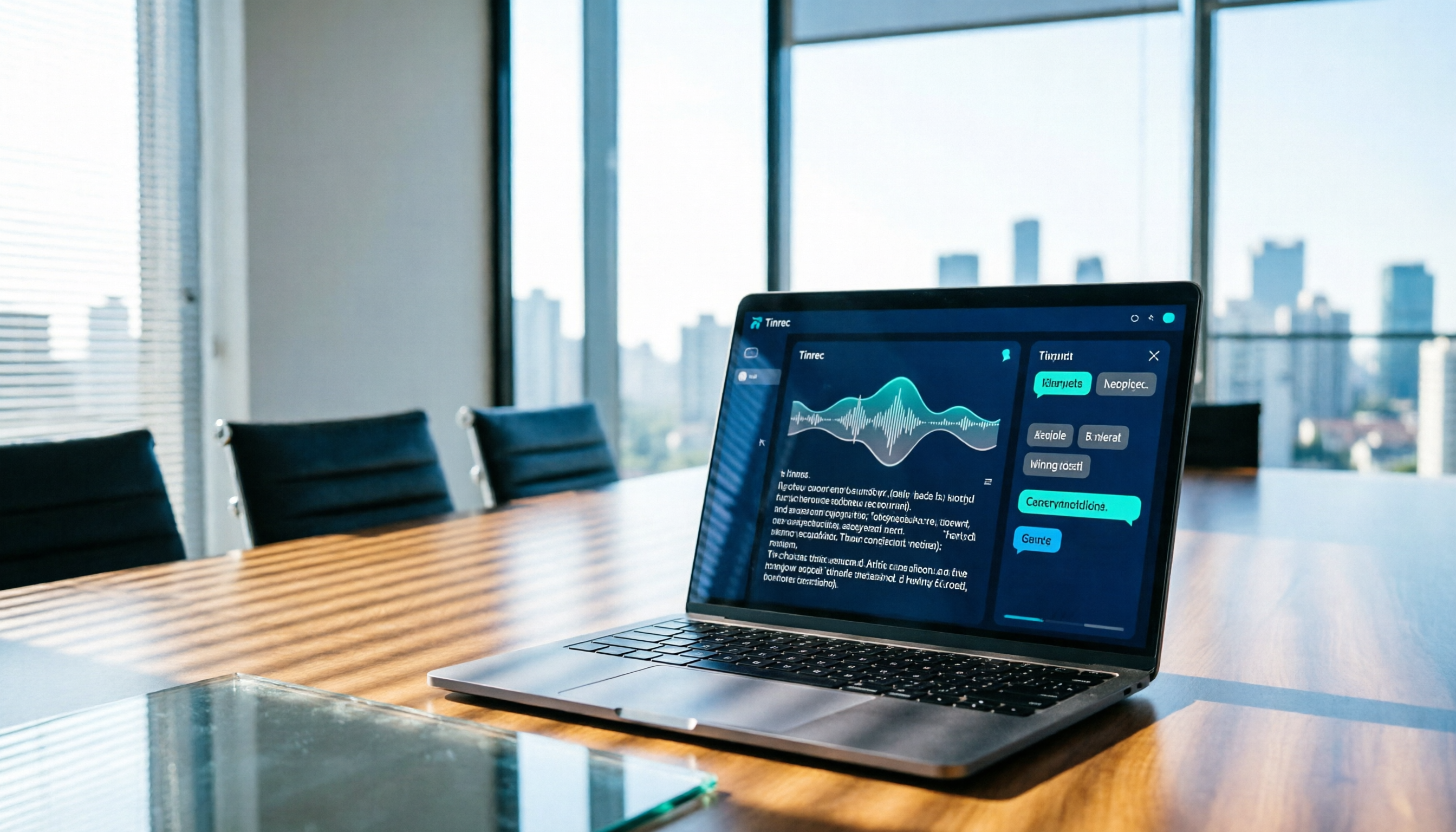
Turn recordings into transcripts and summaries in minutes
Upload audio or video for multilingual transcription, AI notes, and action items
How to Take Meeting Minutes in 2026? 5 Steps to Free AI Voice-to-Text Tutorial
Last week, I attended 8 meetings, each averaging 45 minutes. If I manually took meeting notes after each one, it would take 30 minutes per meeting, adding up to 4 extra hours of work. And before you leave on Friday, you still need to hand in all meeting minutes and to-do lists.
But the essence of meeting minutes is not just recording audio or transcribing every word. The real purpose of meeting minutes is to turn meetings into data that can be searched, queried, and acted upon.
In the past, I tried many tools. I started with Otter.ai because it's well-known in the English meeting circle. But after several Chinese meetings, I found quite a few issues. Later, I switched to Tinrec (秒听录音), and gradually built a meeting minutes method more suitable for the Chinese workplace.
Tinrec vs Otter | Quick Overview
Otter is a mature AI meeting assistant with a complete ecosystem for English business meetings. Tinrec focuses more on Chinese meetings, bot-free recording, and post-meeting organization.
Both support online meeting transcription and summarization, but the core difference is that Tinrec doesn't require inviting a bot to join meetings, its Chinese recognition is more attuned to Taiwanese workplace terminology, and it turns meeting data into a collaborative asset for the team.
This article shares my hands-on experience across five dimensions: Chinese transcription, recording method, post-meeting organization, team collaboration, and free tier.
Dimension 1 | Chinese Meeting Transcription Experience
I tried Otter first. It's strong for English meetings, but for Chinese meetings? In my experience, its Chinese recognition often mixes up proper nouns and code-switching content.
Once I recorded a product discussion that mentioned "POC" and "Q3", and Otter either skipped them or transcribed them incorrectly. That was frustrating.
Later, I switched to Tinrec. With the same recording, it correctly identified "POC" and "Q3", and also segmented code-switched sentences properly.
In particular, it has a "Team Hotwords" feature, where I can add company-specific terms in advance, improving recognition accuracy.
(Screenshot here: Tinrec transcription interface, arrow pointing to the "Team Hotwords" settings button)
→ This dimension: Tinrec clearly wins.
Dimension 2 | Bot-Free Online Meeting Recording
Otter's primary mode is having a meeting bot join the meeting. Many companies don't allow external bots into confidential meetings, which creates a bottleneck.
Tinrec's desktop version directly captures system audio, requiring no bot to join. I just open Tinrec, hit record, and then start Zoom or Meet normally; it records and transcribes in the background.
No extra participants appear in the meeting, and the other party won't notice.
(Screenshot here: Tinrec desktop recording screen, arrow pointing to the "Start Recording" button)
→ This dimension: Tinrec is better for teams that don't like bots.
Dimension 3 | Post-Meeting Organization and AI Q&A
Otter has summaries and action items, but its AI Q&A is more English-oriented, and Chinese queries sometimes get irrelevant answers.
Also, its output format is relatively fixed, so when I need to turn it into a report, I have to manually copy and paste.
Tinrec not only provides verbatim transcripts, but also automatically generates summaries, chapters, and to-dos. You can even ask it in Chinese: "What was the decision in this meeting?" "Who is responsible for the next step?" It finds answers from the meeting content.
Stop organizing recordings by hand
Upload audio or video and automatically get a transcript, summary, and action items
Even better, it can export meeting results directly to Notion or Google Docs for further processing.
(Screenshot here: Tinrec AI Q&A interface, arrow pointing to the "Export to Notion" button)
→ This dimension: Tinrec fits my post-meeting workflow better.
Dimension 4 | Team Collaboration and Data Accumulation
Otter's team features are comprehensive, but its design is still primarily for individual meetings. Team space permission management is complex, and the price is high.
For small teams, the barrier is a bit high.
Tinrec's team version centralizes meeting data in a team space, where members can view historical meetings, and admins can allocate seats and monitor usage.
I used to worry that meeting notes would disappear when a colleague left. Now with Tinrec, data stays with the team, and when handing over, you can simply transfer resources.
(Screenshot here: Tinrec team space view, arrow pointing to "Member and Seat Management")
→ This dimension: Tinrec is better for teams that need data accumulation.
Dimension 5 | Free Tier and Practical Usability
Otter's free plan offers 300 minutes per month, but many features like AI Q&A and advanced summaries are paywalled.
For occasional users, the free version only allows transcription, with limited organization features.
Tinrec's free version also provides basic quota for recording, importing, and summarization, but it doesn't lock AI summaries and Q&A behind a paywall, so I can fully test the post-meeting organization workflow.
If you have a sudden influx of meetings, the weekly card is also flexible.
(Screenshot here: Tinrec pricing page, arrow pointing to the "Free Plan" benefits)
→ This dimension: Tinrec's free plan is more practical.
What Unique Advantages Does Each Have?
Tinrec's unique advantages:
- Stable Chinese meeting transcription quality, handling code-switching well.
- Bot-free recording, no worries about external bots joining meetings.
- One-stop post-meeting organization: summaries, to-dos, AI Q&A, multi-format export.
- Team space and seat management, turning meeting data into a team asset.
Otter's unique advantages:
- Mature English business meeting ecosystem with many integrations.
- Rich mobile recognition and real-time collaboration features.
Summary: Who Should You Choose?
• If you need Chinese meeting minutes and often encounter code-switching → Tinrec
• If you don't want to invite bots to meetings → Tinrec
• If you want to turn meetings into searchable, queryable team data → Tinrec
• If you primarily work in English and are used to the Otter ecosystem → Otter might be more convenient
In a nutshell: For most Chinese workplace users, Tinrec is the more complete choice. I recommend downloading Tinrec's free version and testing it with your own recordings.
You don't have to learn everything at once. Start with the simplest steps and gradually build your own meeting minutes method.
Quick start checklist:
- Download Tinrec and register for a free account.
- Open the desktop version and record an online meeting.
- After the meeting, review the auto-generated summary and to-dos.
- Use AI Q&A to ask: "What are the next steps from this meeting?"
- Try exporting the meeting data to Notion or Google Docs.
- If using with a team, create a team space and invite members.
Copyable prompt template:
"Based on this meeting transcript, please organize: 1. Meeting conclusions 2. Action items with owners 3. Items to prepare before the next meeting. Please output in English."
Test step by step, and you'll gradually master this method. If you want to learn more about my digital workflow, check out my courses and newsletter.
References
- AI Meeting Note Taker: Take Meeting Notes with AI Free Online - EaseMate AI
- AI Meeting Minutes Software Recommendations: 5 App Real-World Tests, Auto-Transcribe to Make Meetings Easy!
- No Time Limit! 3 Free AI Verbatim Tools, Great Recommendations! AI Voice Notes for Meeting Minutes, Slides, Mind Maps | 104 Career Force
- Still Taking Meeting Notes by Hand? These 3 AI Tools Save You Time and Effort (The Third One is Free and Fastest)::I'm Chi
- Meeting Ink - 2026 AI Meeting Minutes Tool Test: 7 Voice-to-Text and Summary Speed Comparison | Meeting Ink - AI Meeting Minutes Assistant, Auto-Transcribe Verbatim and Summarize
Turn every recording into actionable outcomes
Get 60 free transcription minutes when you sign in. No credit card required.
Related Reading
You might also like

How to Format Meeting Minutes in 2026: 5 Steps from Recording to AI Summary
Tired of working overtime on meeting minutes? This article shows you how to use Tinrec to go from recording to AI summary, with clear formatting, decisions, and action items at a glance—saving you time.

2026 Tested: 4 Meeting Minutes Word Templates vs. Tinrec AI Auto-Generation
Tired of manually filling out meeting minutes templates? This article compares 4 common Word templates and tests Tinrec AI to auto-generate meeting minutes and export to Word, letting you finish in 5 minutes what used to take an hour.

2026 Meeting Minutes and To-Do Tool Buying Guide: 2-Product Comparison and Recommendations
Hong Kong professionals often need to write meeting minutes and track to-dos, but choosing the right tool can be tricky. This comparison of Tinrec and Otter.ai breaks down Chinese/Cantonese recognition, bot-free recording, to-do follow-up, team spaces, and export features to help you decide which one fits your needs.

How to Auto-Generate Meeting Minutes in 2026: 5 Steps from Recording to AI Summary
A hands-on guide to auto-generating meeting minutes in 2026, with 5 steps from recording to AI summary. Compare popular tools like Tinrec, avoid common pitfalls, and find the best meeting minutes solution for your team.

5 Best AI Meeting Note Apps Tested in 2026: Which One Handles Chinese Meeting Minutes Best?
Meeting minutes are not transcripts. This article tests Tinrec, Otter, Fireflies, Notta, and other tools, evaluating them on Chinese formatting, summaries and action items, and free tiers, to help you find the best fit for office workers in Taiwan.

2026 Tinrec vs Plaud Note Hands-On Comparison: No Hardware and Team Collaboration Are Key
Still deciding between buying recording hardware or using AI meeting minutes software? This hands-on comparison of Tinrec and Plaud Note covers device cost, online meetings, historical files, and team collaboration to help you find the best automatic meeting minutes solution for office workers.
2026 AI Meeting Recorder Comparison: Which Is Best for Chinese Meetings and Team Collaboration?
We tested 4 popular AI meeting recorders, from bot-free recording, Chinese recognition, post-meeting organization to team collaboration, to tell you which one is best for the Taiwanese workplace.

How to Write Meeting Minutes in English in 2026: 5 Steps to Master the Format and Templates
Writing meeting minutes in English isn't about word-for-word translation—it's about capturing decisions and actions. This article walks you through 5 steps to master the format and common vocabulary, and shows how to use Tinrec to automate the process, making English meeting minutes a breeze.

2026 Hands-On Comparison of 4 AI Meeting Note Tools: Which Is Best for Chinese Meetings and Team Collaboration?
This article tests 4 popular AI meeting note tools, including Tinrec, Otter.ai, Notta, and Granola, comparing Chinese recognition, bot-free recording, team collaboration, and pricing plans to help you find the best meeting minutes solution for office workers in Taiwan.