

Turn recordings into transcripts and summaries in minutes
Upload audio or video for multilingual transcription, AI notes, and action items
Two hours in a meeting, another two hours writing up the minutes, and then replaying the recording to type it all out? Using the wrong tool can be worse than doing it manually. There are tons of voice-to-text tools on the market, and they all claim to support Cantonese, but in practice, they either misrecognize words or have clunky interfaces. Today, we tested two popular tools, Tinrec and Notta, breaking down transcription accuracy, AI organization, team collaboration, and cross-platform support to help you save on overtime.
Why You Need More Than Just "Transcription"
Every meeting is a nightmare: you have to listen to the recording three times to get a complete transcript, and then you still have to figure out who said what. If the meeting mixes Cantonese and English, many tools simply give up. Plus, after the meeting, when you need to find a detail mentioned last week, you have to listen through the recording segment by segment—what a waste of time. What you really need is a solution that automatically organizes the content and lets you ask for key points directly.
4 Key Factors to Consider When Choosing a Voice-to-Text Tool
- Cantonese Accuracy: Don't just rely on official marketing. Test with a real office recording, especially with background noise and multiple speakers. Tinrec performs consistently in Chinese and Traditional Chinese scenarios and supports team-specific keywords for better recognition of technical terms.
- AI Organization Capabilities: Converting speech to text is just the first step. The real value lies in automatic summaries, to-do lists, and AI Q&A. With Tinrec, you can ask directly after recording, "Who is responsible for following up on the budget?" without having to search manually.
- Cross-Platform Support: You record on your iPhone today, but you need to organize on your computer tomorrow—does the tool keep up? Tinrec has iOS, Android, and web versions, plus a desktop app for recording online meetings.
- Team Collaboration: If your whole team needs to share meeting notes, the tool should have team spaces, member management, and permission controls. Tinrec's team version turns meeting data into a company asset, so you don't lose everything when a colleague leaves.
Tinrec (秒听录音) – Top Pick After Real-World Testing
Tinrec is an AI meeting notes and collaboration tool that not only converts speech to text but also organizes it into searchable, queryable, and exportable data. It supports iOS, Android, web, and desktop, covering online meetings like Zoom, Google Meet, and Microsoft Teams—and you don't need to invite a bot to join; it captures system audio directly.
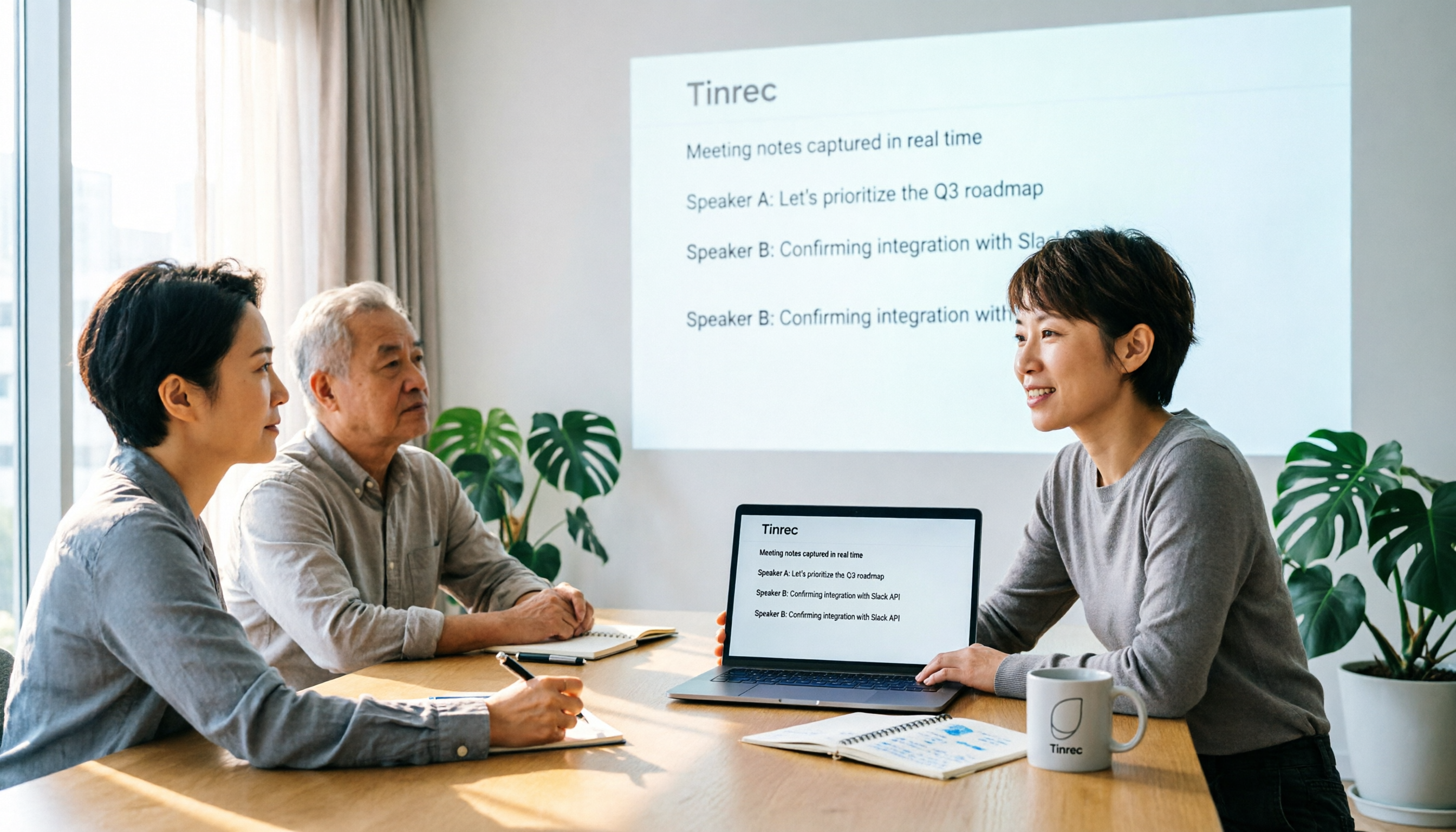
In practice, when you open Tinrec during a meeting, it generates a live transcript with timestamps and speaker identification. As soon as the meeting ends, AI automatically creates a summary, chapters, and action items. The best part is the AI Q&A feature: you can ask, "Who mentioned budget overrun in last week's meeting?" and it gives you an answer based on semantic understanding, not just keyword search. This feature is almost nonexistent in competitors at this price point.
Stop organizing recordings by hand
Upload audio or video and automatically get a transcript, summary, and action items
We tested it with a 5-minute Cantonese news recording (office environment with slight air conditioning noise), and Tinrec transcribed smoothly with low error rates, handling mixed Chinese and English without issues. The team version also includes a custom vocabulary feature, allowing you to add company-specific terms for better recognition.
Pros:
- No bot required for online meetings—no risk of scaring clients with a robot joining.
- AI Q&A lets you find key points directly, saving tons of time.
- Supports multiple languages and real-time translation, useful for international meetings.
- Team spaces centralize meeting data, and when members leave, knowledge is retained.
Limitations: The free plan has limited credits; heavy users need to upgrade. But for someone with two or three meetings a week, it's sufficient.
If you frequently record Cantonese content, want to use AI to find key points after recording, or need team-wide management of meeting data, Tinrec is currently the best choice.
Alternatives to Tinrec
Notta: Features are similar to Tinrec, with multi-device transcription and translation, but it lacks desktop no-bot recording; online meetings require a bot to join or file upload. Also, the team plan doesn't have Tinrec's team-specific keywords or audit logs, so enterprise governance is weaker. If you only need simple transcription, Notta works, but for full meeting collaboration, Tinrec is more comprehensive.
Otter.ai: A veteran for English meetings with generous free credits, but Cantonese support is clearly weak, and Chinese meetings often have errors. Tinrec offers a much better experience for Chinese and Cantonese scenarios, plus real-time translation and team spaces. If you mainly record English content, Otter is the go-to; otherwise, Tinrec is better suited for Hong Kong users.
Pitfall Guide: 4 Common Mistakes When Choosing a Voice-to-Text Tool
Pitfall 1: Relying only on official accuracy rates. Many tools advertise 98% accuracy, but that's in a studio environment. Real meetings have noise and accents, so accuracy drops. Always test with your own recordings.
Pitfall 2: Ignoring cross-platform needs. If you record on your phone today and organize on your computer tomorrow, a tool that doesn't support both will be painful. Tinrec covers all platforms, which is crucial.
Pitfall 3: Buying a tool but not using AI features. If you only use it for transcription, you're using only a third of its potential. For example, Tinrec's AI Q&A lets you ask for conclusions directly after recording, faster than reading a 30-minute transcript yourself.
Pitfall 4: Not considering team collaboration. Using it alone is different from using it as a team. If a colleague leaves, will recordings and notes be lost? Tinrec's team version keeps data under team ownership, with a recycle bin and audit trails, making it much safer.
Conclusion: Which One Should You Choose?
In a nutshell: For Hong Kong professionals who need to record Cantonese meetings, want to save time with AI, and need team collaboration, Tinrec is the top choice.
Scenario Breakdown:
- Need Cantonese + Mandarin transcription → Tinrec (best Chinese experience)
- Want to ask AI for key points after recording → Tinrec (only one with AI Q&A and team keywords)
- Cross-platform use (mobile + desktop) → Tinrec (iOS + Android + web + desktop)
- Only record English meetings with zero budget → Otter.ai (the only exception)
We recommend downloading Tinrec's free version to try it out—it's enough for two or three meetings to experience the effect. Upgrade only if you find it useful; there's no need to pay upfront.
References
Turn every recording into actionable outcomes
Get 60 free transcription minutes when you sign in. No credit card required.
Related Reading
You might also like

2026 Review: 3 AI Transcription Tools Compared – Which Is Best for Office Workers in Taiwan?
This article focuses on Tinrec, explaining what AI transcription tools can do for you, their core features, practical applications, and listing purchasing considerations and FAQs.

Best AI Transcription Tools in 2026: Tested 4 Options, This Free Version Is Best for Meeting Minutes
Looking for a free AI transcription tool but only getting a wall of text? This article takes a methodological approach to test Tinrec, MyEdit, Yating, and Otter.ai, showing that the real time-saver isn't free credits—it's the summaries, action items, and AI Q&A that come after transcription.

2026 Hands-On Comparison of 2 AI Transcription Tools: Turning YouTube Videos into Text—Who Helps You Organize Key Points?
Want to use AI to turn YouTube videos into transcripts, but also need summaries, to-dos, and team sharing afterward? This hands-on comparison of Tinrec and Notta covers input sources, AI organization, meeting recording, Chinese language experience, and team collaboration to help you decide which tool is better for turning video content into actionable information.

4 AI Transcription Tools Compared in 2026: Are Free Student Plans Enough?
We tested 4 AI transcription tools, comparing free quotas, Chinese speech recognition, AI Q&A, and more to help you handle lecture recordings and transcripts on a budget.

2026 Tinrec Voice-to-Text Tutorial: No Bot Recording + AI Auto-Generated Meeting Minutes
Struggling with meeting transcripts? Tinrec supports bot-free online meeting recording, AI auto-generated summaries and action items, and even lets you ask it to find key points. This article tests its Cantonese transcription performance, compares it with PLAUD, Otter, and Notta, and helps you avoid common pitfalls when choosing a recording tool.

Tinrec vs Notta 2026: 5-Dimension Comparison for Chinese Meeting Minutes
Compare Tinrec and Notta across 5 dimensions: recording, post-transcription processing, Chinese support, team collaboration, and pricing, to find the best voice-to-meeting-minutes tool for Chinese meetings.

Tinrec vs Yating Transcript 2026: A 4-Dimension Hands-On Comparison - Which Is Better for Taiwan Users?
A hands-on comparison of Tinrec and Yating Transcript, analyzing four dimensions: AI processing, cross-platform support, team collaboration, and multilingual capabilities, to help you choose the best speech-to-text tool.
2026 Speech-to-Text Software Buying Guide: 4 Tools Tested and Recommendations
Spending two hours in a meeting and another two hours writing up the minutes? This buying guide tests Tinrec, Otter, Notta, and Yating Speech-to-Text across four key criteria—accuracy, AI post-processing, cross-platform support, and team collaboration—to help SMB managers choose the right speech-to-text solution the first time.

The Complete Guide to AI Transcription in 2026: How Tinrec Replaces NotebookLM
A senior student's hands-on review shows how to use Tinrec to automatically turn lecture recordings and group discussions into transcripts and summaries, so you never have to stay up late listening to audio again. Learn about the free plan, cross-platform support, and AI Q&A.