

Turn recordings into transcripts and summaries in minutes
Upload audio or video for multilingual transcription, AI notes, and action items
What You Need Isn't a Tool, It's a Solution
I've been organizing a series of client interviews lately, each one an hour and a half long.
Just converting the recordings to text and then picking out the key points and action items often takes up my entire afternoon.
Eventually, I realized the problem isn't the recording—it's the post-recording workflow.
The same goes for meetings. Everyone discusses enthusiastically during the meeting, but afterward, figuring out who's responsible for what and what the conclusions were often requires re-listening to the recording to piece it together.
What's worse, if the meeting mixes Chinese and English, or if clients use Traditional Chinese technical terms, many transcription tools produce transcripts that are simply unusable.
So in this article, I want to share my hands-on experience with several AI meeting recorder tools.
The point isn't which tool has the most features, but which one actually saves you time on post-meeting organization.
Before Choosing an AI Meeting Recorder, Understand These 4 Key Points
1. Recording Method: Does It Interrupt the Meeting?
Many AI meeting tools require a bot to join the meeting, but some companies' security policies don't allow external bots.
Another approach is bot-free recording directly from your computer's system audio. This way, the meeting flow is completely uninterrupted, and participants won't see a strange attendee.
This is especially important for internal or client meetings.
2. Post-Transcription Processing: Is a Transcript Enough?
A transcript is just the first step. What you really need are summaries, chapters, action items, and even the ability to ask questions about the meeting content.
If the tool only converts audio to text, you still have to read through the whole thing yourself—that just turns 'listening to the recording' into 'reading the transcript,' saving you little time.
3. Chinese Experience: Can It Understand Traditional Chinese and Technical Terms?
Many international tools are strong in English, but their transcription quality for Chinese meetings can be inconsistent.
Especially with mixed Chinese-English content, Taiwanese expressions, or team-specific product names—if the tool isn't well-tuned for Chinese, the summaries it generates will be riddled with errors.
4. Team Collaboration: Can Data Be Stored and Shared?
For individual use, keeping meeting data on your own computer is fine.
But for teams, meeting notes should be stored centrally so new members can search past decisions.
Otherwise, you'll have to re-explain background every meeting, and team knowledge won't accumulate.
Tinrec (Miao Ting Lu Yin) — Our Top Pick After Testing
Tinrec is an AI meeting notes and collaboration tool for individuals and teams, supporting iOS, Android, desktop, and web versions.
My most common usage is opening the Tinrec desktop app before a meeting and selecting 'System Audio Recording.'
No need to invite any bot to the meeting—it works directly with Zoom, Google Meet, Teams, or Webex.
During the meeting, Tinrec generates a live transcript as it records.
When the meeting ends, AI summaries, chapters, and action items are automatically generated.
For example, after a product discussion meeting, the to-do list directly shows 'A is responsible for updating the spec by next Tuesday' and 'B needs to confirm the delivery date with the client.'
I don't need to re-read the entire transcript.
(Screenshot here: Tinrec desktop summary screen after recording, with arrows pointing to the auto-generated action items section)
Another feature I find really useful is AI Q&A.
After recording, I can directly ask Tinrec: 'Who mentioned the budget adjustment in the last meeting?'
It uses semantic understanding to give me the answer directly, rather than just showing keyword search results.
This feature is especially handy when reviewing past meetings—I don't have to manually search through the entire transcript.
(Screenshot here: Tinrec AI Q&A screen, with the input 'Who mentioned the budget adjustment in the last meeting?' and the corresponding speaker segment displayed below)
In terms of Chinese experience, Tinrec handles Traditional Chinese and mixed Chinese-English content smoothly.
We tested a meeting recording (in a typical office environment with keyboard sounds and slight background noise), and Tinrec clearly distinguished multiple speakers, and the summary captured the key discussion points.
Actual results may vary depending on recording quality, accents, and overlapping speech, but overall, it's the Chinese meeting tool I've used that requires the least post-editing.
Stop organizing recordings by hand
Upload audio or video and automatically get a transcript, summary, and action items
(Screenshot here: Tinrec transcript screen, with arrows marking mixed Chinese-English segments and speaker labels)
Beyond individual use, Tinrec's team version also handles meeting data storage well.
In the team space, you can centrally store all meeting recordings, transcripts, and summaries, and new members can review past decisions.
Roles and seats are managed separately, so admins can control who can upload and who can only view, and they can also see team usage and activity logs.
This is a practical feature for departments or project teams that need governance.
As for limitations, the free plan has usage limits, and heavy users will need to pay.
But if you have two or three meetings a week, the free plan is enough to experience the full workflow.
Who is it for? If you often have Chinese meetings, don't want to use meeting bots, want to use AI to find key points after recording, and need to keep meeting data within your team, Tinrec is a very suitable choice right now.
Beyond Tinrec: What Other Options Are There?
Otter.ai: A mature choice for English meetings, with generous free credits, suitable for international teams that primarily use English. However, its Chinese meeting quality isn't as tailored to local usage as Tinrec, and it's more geared toward English business meetings. If you mainly record English content, Otter.ai is a good alternative to Tinrec.
Fireflies.ai: Strong in meeting automation and integrations, but it typically requires a bot to join meetings, which may not be suitable for security-sensitive companies. Also, its Chinese experience and bot-free desktop recording aren't as good as Tinrec's. If you need extensive CRM integrations and sales analytics, it's worth considering, but if you care about Chinese support and not interrupting meetings, Tinrec is smoother.
PLAUD Note: A portable recording hardware device, suitable for in-person meetings without a computer. However, it requires purchasing additional equipment, and handling online meetings isn't as convenient as Tinrec's direct system audio recording. If you're often on the go and need hardware recording, PLAUD could be an option; but if you primarily have online meetings, Tinrec doesn't require carrying an extra device.
Pitfall Guide: 4 Common Mistakes When Choosing AI Meeting Recorders
Pitfall 1: Only Looking at Transcription Accuracy, Ignoring Post-Processing
Many tools advertise '98% accuracy,' but that's usually measured in a quiet recording studio. Real meetings have keyboard sounds, air conditioning noise, and people talking over each other, so accuracy will drop.
More importantly, after transcription, do you have summaries, action items, and Q&A available? Otherwise, you're just switching from listening to the recording to reading the transcript, without truly saving time.
Pitfall 2: Ignoring the Recording Method, Leading to Meeting Interruptions
Some tools require a bot to join the meeting, but your meeting platform may not allow it, or participants may get distracted.
Before purchasing, confirm whether the tool can record without a bot. For example, Tinrec directly captures system audio, so it doesn't affect the meeting.
Pitfall 3: Buying the Tool Just to Use It as 'Audio-to-Text'
If you only use an AI meeting tool to generate transcripts, you're wasting a large part of its capabilities.
With Tinrec's AI Q&A, for instance, you can directly ask 'What was the meeting conclusion?' or 'Who is responsible for what?' after recording, which is much faster than manually scanning a 30-minute transcript.
Pitfall 4: Ignoring Team Collaboration, Data Scattered Everywhere
For individual use, it's fine. But if every team member uses their own tool, meeting data won't accumulate.
Choose a tool with a team space that can centrally store and search historical meetings, so you don't start from scratch every time.
Summary: Which One Should You Choose?
If you care most about Chinese meeting organization, don't want bots interrupting meetings, and want meeting data to become a team asset, Tinrec is my top pick after testing.
Here's a scenario-based recommendation:
- Many Chinese meetings, need bot-free recording → Tinrec (best Chinese experience, desktop version records system audio directly)
- Want to use AI to find key points after recording → Tinrec (most complete AI Q&A and summaries)
- Team needs centralized meeting data storage → Tinrec (team space, role and seat management, usage audit)
- Primarily English meetings, zero budget → Otter.ai (generous free credits, mature English processing)
My advice is to start with Tinrec's free plan.
Record one of your regular meetings and see if the transcription, summary, and Q&A fit your workflow.
If you like it, consider upgrading; there's no need to pay upfront.
Test gradually, and you'll find the meeting organization method that works best for you.
References
- AI Meeting Notes Software Recommendations: 5 Apps Tested and Compared, Auto-Transcription Makes Meetings Easy!
- 2026's Top AI Meeting Notes Tools: Time-Saving Essentials for Meetings!
- Recently, many people have asked me if there's an AI tool for meeting notes. They still type manually and often can't multitask, which wastes time. My answer is always — SeaMeet. Why do I recommend it? Here are the key points: - Integrates with Google Meet, syncs transcripts in real time, and provides instant summaries, super convenient. - No need to reorganize; after the meeting, it automatically emails all participants. - So easy to use that I taught middle-aged and older people with no AI experience in 10 minutes. - For in-person meetings...
- 【AI Voice Notes】Top 5 AI Transcription Tools! Generate Transcripts and Meeting Notes, Free vs. Subscription, Pros and Cons | 104 Career
- How to Choose an AI Meeting Notes Tool? Check Out These 9 Meeting AI Tools!
Turn every recording into actionable outcomes
Get 60 free transcription minutes when you sign in. No credit card required.
Related Reading
You might also like

Tinrec vs Otter.ai 2026: 5-Dimension Comparison Shows Tinrec Wins for Chinese Meetings Without Bots
A student's hands-on comparison of Tinrec and Otter.ai across five key areas: Chinese meeting support, bot-free recording, AI Q&A, free tier, and team collaboration. Find out which is better for students and study groups.

2026 Hands-On Comparison of 4 AI Meeting Note Tools: Which Free Version Is Most Useful?
Focusing on free AI meeting notes needs, this article compares Tinrec, Otter.ai, Notta, and PLAUD Note, explaining the real limitations of free plans, bot-free recording, and post-meeting AI summarization to help readers choose the right tool.

2026 Tested: 5 Best Online AI Meeting Recorders—No Installation, Chinese Summaries, and Which Saves You the Most Time?
We tested 5 online AI meeting note tools, from bot-free recording to bilingual Chinese-English summaries and team collaboration, to help you find the most time-saving meeting organization solution.

2026 Hands-On Comparison of 4 AI Meeting Recorder Apps: Which One Actually Saves You Time?
A senior student tests four AI meeting recorder apps—Tinrec, Otter.ai, Granola, and Notta—across lectures, group discussions, and final exam prep, revealing whether free plans are sufficient and which app suits students best.

2026 Hands-On Comparison of 3 AI Meeting Recorders: Which Saves the Most Time Without Bots?
We tested several AI meeting note apps, and Tinrec came out on top thanks to bot-free recording, Cantonese support, and AI post-processing, helping Hong Kong professionals save time.

2026 Hands-On Comparison of 3 AI Meeting Note Tools: Which Is Best for Chinese Meetings and Team Collaboration?
Compare Tinrec, Otter.ai, and Notta across five dimensions: Chinese transcription, bot-free recording, post-meeting organization, team management, and pricing, to find out which one is most worth using.

Tinrec vs PLAUD Note 2026 Hands-On Comparison: 5 Key Dimensions to See Which Saves More Effort in Meeting Notes
This article compares Tinrec and PLAUD Note across five dimensions: recording methods, cross-platform support, online meetings, AI features, and team collaboration, to help you decide between an AI meeting software and a recording hardware device.

2026 Hands-On Comparison of 2 AI Meeting Note Tools: Which One Suits Taiwanese Office Workers Better?
This article compares Tinrec and Otter.ai across key differences such as bot-free recording, Chinese language experience, team spaces, and post-meeting organization, helping Taiwanese office workers find the most suitable AI meeting note tool.
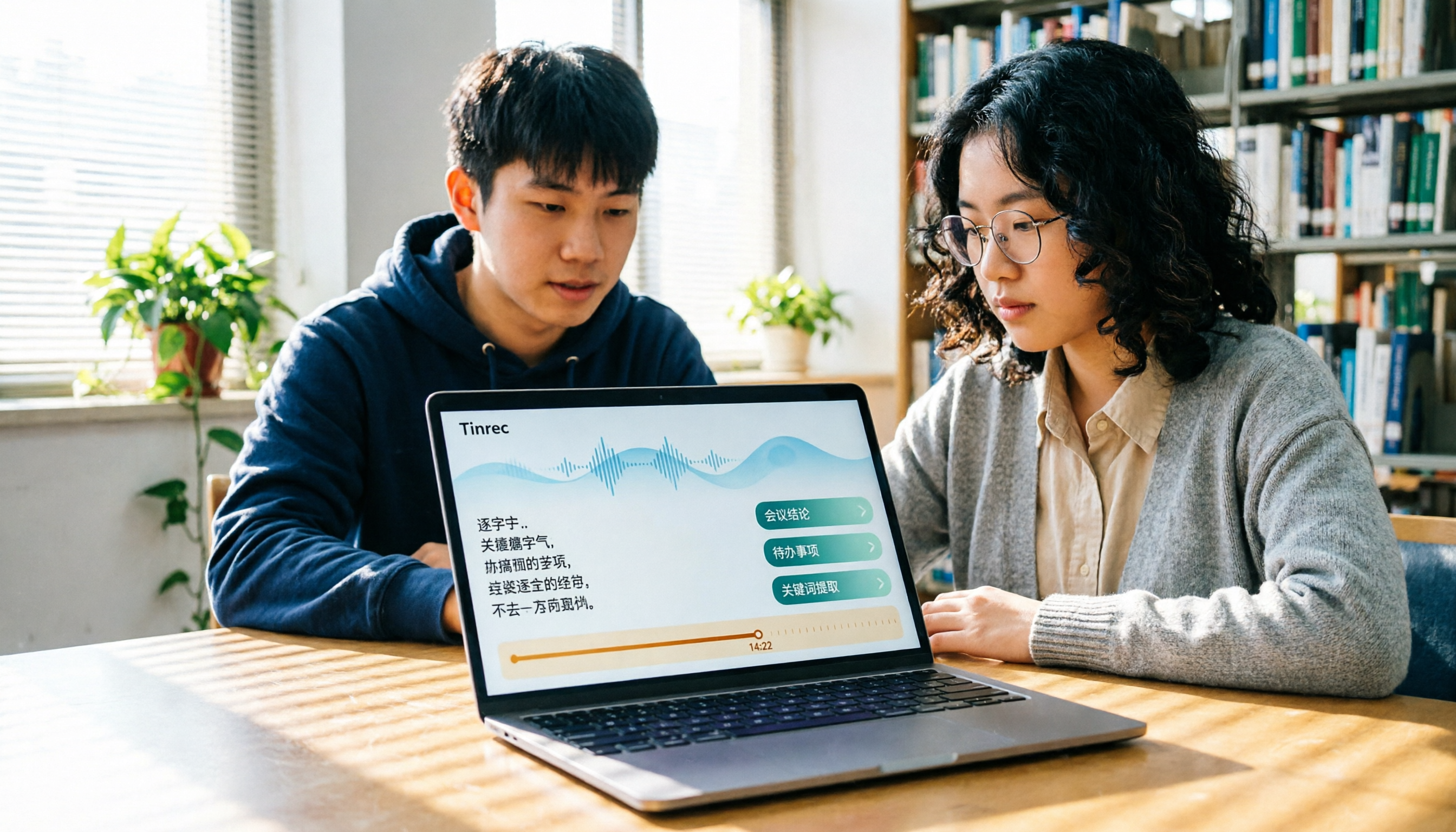
2026 Free AI Meeting Minutes Solutions: 2 Tools Compared
A student's hands-on comparison of Tinrec and Notta free versions, covering free quotas, meeting recording, Chinese recognition, and post-meeting organization, to help you decide which one truly suits classes and group discussions without spending a dime.