

Turn recordings into transcripts and summaries in minutes
Upload audio or video for multilingual transcription, AI notes, and action items
Many people think an AI meeting assistant is just "record + transcribe" and that's it. Honestly, I thought the same at first, so I just threw my lecture recordings into a transcription tool, thinking that would give me notes. But when I opened that thousands-of-words transcript before finals, I had no idea where the key points were—I just traded "hand-copying fatigue" for "eye-strain fatigue." Then I switched to Tinrec and realized the real value of a good AI meeting assistant lies after the recording: it should help you organize summaries, extract action items, and let you ask follow-up questions directly, rather than just dumping a wall of text. Based on my experience using it throughout a semester of classes, group discussions, and internship interviews, here's how to use AI meeting assistant features in 5 easy steps.
What Can an AI Meeting Assistant Do for You?
Scenario 1: Record an 8 AM class, review it by noon Last semester, I took a required course where the professor talked fast and flipped through slides even faster. I used the Tinrec mobile app to record, and it transcribed in real time—the text was ready before class ended. The best part is it also auto-generated a summary and chapters, so I didn't have to listen from start to finish.
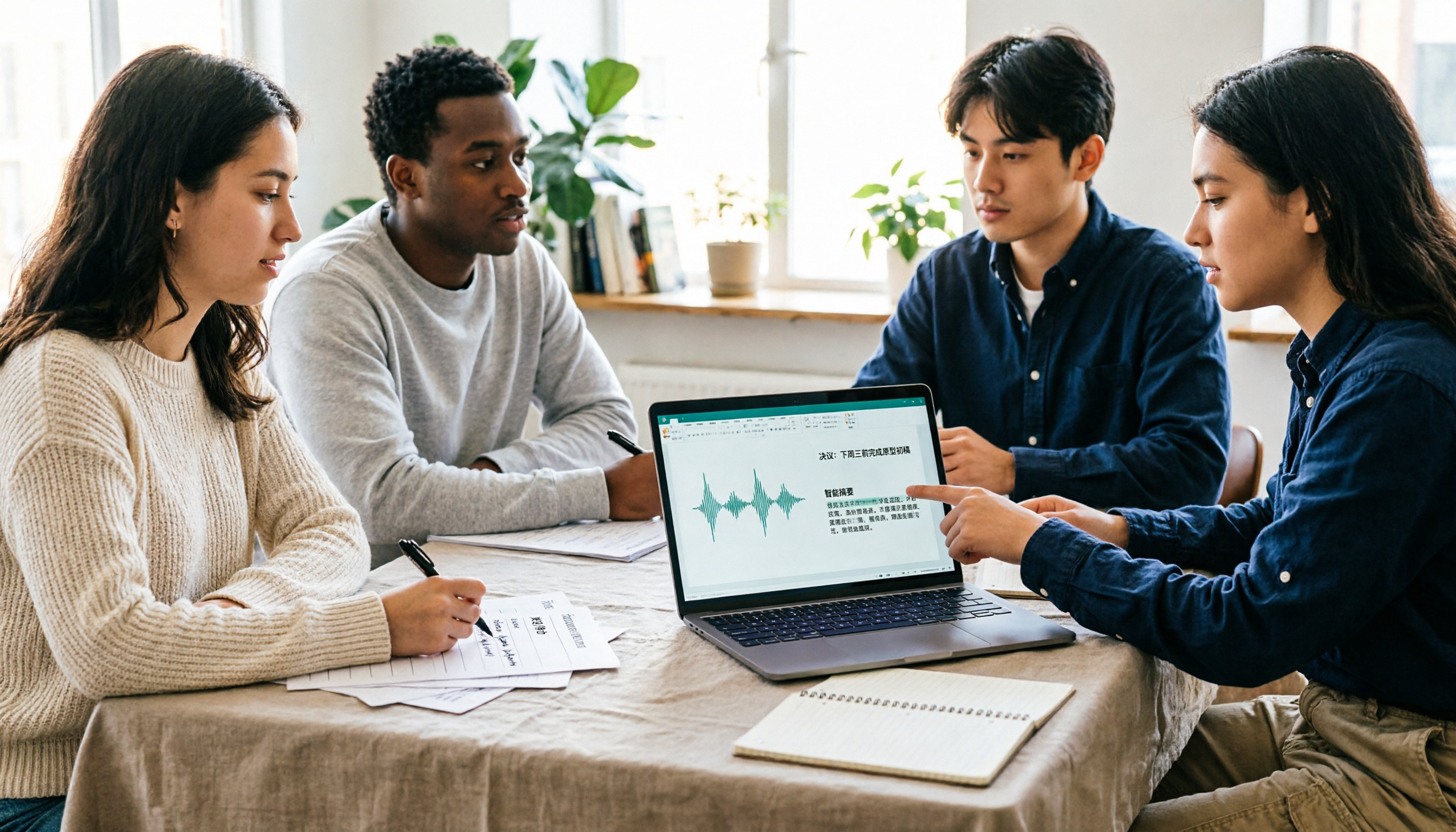
Scenario 2: Group discussions without forgetting conclusions afterward My group was working on a project, and we chatted for half an hour, but afterward no one remembered who was responsible for what. Using the Tinrec desktop version to record the online meeting without a bot, I could directly see the extracted action items—who does what and deadlines were all clear.
Scenario 3: Interview clients during internships without replaying recordings For my internship, I conducted user interviews. Before, I had to rewind repeatedly to hear what clients said. Now, after the interview, I just ask Tinrec, "What was the client's reaction to the price?" It answers based on semantic understanding, not just keyword search.
What Are the Core Capabilities of an AI Meeting Assistant?
Real-time transcription: It doesn't wait until the recording ends; it generates text as you record. Tinrec's real-time transcription lets you check the text during class or meetings to ensure you don't miss key points. For courses or meetings with mixed Chinese and English, its Chinese experience is smoother than many English tools.
AI summaries and chapters: It doesn't condense hours of audio into a useless paragraph; instead, it structures topics, conclusions, and important sections. Long meetings are split into chapters, so you can jump directly to the part you need when reviewing.
Action item extraction: Actions mentioned during meetings or discussions, like "I'll handle the presentation" or "Submit materials by Wednesday," are compiled into a to-do list by Tinrec, so you don't have to write them separately.
AI Q&A: This is my most-used feature. After class, you can ask, "Did the professor mention the final exam scope?" or "What are the grading criteria for this assignment?" Tinrec answers based on the meeting content, which is much faster than searching for keywords.
Export and post-processing: Transcription isn't the end. Tinrec lets you export summaries, transcripts, and action items to common note-taking or document tools, and can also generate reports or tables. This connects meeting data to your existing note workflow.
Practical Use Cases: My 5 Steps with Tinrec
This is my fixed routine after every class or meeting. Just follow along.
Step 1: Choose the recording source For in-person classes or interviews, use the Tinrec mobile app to record. For online meetings, use the Tinrec desktop version to capture system audio—it works with Zoom, Google Meet, Microsoft Teams, and Webex, without inviting a bot to the meeting, so it doesn't disturb others.
Stop organizing recordings by hand
Upload audio or video and automatically get a transcript, summary, and action items
Step 2: Start recording and check real-time transcription After pressing record, Tinrec generates text as it records. I usually glance at the text to ensure it's keeping up, and I make sure not to cover the speaker or microphone. For mixed-language classes, you can enable real-time translation or bilingual viewing.
Step 3: After recording, review the AI summary and chapters first Don't rush to read the transcript. Instead, look at the summary and chapters Tinrec generates to understand the structure of the discussion. It breaks long meetings into sections, so you immediately know where the key points are.
Step 4: Use AI Q&A to dig into details and organize action items Next, I ask Tinrec specific questions like, "What method did we finally decide for the experiment design?" or "Did anyone mention a budget cap?" I also review the extracted action items and add anything missing.
Step 5: Export to your notes or team space For personal class notes, I export to my preferred note-taking tool. For group projects, I put meeting materials into Tinrec's team space so all members can view past meetings, summaries, and action items. The benefit of a team space is that if someone leaves, the data isn't lost, and handovers are easier.
4 Things to Watch When Choosing an AI Meeting Assistant
Don't just trust ads for accuracy. Test it in your own environment. Tinrec performs reliably with clear audio and typical meeting settings, but if the recording is noisy or people talk over each other, it may miss words—so replay important parts to confirm.
Check how it records online meetings. Some tools require a bot to join the meeting, which needs consent from the host and participants, making it cumbersome. Tinrec's desktop version captures system audio directly without adding a participant, which is friendly for student group discussions or internship meetings.
Post-meeting organization matters more than transcription. If a tool only gives you a transcript, you still have to spend time finding key points. Tinrec's summaries, chapters, action items, AI Q&A, and export features are what truly save you time.
Calculate pricing and team plans carefully. I started with the free version, which had enough credits to try a couple of classes. If you're sharing with a group, Tinrec offers a team plan that manages members, seats, and usage, so you don't all share one account. But students usually start with the individual plan.
Frequently Asked Questions
Q: Do I need to buy separate recording hardware for an AI meeting assistant? No. Tinrec has mobile, desktop, and web versions, so you can record with your phone or laptop—no need for a separate recorder or hardware.
Q: Is the free version enough for students? If you just want to try it for one class or one interview, the free version has basic credits to start. I don't recommend buying the paid version right away; make sure it actually saves you time first.
Q: Do I have to invite a bot to online meetings? Not necessarily. Tinrec's desktop version can record system audio, so no bot is needed. Just open Tinrec and start recording before the meeting.
Q: Can transcription be 100% accurate? No. Actual performance is affected by recording quality, accents, multiple people speaking at once, and technical terms. Tinrec can greatly reduce manual organization time, but for important information, it's best to check the recording and transcript timestamps.
Q: What data can team members see? Currently, Tinrec's team plan shares data at the team level, so all active members can read team data; members without a seat can view but cannot upload, edit, or export. So don't treat team sharing as a tool where each person can customize privacy permissions.
Conclusion
An AI meeting assistant isn't just about "recording and transcribing." What's truly useful is what happens after recording: AI helps you organize summaries, extract action items, let you ask follow-up questions, and export results to your notes or team space. I used Tinrec for a full semester, from 8 AM classes to group projects and internship interviews, and it saved me tons of time replaying recordings. If you're a student, I suggest starting with Tinrec's free version for a couple of classes or one interview to experience what it's like to have readable key points right after recording.
References
Turn every recording into actionable outcomes
Get 60 free transcription minutes when you sign in. No credit card required.
Related Reading
You might also like

2026 Comparison of 5 Meeting Minutes Formats: Free Templates vs. AI Tools—Which Saves More Time?
There are countless meeting minutes formats—should you download a Word template and fill it in manually, or use AI to generate them automatically? This article compiles 5 common meeting minutes formats and free download sources, and compares manual template filling with Tinrec's instant recording across five dimensions: filling speed, export, search, team collaboration, and price, to help you choose the most time-saving approach.
5 Meeting Minutes Word Templates Tested for 2026: You Filled Out the Table, But Still Missed the Decisions?
Downloaded a bunch of meeting minutes Word templates but still can't write a record you can submit? Starting from real scenarios like student group projects, classes, interviews, and internship weekly meetings, this article compares the field designs of 5 common meeting minutes templates, outlines what a truly useful format should include, and demonstrates how to use Tinrec to turn recordings into transcripts, summaries, and action items, then paste them back into a Word template.

Notion vs Tinrec: Which AI Meeting Notes Tool Is Better for Chinese-Speaking Teams in 2026?
Is taking meeting notes in Notion really easier? This hands-on comparison looks at Notion (templates + Notion AI Meeting Notes) and Tinrec, covering how meeting audio gets in, post-meeting outputs, querying past meetings, team governance, and cross-language meetings, with scenario-based recommendations and FAQs.

5 Meeting Minutes Templates Compared in 2026: Word, PDF, Excel, or AI-Generated?
Downloaded a bunch of meeting minutes templates but can't make them work? This article tackles common pitfalls, breaks down the 5 essential fields a good template should have, compares 5 formats in practice, and shows how to automate the template-filling work with Tinrec.

5 Meeting Minutes Formats Tested for 2026: Which One Is Least Likely to Miss Decisions?
How to choose a meeting minutes format? This article starts with seven essential elements and four meeting types with corresponding formats, then tests and compares the workflows and limitations of tools like Tinrec, Otter.ai, Granola, and Notta for generating meeting minutes, with a pitfalls guide and selection advice.

How to Write English Meeting Minutes in 2026: 6 Sections + AI Auto-Summary
English meeting minutes are not a verbatim transcript. This guide starts with the most common mistakes, then covers the 6 standard sections of meeting minutes, ready-to-use English phrases and tenses, and compares Tinrec, Otter.ai, Granola, and Notta for Chinese-language meetings and post-meeting organization—so you can deliver usable minutes in half an hour.

4 Free Meeting Notes Tools Tested: Which Free Tier Actually Works? (2026)
Many free meeting notes tools exist, but 'free' means very different things. This article cuts through common misconceptions and compares Tinrec, Otter.ai, Notta, and TurboScribe on free quotas, Chinese recognition, and post-meeting organization to help you find the one that truly saves time.

2026 Meeting Minutes Action Items: 4 Free Tools Compared
Your English meeting minutes look great, but no one takes action afterward? The problem usually isn't the English—it's the action items section. This guide covers practical English phrasing for action items, assigned tasks, deadlines, and resolutions, and compares four meeting-notes tools with free plans: Tinrec, Otter.ai, Notta, and Granola. Includes free-tier limits, key buying criteria, and common pitfalls to avoid.

How to Write Meeting Minutes in English: Standard Format & Key Phrases (2026 Guide)
Learn how to write English meeting minutes: correct terminology, a 12-item standard format, resolutions and past-tense action verbs, plus a hands-on tool test and comparison of 3 alternatives. Master English meeting minutes in one guide.