

Turn recordings into transcripts and summaries in minutes
Upload audio or video for multilingual transcription, AI notes, and action items
4 Best WhatsApp Voice-to-Text Methods in 2026: Official Feature, AI Tools, and File Transcription Compared
Got a voice message but can't listen? You don't have to keep hitting play
In a meeting, on your commute, or at the library, you receive a 50-second WhatsApp voice message from a friend or colleague. You can only stare at it, wondering: What did they say?
To make it worse, sometimes you get several voice messages in a row, each over a minute long. To quickly grasp the key points, you'd have to listen from start to finish.
If you've been in these situations, this article is for you. We tested several WhatsApp voice-to-text methods to find the most convenient one.
Before choosing a WhatsApp voice-to-text solution, understand these 4 key points
Accuracy: Official accuracy claims are usually tested in quiet environments. In real use, background noise, accents, and overlapping speakers can affect results. To know if it works well, test it with your own recordings.
Privacy: WhatsApp's official feature boasts end-to-end encryption, with transcription done on your phone, so third parties can't access it. But if you use other tools that require uploading audio, you're handing your content to someone else, so assess the privacy risks yourself.
Language support: WhatsApp's official transcription currently supports Cantonese, Mandarin, and other languages, but it only transcribes within the same language—you can't transcribe English audio into Chinese. Third-party tools usually support more language combinations.
Post-processing capabilities: Transcribing text is just the first step. The ability to auto-generate summaries, to-dos, search highlights, or even export to other tools is what truly saves time.
Tinrec (秒听录音) — Our Top Pick After Testing
Tinrec (秒听录音) is an AI meeting notes and collaboration tool that supports multiple languages. Besides handling audio files, it can also handle online meetings, offline recordings, and interviews. If you need to convert WhatsApp voice messages to text and also want to organize, search, and track the content afterward, it's a very worthwhile option.
Not just transcription—it turns content into usable data
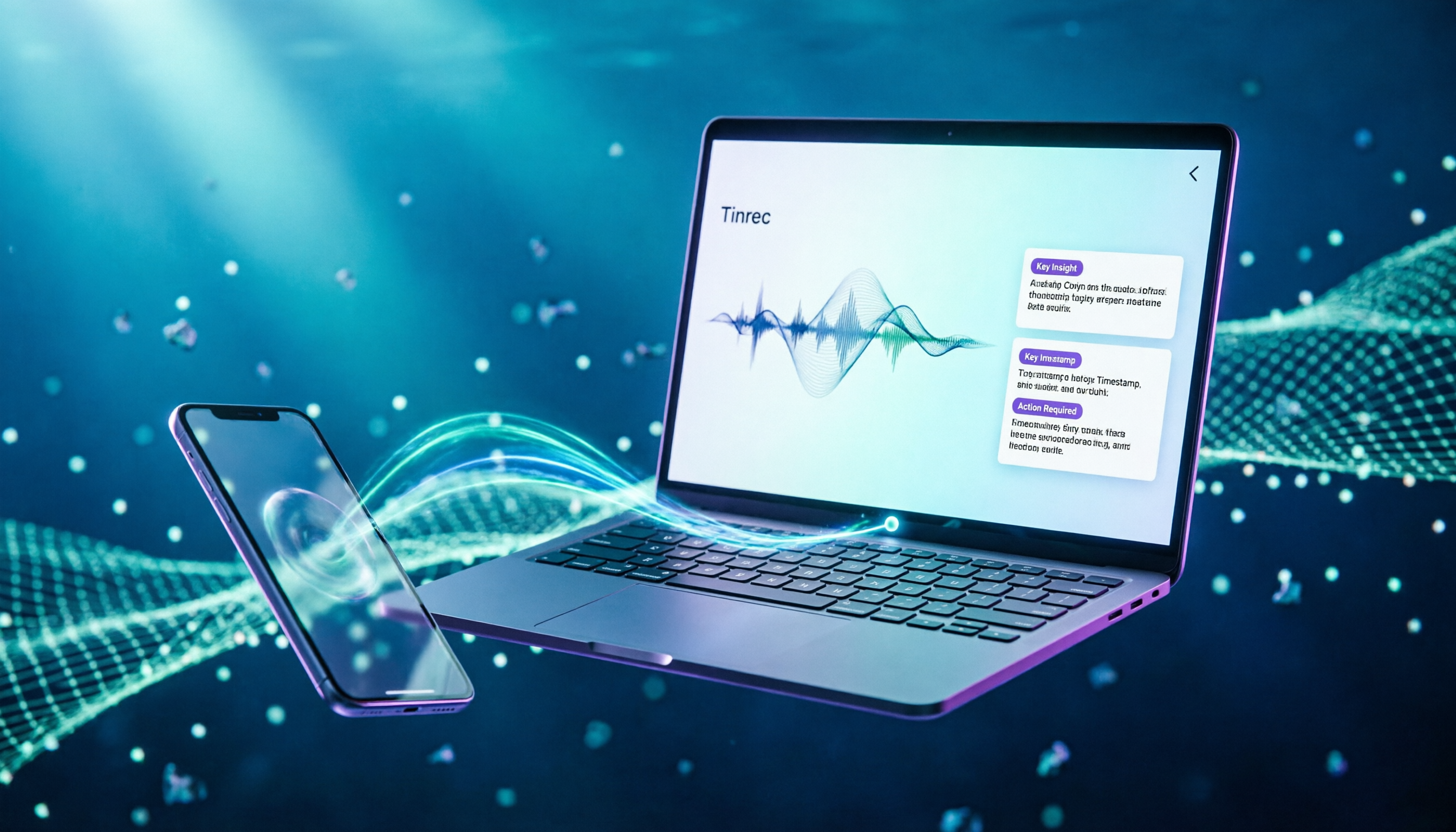
For example, you receive a 3-minute voice message that mixes client requirements, budget discussions, and next steps. After uploading the audio to Tinrec, it doesn't just give you a transcript; it also auto-generates a summary, chapters, key points, and action items. You don't have to manually re-listen to quickly grasp what the other person wants you to do.
Even better is the AI Q&A feature. After recording or importing, you can ask directly: "What was the budget cap mentioned earlier?" Tinrec answers based on the content, rather than just giving you a bunch of keyword search results. Few tools in this price range offer this level of functionality.
Cross-platform and team collaboration
Tinrec is available on iOS, Android, desktop, and web, so you can use it on your phone or computer. If you work with colleagues on client messages or meeting recordings, the team plan centralizes all data in one space, allowing members to view, search, and comment, while admins can manage usage and permissions.
Honest about limitations
The free plan only offers basic quotas, and heavy users may need to pay. Also, if you're a light user who only occasionally checks a voice message, Tinrec's features might be overkill; in that case, try WhatsApp's official feature first.
Who is it for?
If you need to process large volumes of voice content or meeting recordings, or if you want to turn transcriptions into work-ready data, Tinrec is a very worthwhile option to try.
Beyond Tinrec: Other Options
WhatsApp Official "Voice Message Transcription"
Stop organizing recordings by hand
Upload audio or video and automatically get a transcript, summary, and action items
This is the most direct solution. Just go to WhatsApp's Settings → Chats, find "Voice message transcripts," enable it, and select your language (Cantonese is supported). After that, you'll see text for incoming voice messages. The advantages are end-to-end encryption, completely free, and no extra app needed. But the limitations are clear: it only works for WhatsApp messages, doesn't support cross-language translation, has no summaries or to-dos, and it's being rolled out gradually, so not everyone has access yet.
iMyFone VoxBox
If you can't wait for the official feature, this third-party tool can transcribe WhatsApp recordings to text, supporting Cantonese, Taiwanese, and other languages. However, note that you must upload audio to third-party servers, which poses higher privacy risks. Also, it only does transcription—no AI summaries, Q&A, or team spaces like Tinrec—so you'll have to handle post-processing yourself.
Otter.ai
If you mainly deal with English meetings or English voice messages, Otter.ai's free plan offers 300 minutes per month, which is generous. It also allows importing audio files for transcription. However, its ability to process Chinese or Cantonese content is not as comprehensive as Tinrec's, and it doesn't have a streamlined workflow for WhatsApp messages. It's best for those with heavy English needs.
Pitfall Guide: 4 Common Mistakes When Choosing a WhatsApp Voice-to-Text Tool
Pitfall 1: Assuming the official feature handles all recordings
WhatsApp's official transcription only works for voice messages received on WhatsApp; it can't process general audio files, meeting recordings, or videos. If you need broader functionality, you'll need other tools.
Pitfall 2: Only looking at free quotas, ignoring post-processing capabilities
Transcription is just the first step; the real time savings come from summaries, to-dos, and search. If a tool only transcribes, you'll still have to read the entire transcript yourself.
Pitfall 3: Uploading voice to third parties for convenience, ignoring privacy
WhatsApp's official feature excels with end-to-end encryption. But many third-party tools require uploading audio to their servers. If the content is sensitive, this is a significant risk. Always review the privacy policy before using.
Pitfall 4: Ignoring cross-platform and team needs
Individual use and team use have completely different requirements. If you need to share voice transcriptions with colleagues, assign to-dos, and track progress, you need a tool with team collaboration features, not just a personal transcription service.
Conclusion: Which One Should You Choose?
Simply put, if you only occasionally receive a few WhatsApp voice messages and want to quickly read them, just use the official "Voice message transcripts" feature—it's free and secure.
But if you need to handle large volumes of voice or meeting recordings, or want automatic summaries, to-dos, search, and export, Tinrec is a more complete and efficient choice.
Scenario-based recommendations:
- Just want to quickly read a single WhatsApp voice message → WhatsApp official feature (free, end-to-end encrypted)
- Need to transcribe lots of voice, meeting recordings, and generate summaries and to-dos → Tinrec (AI post-processing, cross-platform, team space)
- Occasionally transcribe Chinese or Cantonese clips and don't mind privacy trade-offs → iMyFone VoxBox (multi-language support)
- Primarily English meetings or English voice messages → Otter.ai (generous free tier)
Final advice: Try WhatsApp's official feature first. If it's not enough, download Tinrec's free version to test it out—no need to rush into paying.
References
- WhatsApp voice-to-text feature finally launches! 3-step setup guide, no more forced listening
- WhatsApp voice-to-text officially launches in Hong Kong! Simple 3-step setup for iOS/Android, plus unofficial AI conversion methods
- "Latest" WhatsApp voice-to-text 2026 official method!
- WhatsApp voice-to-text new feature is here! Check Android and iPhone setup methods now
- Reporter's test: WhatsApp voice-to-text works! Simple 3-step setup for iOS/Android
Turn every recording into actionable outcomes
Get 60 free transcription minutes when you sign in. No credit card required.
Related Reading
You might also like
5 Ways to Transfer iPhone Voice Memos to Windows in 2026: Which Is Fastest and Lossless?
Most people get stuck after saving iPhone voice memos to Files when trying to move them to a Windows PC. This hands-on test compares five transfer methods—speed, file size limits, and downstream organization costs—and explains why transferring the audio is only half the battle; the real time sink is transcription, extracting key points, and turning recordings into usable data.

2026 AI Meeting Notes Tool Comparison: Tinrec vs Notta — Which Is Better for Chinese Meetings Across 5 Key Dimensions?
The biggest pitfall when choosing an AI meeting notes tool is focusing only on transcription accuracy. This comparison starts from the question "where should meeting data ultimately live?" and evaluates Tinrec and Notta across 5 dimensions: Chinese meeting input sources, online meeting capture methods, post-meeting outputs, team governance, and pricing/quotas — helping you decide which tool better fits your workflow.

2026 AI Meeting Notes Tools Compared: Which Turns Transcripts into Actionable Meeting Records?
We tested 3 AI meeting notes tools in 2026, comparing transcripts, summaries, action items, AI Q&A, exports, and team permissions. Includes a ready-to-use meeting record template and pitfalls to avoid, helping you spend less time on post-meeting work.

How to Take AI Meeting Notes in 2026: 5 Steps from Recording to Team Summary
A common AI meeting notes approach on PTT is to transcribe first and then ask AI to organize, but what really affects efficiency is whether meeting data can be searched, queried, and handed over. This article breaks down the process in 5 steps and compares Tinrec, Otter.ai, Notta, and Granola on differences in Traditional Chinese meetings, bot-free recording, and team governance.

2025 AI Meeting Notes Tools Compared: Which One Actually Saves You Time?
The real pain point of meeting notes isn't missing a recording—it's that no one ever reviews it. This article tests and compares Tinrec, Notta, Granola, and Otter.ai across five dimensions: recording capture method, post-meeting organization, Chinese language performance, data ownership, and pricing quotas. It also covers four common purchasing mistakes to help you choose the right tool within your budget.

2026 Real-Time Transcription Tools Compared: Which One Is Easiest for Live Note-Taking?
Discover the four key factors for choosing a real-time transcription tool: live vs. upload-based transcription, Chinese and mixed-language recognition, post-meeting organization, and online meeting audio capture. We tested Tinrec, Yating Transcription, Transcribe, and cSubtitle to see which scenarios each suits best, plus common pitfalls and selection tips.

2026 AI Meeting Notes Tools Compared: Which Latest Version Best Suits Chinese-Speaking Teams?
Many people choose AI meeting notes tools based only on transcription and free minutes, overlooking post-meeting output, meeting capture methods, and team governance. This article compares Tinrec, Otter.ai, Notta, and Granola using the same meeting workflow—from Chinese-language experience, bot-free recording, summaries and action items, AI Q&A, to team seats and pricing—to help you decide which latest version to choose.

2026 AI Meeting Notes Comparison: 4 Tools Tested for Free Tiers and Team Costs
AI meeting note tools range from $0 to $30 per month, but a low monthly fee doesn't mean low total cost. We tested Tinrec, Granola, TurboScribe, and PLAUD with a 30-minute mixed Chinese-English meeting recording, breaking down free tiers, cost per hour, team seats, and post-meeting outputs to help you calculate the truly cost-effective option.

2026 AI Meeting Notes Tools Compared: Tinrec, Notta, Granola, Otter.ai — Which Summary Is Most Useful?
In 2026, AI meeting notes tools compete on what they do after transcription, not just speech-to-text. This comparison of Tinrec, Notta, Granola, and Otter.ai covers how meetings are recorded, summary and action item performance, Chinese and mixed Chinese-English handling, free tiers and pricing, and team data ownership, plus four common pitfalls and practical selection advice.