

Turn recordings into transcripts and summaries in minutes
Upload audio or video for multilingual transcription, AI notes, and action items
4 Best Speech-to-Text Platforms in 2026: Which Free Plan Is Worth It?
Two hours in meetings, two more organizing notes? Avoid these inefficient habits first
Many people think speech-to-text is just "turning audio into text," so they upload a file to any free tool and end up with either a wall of unpunctuated text, or they realize they still have to manually organize the key points, or the free limit is only a few minutes and the recording cuts off halfway.
An even more common scenario: you record a meeting on your phone, then listen and type afterward, spending another two hours on a two-hour meeting. You think you're saving money, but you're actually wasting more time.
In reality, when choosing a speech-to-text platform, what really matters isn't just "can it transcribe for free," but whether the output is ready to use. If the tool can automatically segment, punctuate, generate summaries and action items, and even let you query meeting content with questions, that's what truly saves you time.
Before choosing a speech-to-text platform, understand these 4 key points
Don't rely solely on official accuracy claims. Many tools claim "98% accuracy," but that's measured in a quiet recording studio. In real meetings with air conditioning noise, keyboard clicks, and people talking over each other, accuracy drops significantly. Test the free version with your own recordings to see actual performance.
Check if the free limit covers "one full meeting." Having a free tier doesn't mean it's useful. If the free version only gives you 3 minutes, you can't even finish the opening, so it's as good as nothing. Choose a tool whose free limit covers at least a 30-minute meeting to be truly practical.
Look for "post-transcription organization." Getting a raw transcript isn't enough; you still need to find key points, write minutes, and list action items. If the tool can auto-generate summaries, chapters, and to-dos, it's doing half your post-meeting work for you.
Cross-platform and team collaboration matter too. If you record on your phone today and organize on your computer tomorrow, a tool without multi-device sync will be painful. If you share meeting notes with colleagues, you need a team space for unified storage, search, and tracking.
Tinrec (Instant Audio Transcription) — Our Top Pick After Testing
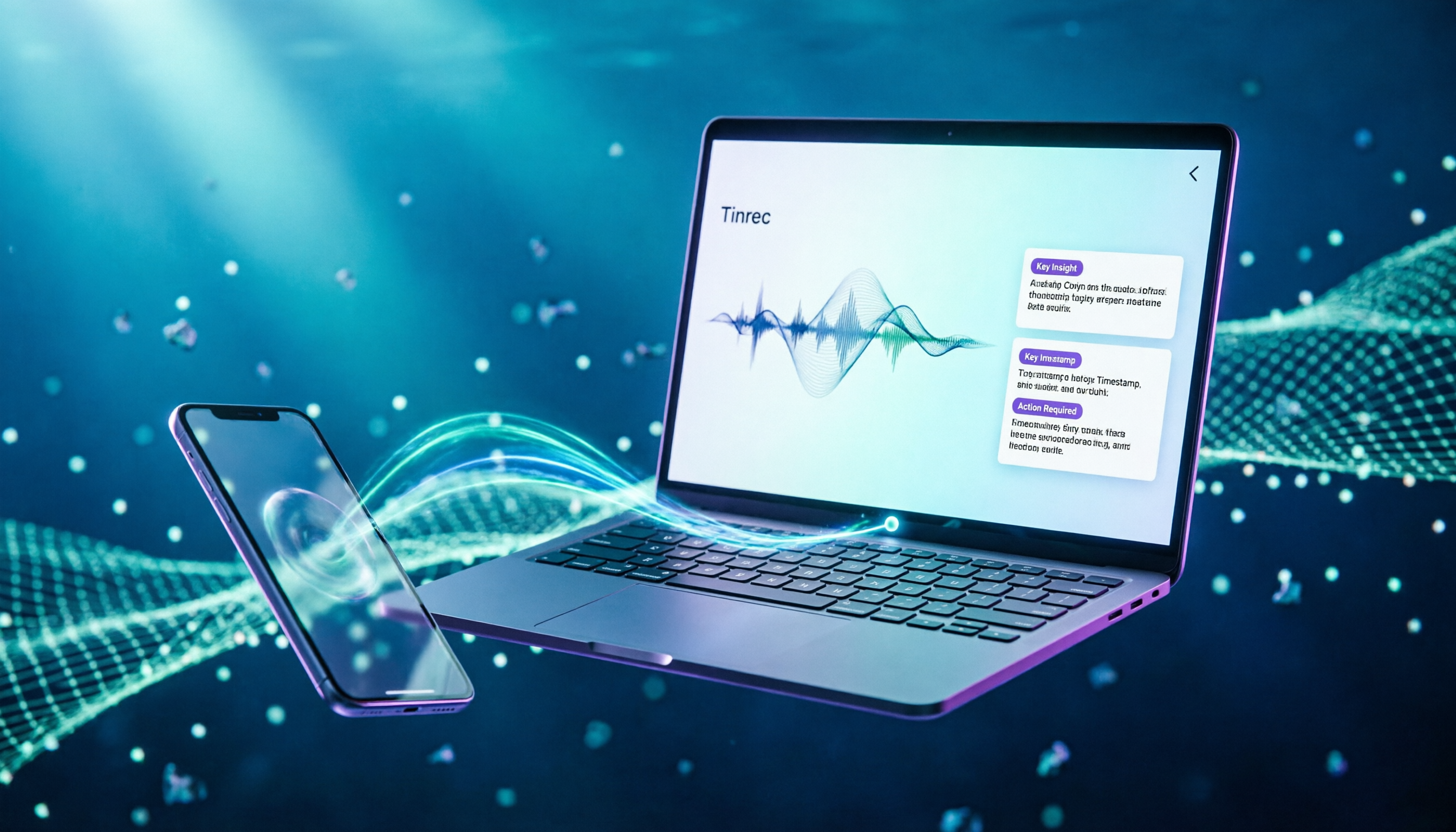
Tinrec is an AI meeting notes and collaboration tool that supports multiple devices. It doesn't just transcribe audio; it also automatically organizes content into summaries, chapters, and action items, and even allows AI Q&A around the meeting content.
In my testing, my favorite feature is its "bot-free online meeting recording." You don't need to add a bot to Zoom, Google Meet, or Teams. Just open the Tinrec desktop app, and it captures your computer's system audio directly, generating a live transcript as it records. This is very convenient for those who don't want third-party participants in their meetings.
After transcription, Tinrec automatically generates summaries and chapters, breaking long meetings into readable sections. Even more useful is the AI Q&A feature—after recording, you can ask, "Who mentioned the budget in the last meeting?" and it will understand the context and give you the answer, not just keyword search results. Few tools in this price range offer this capability.
I tested a 5-minute Chinese meeting recording (indoor, with slight air conditioning noise). Tinrec's transcription was smooth, with natural punctuation and segmentation. While there's no official figure, based on my regular use, recognition performance is solid for clear recordings, and Traditional Chinese displays correctly.
Stop organizing recordings by hand
Upload audio or video and automatically get a transcript, summary, and action items
The advantages are clear: bot-free recording, AI summaries and Q&A, real-time translation, multi-format export, and a team space for unified meeting data management. The personal free plan offers basic quotas, letting you experience recording, import, summarization, and transcription. Try it out, and upgrade if you find it useful.
Limitations to be honest about: the free plan isn't unlimited, and heavy users will need to pay. Also, for highly regulated scenarios like medical or legal, you should verify licensing and compliance yourself. But for the average office worker with two or three meetings a week, the free plan, occasionally supplemented with paid options, is usually sufficient.
Who is it for? If you frequently handle Chinese meetings, don't want meeting bots, want to use AI to find key points after recording, or switch between phone and computer, Tinrec is currently a top contender worth considering.
Beyond Tinrec: What Other Options Are There?
Otter.ai: A mature choice for English meetings. The free plan offers 300 minutes per month, which is generous. However, if you primarily handle Chinese content, Otter's advantages are less obvious; it also lacks Tinrec's bot-free desktop recording and real-time translation, and its Chinese team collaboration is weaker. Only consider it if you regularly record English meetings.
Notta: Focuses on multilingual transcription and translation. The free plan offers 120 minutes per month, with a max of 3 minutes per session, making it better for short clips or audio files. Its strengths are subtitles and translation, but post-meeting AI Q&A and team knowledge management aren't as complete as Tinrec's. If you just need to quickly transcribe short clips, Notta works, but for meeting notes, Tinrec is smoother.
TurboScribe: Specializes in long files and bulk transcription. The free plan gives you 3 files per day, each up to 30 minutes, suitable for occasional interview transcription. However, it lacks real-time meeting transcription, AI Q&A, and action item extraction. You get a raw transcript, and you'll have to organize it yourself. In contrast, Tinrec is "ready to use after transcription," saving you manual work.
Pitfall Guide: 3 Common Mistakes When Choosing a Speech-to-Text Platform
Mistake 1: Choosing based solely on "free." If the free version only offers 3 or 5 minutes, you can't even finish a meeting, so it's a waste of time. First, check if the free quota covers your actual use case before deciding.
Mistake 2: Ignoring post-transcription organization costs. Some tools only give you a transcript, with no summaries, action items, or Q&A. You think you're saving time on listening and typing, but you're just shifting the work later. Choose a tool that automatically organizes key points and action items to truly save time.
Mistake 3: Overlooking cross-platform and team sharing. If you record on your phone today and organize on your computer tomorrow, and files can't sync, or meeting notes are scattered across personal accounts, you'll lose track over time. Tools like Tinrec's team space centralize meeting data, so records don't leave when team members change.
Summary: Which One Should You Choose?
Overall, if you want a speech-to-text platform where "the free version is truly sufficient and the output is ready to organize," Tinrec is our top pick after this test. It doesn't just turn audio into text; it turns meeting content into searchable, collaborative, and trackable team knowledge.
Recommendations by scenario:
- Need Chinese meeting transcription + bot-free recording + AI Q&A → Tinrec (top pick)
- Primarily record English meetings and need lots of free minutes → Otter.ai (the only exception)
- Only handle short clips or need translated subtitles → Notta
- Occasionally transcribe long files without needing post-processing → TurboScribe
We suggest starting with Tinrec's free version and recording an actual meeting to see if the transcription quality and AI organization meet your needs. Don't rush to pay; upgrade only if it feels right.
References
- Online AI Speech-to-Text Tool: Free MP3 or Recording to Transcript - MyEdit
- Tested: 4 Best Online Speech-to-Text Tools, Free Instant Recording to Transcript
- Audio to Text - Free Speech-to-Text Tool
- Online AI Auto-Transcribe for Voice, Video, and Recordings - Free Trial - cSubtitle
- Unlimited Time! 3 Free AI Transcript Tools, Highly Recommended! AI Voice Notes for Meeting Minutes, Slides, and Mind Maps - 104 Career Center
Turn every recording into actionable outcomes
Get 60 free transcription minutes when you sign in. No credit card required.
Related Reading
You might also like
5 Ways to Transfer iPhone Voice Memos to Windows in 2026: Which Is Fastest and Lossless?
Most people get stuck after saving iPhone voice memos to Files when trying to move them to a Windows PC. This hands-on test compares five transfer methods—speed, file size limits, and downstream organization costs—and explains why transferring the audio is only half the battle; the real time sink is transcription, extracting key points, and turning recordings into usable data.

2026 AI Meeting Notes Tool Comparison: Tinrec vs Notta — Which Is Better for Chinese Meetings Across 5 Key Dimensions?
The biggest pitfall when choosing an AI meeting notes tool is focusing only on transcription accuracy. This comparison starts from the question "where should meeting data ultimately live?" and evaluates Tinrec and Notta across 5 dimensions: Chinese meeting input sources, online meeting capture methods, post-meeting outputs, team governance, and pricing/quotas — helping you decide which tool better fits your workflow.

2026 AI Meeting Notes Tools Compared: Which Turns Transcripts into Actionable Meeting Records?
We tested 3 AI meeting notes tools in 2026, comparing transcripts, summaries, action items, AI Q&A, exports, and team permissions. Includes a ready-to-use meeting record template and pitfalls to avoid, helping you spend less time on post-meeting work.

How to Take AI Meeting Notes in 2026: 5 Steps from Recording to Team Summary
A common AI meeting notes approach on PTT is to transcribe first and then ask AI to organize, but what really affects efficiency is whether meeting data can be searched, queried, and handed over. This article breaks down the process in 5 steps and compares Tinrec, Otter.ai, Notta, and Granola on differences in Traditional Chinese meetings, bot-free recording, and team governance.

2025 AI Meeting Notes Tools Compared: Which One Actually Saves You Time?
The real pain point of meeting notes isn't missing a recording—it's that no one ever reviews it. This article tests and compares Tinrec, Notta, Granola, and Otter.ai across five dimensions: recording capture method, post-meeting organization, Chinese language performance, data ownership, and pricing quotas. It also covers four common purchasing mistakes to help you choose the right tool within your budget.

2026 Real-Time Transcription Tools Compared: Which One Is Easiest for Live Note-Taking?
Discover the four key factors for choosing a real-time transcription tool: live vs. upload-based transcription, Chinese and mixed-language recognition, post-meeting organization, and online meeting audio capture. We tested Tinrec, Yating Transcription, Transcribe, and cSubtitle to see which scenarios each suits best, plus common pitfalls and selection tips.

2026 AI Meeting Notes Tools Compared: Which Latest Version Best Suits Chinese-Speaking Teams?
Many people choose AI meeting notes tools based only on transcription and free minutes, overlooking post-meeting output, meeting capture methods, and team governance. This article compares Tinrec, Otter.ai, Notta, and Granola using the same meeting workflow—from Chinese-language experience, bot-free recording, summaries and action items, AI Q&A, to team seats and pricing—to help you decide which latest version to choose.

2026 AI Meeting Notes Comparison: 4 Tools Tested for Free Tiers and Team Costs
AI meeting note tools range from $0 to $30 per month, but a low monthly fee doesn't mean low total cost. We tested Tinrec, Granola, TurboScribe, and PLAUD with a 30-minute mixed Chinese-English meeting recording, breaking down free tiers, cost per hour, team seats, and post-meeting outputs to help you calculate the truly cost-effective option.

2026 AI Meeting Notes Tools Compared: Tinrec, Notta, Granola, Otter.ai — Which Summary Is Most Useful?
In 2026, AI meeting notes tools compete on what they do after transcription, not just speech-to-text. This comparison of Tinrec, Notta, Granola, and Otter.ai covers how meetings are recorded, summary and action item performance, Chinese and mixed Chinese-English handling, free tiers and pricing, and team data ownership, plus four common pitfalls and practical selection advice.