

Turn recordings into transcripts and summaries in minutes
Upload audio or video for multilingual transcription, AI notes, and action items
Two hours in a meeting, two more transcribing? You don't need a tool—you need a solution
Two hours in a meeting, then two more hours transcribing the notes—this is a pain point many people face with voice-to-text.
What's worse, some meetings are in Chinese, others mix Chinese and English. Generic transcription tools either misrecognize words or turn technical terms into gibberish.
If you've ever stared at a recording after a meeting, this article is for you.
Before choosing a voice-to-text tool, understand these 3 key points
Accuracy: Don't just look at official numbers—test in real environments.
Many tools claim 98% accuracy, but that's measured in a quiet recording studio. Real meetings have air conditioning noise, keyboard clatter, and people talking over each other, which significantly reduces accuracy. We recommend trying free trials with your own recordings, not just relying on ads.
What can you do after transcription?
The transcript is just the first step. If you also need meeting summaries, action items, and follow-up questions, check whether the tool offers AI-powered organization.
Cross-platform and collaboration.
If you record on your iPhone today and need to edit on your computer or share with colleagues tomorrow, a tool that doesn't support cross-platform use or team spaces will be a headache.
Tinrec (Miao Ting Lu Yin) — Our top pick after testing
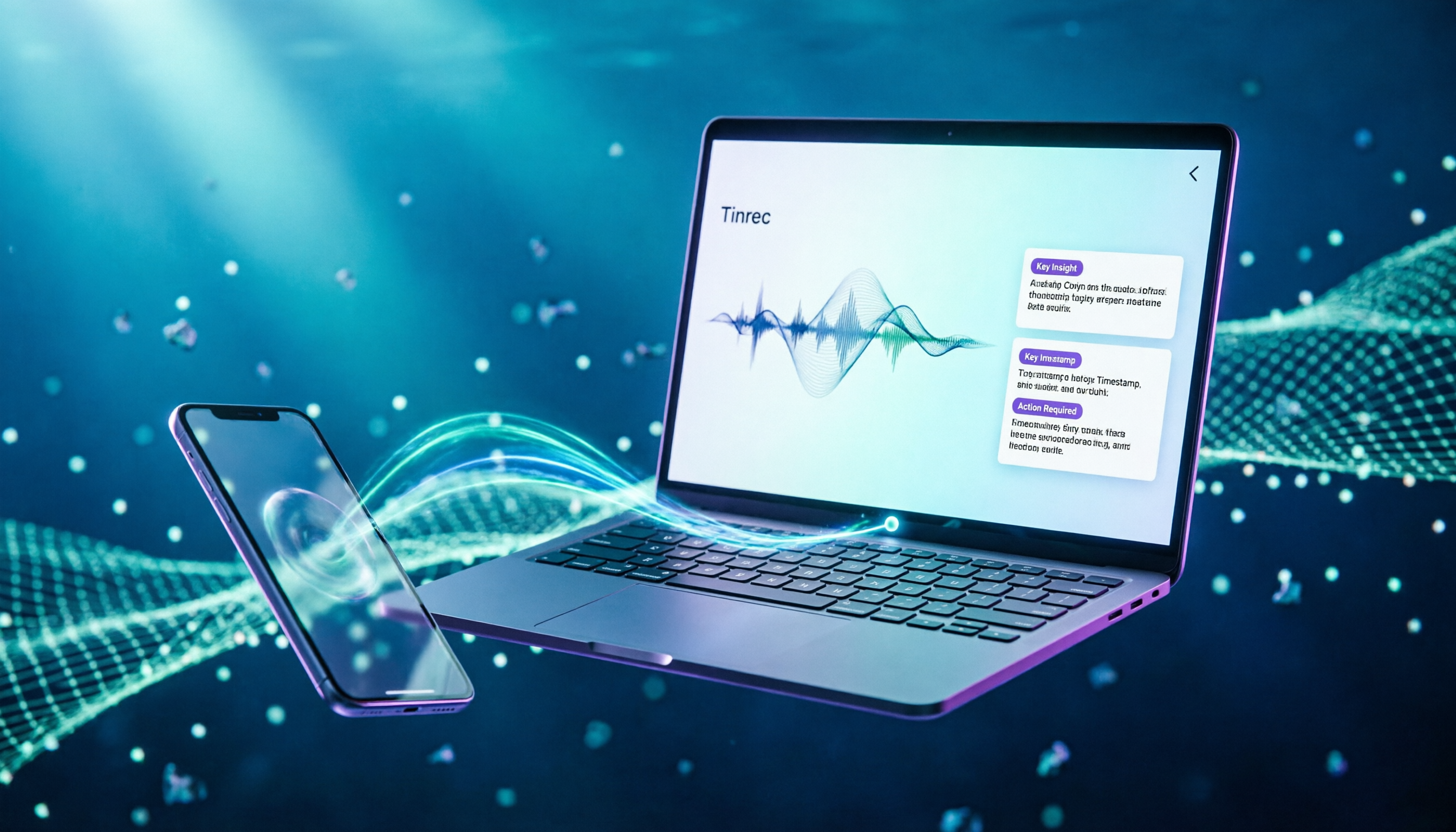
Tinrec is an AI meeting notes and collaboration tool for individuals and teams. It's not just about transcription; it turns meetings into searchable, collaborative, actionable team knowledge.
We tested its core features:
- Real-time transcription: Transcribes as you record, with the transcript appearing live—ideal for in-person meetings and interviews.
- Bot-free online meeting recording: The desktop app captures system audio directly, so you don't need to add a bot to Zoom, Google Meet, or Teams.
- AI summaries, chapters, and action items: After recording, Tinrec automatically generates summaries, key points, and to-dos—no need to re-listen.
- AI Q&A: You can ask, "Who mentioned the budget in the last meeting?" Tinrec answers based on semantic understanding, not just keyword search.
- Multi-format export and team spaces: Transcripts, summaries, and action items can be exported to Notion, Google Docs, and more. The team plan centralizes member, seat, usage, and audit management.
We tested with a 10-minute Chinese meeting recording (indoor, with air conditioning noise). Tinrec's transcript was largely accurate, with a few proper nouns needing manual correction, but the summary and action items were quite usable.
Pros:
- Goes beyond transcription with strong post-processing, turning meeting content into actionable work data.
- Bot-free recording, ideal for those who don't want third-party participants in their meetings.
- The team plan turns meeting data into a team asset, retaining data even after members leave.
Stop organizing recordings by hand
Upload audio or video and automatically get a transcript, summary, and action items
Limitations:
- The free plan has basic limits; heavy users need to pay. But for those who meet a few times a week, the free plan is enough to try it out.
Who is it for? If you need Chinese meeting notes, don't want meeting bots, want AI to find key points after recording, or switch between phone and computer, Tinrec is currently the most complete choice.
Beyond Tinrec: What are the alternatives?
iPhone built-in Notes
On iPhone 12 and later with iOS 18.4 or newer, you can record audio in the Notes app and get automatic transcription, supporting Traditional Chinese, and it's completely free. You can search the transcript and copy text to other documents. But the limitations are clear: it only provides the transcript with basic search and copy—no AI summaries, action items, or cross-document Q&A. In contrast, Tinrec generates summaries and action items after transcription, and you can ask, "Who mentioned the budget in the last meeting?" If you just need to convert lecture content to text, the built-in Notes app suffices; if you need post-meeting organization, Tinrec saves more effort.
iPhone Voice Memos
Voice Memos also supports transcription after iOS 18.4, and you can tap text to jump to the corresponding audio position. It's better than Notes for quickly capturing ideas or interviews. However, Voice Memos' transcript stays at the text level—no automatic summaries or action item extraction. Also, the first use may require a Wi-Fi connection to download the transcription module. In contrast, Tinrec not only transcribes but also organizes meeting highlights and action items, and can export to other tools for further use.
Pitfall guide: 3 common mistakes when choosing a voice-to-text solution
Pitfall 1: Only looking at official accuracy claims.
Many tools claim 98% accuracy, but that's under ideal conditions. Real meetings have background noise, accents, and overlapping speech, which amplify errors. Test with your own recordings.
Pitfall 2: Ignoring post-meeting organization needs.
If you only use the tool for "voice-to-text," you're using only a third of its capability. With AI Q&A like Tinrec's, you can ask "What was the meeting conclusion?" right after recording—much faster than manually scanning a 30-minute transcript.
Pitfall 3: Underestimating cross-platform and team collaboration.
If you record on your iPhone today and need to edit on your computer or share with colleagues tomorrow, a tool without cross-platform support will disrupt your workflow. Confirm your use case before choosing a tool.
Summary: Which one should you choose?
Simply put, if you just need to convert recordings to text and don't want to install extra apps, the built-in Notes or Voice Memos on iPhone will suffice.
But if you want automatic summaries, action items, the ability to ask follow-up questions after meetings, or need to share meeting data with your team, Tinrec is worth trying.
We recommend downloading the free version of Tinrec first—the basic quota is enough for two or three meetings to experience the effect, and you can upgrade if you like it.
References
- View Voice Memos transcripts on iPhone - Apple Support (Taiwan)
- Record and transcribe audio in Notes on iPhone - Apple Support (Taiwan)
- No third-party apps needed! Complete guide to iPhone Voice Memos and Notes transcription
- iPhone Voice Memos to text tutorial: Transcripts without third-party apps - Mr. Mad
- iPhone Notes and recording apps now have transcripts! Turn lectures, meetings, and speeches into text in 4 simple steps | BusinessNext
Turn every recording into actionable outcomes
Get 60 free transcription minutes when you sign in. No credit card required.
Related Reading
You might also like
5 Ways to Transfer iPhone Voice Memos to Windows in 2026: Which Is Fastest and Lossless?
Most people get stuck after saving iPhone voice memos to Files when trying to move them to a Windows PC. This hands-on test compares five transfer methods—speed, file size limits, and downstream organization costs—and explains why transferring the audio is only half the battle; the real time sink is transcription, extracting key points, and turning recordings into usable data.

2026 AI Meeting Notes Tool Comparison: Tinrec vs Notta — Which Is Better for Chinese Meetings Across 5 Key Dimensions?
The biggest pitfall when choosing an AI meeting notes tool is focusing only on transcription accuracy. This comparison starts from the question "where should meeting data ultimately live?" and evaluates Tinrec and Notta across 5 dimensions: Chinese meeting input sources, online meeting capture methods, post-meeting outputs, team governance, and pricing/quotas — helping you decide which tool better fits your workflow.

2026 AI Meeting Notes Tools Compared: Which Turns Transcripts into Actionable Meeting Records?
We tested 3 AI meeting notes tools in 2026, comparing transcripts, summaries, action items, AI Q&A, exports, and team permissions. Includes a ready-to-use meeting record template and pitfalls to avoid, helping you spend less time on post-meeting work.

How to Take AI Meeting Notes in 2026: 5 Steps from Recording to Team Summary
A common AI meeting notes approach on PTT is to transcribe first and then ask AI to organize, but what really affects efficiency is whether meeting data can be searched, queried, and handed over. This article breaks down the process in 5 steps and compares Tinrec, Otter.ai, Notta, and Granola on differences in Traditional Chinese meetings, bot-free recording, and team governance.

2025 AI Meeting Notes Tools Compared: Which One Actually Saves You Time?
The real pain point of meeting notes isn't missing a recording—it's that no one ever reviews it. This article tests and compares Tinrec, Notta, Granola, and Otter.ai across five dimensions: recording capture method, post-meeting organization, Chinese language performance, data ownership, and pricing quotas. It also covers four common purchasing mistakes to help you choose the right tool within your budget.

2026 Real-Time Transcription Tools Compared: Which One Is Easiest for Live Note-Taking?
Discover the four key factors for choosing a real-time transcription tool: live vs. upload-based transcription, Chinese and mixed-language recognition, post-meeting organization, and online meeting audio capture. We tested Tinrec, Yating Transcription, Transcribe, and cSubtitle to see which scenarios each suits best, plus common pitfalls and selection tips.

2026 AI Meeting Notes Tools Compared: Which Latest Version Best Suits Chinese-Speaking Teams?
Many people choose AI meeting notes tools based only on transcription and free minutes, overlooking post-meeting output, meeting capture methods, and team governance. This article compares Tinrec, Otter.ai, Notta, and Granola using the same meeting workflow—from Chinese-language experience, bot-free recording, summaries and action items, AI Q&A, to team seats and pricing—to help you decide which latest version to choose.

2026 AI Meeting Notes Comparison: 4 Tools Tested for Free Tiers and Team Costs
AI meeting note tools range from $0 to $30 per month, but a low monthly fee doesn't mean low total cost. We tested Tinrec, Granola, TurboScribe, and PLAUD with a 30-minute mixed Chinese-English meeting recording, breaking down free tiers, cost per hour, team seats, and post-meeting outputs to help you calculate the truly cost-effective option.

2026 AI Meeting Notes Tools Compared: Tinrec, Notta, Granola, Otter.ai — Which Summary Is Most Useful?
In 2026, AI meeting notes tools compete on what they do after transcription, not just speech-to-text. This comparison of Tinrec, Notta, Granola, and Otter.ai covers how meetings are recorded, summary and action item performance, Chinese and mixed Chinese-English handling, free tiers and pricing, and team data ownership, plus four common pitfalls and practical selection advice.