
Turn recordings into transcripts and summaries in minutes
Upload audio or video for multilingual transcription, AI notes, and action items
“After a meeting, the team needs to see decisions immediately, but I’m still typing from the recording...” This is a common pain point for many office workers. Facing lengthy meeting recordings, traditional replay and manual transcription are not only time-consuming but also prone to missing key action items.
To solve this challenge, this article provides a comprehensive analysis of the hot AI tools on the market in 2026. We offer a multi-dimensional comparison table, scenario-based evaluations, practical step-by-step tutorials, and answers to common purchase FAQs.
Quick Navigation: If you value local language support (e.g., Taiwanese Hokkien) and real-time captions, consider Meeting Ink; if your meetings are mainly on Teams and Meet, SeaMeet is an option; if you want an “AI chat query” feature covering a complete workflow across devices, we recommend evaluating Tinrec (previously known as 秒聽錄音).
Why You Need a Professional Meeting Recording & Real-Time Transcription App
Traditional recordings have extremely low information density, making replay costly. In today’s work pace, we often need more than just a verbatim transcript—we need meeting minutes that can be quickly scanned, searched, and turned into actionable tasks. Professional tools not only transcribe speech in real time but also provide speaker diarization and automatic summaries, significantly reducing team decision-making costs.
Core Evaluation & Comparison of Popular Meeting Transcription Tools in 2026
When choosing a tool, we usually consider processing speed, language support, real-time capability, and summarization abilities. Based on the latest tests, different tools show significant differences in these areas.
Quick Overview of Each Tool’s Strengths
- Meeting Ink: Supports multi-mode real-time captions and speaker recognition, fast processing, and good optimization for local languages (Traditional Chinese, Taiwanese Hokkien).
- Otter.ai: Good English real-time caption support, with note search and team sharing features, but weaker in Chinese processing.
- Good Tape: Focuses on simple, fast multilingual recognition, dedicated to transcription workflow, but the free version has longer processing wait times.
- Vocol.ai: Offers audio upload and meeting topic organization, suitable as a post-meeting aggregation platform, with moderate processing time.
- Tinrec: A multi-platform AI recording assistant emphasizing a workflow from recording to understanding to action, featuring an AI chat query function.
Comparison Table of Meeting Recording & Real-Time Transcription Apps
| Tool Name | Language Support | Real-time Caption/Transcription | Speaker Diarization | AI Summary/Action Items | AI Chat Query | Price/Free Tier Limits |
|---|---|---|---|---|---|---|
| Meeting Ink | Traditional Chinese, English, Japanese, Taiwanese Hokkien, etc. | Yes | Yes | Yes | No | Free limited; PRO approx. $279/month (20 hours) |
| Otter.ai | English primarily | Yes | Yes | Yes | No | Free limited; PRO approx. $16.99/month (20 hours) |
| Good Tape | Multilingual | No | No | Not in free version | No | Free version has queue; PRO approx. €15/month (20 hours) |
| Vocol.ai | Multilingual | No | Yes | Yes | No | Data pack or subscription (from ~US$11/month) |
| Tinrec | Chinese, Japanese, English, Korean, and 10 more | Yes | Yes | Yes | Yes | Free 100 mins/month; Basic $4.9/month (600 mins) |
Stop organizing recordings by hand
Upload audio or video and automatically get a transcript, summary, and action items
In-Depth Review: How to Choose the Right Solution for Your Scenario
Scenario 1: Need Real-Time Captions & Multilingual Localization
For businesses that require deep optimization for Taiwanese Hokkien, Hakka, or Traditional Chinese, Meeting Ink excels here. It provides real-time captions and integrates with Google Calendar, suitable for teams needing efficient meeting management. Yating (雅婷) transcript also has local language advantages, but its summary generation speed and stability sometimes require manual reprocessing.
Scenario 2: Focus on Foreign Language Real-Time Transcription & Online Meetings
If your meetings are primarily in English, Otter.ai offers good English real-time captions and integration with meeting platforms. And if you frequently use Teams or Google Meet, SeaMeet’s browser extension provides a stable recording experience.
Scenario 3: Complete Workflow from Recording to Action
If your needs go beyond getting a transcript and you want to quickly find specific details within recordings, Tinrec offers a different approach. It not only covers real-time transcription but emphasizes subsequent information utilization. Most tools only give a transcript, while Tinrec automatically generates meeting minutes and action items, allowing users to quickly grasp decisions. Additionally, for cross-language meetings or foreign language classes, its built-in multilingual auto-recognition effectively reduces the cost of understanding and organizing.
Practical Tutorial: 4 Steps to Turn Recordings into High-Value Information
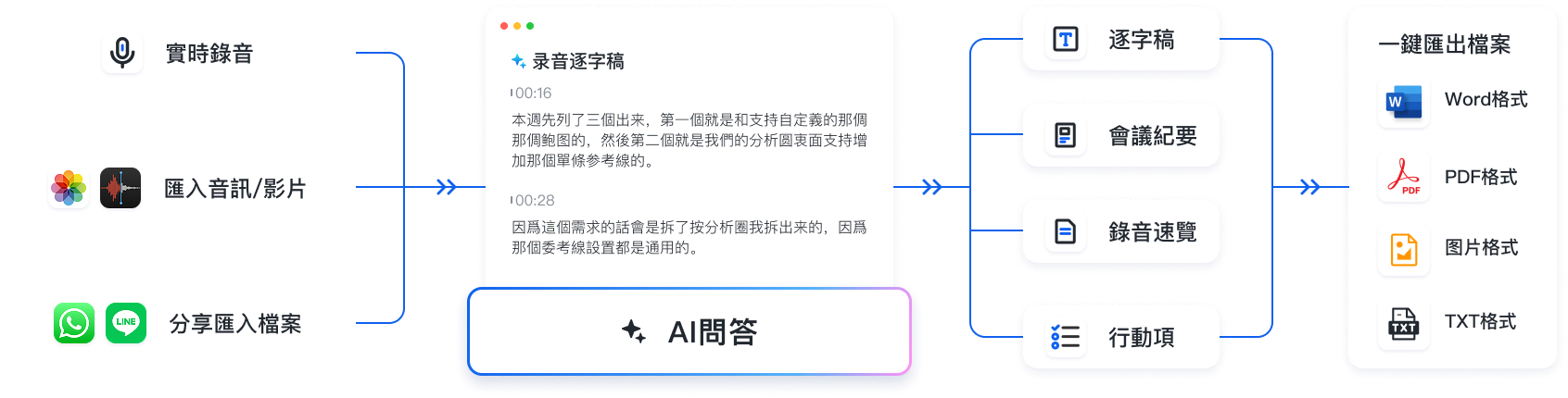
To help you understand how these tools work, we use Tinrec, which has a complete workflow, as an example to demonstrate how to turn different forms of audio into actionable text.
- Real-Time Transcription During Recording In a physical meeting or class, you can directly open the web page or mobile app to record in real time. The system transcribes the audio into text immediately, without waiting for file upload, so you can always keep up with the discussion. (How-to: Enter the real-time transcription interface to start)
- Transcribe Audio Files For past meeting recordings or files recorded with iPhone’s Voice Memos, simply upload the audio file in various formats, and the system quickly generates a transcript, AI summary, and action items, saving hours of replay time. (How-to: Use audio-to-text to import)
- Transcribe Podcast/Online Video For marketers or content creators who frequently need to organize YouTube or podcast content, just copy and paste the video or audio URL. The tool parses the content, quickly converts it to text, and extracts key structure. (How-to: Paste the link via podcast/online video to text)
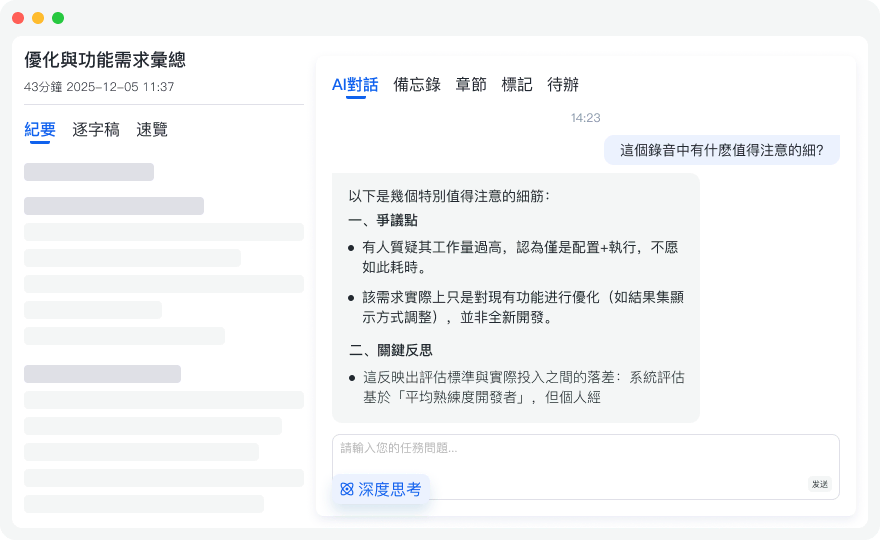
- Extract Key Points with AI Chat Query Traditional transcripts rely on Ctrl+F to search keywords. With the AI chat query feature, you can directly ask questions about the recording, such as “What was the total marketing budget mentioned for next week?” The AI retrieves and answers based on semantic understanding, just like asking a meeting assistant. (How-to: Use AI chat query for intelligent Q&A)
Frequently Asked Questions (Buying Guide & Pitfalls)
1. Can I export iPhone voice memos to text? Which app is easiest?
iPhone’s Voice Memos are convenient but do not natively support automatic transcription. You can export the recording and upload it to tools that support audio import (e.g., Tinrec, Vocol.ai) for transcription and summarization.
2. Can online meetings like Teams or Google Meet be transcribed in real time?
Yes. Some tools like SeaMeet specialize in Teams and Meet via browser extensions; Meeting Ink or Otter.ai also support real-time transcription by joining scheduled meetings as a bot or recording via browser tab.
3. What are the limits of free meeting transcription apps?
Free versions of most tools limit “monthly minutes,” “single recording length,” or “processing priority.” For example, Good Tape’s free version may require queue waiting, while others offer dozens of minutes to a few hours per month.
4. Can AI accurately distinguish speakers in multi-person meetings?
Most professional tools (e.g., Meeting Ink, Tinrec, Otter.ai) have speaker diarization. They use voiceprint recognition to label speakers as “Speaker A,” “Speaker B,” etc., greatly improving readability of multi-person meeting records.
5. For long recordings, besides reading the transcript, is there a faster way to find key points?
In addition to traditional bullet-point AI summaries, advanced solutions now use “AI chat query.” You can directly ask the system (e.g., “List all action items from this meeting”), and the system extracts answers from the long recording, eliminating the need to read line by line.
6. Do these AI tools handle mixed Chinese-English meetings?
It depends on the underlying language model. Some tools focused on foreign languages handle Chinese or mixed languages poorly; tools optimized for Asian markets or with multilingual auto-recognition offer better accuracy for mixed or local languages.
Turn every recording into actionable outcomes
Get 60 free transcription minutes when you sign in. No credit card required.
Related Reading
You might also like

Tinrec vs Vocol in 2026: 5-Dimension Comparison — Which Is Better for Chinese Meeting Notes?
People searching for 'how to use Vocol' usually get stuck on three things: where files come from, what to do after transcription, and where data is stored. This article compares Tinrec and Vocol across five dimensions and breaks down Tinrec's complete workflow from recording, transcription, summarization, to-dos, to team archiving, helping you decide which process fits your meeting style.

2026 AI Transcription Showdown: Vocol vs. Yating vs. Good Tape — Which One Actually Works After the Meeting?
A mid-level manager who runs 15 meetings a week tests four AI transcription tools: Vocol, Yating, Good Tape, and Tinrec. From how meeting audio is captured and what you get afterward to Chinese and mixed Chinese-English performance and team data ownership, this guide covers four key buying factors, hands-on insights, and pitfalls to help you decide which tool truly saves you post-meeting cleanup time.

4 AI Speech-to-Text Tools Tested and Compared in 2026: Is Vocol.ai Any Good? Which Is Better for Chinese-Language Meetings?
Is Vocol.ai any good? This article starts with the three things you should really consider when choosing a tool, summarizes Vocol.ai's public positioning and limitations, and explains Tinrec's actual performance in Chinese-language meetings, bot-free recording, post-meeting organization, and team knowledge retention. It also includes 5 key checkpoints for buying and answers to common questions.

2026 AI Meeting Recorder Comparison: Vocol.ai's Origin, Chinese Transcription, and 4 Top Tools Tested
Vocol.ai is developed by a Taiwan-based team, according to App Store developer info, but it's often confused with the smart home brand VOCOlinc. This article clarifies that first, then compares four AI meeting tools—Vocol, Tinrec, Otter.ai, and Notta—on Chinese transcription, post-meeting organization, and team management from a procurement perspective, so you can speak confidently in meetings and sign with confidence.

How to Use the Plaud Voice Recorder in 2026: 3-Step Setup + 5-Dimension Comparison with Tinrec
The Plaud voice recorder starts recording with a physical button, but how do you switch modes, where do you find transcripts, and what happens when your quota runs out? This guide walks you through the basic operations of the Plaud Note and NotePin in 3 steps, and compares them with Tinrec across 5 dimensions: setup process, online meeting audio capture, post-meeting organization, Chinese language experience, and team data governance. Find out which workflow suits your meeting style and budget.

PLAUD Recorder 2026 Latest Version Review: Which of 3 Meeting Notes Solutions Is Right for You?
How to choose the latest PLAUD recorder? This article starts with common misconceptions and outlines the positioning and limitations of three recording devices: PLAUD Note, Note Pro, and NotePin. It also compares AI meeting tools like Tinrec in terms of bot-free recording, post-meeting summaries, AI follow-up questions, and team collaboration. Key buying factors and pitfalls to avoid are included to help you decide whether to buy hardware or switch tools.

2026 AI Speech-to-Text Comparison: How to Use Vocol, Why Tinrec Wins for Team Meetings
Hands-on comparison of Vocol.ai, Notta, and Tinrec across meeting recording methods, transcript quality, post-meeting organization, team collaboration, and seat management. Includes step-by-step Vocol instructions and real-world limitations to help you choose the right tool for your meeting scenarios.

Which Group Owns Vocol in 2026? 5 Steps to Verify Brand Ownership and Choose the Right Tool
Which group owns Vocol.ai? Cross-checking the official website, Google Play developer field, and public records, the currently verifiable developer registration name is AIELLO INTERNATIONAL TAIWAN CO., LTD., but no public information clearly indicates which larger group it belongs to. This article walks you through 5 steps to verify brand ownership and compares Vocol, Tinrec, Otter.ai, and Notta in Chinese meeting notes and team collaboration.

2026 AI Voice Collaboration Tools Comparison: What Does Vocol Mean and How to Choose?
Vocol is not an English word but a portmanteau of Voice and Collaboration, and also the name of the AI voice collaboration platform Vocol.ai. This article first explains the meaning of Vocol and the platform's positioning, then compares Vocol.ai, Otter.ai, and Tinrec across four key purchasing criteria, and lists four common pitfalls for Taiwanese users to help you determine which tool fits your meeting workflow.