
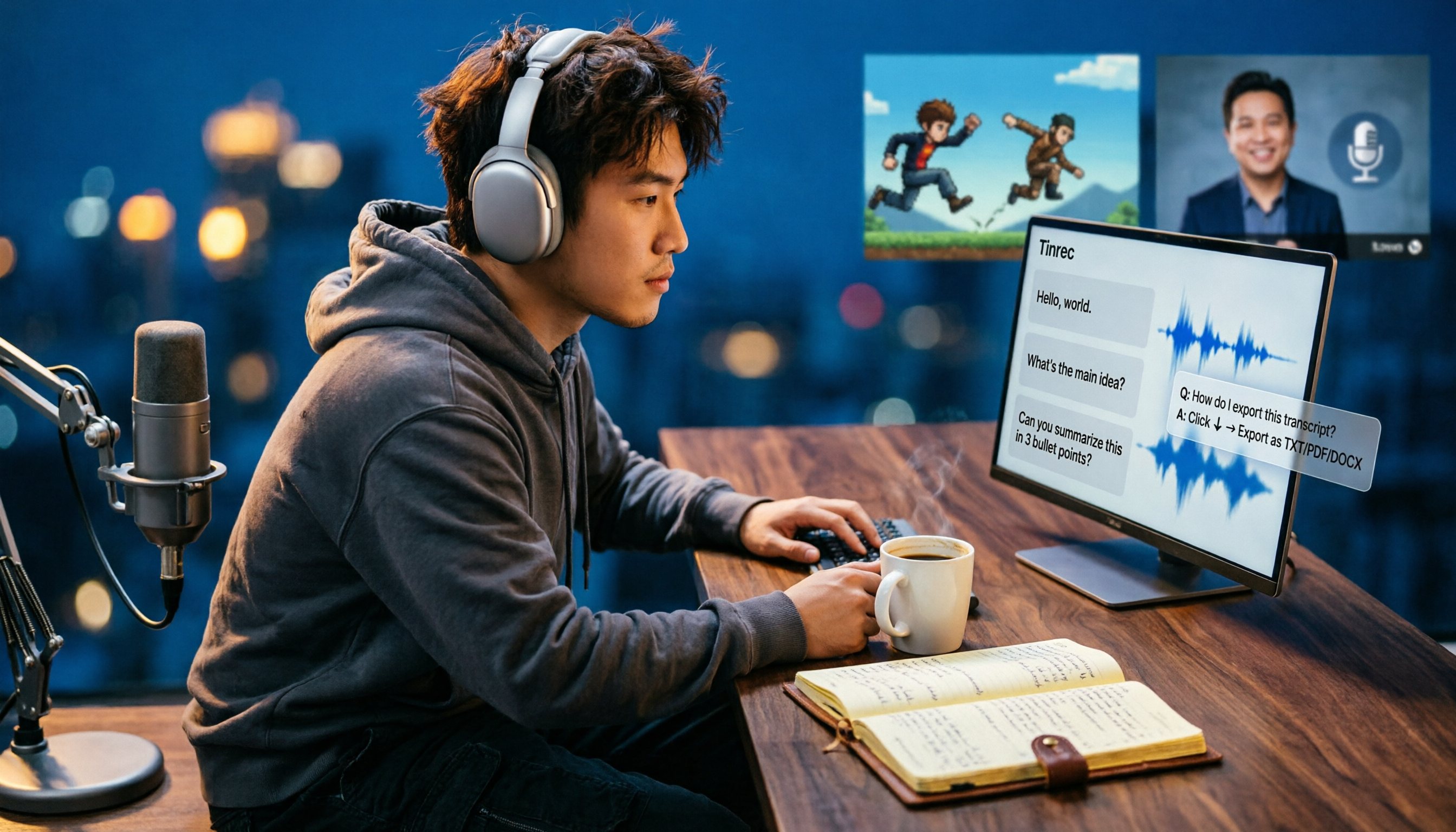
Turn recordings into transcripts and summaries in minutes
Upload audio or video for multilingual transcription, AI notes, and action items
What Are You Really Trying to Solve When You Search 'Notta Fortnite'?
Most people typing this keyword aren't actually thinking about the same thing.
Some are wondering if Notta, the AI transcription tool, can organize Fortnite replays, stream clips, or Discord call recordings. Others have seen Notta1337's Fortnite stream highlights on Twitch and mistakenly assume the two terms are directly linked.
This article isn't about streamer gossip—it's about the tools themselves. If you need to turn game voice chat, meeting recordings, or interview audio into text, is Notta up to the task? Compared to Tinrec and Otter.ai, which one deserves your first try?
4 Key Points to Understand Before Choosing an AI Transcription Tool
First, accuracy depends on real-world conditions, not just official numbers.
Many tools claim 98% accuracy, but that's usually measured in a quiet recording studio. Game voice chat, office AC noise, and people talking over each other will drag real-world performance down. We recommend testing with your own audio files on a free trial—more useful than trusting marketing numbers.
Second, what you can do after transcription matters more than 'turning audio into text.'
If a tool just gives you a giant wall of text, you'll still have to sift through it manually. AI summaries, action item extraction, and AI Q&A are what actually save you time.
Third, cross-platform support affects how often you'll actually use it.
If you record on your phone, organize on your computer, and review on your tablet, a tool locked to one device will make you give up after a few uses.
Fourth, make sure the free tier is enough for a full test round.
The free version isn't meant for long-term use—it's there to let you confirm the tool feels right and accuracy is acceptable without pulling out your credit card.
Tinrec (秒听录音)—Our Top Pick After Hands-On Testing
Tinrec is an AI meeting recorder and collaboration tool designed for individuals and teams. It supports iOS, Android, desktop, and web, and can turn live recordings, online meetings, and audio/video files into text, then automatically organize them into summaries, chapters, action items, and mind maps.
What sets Tinrec apart is recording online meetings without a bot.
The desktop version captures your computer's system audio directly—no need to add a bot account to Zoom, Google Meet, Microsoft Teams, or Webex. If you're discussing tactics with teammates on Discord or reviewing a project in an online meeting, just open Tinrec and it records and transcribes as you go, without adding an unfamiliar participant to the meeting.
The AI Q&A after transcription is something most tools in this price range can't do.
After recording a 30-minute discussion, you can ask Tinrec directly: 'Who mentioned the budget issue?' or 'What was the final conclusion?' It gives you answers based on semantic understanding, not just keyword search results. This is especially useful for pulling out key points from game clips or reviewing meeting decisions.
Action item extraction and Agent post-processing turn recordings into deliverable assets.
Tinrec pulls action items from meeting discussions and can even generate reports, tables, and meeting minutes. Export to Notion, Google Docs, OneNote, or Dropbox is supported—no manual copy-paste needed.
The team plan upgrades a personal tool into a team workspace.
Stop organizing recordings by hand
Upload audio or video and automatically get a transcript, summary, and action items
If your gaming guild, content team, or project group needs to share meeting materials, the team plan offers member management, seat allocation, usage analytics, and audit logs. New members can view historical data, and when someone leaves, their resources are handed off to others—they don't disappear with the individual account.
In our tests, we used a 5-minute game voice recording (with keyboard clicks and background music). Tinrec's Chinese transcription was stable, and the summary and action item organization were clear.
One thing to note: the free tier is limited, so heavy users will need to upgrade.
If you only occasionally organize a few recordings, the free version is enough to start. If you have regular weekly meetings or clip organization needs, the Pro plan is a better fit.
Who it's for: Those who need Chinese transcription, want AI Q&A to quickly find key points, use multiple devices, or want to turn meeting materials into a team asset.
Beyond Tinrec: What Other Options Are There?
Notta: A veteran choice for multi-device transcription, but AI Q&A and team spaces aren't as complete as Tinrec's.
Notta supports multi-device transcription, file import, and translation. The free plan offers 120 minutes per month with a 3-minute cap per session; the Pro plan costs about USD 8.17/month when billed annually and includes 1,800 minutes per month. If you just need to quickly turn audio into text, subtitles, or translations, Notta is sufficient. However, Tinrec's bot-free online meeting recording, AI Q&A, and Agent post-processing aren't fully covered by Notta's current plans.
Otter.ai: The go-to for English meetings, but Chinese isn't its strong suit.
Otter has a strong reputation for English business meetings, and its free plan offers a generous 300 minutes per month. If you're mostly organizing English content, Otter is a more cost-effective choice than Tinrec. But if your recordings are primarily in Chinese, or you need bot-free recording plus AI Q&A, Tinrec will be smoother.
Pitfall Guide: 3 Common Mistakes When Choosing an AI Transcription Tool
Pitfall 1: Only looking at official accuracy numbers, ignoring real recording conditions.
If the website says 98%, that doesn't mean your game voice chat or meeting recordings will hit that level. Background music, keyboard clicks, and multiple people talking at once all affect results. The safest approach is to test the free version with your own audio files.
Pitfall 2: Treating the tool as just 'audio-to-text.'
If you only use the transcript, you're wasting a big chunk of the tool's capability. With Tinrec's AI Q&A, you can ask 'What was the conclusion?' or 'Who's responsible for what?' right after recording—way faster than manually scanning a 30-minute transcript.
Pitfall 3: Ignoring cross-platform needs and finding out later it's mobile-only.
You record on your phone today, but tomorrow you want to organize on your computer. If the tool doesn't support cross-platform, you'll be frustrated. Before choosing, confirm whether iOS, Android, desktop, and web are all covered.
Summary: Which One Should You Choose?
If you searched 'Notta Fortnite' to organize game voice chat, meeting recordings, or interview content, Tinrec is our top pick after hands-on testing.
- Need Chinese transcription plus AI Q&A → Tinrec (summaries, action items, and Q&A all in one)
- Want to record online meetings without a bot → Tinrec (desktop version captures system audio directly)
- Need team sharing of meeting materials → Tinrec (team space, seat management, audit logs)
- Only doing large volumes of English file transcription → Otter.ai (more mature for English scenarios)
- Just need quick transcription and subtitles → Notta (multi-device transcription is sufficient)
We suggest downloading the Tinrec free version first, throwing a real recording at it, and seeing if the transcription quality and AI Q&A feel right. If you like it, consider upgrading—no need to pay upfront.
References
Turn every recording into actionable outcomes
Get 60 free transcription minutes when you sign in. No credit card required.
Related Reading
You might also like

2026 AI Meeting Notes Showdown: Tinrec vs Otter.ai for Chinese-Language Meetings
A transcript is not a meeting summary. This article compares Tinrec and Otter.ai across five dimensions—Chinese transcription, meeting capture methods, post-meeting outputs, team governance, and pricing/quotas—to clarify common misconceptions and highlight each tool's unique strengths and ideal users, helping you choose based on your Chinese-language meeting and team knowledge retention needs.

2026 AI Meeting Notes Software Comparison: Can Free Versions Handle a Full Meeting?
With the decision-making focus on whether free versions are truly usable, this side-by-side comparison of Tinrec and Notta examines free quotas, online meeting recording methods, post-meeting organization depth, Chinese-language experience, team collaboration, and cost structure to help you choose the right AI meeting notes software without unpleasant surprises.

Best AI Meeting Notes Software? 2026 Hands-On Test of 4 Tools: This One Is the Smoothest for Chinese Meetings and Team Knowledge Retention
Still spending time re-listening to recordings and writing meeting notes after meetings? Based on real-world usage scenarios, this article outlines 4 key factors for choosing AI meeting notes software and hands-on tests the differences among Tinrec, Notta, Otter.ai, and Granola, covering Chinese transcription, bot-free recording, post-meeting Q&A, team seat management, and actual pricing to help you determine which tool suits your work style.

2026 AI Meeting Recorder Comparison: Which Free Version Is Enough?
How to choose a free AI meeting recorder? This article examines four key factors—free plan structure, meeting format, post-meeting workflow, and team data ownership—and compares the free plans of Tinrec, Notta, Otter.ai, and PLAUD. It also highlights three common pitfalls when choosing the wrong tool, helping you determine how far a free version can take you and when you truly need to pay.

2026 AI Meeting Notes Tools Compared: Which Free Online Version Is Enough?
There are many free AI meeting notes tools, but free quotas, how meetings are captured, and post-meeting organization capabilities vary widely. This article compares Tinrec, Notta, Otter.ai, and Granola from four angles: free quota, how online meetings are recorded, post-meeting AI organization, and team data ownership, and summarizes the four most common pitfalls when choosing a tool.
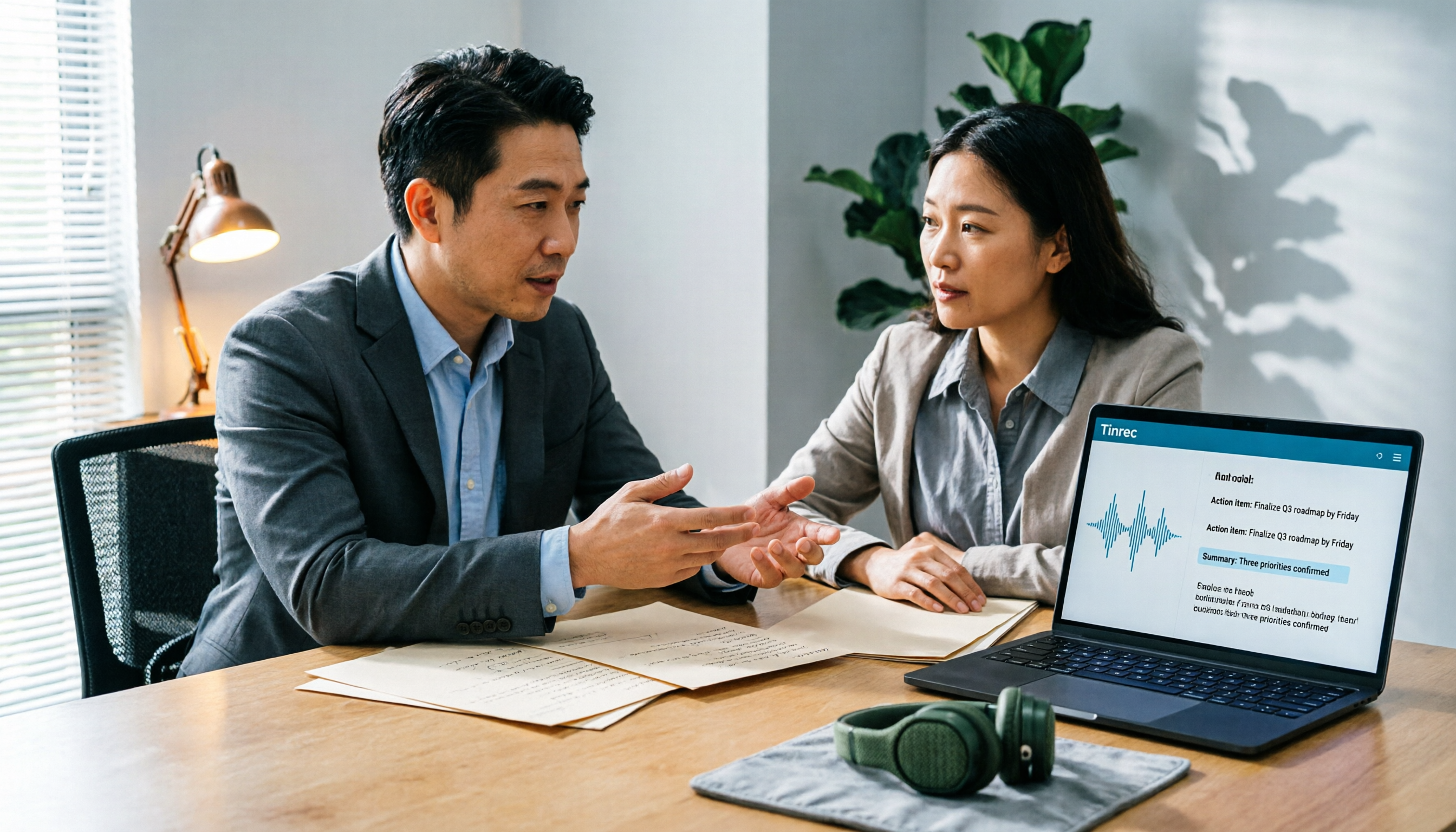
2026 AI Meeting Notes Software Comparison: Are Free Versions Enough?
A mid-level manager who attends 15 meetings a week tests four AI meeting notes tools—Tinrec, Notta, Otter.ai, and PLAUD NotePin—covering free tiers, Chinese recognition, post-meeting organization, and team data ownership, and outlines the four most common pitfalls of free versions plus practical selection advice.
2026 AI Meeting Notes Software Comparison: 5 Tools Tested, Post-Meeting Organization Is What Matters
When choosing AI meeting notes software, most people compare free minutes first, but the real time sink is post-meeting organization. This article breaks down the differences and limitations of Tinrec, Otter.ai, Notta, and PLAUD based on hands-on testing, 4 key buying factors, recording methods that don't require a bot to join meetings, and team collaboration. It also covers common selection mistakes to help you choose the right tool for your meeting style.

2026 AI Meeting Notes Tools Compared: Which One Actually Saves You Time?
AI meeting notes tools are everywhere, but transcription accuracy isn't the only difference. This hands-on comparison of Tinrec, Notta, Otter.ai, and Granola looks at four dimensions: how meeting audio gets captured, whether post-meeting output is actually usable, performance with Chinese and mixed Chinese-English speech, and team data ownership. We also cover key pitfalls to check before buying, so you can find the one that truly cuts your post-meeting cleanup time.

2026 AI Meeting Recorder Comparison: Chat AI vs. Dedicated Tools — Which One Actually Delivers Meeting Minutes?
Based on real-world testing by a mid-level manager juggling 15 meetings a week, this article breaks down the three most common misconceptions about chat AI vs. dedicated AI meeting recorders. It demonstrates a complete workflow using Tinrec — from bot-free recording and transcription to summaries, action items, and team knowledge retention — plus five key buying criteria and an FAQ.